Every growing business hits the same strategic crossroads sooner or later: Should we expand by controlling more of our supply chain or by dominating more of our market?
The answer to that question defines your cost base, your competitive advantage, your business complexity, and, ultimately, your long-term profitability. Yet many business leaders struggle to distinguish between vertical integration vs horizontal integration, let alone decide which approach fits their specific situation.
Get the decision wrong, and you are putting money into a strategy that stretches your core business, dilutes concentration, or triggers an antitrust investigation. Take the right step supported by a sound knowledge and a platform that will help you grow, and you can access efficiencies, cement your position in the market, and speed up revenue in a manner that competitors cannot possibly replicate.
This guide breaks down vertical and horizontal integration with precision, clear definitions, real-world examples, honest pros and cons, and a practical framework for choosing the strategy that fits your business. This is the playbook required in case you are developing, expanding, or measuring a commerce operation.
What Is Vertical Integration?

Vertical integration is a business model in which a firm extends its control to various levels along its own supply chain, either towards the raw materials (upstream) or the market end-user (downstream).
Imagine it this way: consider that a single thread starts in a cotton field and ends up on a T-shirt on a store shelf. A vertically integrated firm takes possession of more of that thread, owning the farm, the textile mill, the manufacturer, the distribution center, and the retail storefront, rather than using third parties at each stage.
The core meaning of vertical integration is simple: eliminate the middleman by becoming the middleman. It provides businesses with more control over quality and costs, timelines, and the customer experience at each step of the value chain.
Why Businesses Pursue Vertical Integration
The vertical integration of companies is often aimed at:
- Lessen reliance on suppliers or distributors who are likely to increase prices, be in short supply, or distribute to competitors.
- Secure margins by taking the profit that would be taken by third-party intermediaries.
- Enhance quality management throughout the production process or delivery.
- Reduce time to market by removing coordination time between supply chain partners.
- Establish competitive advantages that competitors can hardly duplicate.
Types of Vertical Integration
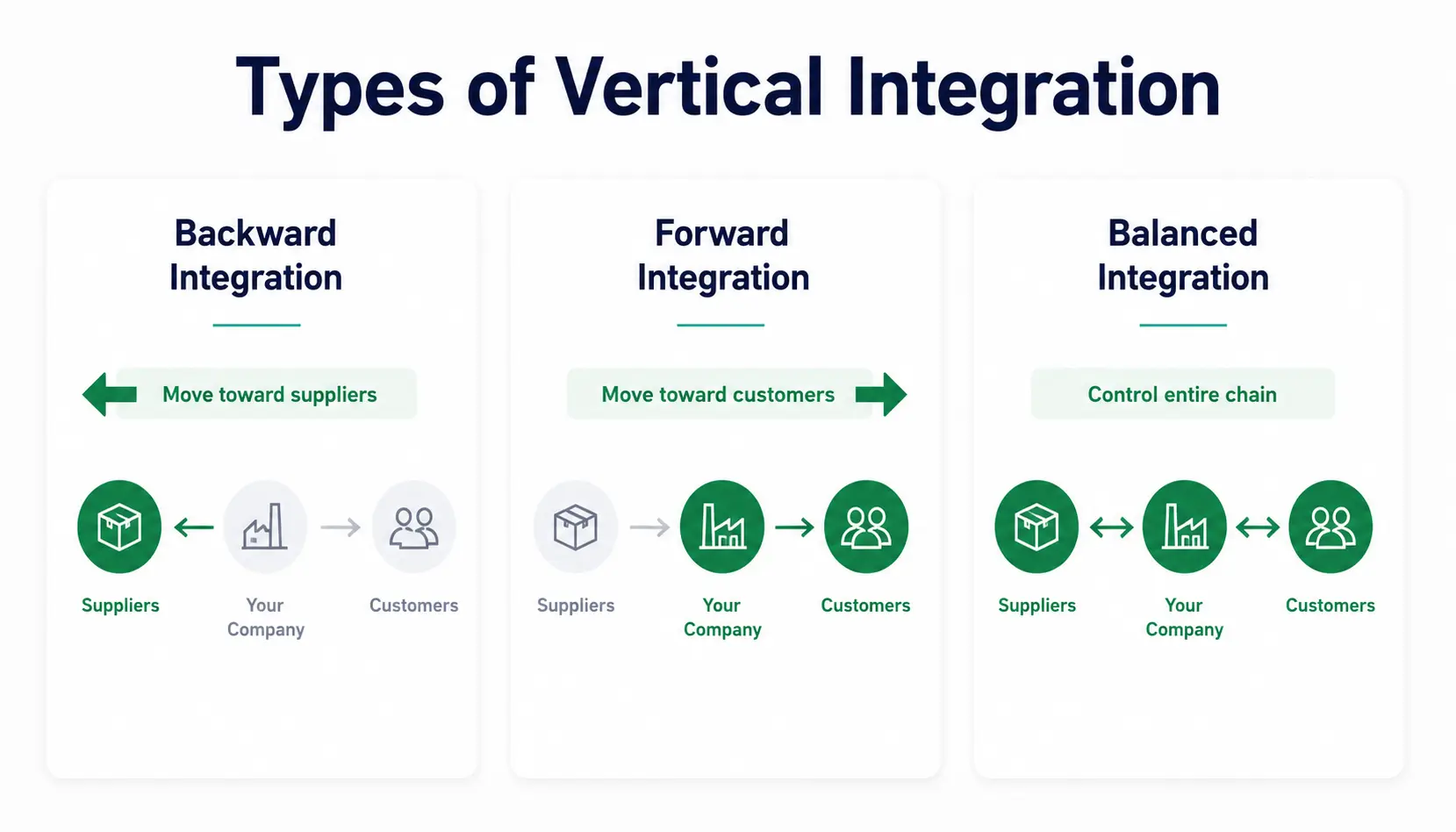
Vertical integration can be categorized based on the direction of expansion within the supply chain. It includes forward integration, moving closer to the customer, and backward integration, moving toward raw material sources.
Backward (Upstream) Vertical Integration
This happens when a company develops or acquires capabilities along its supply chain toward the source of its inputs.
Example: A clothing company that purchases a fabric mill to regulate the quality and the price of the raw materials.
Backward integration is typically undertaken to gain control over supply, lower input costs, and prevent lock-in with vendors.
Forward (Downstream) Vertical Integration
This is a process that occurs as a company expands toward the near-customer end of the supply chain.
Example: A manufacturer opening up its own retail outlets instead of using third-party retailers to market its goods.
Forward integration enables companies to take control of customer relationships, achieve higher margins, and gain more information about end-user behaviour.
Balanced (Full) Vertical Integration
Other firms are seeking complete vertical integration, whereby they have control over each step of the source of raw material to customer delivery. This is the least risky and the most capital-intensive type, which can provide the largest level of operational control and margin capture.
Example: Apple is designing its own chips, producing its own devices (through both owned and contracted plants), selling its own stores, and running its own App Store that dictates the experience between silicon and software.
Examples of Vertical Integration
It is easy to learn abstract strategy through examples. The following are some of the most enlightening real-life examples of vertical integration:
Amazon
Amazon is perhaps the most comprehensive modern example of vertical integration. Amazon began as an online market and has progressively ventured into logistics, production, and cloud computing (AWS).
At the same time, it has moved into content delivery (Prime Video) and brick-and-mortar storefronts. This is a multi-directional integration that allows Amazon to manage the customer experience from product discovery to door delivery.
Tesla
Tesla provides a fascinating case of vertical integration in the car industry. The company manufactures its own batteries (Gigafactories), creates its own autonomous driving chips, manufactures its own vehicles, and sells the cars through its own stores and on its website (without even going through traditional dealerships at all).
This vertical integration would allow Tesla to control the full customer experience and gain significant cost benefits as production grows.
Netflix
Netflix began as a DVD rental company, then moved to streaming external material, but has now been on a chill of generating original material.
Netflix is able to produce its own content and shows, films, removing the need to depend on the studios, gaining content exclusivity, and generating greater value out of every subscriber. This is backward integration of textbooks by making a guarantee of content provision through becoming the provider.
Starbucks
Starbucks controls the supply chain of its coffee from its relationships with farmers, direct purchasing, roasting its own coffee in its own coffee, and delivering it in its own branded stores.
This vertical integration allows Starbucks to work with the same standard of quality all over the world, which is one of the pillars of their brand promise.
What Is Horizontal Integration?

Horizontal integration is a business practice whereby the company purchases or merges with its competitors at the same stage of the value chain in the same industry or market.
Instead of moving inward towards the supply chain (as vertical integration does), horizontal integration moves outward across the market. This is with a view to increasing market share, reducing competition, reaping economies of scale, or diversifying the product/service portfolio.
An analogy: In the case of vertical integration, it has a broader literal sense: taking a ladder step in-by-step (going up or down the supply chain), but horizontal integration means using the platform (to be spread across) at the same level and increasing your footprint in the competitive landscape without necessarily changing how you work.
Why Businesses Pursue Horizontal Integration
Horizontal integration is usually undertaken by companies to:
- Expand market share in a short amount of time through existing customer bases.
- Either kill or minimize direct competition from the major competitors.
- Prepare economies of scale, which reduce the unit cost.
- Grow for products without creating new capabilities.
Types of Horizontal Integration
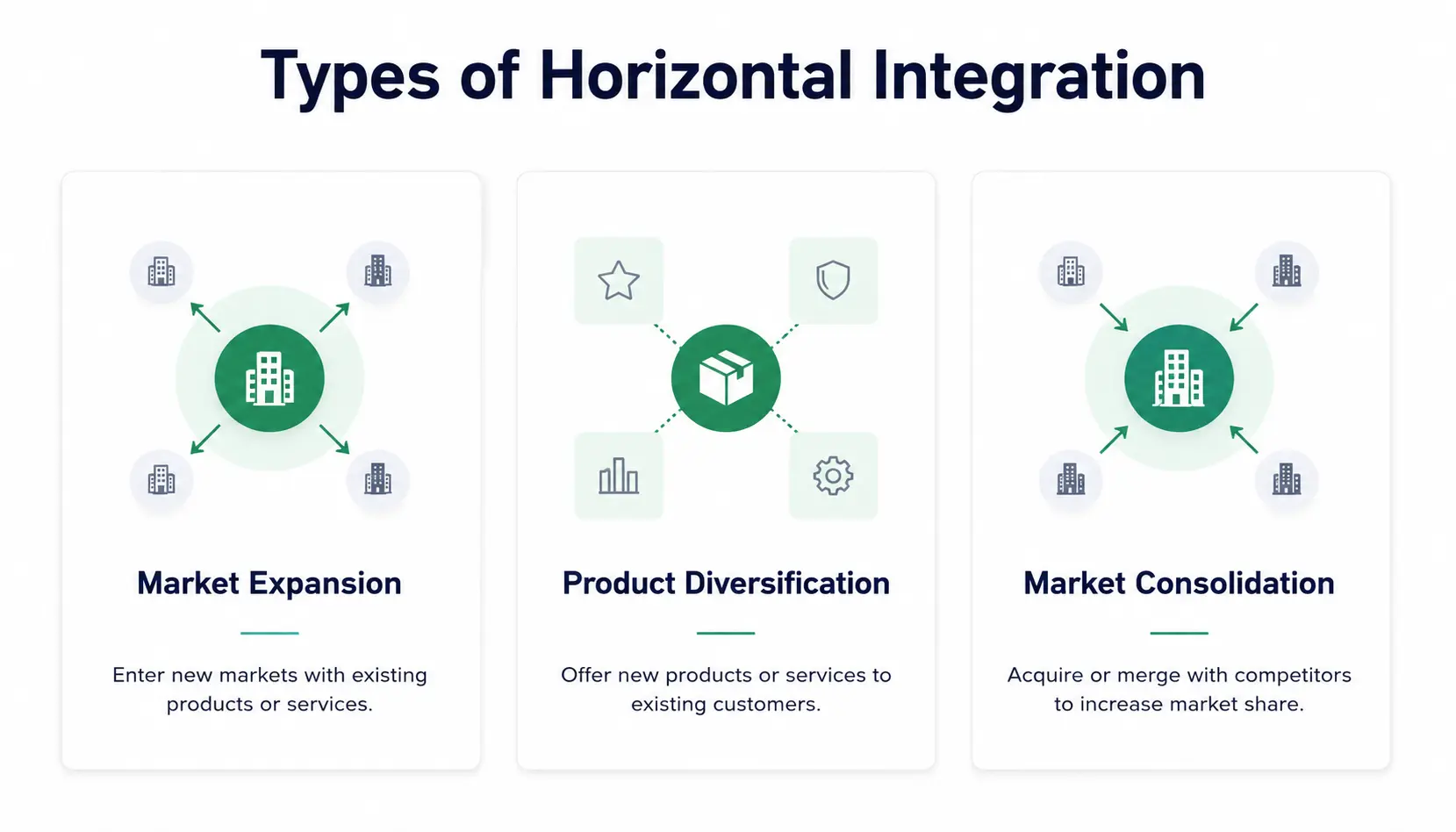
Horizontal integration has various forms, and all of them attempt to strengthen a company’s market position. These types include mergers, acquisitions, strategic alliances, and joint ventures with competitors or like businesses.
Market Expansion (Geographic)
When a company purchases a competitor in a new region or country, it is for the purpose of gaining access to a broader geographic scope without having to start in a new market from the bottom.
Example: An American SaaS company is taking over a European software company in order to enter the EU market without setting up locally focused divisions.
Product/Service Diversification
When a company purchases a company that has complimentary or adjacent product in the same market level.
Example: A hotel hub buys a vacation rental company to provide clients with different range of accommodation at different prices.
Market Consolidation
When a company purchases its direct competitors, it is able to take advantage of reduced competition, consolidated market share, and greater pricing power.
Example: Two medium-sized grocery chains joining together to better compete with formidable national competitors.
Examples of Horizontal Integration
Here are compelling real-world horizontal integration examples across industries:
Disney and Pixar / Marvel / Lucasfilm
The acquisition of Pixar by Disney in 2006, Marvel Entertainment by Disney in 2009 and Lucasfilm by Disney in 2012 are some of the first leading examples of horizontal integration. All acquired companies were in the same general entertainment industry. Disney has been able to expand their content, franchise, and audience base in a short period of time without having to change their roles within the value chain fundamentally. The result? One of the greatest entertainment empires of all time.
Facebook (Meta) and Instagram / WhatsApp
Meta’s acquisitions of Instagram and WhatsApp are examples of defining horizontal integration in the digital economy. These two sites were similar in terms of their overall need and had the same users in terms of attention. Acquisitions of these competitors helped Facebook to strengthen its control in the social media sector before they gained the strength to counter its core business.
Marriott and Starwood Hotels
The acquisition of Starwood Hotels & Resorts by Marriott in 2016 gave birth to the largest hotel company in the world. The two companies were operating at the same point on the value chain and through the classic horizontal integration, the merger allowed Marriott to attain a phenomenal increase in the number of global properties, loyalty programs, and supplier’s bargaining power.
Exxon and Mobil
One of the most notable horizontal integrations in the history of energy is the 1998 merger of Exxon and Mobil. Both were giant oil and gas companies operating at the same level in the market. Their merger resulted in ExxonMobil becoming one of the largest companies in the world in terms of revenue with highly enhanced scale, pricing, and efficiency of operation.
Side-by-Side Comparison of Vertical Integration vs Horizontal Integration

A side-by-side comparison highlights how vertical and horizontal integration differ in strategy, scope, and impact on business operations. Understanding these contrasts helps businesses choose the approach that best aligns with their growth and market objectives.
| Dimension | Vertical Integration | Horizontal Integration |
| Direction of Expansion | Along the supply chain (up or down) | Across the market (same level) |
| Primary Goal | Control over production/distribution | Market share and scale |
| Method | Acquiring suppliers or distributors | Acquiring competitors or adjacent firms |
| Risk Profile | Operational complexity, capital intensity | Regulatory scrutiny, integration challenges |
| Speed of Results | Slower (operational build-out required) | Faster (market share acquired immediately) |
| Best For | Supply chain control, margin protection | Market dominance, scale, diversification |
| Examples | Amazon, Tesla, Netflix, Starbucks | Disney, Meta, Marriott, ExxonMobil |
| Competitive Advantage | Operational efficiency, quality control | Market power, brand portfolio, economies of scale |
| Regulatory Risk | Lower | Higher (antitrust concerns) |
Pros and Cons of Vertical & Horizontal Integration
Vertical integration strengthens control over the supply chain, while horizontal integration boosts market share by consolidating competitors. Both strategies have unique risks and rewards that impact growth, efficiency, and competitiveness.
| Type | Pros | Cons |
| Vertical Integration |
|
|
| Horizontal Integration |
|
|
How to Choose the Right Integration Strategy?

Choosing between vertical integration vs horizontal integration isn’t a one-size-fits-all decision. The correct strategy is determined by your industry dynamics, competitive position, capital availability, and long-term goals.
Choose Vertical Integration When:
- You are highly reliant on a few suppliers or distributors who have the bargaining power over you.
- There is a brand or regulatory risk that is being created due to quality control failures.
- You are losing billions to middlemen who can be obtained within.
- A real competitive differentiator is your supply chain (e.g., proprietary ingredients, manufacturing process or delivery speed).
- You possess the operational skills and funds to handle other value chain levels.
Choose Horizontal Integration When:
- Your key strategic imperative is market share growth.
- You are in stiff competition with a particular competitor, and acquisition is more effective than competing with it in an organic way.
- You desire to expand into a new geography or customer faster than the organic expansion can enable you to do.
- Your industry is a highly profit-driven industry that is dependent on economies of scale.
- You have found acquisition targets that have undervalued or hard-to-copy assets in the form of technology, brand, team, and customers.
A Practical Decision Framework
These four dimensions should be critiqued thoroughly prior to investing in either strategy:
- Strategic Fit: Does this expansion strengthen your core competitive advantage or does it weaken it?
- Financial Capacity: Does it have the financial capability to finance the investment without jeopardizing its core operations?
- Operational Readiness: Are you an expert manager who can work in the new area?
- Market Timing: Is this the right time to acquire the target? Are the desired target companies fairly valued? Is the market prepared to undergo a consolidation, or is your company in a competitive position to undertake the acquisition?
Most of the businesses also seek hybrid solutions that incorporate aspects of the two strategies as they grow their businesses. As an example, a retailer may purchase a competitor (horizontal) and at the same time invest in manufacturing its own label (vertical) in an attempt to increase margins. The strategies are not exclusive to each other.
How SpxCommerce Supports Both Integration Strategies?
Either you have a growth strategy to intensify supply chain control or increase your market footprint, or a technology platform under your operations becomes a decisive factor in whether you can successfully achieve the strategy’s objective.
SpxCommerce is specifically designed to help businesses navigate these growth transitions, so they can get the commerce infrastructure that makes integration strategies more than just talk.
Supporting Vertical Integration
When you embark on vertical integration to buy suppliers, develop distribution, or open up direct-to-consumer channels, you are essentially adding additional complexity to your operations. SpxCommerce enables you to cope with that complexity:
- Still unified commerce operations that allow procurement, inventory, fulfillment, and customer-facing channels to be linked in a single platform so newly integrated steps in your supply chain can be easily inserted, without causing data silos.
- Direct-to-consumer channel enablement, such that brands in the future moving towards the customer can launch and scale DTC commerce without re-platforming.
- Supplier and vendor management capabilities that automate the onboarding of the new or consolidated supply chain partner.
- Live inventory visibility in both owned and third-party fulfillment nodes is important when you have greater control over the supply network.
Supporting Horizontal Integration
Integrating two operating businesses without value destruction is the challenge in case you buy a rival and penetrate the neighbouring markets. SpxCommerce hastens that process:
- Multi-brand and multi-storefront operations on one platform, so acquired businesses can retain their brand name while sharing back-end infrastructure, lowering overhead costs.
- Geographic horizontal expansions localization, currency, and language support of the market. Market expansion support with localization functionality, regional catalog management, and currency/language support.
- Scalable architecture able to survive as you grow together as a combined entity without having to replace the platform every time you hit a milestone.
- Customer information consolidation combines buyer information, application history, and actions on acquired customer bases, creating a combined market share to create combined intelligence.
The SpxCommerce Advantage
To develop a commerce operation that can sustain either of the integration strategies, more than shelf software is required. It needs a platform that will be flexible, scalable, and complex, and a partner that comprehends the operational needs of growth due to integration.
SpxCommerce is that combination: the infrastructure of an enterprise-grade commerce, extensive integration experience, and a customer success approach with your strategic objectives as the gauge of platform success.
Prepared to develop a trade operation that develops with your integration approach? Educate yourself about SpxCommerce or contact a solution specialist and talk about your needs.
Conclusion
The choice between vertical integration vs horizontal integration is ultimately a strategic bet on where your competitive advantage lives and where your growth opportunity is greatest.
Vertical integration is the correct action when having the ability to manipulate your supply chain is a competitive edge in its own right, as having more of the process translates to a higher standard of quality, reduced costs, or a more justifiable marketplace. The example of Tesla and Amazon companies has demonstrated that strong vertical integration, when properly implemented, can form almost impassable competitive moats.
Horizontal integration is a correct action where your market opportunity is characterized by scale and share as they become wider more easily and with less capital. The examples of Disney’s entertainment business and the social media dominance of Meta show what horizontal integration can bring to its best.
The similarity between the two strategies is that they both have a common need, which is having the appropriate operational infrastructure to implement the strategies without losing the agility and focus that initially made the business worth expanding in the first place.
That is where SpxCommerce enters, providing businesses with the platform commerce foundation to advance to ambitious expansion plans without being dragged down by its operations. Whatever your business is, incorporating the appropriate technology partner is what will help you to create the difference between the strategy as vision and the strategy as reality.
FAQs
What are the main differences between vertical and horizontal integration?
Vertical integration moves up and down the supply chain towards controlling production or distribution; horizontal integration moves across the market towards greater scale or a greater market share. They vary in method, risk, speed, and competitive advantage and include such examples as Tesla and Disney.
How do companies decide which integration strategy to pursue?
The motive for choosing vertical integration is that supply chain control or quality forms competitive advantage for companies. Horizontal Integration is favored if the objective is market share, growth or geographical expansion based on the financial capacity, operational readiness, and strategic fit.
What are the types of vertical integration?
Vertical integration can be backward (purchasing suppliers or raw materials), forward (getting closer to customers by selling directly to them) or balanced/full (controlling the whole supply chain). Examples include Starbucks farms, Netflix content production, and Apple end-to-end.
Can a business pursue both vertical and horizontal integration?
Yes, many companies combine strategies by both buying competitors out (horizontal), while building their own supply chain or products out (vertical) so that they can increase their market position and margins at the same time (leveraging both scale and operational control).
How can technology platforms support integration strategies?
Platforms such as SpxCommerce offer support for vertical integration by combining supply chain and DTC channels and horizontal integration by supporting multi-brand management, geographic expansion support, and customer data consolidation, which will ensure smooth operations during growth and acquisitions.
What is the main takeaway when choosing between vertical and horizontal integration?
The rule of thumb is to select the appropriate strategy on the basis of where a company’s competitive advantage is situated. Vertical integration enhances control over the supply chain, and horizontal integration will increase market share, scale and diversification possibilities, both of which require readiness for operations and the necessary technology infrastructure.