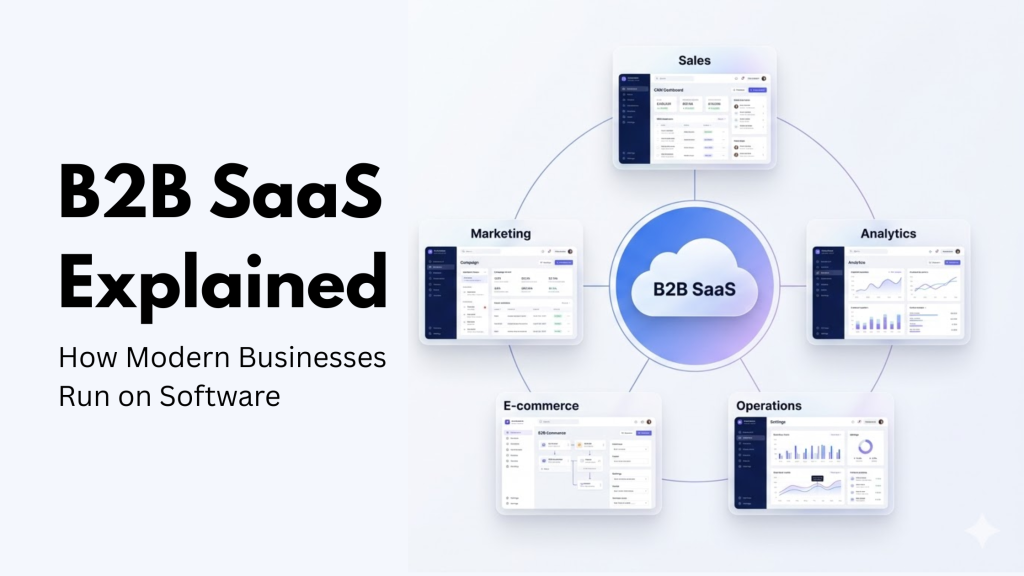
Think what it will be like to conduct business in 2026 without any software subscription. No CRM. No project management tool. No cloud-based billing. Sounds impossible, right? That’s exactly how deeply B2B SaaS has woven itself into the fabric of modern commerce.
Whether you’re a startup founder, a seasoned enterprise executive, or a digital marketer trying to decode the next big growth channel, understanding B2B SaaS isn’t optional anymore. It’s table stakes.
In this guide, we’ll break down what B2B SaaS really means, show you real-world examples that are crushing it, reveal the marketing strategies that drive growth, and share success stories that will inspire your next move. And yes, we’ll also show you how platforms like SpxCommerce are reshaping the B2B SaaS landscape for commerce-driven businesses.
What Is B2B SaaS?
If you’ve been in the business world for more than five minutes, you’ve probably heard the term B2B SaaS thrown around in pitch decks, boardrooms, and marketing emails. However, what is it actually, and what is so important about it?
Let’s break it down simply:
B2B SaaS stands for Business-to-Business Software as a Service. It means the cloud-based software solutions that one business sells to another, but not to individual consumers. Businesses subscribe to software online, avoiding the need to buy and install it on-premises, and access it whenever and wherever they like.
Think of it this way: if your company uses Salesforce to manage your sales pipeline, HubSpot to run email campaigns, or Slack to keep your team connected, you’re already using B2B SaaS. It is software that drives the business operations, business growth, and competition.
| The B2B SaaS meaning in one sentence: Cloud-delivered software sold on a subscription model, designed specifically to solve business problems for other businesses. |
Why B2B SaaS Is Taking Over the Business World?
The figure for the SaaS market will leave your jaw on the floor: its global market size in 2023 was more than $270 – $320 billion, and it is estimated to exceed $1 trillion in 2032. That is not a fashion, that is a change.
So why are businesses going all-in on B2B SaaS software?
Lower upfront costs
No expensive hardware. No IT army. Only a monthly or yearly subscription.
Scalability
SaaS grows as you grow, whether you are a 5-person startup or a 5,000-employee business.
Automatic updates
Maintenance, security patches, and upgrading of features are all managed by vendors – not by you.
Remote-friendly
The access to the cloud implies that your team can work anywhere on Earth.
Data and insights
Modern B2B SaaS platforms come packed with analytics, giving businesses real-time intelligence to make smarter decisions.
B2B SaaS vs B2C SaaS: What’s the Difference?
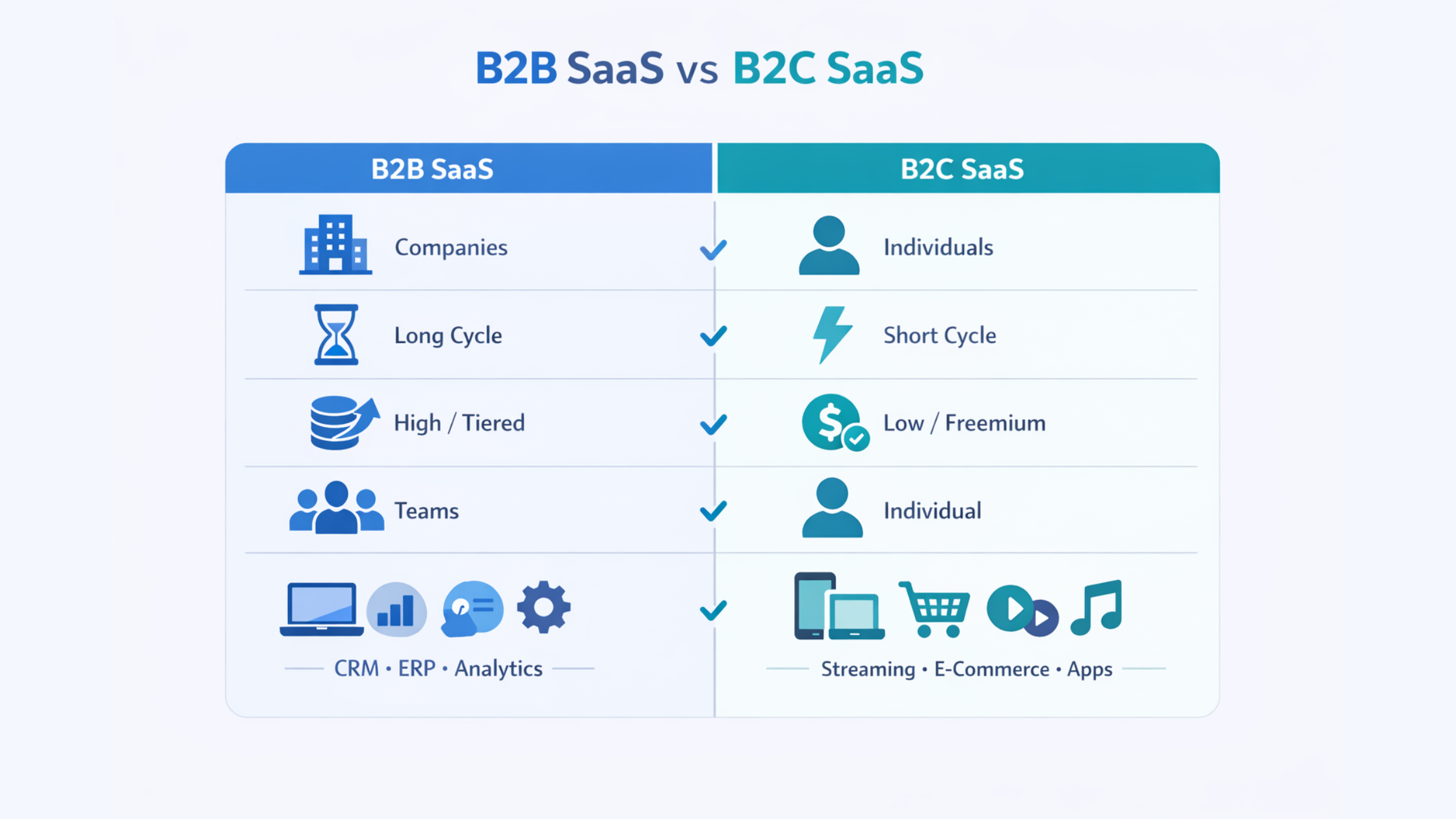
Before we go deeper, it helps to understand what sets B2B SaaS apart from its consumer-facing cousin, B2C SaaS.
| Feature | B2B SaaS | B2C SaaS |
| Buyer | Companies / Teams | Individual Consumers |
| Sales Cycle | Long (weeks to months) | Short (minutes to days) |
| Pricing | Higher, tiered | Low, freemium-heavy |
| Decision Maker | C-suite, Managers | Individual user |
| Examples | Salesforce, Slack, SpxCommerce | Netflix, Spotify, Duolingo |
B2B SaaS Examples: Platforms You’ve Probably Already Used
Let’s ground this in reality with some standout B2B SaaS examples that have reshaped entire industries:
1. Salesforce – The CRM Giant
Successfully, Salesforce virtually created the SaaS playbook. It has fully taken CRM to the cloud and provided a 360-degree view of customer relationships. It has a global customer base of more than 150, 000 businesses today.
2. HubSpot – Inbound Marketing, Perfected
HubSpot made the concept of customer attraction (instead of customer hunting) a full-fledged movement. They are an all-in-one service that provides marketing, sales, service, and CMS under a single SaaS.
3. Slack – Communication Reimagined
Prior to Slack, companies were being overwhelmed by email chains. Slack provided teams with a quicker, more structured way to communicate and collaborate, and ultimately sold to Salesforce for $27.7 billion.
4. Zoom – The Meeting Room in Your Browser
After the pandemic, Zoom turned into a lifeline for businesses throughout the world. It’s a perfect example of B2B SaaS solving a universal business problem at a massive scale.
5. SpxCommerce – B2B Commerce SaaS Built for Growth
SpxCommerce is a modern B2B SaaS commerce platform designed specifically for manufacturers, distributors, and wholesalers who need more than what traditional e-commerce platforms offer.
In contrast to generic e-commerce tools, SpxCommerce is designed to be complex (B2B), with custom pricing plans, buyer-specific catalogs, bulk buying, ERP integrations, and a headless design that allows businesses to own their front-end experience.
When you are a business that sells to other businesses, not necessarily consumers, SpxCommerce puts in the infrastructure to do it at a scale without being constrained by consumer-oriented platform features.
- Full customization, Headless, API-first.
- B2B-native characteristics: contract prices, account hierarchies, approval procedures.
- Integration with ERPs, PIMs, and CRMs.
- Constructed to accommodate intricate buyer paths that are peculiar to B2B business.
Whether you’re selling industrial parts, wholesale goods, or tech hardware to business buyers, SpxCommerce is where serious B2B SaaS commerce happens.
B2B SaaS Marketing: How Do You Sell Invisible Software?
Here’s the fascinating challenge with B2B SaaS marketing: you’re not selling a physical product. You are selling results – productivity, development, time, money. And you tend to be selling it to more than one stakeholder in one company.
That makes B2B SaaS marketing a unique beast. We can discuss the way the most successful companies do it.
B2B SaaS Marketing Strategies That Actually Work
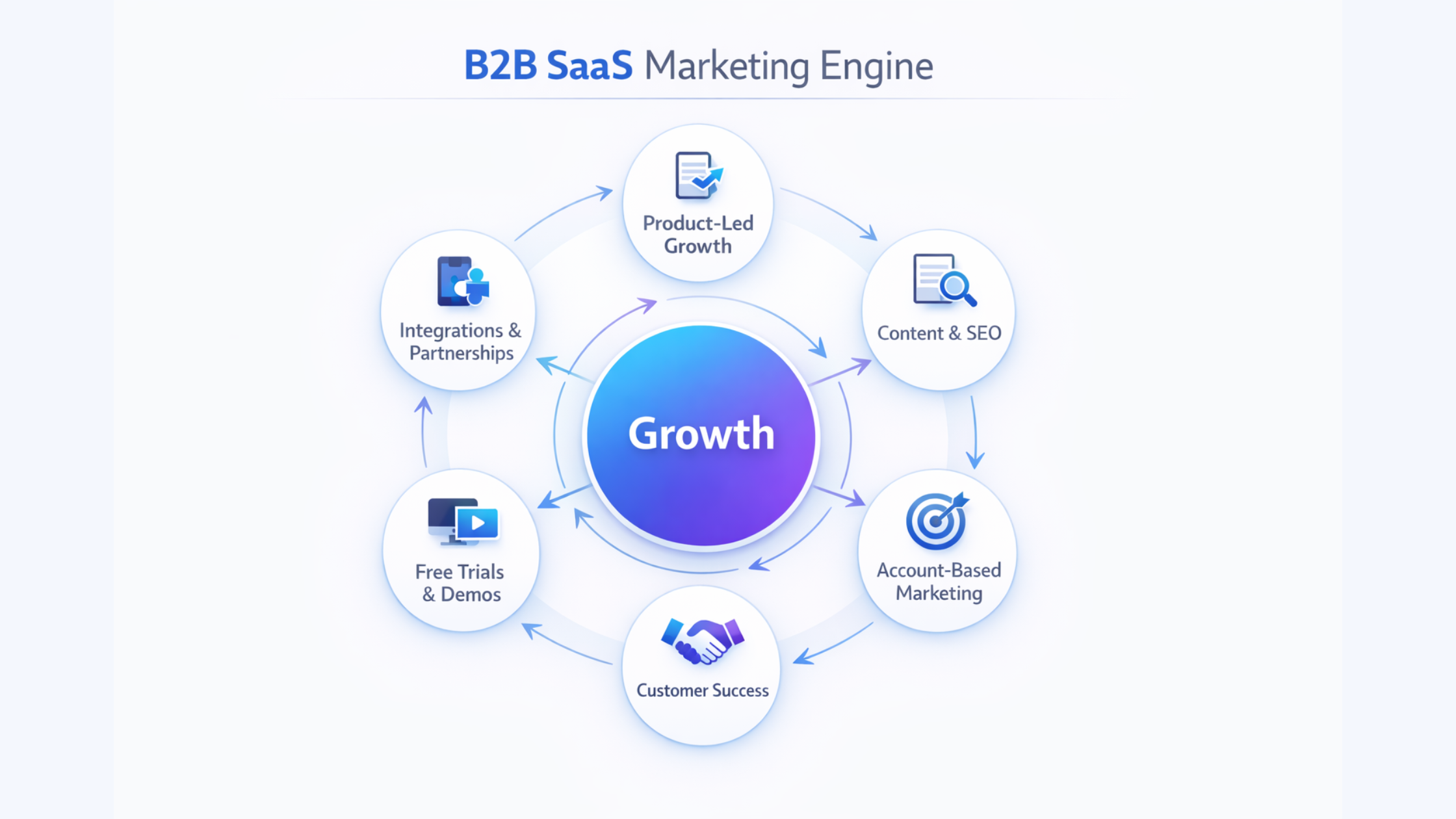
1. Product-Led Growth (PLG)
This is how Slack, Dropbox, and Zoom became household names. You do not give a sales pitch, but the product itself. Provide a free trial or freemium and make the product speak for itself as the user gets to experience the value.
The rationale is easy to understand: a client who already had the experience with using your software loves it will be far easier to convert than a client who has just read a brochure.
SpxCommerce capitalizes on this idea by providing commerce businesses with a preview of the potential of AI-based analytics to increase their bottom line- prior to requesting a long-term contract.
2. Content Marketing & SEO
In case you want to capture the attention of businesses that are actively seeking solutions, you must present yourself where they are searching, search engines. Publishing high-value content around keywords your ideal customers are typing into Google is one of the highest-ROI strategies in B2B SaaS marketing.
This very blog is an example of that strategy in action.
3. Account-Based Marketing (ABM)
Instead of casting an extremely broad net, ABM reverses the script: find the list of your desired high-value accounts and create hyper-personalized campaigns that precisely target them. It’s precision over volume and in B2B SaaS, where one enterprise deal can be worth millions, the math makes sense.
4. Customer Success as a Growth Engine
The essence of SaaS is retention. A churned customer not only constitutes a loss of revenue,but it is a loss of an advocate. By investing in your genuine customer success (as opposed to customer support), your customers not only stay longer, but also increase their usage and, above all, refer.
5. Partner and Integration Ecosystems
B2B SaaS companies that integrate with the tools their customers already use grow faster. SpxBI.AI will become a hassle-free transition when it integrates directly with your current e-commerce or ERP solutions and will not make a switch an option.
6. Free Trials and Demo-Led Sales
The best sales tool can be a good product demonstration. Demonstrating to a prospective customer how precisely your platform will address their particular issue in action breaks the sales process.
Lessons From the Top B2B SaaS Success Stories
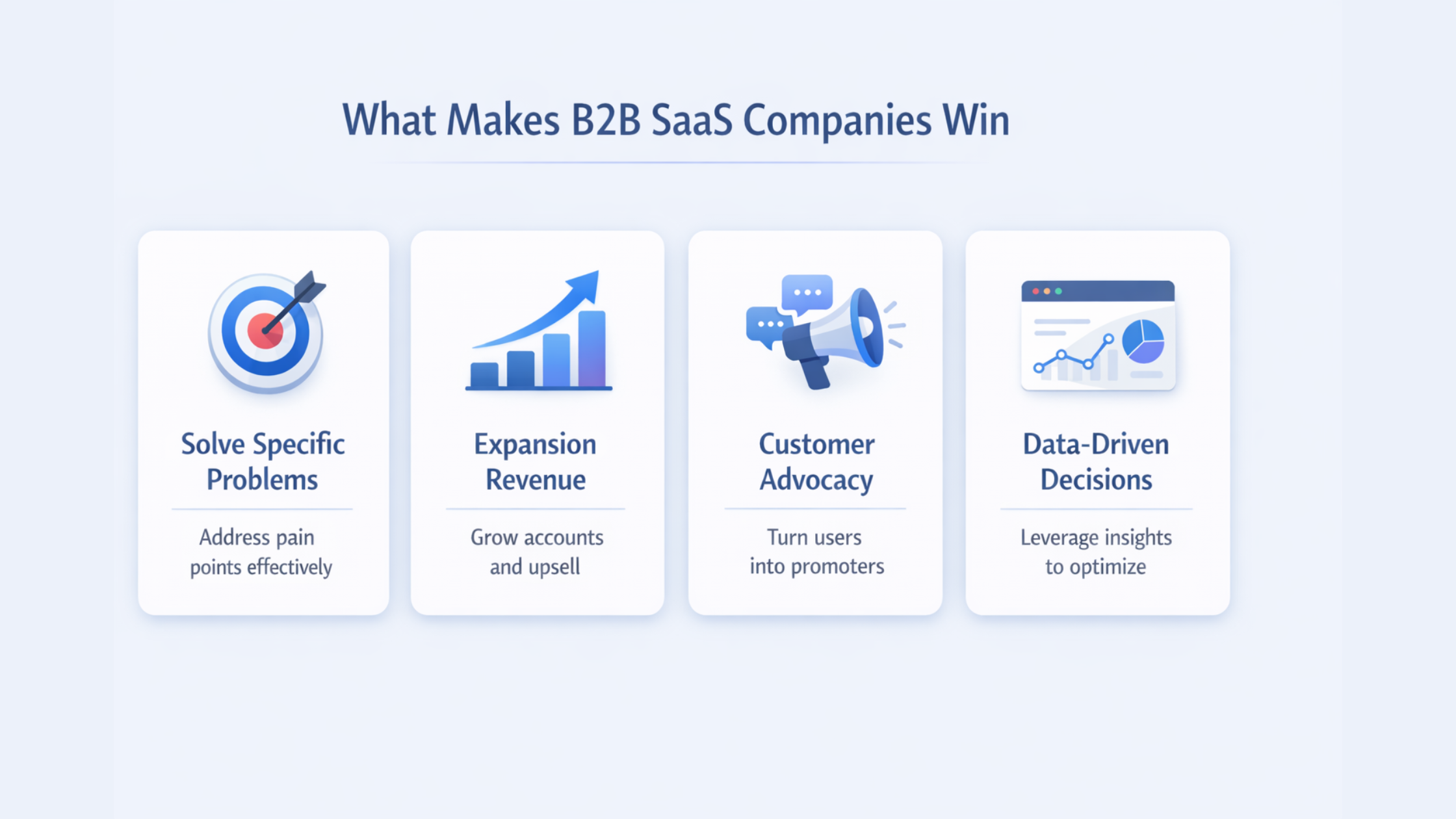
Let’s zoom out and look at what separates the B2B SaaS companies that thrive from those that plateau.
Lesson 1: Solve a Painful, Specific Problem
The most successful B2B SaaS companies don’t try to solve everything; they identify one acute pain point and solve it better than anyone else. HubSpot did not attempt to substitute all marketing tools; it has made inbound marketing available. Zoom did not disrupt the communication business; they just made video calls work.
Lesson 2: Make Expansion Revenue a Core Strategy
The most intelligent SaaS enterprises can structure their pricing and products to ensure their subscriptions grow as their customer base expands. This is referred to as Net Revenue Retention (NRR), and firms with an NRR greater than 120% can grow without acquiring new customers.
Lesson 3: Turn Customers Into Champions
Salesforce created an ecosystem (Dreamforce, Trailhead, the AppExchange) that makes customers feel like they are part of something larger. As soon as your customers are supporters, your marketing machine is self-driven.
Lesson 4: Use Data to Drive Every Decision
The best B2B SaaS companies are obsessively data-driven from product development to customer success to marketing. Here is where SpxBI.AI.AI fits in the table. SpxBI.AI will enable businesses to gain real-time AI-driven insights into their operations and performance, which, in turn, will help the company make the kinds of decisions that distinguish rapidly growing firms from those that do not.
How to Choose the Right B2B SaaS Platform for Your Business
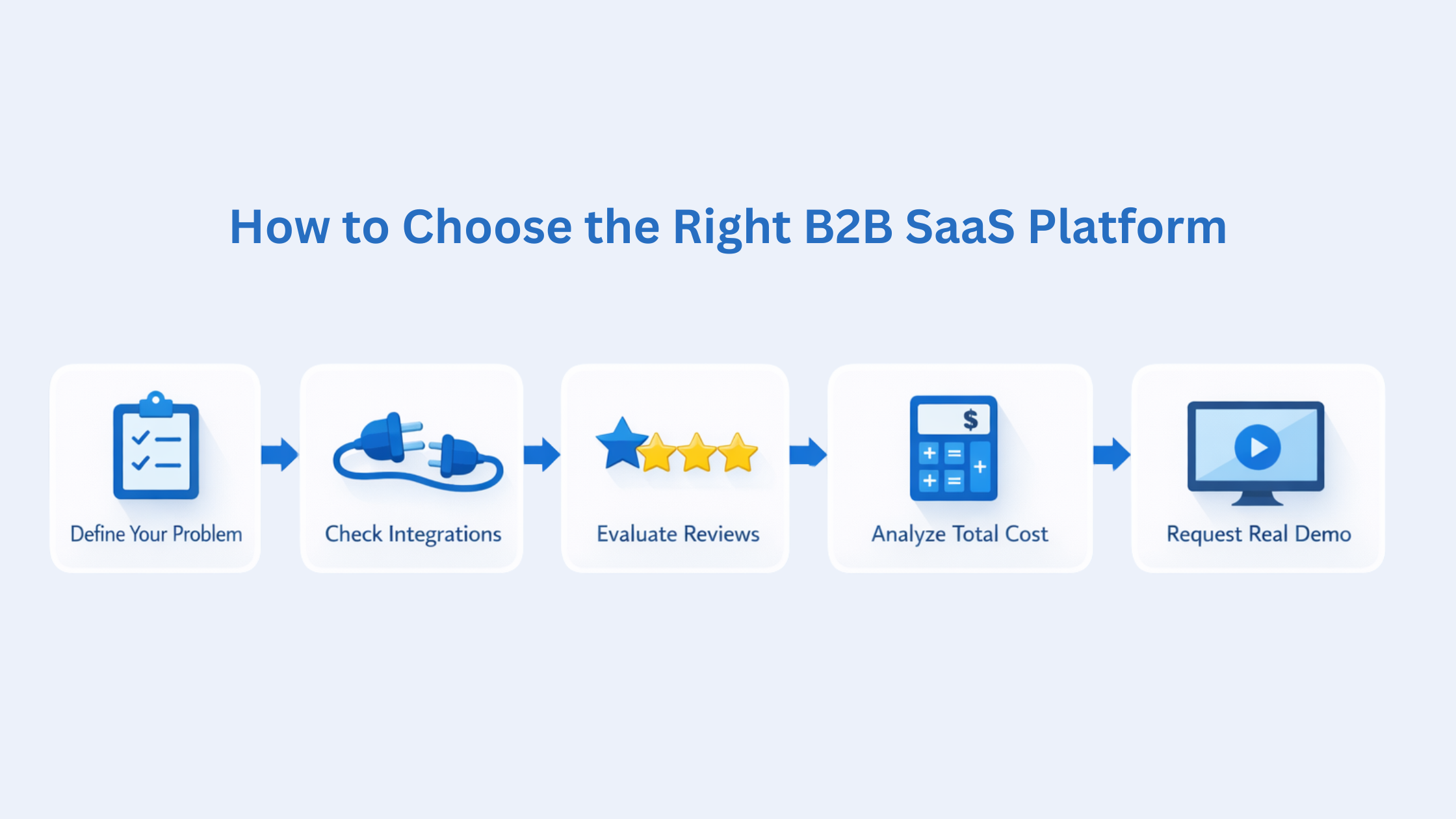
With thousands of B2B SaaS options on the market, how do you choose? Here’s a practical framework:
- Do not begin with software; start by identifying the issue and the result you want. What is the exact business issue that you are attempting to address?
- The most appropriate SaaS tools are compatible with others. Ensure that any platform you are interested in is compatible with your existing technology stack.
- Determine the vendor’s customer success history. Five-star reviews on G2, Capterra, and Trustpilot will say more than any advertisement.
- Consider the total cost of ownership. Consider not only the subscription fee, implementation, and training, but also continual management.
- Ask to be demonstrated with your real data. Any credible B2B SaaS vendor should be able to show you their platform solving your actual problem, not a generic use case.
How SpxBI.AI Is Elevating the B2B SaaS Game
SpxCommerce represents where B2B SaaS is headed.
It doesn’t just help businesses manage sales, inventory, and customers; it helps them optimize performance. At the core of the platform is SpxBI, a built-in intelligence feature that goes beyond reporting data to explain why things are happening and what to do next.
Instead of juggling disconnected dashboards and spreadsheets, you get:
- Integrated sales and revenue visibility
- Customer behavior and profitability insights
- Inventory and supply-demand intelligence
- Channel and dealer performance analytics
- Actionable AI-driven recommendations
For manufacturers, distributors, and commerce-driven brands operating in complex markets, that kind of embedded intelligence isn’t optional; it’s essential.
SpxCommerce turns operational data into strategic clarity, making your business not just more efficient, but smarter.
Conclusion
The one lesson from this deep dive is that B2B SaaS is not a type of software, but an entirely new way to create and capture business value.
The most successful B2B SaaS businesses realize that their clients are not purchasing software; they are purchasing results. Better sales. Smarter decisions. Faster growth. Fewer headaches.
Such is the assurance that SpxCommerce and systems such as SpxBI.AI promise to provide businesses in commerce the intelligence platform they require to compete and succeed in a market that is becoming increasingly complex.
Regardless of whether you have just begun to think about which B2B SaaS platform can help you and your business or you already have a stack in place and want to streamline it, one thing is definite: the companies that adopt intelligent, cloud-based software in the present day will be the ones dominating the industries tomorrow.
FAQ
1. What is B2B SaaS?
B2B SaaS (Business-to-Business Software as a Service) is software that is available on subscription and is sold to businesses via the cloud. It assists businesses in running operations, sales, marketing, analytics, and trade without the need to install on-premises systems.
2. What are examples of B2B SaaS?
Popular examples include Salesforce, HubSpot, Slack, Zoom, and SpxCommerce, all delivering cloud software to other businesses.
3. Why is B2B SaaS growing so fast?
It minimizes initial expenses, scales, and supports remote work, providing real-time data and thus being more adaptable and effective than traditional software.
4. What types of B2B SaaS software exist?
Big divisions are CRM, marketing automation, ERP, project management, cybersecurity, human capital management, analytics, and B2B commerce platforms.
5. What is Product-Led Growth (PLG)?
Product-Led Growth allows users to experience the product through free trials or freemium plans, creating an opportunity to make a purchase based on their experience using the software.
6. How do you choose the right B2B SaaS platform?
Specify your issue, verify integrations, test scalability, review customer reviews, examine total costs, and invite a demo with real business data.