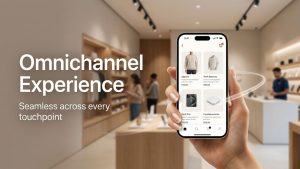
Customers do not perceive brands in silos, but flow through email, social media, websites, apps, and offline touchpoints. They want continuity, meaning, in turn, messages that mirror what they have already viewed, communications that engage them in a manner that makes them feel connected, and experiences that change with their actions. When marketing channels are not synchronized, continuity is lost, leading to duplication, missed opportunities, and unnecessary expenditures.
Cross-channel marketing solves this by turning disconnected touchpoints into a coordinated system. It links data, messaging, and timing across channels to ensure that each interaction is a continuation of the previous one, moving the customer forward rather than back. The outcome is a more appropriate, more effective, and measurable customer journey.
This cross-channel marketing guide disaggregates from multichannel and omnichannel strategies, and explains how to devise strategies that coordinate channels, enhance attribution, and deliver more robust business results.
What Is Cross-Channel Marketing?
Cross-channel marketing is a customer interaction model that integrates various marketing channels (including email, social media, paid advertising, SMS, push notifications, and in-store interactions) into an integrated system. Data and context are exchanged via these channels to provide a streamlined, relevant, and increasingly personalized experience throughout the customer journey.
Cross-channel marketing lies between the multichannel and omnichannel strategies and emphasizes integrating channels rather than operating them separately. Each interaction is a continuation of the previous one, rather than a repetition of the message. To illustrate, when a customer clicks on an email about running shoes, the ad they see on social media continues the same story rather than starting a new one.
One way to think about this is to use a relay race analogy: instead of running different races, each channel forwards information, such as customer behavior and intent, to the next channel. This makes the experience smoother and more interconnected.
Central to cross-channel marketing is shared intelligence, in which channels rely on similar data to make each touchpoint informed, timely, and relevant.
Cross-Channel vs. Omnichannel vs. Multichannel
Any comprehensive guide to cross-channel marketing should explain the differences between cross-channel, omnichannel, and multichannel marketing. Due to the tendency to use these terms interchangeably, this can result in a misaligned strategy and the purchase of the wrong tools.
| Dimension | Multichannel | Cross-Channel | Omnichannel |
|---|---|---|---|
| Channel Coordination | None, independent silos | Partial channels share data | Full channels are integrated |
| Shared Customer Data | No | Yes for targeting & suppression | Yes, fully unified CDP |
| Messaging Awareness | Each channel is unaware of the others | Channels inform each other’s messaging | All channels share the complete journey context |
| Attribution | Per-channel only | Multi-touch across channels | Full journey, real-time attribution |
| Personalization Depth | Basic per-channel | Cross-channel behavioral | Real-time, full-history |
| Technology Complexity | Low | Medium | High. requires CDP + integration layer |
| Best Starting Point | Yes, low barrier to entry | Yes, realistic for most teams | After cross-channel mastery |
Key Component of Cross-Channel Strategy
There are five components that are interdependent in a cross-channel strategy. Every layer relies on the layers below it. The reason most cross-channel implementations fail is that they bypass core data work to go directly to campaign execution.
1. Unified Audience Data Foundation
A centralized audience data platform, Customer Data Platform (CDP), or a tightly integrated CRM + analytics stack that consolidates identity, behavioral, transactional, and preference data across all channels.
It is this integrated profile that enables cross-channel awareness. In its absence, the channels lack a common intelligence to coordinate.
2. Cross-Channel Audience Segmentation
The segmentation is based on data from all channels, not just a single channel. An example of a cross-channel segment would be: ‘customers that received our email about Product X within the past 7 days but did not click, and visited the product page twice, and are not a current subscriber.’ Such rich behavioral segmentation can only be achieved when channel data is integrated.
3. Campaign Orchestration Engine
A marketing automation or orchestration system that can control the next channel to fire, the sequence to fire, and the message to fire, based on the real-time behavior of a customer on all channels.
This is the working level of intelligence that translates your cross-channel strategy to real campaign execution. It manages suppression, frequency limits, trigger requirements, and fallback logic.
4. Cross-Channel Attribution Model
A conversion credit system that allocates attribution credit to every channel and touchpoint that contributed to a purchase, not only the final point of interaction or the channel with the largest spend.
It is cross-channel attribution, which makes your reporting go from reporting which channel spent what to reporting which channel sequence was in fact driving revenue. It is the feedback mechanism that keeps you improving your strategy.
5. Measurement & Closed-Loop Reporting
A reporting layer, which links all channel activity to business performance, in terms of revenue, LTV, churn, and incremental lift, and feeds that insight to segmentation and orchestration.
The cycle is: information in, decision taken, campaign implemented, result measured, information revised. Your cross-channel strategy will be gradually enhanced without closed-loop reporting, and it will be continuously enhanced alongside it.
How Cross-Channel Marketing Works?
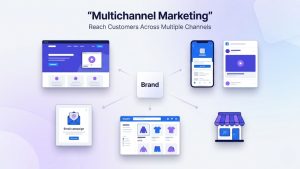
Cross-channel marketing strategy architecture is a hub-and-spoke architecture with a central layer of coordination that connects all active channels in the system, enabling behavioral signals, audience membership, and campaign states to be shared in real time. The following is what that would look like in practice:
The key difference between multichannel and the center coordination layer is the center layer. The strategy is the channels in a multichannel approach. The strategy is the coordination layer in cross-channel, and the channels are executed instruments. Upon a customer opening an email, visiting a product page, and then viewing a social advertisement that appears relevant to the customer, that sequence results from real-time data sharing via the coordination layer.
The Step-by-Step Cross-Channel Campaign Process:
- Trigger event: Customer behavior signals the coordination layer.
- Audience update: The unified profile of the customer is updated with the new behavioral signal. Membership of the segments can vary.
- Channel decision: The orchestration engine decides which channel to answer next, within what time frame, with what message, based on campaign rules and customer history.
- Suppression check: The system will, prior to firing, verify whether this customer should be excluded from this touchpoint based on recency, frequency, or prior conversion.
- Campaign execution: The channel chosen conveys the message. The delivery incident is recorded again in the unified profile.
- Attribution update: If conversion occurs, the attribution model assigns partial credit to all contributing channels. Budget and strategy suggestions are revised.
Cross-Channel Attribution: Measuring Real Impact
The analysis model that allocates conversion credit to the marketing touchpoints that actually influenced a customer’s decision to purchase across all channels of your strategy is known as cross-channel attribution. It is perhaps the most significant and the most misconceived aspect of cross-channel marketing.
Unless you do cross-channel attribution, you will make the systematic mistakes of over-investing in the channels that seem to appear last in the journey and under-investing in the channels that generate awareness and intent. This is one of the most costly attribution blind spots in digital marketing.
| Attribution Model | How Credit Is Assigned | Best Use / Limitation |
|---|---|---|
| Last-Click | Full credit to the final touchpoint | Undervalues awareness channels (SEO, social) |
| First-Click | Full credit to the first touchpoint | Ignores conversion-stage channels entirely |
| Linear | Equal credit to all touchpoints | Simple but imprecise for complex journeys |
| Time-Decay | More credit to recent touchpoints | Good for short sales cycles |
| Position-Based | 40% first + 40% last, 20% middle | Balanced but requires calibration |
| Data-Driven (AI) | ML assigns credit based on actual impact | Most accurate, requires sufficient data volume |
Main Types of Cross-Channel Campaigns
Cross-channel campaigns can be divided into various patterns that target different customer lifecycle stages. Knowing these trends helps you choose the appropriate campaign type to achieve your goals.
1. Acquisition Campaigns
The aligned campaigns use multiple channels simultaneously to acquire new customers. A standard flow: awareness is generated with top-of-funnel content or social advertisement, consideration is generated with paid search retargeting, and a welcome sequence is generated with email sign-up.
The channel’s engagement data is shared with the next channel in the chain, allowing the email welcome series to tailor its message based on the social ad the customer has been clicking.
2. Abandonment Recovery
The cross-channel campaign type has the best ROI. If a customer leaves a cart or a checkout flow, a sequence of events is launched: an email in an hour, a push notification in 3 hours if the email was not opened, and a retargeting ad on social in 24 hours.
The channels that follow only become active if the last one was unsuccessful in converting – over-messaging is avoided without compromising on the recovery pressure.
3. Re-Engagement
The campaigns are aimed at customers who have become silent across every channel. The cross-channel methodology recognizes customers who have reduced their engagement on email, whose app sessions have decreased, and who no longer click social ads, and implements a win-back campaign with uniform messages across all three, increasing in value with each touch.
4. Upsell and Loyalty Campaigns
Post-purchase advertising, which leverages your e-commerce or marketplace purchase data to instigate cross-channel upsell sequences.
When a customer purchases a camera on your marketplace, they are offered free product suggestions via email, lens accessories in their social feed, and a push notification about a bundle offer when they next open the app.
The cross-channel coordination guarantees that each channel does not randomly offer the recommendations in turn.
5. Event-Based Campaigns
Promotions based on events in the real world – seasonal promotions, new product releases, price reductions, out-of-stock notifications – that initiate messages delivered by email, SMS, push, and paid advertising, each channel tailored to its native platforms but all coordinated around the same offer and time frame.
Real-World Cross-Channel Marketing Examples
Leading brands show how coordinated cross-channel strategies turn data into seamless customer experiences. From re-engaging inactive users to driving timely purchases, these examples illustrate how emails, push notifications, social ads, and in-app messaging can work together to increase engagement, conversions, and loyalty.
1. Netflix – Cross-Channel Re-engagement
The cross-channel re-engagement at Netflix is one of the most advanced technologies in consumer technology.
If the subscriber’s viewing frequency declines, Netflix sends email suggestions, push notifications for new releases in their favorite genres, in-app banners when the subscriber visits, and social advertising for high-churn-risk subscribers.
All channels transmit knowing what the others have sent – no repetition, no contradiction. Each touchpoint is a relevant continuation of the same conversation: here is what you might love watching next.
Netflix uses AI-driven personalization to predict churn and recommend content, achieving a low churn rate of around 2.3 % and sustaining major subscriber retention.
2. Myntra – Indian Fashion Cross-Channel Campaigns
Myntra carries out well-organized cross-channel promotions during sale events. Email teasers create anticipation, push notifications are fired when the sale goes live, in-app personalized product recommendations based on their browsing history, and social retargeting ads show the categories each customer browsed most recently.
Attribution is followed through each channel to determine the sequence that drove the highest conversion rate, and the insights are directly incorporated into the orchestration logic for the next campaign.
3. Zomato – Food Delivery Cross-Channel Coordination
Zomato organizes push notifications, emails, SMS, and in-app messages with incredible accuracy based on menu timeframes and order history.
A customer who orders Thai food on Friday nights will get a personalized push notification at 6.45 PM on Fridays when a local Thai restaurant has a deal.
If the push is not opened within 20 minutes, an SMS is sent. If that is not engaged, the in-app banner shows the offer on the next app open. This cross-channel coordination on a time and behavioral basis leads to much higher order frequency than any single-channel method.
Cross-Channel Marketing Tools and Technologies
Implementing a cross-channel strategy requires integrations across your data, orchestration, analytics, and execution layers. The following are the top platforms in both categories:
| Category | Popular Tools & Platforms |
| Customer Data Platforms (CDP) | Segment, Tealium, mParticle, Bloomreach CDP |
| Campaign Orchestration | Braze, MoEngage, Iterable, Salesforce Marketing Cloud |
| E-Commerce & Marketplace | Shopify Plus, SPXCommerce, Adobe Commerce, BigCommerce |
| Email Marketing | Klaviyo, Mailchimp, Brevo, ActiveCampaign |
| Paid Media Management | Google Ads, Meta Ads Manager, Trade Desk, Amazon DSP |
| Push & In-App Messaging | OneSignal, Airship, CleverTap, WebEngage |
| Attribution & Analytics | Northbeam, Rockerbox, Triple Whale, Adjust |
| Personalization | Nosto, Optimizely, Dynamic Yield, Adobe Target |
| Social Media Advertising | Sprinklr, Hootsuite Ads, AdEspresso, Smartly.io |
Best Practices for Cross-Channel Marketing
Successful cross-channel marketing isn’t just about using multiple platforms, and it’s about making them work together intelligently. These best practices focus on building a strong data foundation, designing behavior-driven campaigns, sequencing interactions thoughtfully, and measuring true impact to maximize relevance, efficiency, and ROI.
01. Establish Your Database Before Your Campaign Schedule
Cross-channel failure mode is most often associated with the development of campaigns without the data infrastructure.
Unless you have coherent customer profiles, you cannot target a customer who has already bought during an acquisition campaign, or a customer who has read email content triggered by a relevant social advertisement.
Before scaling the volume of cross-channel campaigns, invest in your CDP or data integration layer, even a simple one.
02. Plan Designs on Customer Behavior, and not on a Channel Schedule
Customer activities should cause cross-channel campaigns rather than a marketing calendar. An abandoned cart left at 11 PM must send an email immediately, not at 9 AM the next day when your system sends the emails.
What distinguishes high-performing cross-channel campaigns from scheduled blasts with cross-channel labels is behavior-driven orchestration with real-time triggers and proper time-window logic.
03. Use Cross-Channel Suppression before Scaling
Targeting is as significant as suppression. After a customer converts, they should be blocked from all acquisition-level campaigns across all channels simultaneously.
An acquisition advertisement should never appear to a customer who has only made a purchase, or an email telling them of a discount on something they were fully charged for yesterday.
Cross-channel suppression demands a single set of data and real-time synchronization across your channels – it has to be built before you go large.
04. Channel Sequencing vs. Channel Simultaneous Broadcasting
Cross-channel coordination means channels are not activated simultaneously but rather one after another, depending on the customer’s reaction.
If a client opens and clicks your email, the retargeting ad must not be triggered. After 24 hours, they will receive a push notification as a follow-up in case they do not open the email.
It is this type of if/then sequencing logic that makes cross-channel marketing different than multichannel broadcasting, and it is what drastically minimizes message fatigue.
05. Embrace Multi-Touch Attribution Early
Each week, you systematically make biased budget decisions because you use last-click attribution.
Switch to position-based, time-decay, or data-driven attribution as fast as your volume of conversion will permit.
Even a basic linear attribution model that puts credit evenly across all the touchpoints will give you, at a glance, a better idea of what channels are helping generate revenue in your cross-channel campaigns.
06. Measure Growth in Lift, Not Attributed Revenue.
Attribution models provide a story of what channels affected a conversion. Incrementality testing will tell you whether those channels are the cause.
Carry out frequent hold-out experiments, inhibiting a channel in a control group and comparing conversion rates to determine the incremental value of each channel in your cross-channel strategy.
Lacking incrementality data, you could be buying channels that are simply watching conversions that would have happened anyway.
Building Your Cross-Channel Marketing Strategy
This is your working cross-channel marketing strategy model – a step-by-step process of developing a coordinated, measurable, and incessantly enhancing cross-channel program.
Audit your existing channel siloes
Map all the channels you are currently running. In either case, record information on customer data captured, location, and other channels. Such an audit shows your existing deficiencies in coordination.
Create a single data platform
Select and deploy a CDP or data integration layer that consolidates customer identity and behavioral data across all channels. Begin with your top two or three channels by traffic. Expand from there.
Establish your most important types of campaigns
Determine the two or three cross-channel campaign types that will deliver the greatest ROI in the short term for your business. The correct starting points are almost always abandonment recovery and post-purchase upsell.
Map your channel sequences
For each campaign type, specify the channel sequence, timing logic, trigger conditions, and suppression rules. Record this as a formal campaign flow and then put anything in your tools.
Install attribution prior to scaling spend
Before scaling cross-channel campaign volume, install a multi-touch attribution model. Last-click attribution will instantly corrupt your perception of channel sequences that are performing.
Measure, optimize in 30-day cycles
Conduct your initial cross-channel campaigns, compare performance to baseline, and refine sequencing logic, timing, and creative after every 30 days. Compounding effect of competitive advantage in cross-channel: the quality of data generated at each optimization cycle leads to better campaigns.
Data, not assumptions, to expand channels
The only channels to add to your cross-channel program are those your data shows are already used in the journeys of high-value customers. Do not add channels just to make them appear; add them because they contribute to the sequences that generate revenue.
Why SPXCommerce for Cross-Channel Marketplace Marketing?
The fundamental issue of cross-channel marketing that we will address at SPXCommerce is the lack of data on marketplace fragmentation. We become your single platform for commerce, consolidating customer behavior, transactions, and vendor data into a single, dependable system.
This allows your marketing channels to work together with real-time intelligence, ensuring shared, timely, and relevant messaging remains consistent.
By enabling major campaigns such as abandonment recovery, upsell, and re-engagement with precise behavioral triggers, we should be able to make coordination actionable.
Attribution is also enhanced by our centralized data, and you can see which channel sequences really generate revenue and where to spend.
As your marketplace grows, we make sure to streamline your cross-channel strategy to be more efficient, measurable, and effective, not more complex.
Conclusion
Cross-channel marketing is not a competitive edge anymore, and it’s a requirement of brands in a multi-touchpoint, fragmented world. Consumers demand seamless, relevant experiences that mirror their behavior and preferences across all interactions.
To meet that expectation, it is not sufficient to be on the various channels, but rather the channels should be integrated as a coordinated system.
By building a robust data foundation, implementing behavior-based campaigns, and appropriately attributing results, companies can align uncoordinated efforts to deliver unified customer experiences.
The effect is evident: increased engagement, more effective spending, and better business decisions informed by smarter decision-making.
It is important to begin pragmatically. Target high-impact applications, such as abandonment recovery or post-purchase upsell, apply basic coordination, and refine on actual performance metrics. The effectiveness of your cross-channel strategy will increase as your data maturity and orchestration capabilities grow.
In the end, the winning brands are not those that have the highest number of channels, but those that relate to them in the most appropriate ways.