Have you ever wondered how a grocery delivery application, which was created on the basis of I hate shopping for groceries myself became a billion-dollar company? That is how Instacart all started, and it is as interesting as the platform itself.
If you’ve been curious about how Instacart works and makes money, what makes its business model tick, or how you can launch something similar, you’re in the right place.
Here we are dissecting it down in this blog, starting with the story of the founding of Instacart and their three-sided marketplace model, to their various revenue streams and the features of the platform.
Let’s dive in.
When Did Instacart Start? A Quick Origin Story
When did Instacart start? It starts in 2012, when Apoorva Mehta, an ex-Amazon engineer, along with Max Mullen and Brandon Leonardo, resolved a highly personal issue, the vexation of shopping for groceries.
Apoorva had worked in Amazon for years and observed how customer loyalty was triggered by speed and experience in delivery. He used the same principles to develop Instacart. There is a legend that when Mehta made the very first order through the initial version of the app, he herself carried the groceries by walking to the shop and getting the products personally. Talk about bootstrapping!
Instacart opened up shop in San Francisco, expanded quickly by word-of-mouth, and in 2015 the company had an approximate of 200 employees. It is functional in thousands of cities in the US and Canada today, with more than 14.4 million daily active users and annual revenue of $3.38 billion in 2024.
Instacart has a history of filling a niche and expanding expeditiously, which is why it started with a personal grocery complaint and ended up a grocery delivery business empire.
Understanding the Instacart Business Model: A Three-Sided Marketplace
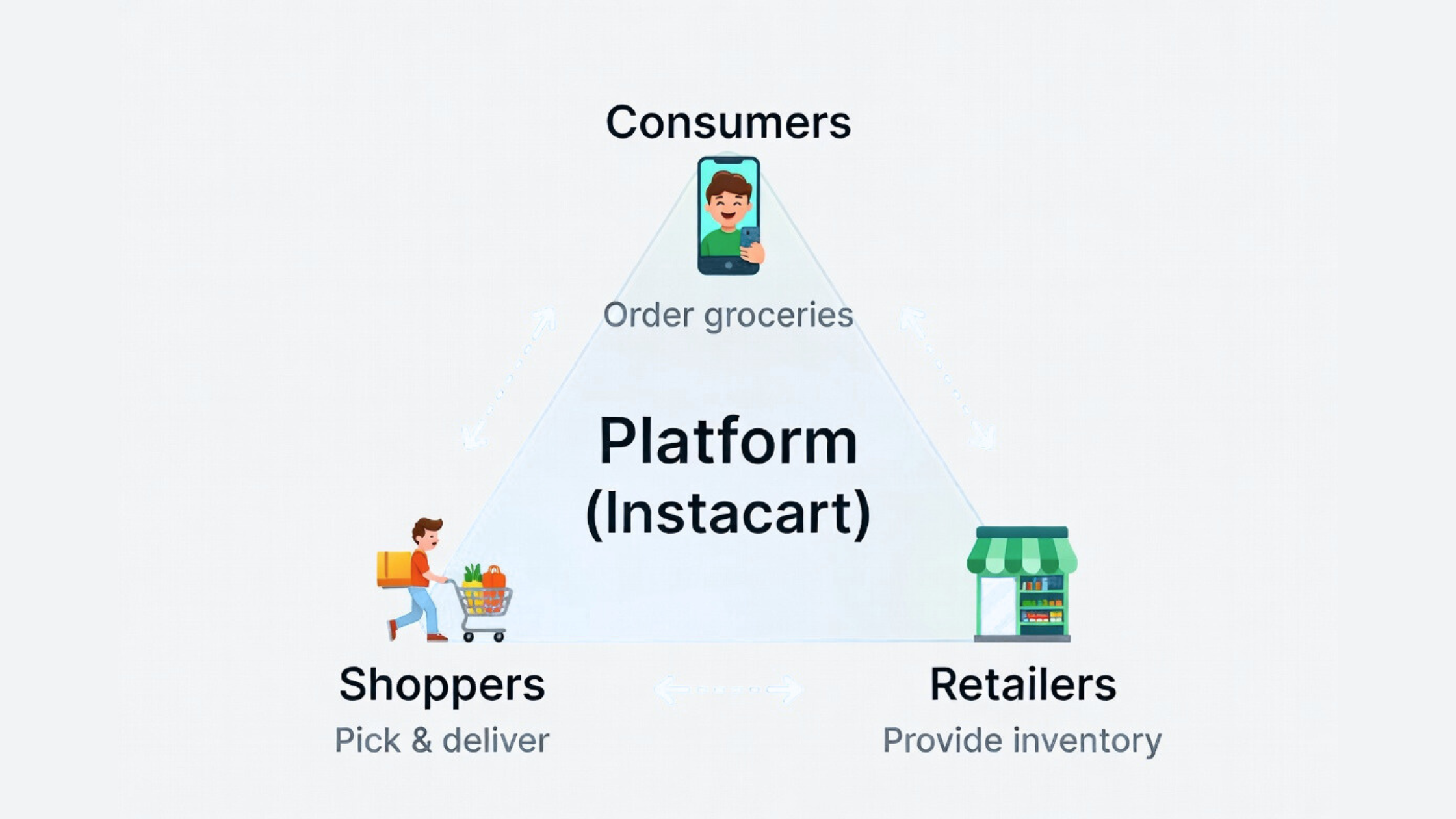
Before we get into how Instacart makes money, it’s important to understand who the Instacart business model actually serves. Instacart is a three-sided marketplace platform that is linked to three different groups:
1. Retail Partners (Grocery Stores)
Such are grocery stores, supermarkets, and specialty stores that Instacart works with to add their products to the platform. Large chains have collaborated with Instacart to offer online storefronts without having to build their own, including Kroger, Costco, Whole Foods, and Aldi.
Partners in retail receive greater digital reach, higher order volumes, and access to Instacart’s data analytics without bearing the cost of building their own delivery infrastructure.
2. Instacart Shoppers (The Workforce)
The fulfilment model of Instacart relies on shoppers. They come in two forms:
-
Full-Service Shoppers: This is an independent contractor who collects the store items and delivers them to the customers. They determine their own working schedule and receive payment on a per-batch basis and tips.
-
In-Store Shoppers: Part-time workers who operate within partner retail outlets to collect and package orders, but do not deliver.
This model is attractive to gig workers, and the shopping workers register using the Instacart Shopper app, undergo a background check, and begin earning on a part-time basis.
3. Consumers (End Users)
Those are average consumers who use the Instacart app or website to order groceries from their preferred local stores. They will be able to select same-day delivery (in most cases, 1-2 hours), scheduled delivery, or in-store pickup. The virtual world has been designed to feel like walking through a grocery store, without the hassle of parking.
This is the three-sided model in which Instacart is brilliant. By linking all three stakeholders to a single platform, Instacart generates value for all of them and makes each layer monetizable.
How Does Instacart Work? Step-by-Step Process
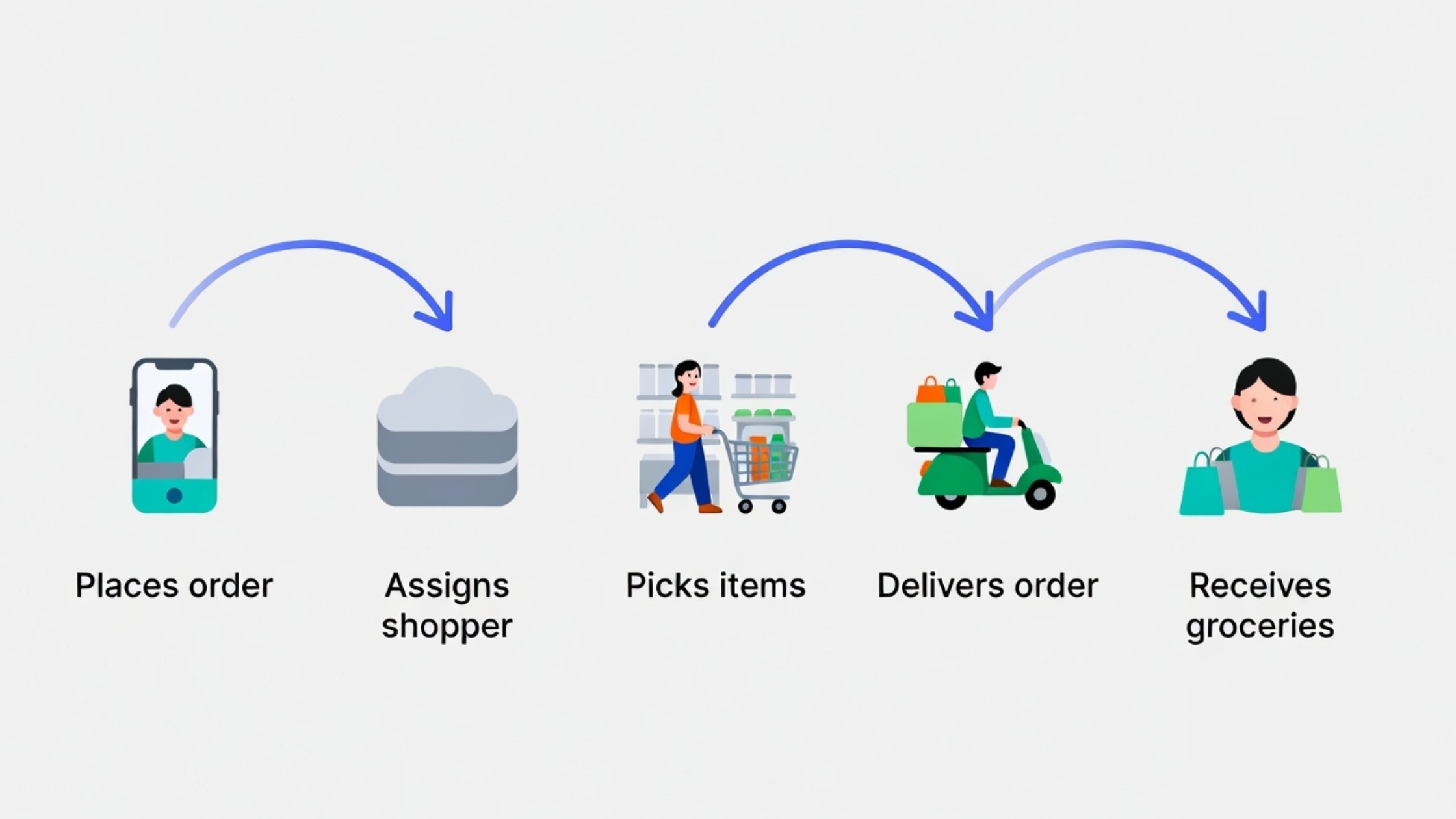
Let’s dive into a step-by-step process to know how instacart work:
For Consumers
- Get registered or log in to the Instacart application or webpage.
- Add your delivery address to view local partner stores.
- Shop, shop, add products to your cart, and use any coupons or promotion codes.
- Select the time of delivery or pickup.
- Order and pay (using credit card, debit card, EBT, or Instacart credits).
- One of these shoppers is assigned, selects your products, and ships them to you, often in 1-2 hours.
- The app gives you the opportunity to keep an eye on your order.
For Shoppers
- Sign up on the Instacart Shopper application and verify.
- Search for order batches that are in your area.
- Take a batch and go to the specified store.
- The goods will be picked, scanned, and bagged according to the customer’s list of the customer.
- Make contact with customers in case the merchandise is out of stock and propose alternatives.
- Delivery to the customer’s door.
- Make money per batch and tips from customers.
For Retail Partners
- Enter into an agreement with Instacart as a partner.
- Combine product catalog and inventory with the Instacart platform.
- Record goods and price fixing (which can involve markups).
- Get the notifications about orders and align with in-store or Instacart shoppers.
- Attain access to the advertising opportunities on the platform (Instacart Ads).
How Does Instacart Make Money? Instacart Revenue Model Explained?
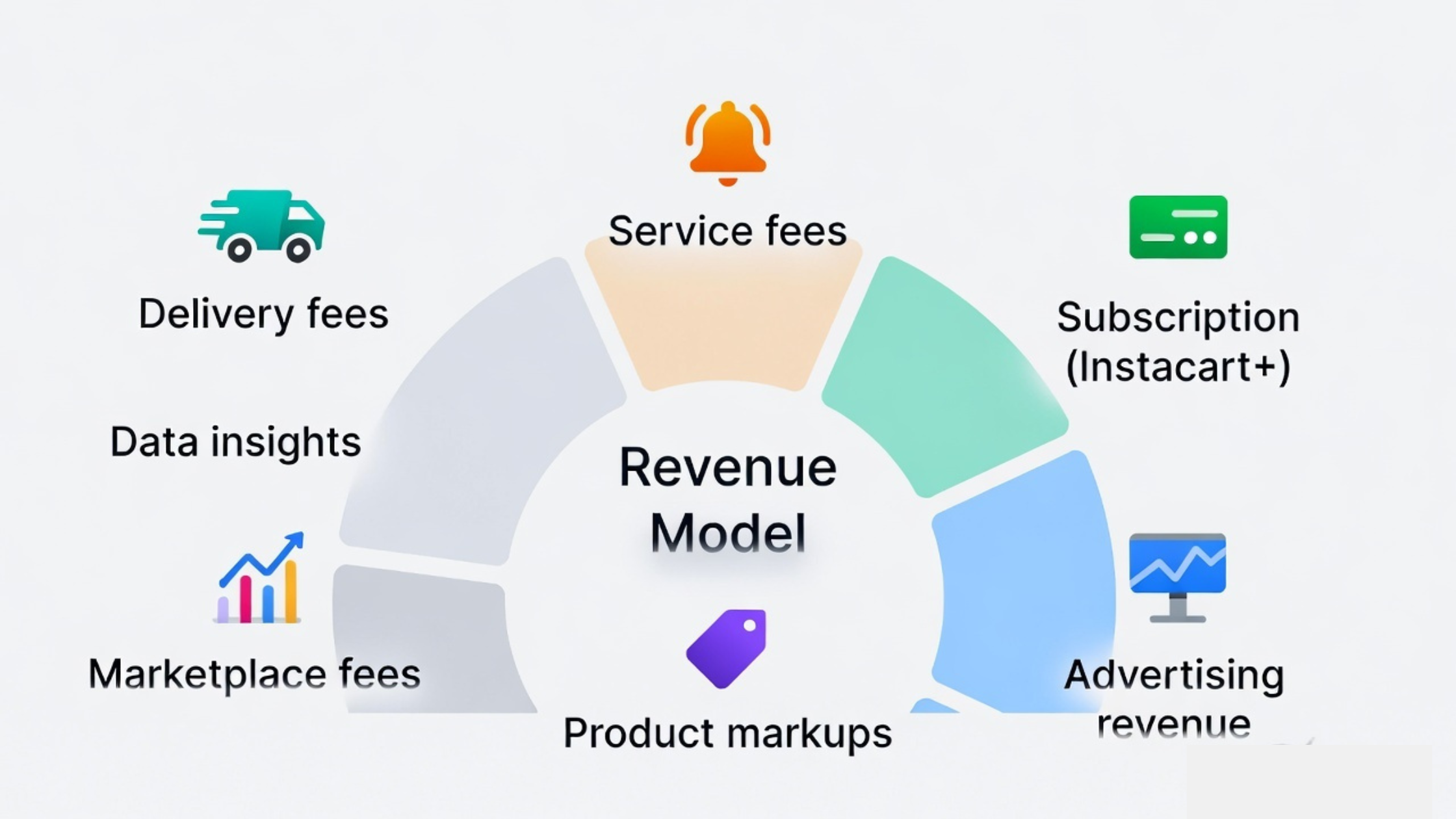
Now, for the big question, “How does Instacart make its money?” The solution is via an intelligent diversified revenue model, which exploits different sources of income. Let’s break it all down.
1. Delivery Fees
Each time a customer orders products without having an Instacart+ membership, they have to pay a delivery fee. To deliver the same day, the cost starts with $3.99 when the order is more than $35. In the event of smaller or faster delivery windows, the fee can be increased.
Delivery fees form a core part of Instacart’s revenue, directly contributing to operational costs and profitability.
2. Service Fees
Besides delivery fees, Instacart will provide a service fee (usually 5% of the order amount) and a minimum fee. This includes operational expenses such as background investigation, shopper services, insurance ,and customer services.
It is noteworthy: pickup orders usually do not involve the service fee, a good feature to consider among low-cost customers.
3. Instacart+ Membership (Subscription Revenue)
Previously called Instacart Express, Instacart+ is the subscription plan of the platform. The membership costs $99/year (or $9.99/month), where members receive:
- Free shipping when purchasing goods worth $35 and above.
- Reduced service fees
- Member-only offers and points.
- Priority support
This subscription model gives Instacart a reliable and recurring income and a base of frequent customers. It’s one of the most important pillars of the Instacart revenue model.
4. Markup Pricing
This is one thing that most users are not aware of: Instacart charges more than in-store prices on most items at several partner shops, and it can be as much as 15% or more. This is one of the key answers to “how Instacart makes money.” The platform essentially earns the difference between the marked-up price and the store’s actual retail price.
This is not permitted by all retailers; some demand parity pricing. However, when one does, it is a huge and underappreciated source of revenue.
5. Partner Fees and Enterprise Licensing
Instacart is not a mere marketplace its also peddling its technology. Grocery retailers can use the Instacart Platform to license the Instacart technology stack (including white-label apps, fulfillment tools, and data analytics) to operate their own digital experiences.
Instacart sells this technology to major retail chains, creating a large B2B income stream that is not directly tied to consumer fees.
6. Advertising Revenue (Instacart Ads)
Instacart has become one of the largest advertising platforms for consumer packaged goods (CPG) brands, unobtrusively. Brand products can be promoted on the platform through Instacart Ads, where brands will pay to place a brand banner at the bottom of search results, in featured banners, and on brand pages.
This is one of Instacart’s fastest-growing revenue segments. PepsiCo, Kraft Heinz, and Unilever brands have active advertisements on Instacart to reach the audience at the right point when they are about to make a purchase. It is Google Ads on grocery aisles.
7. Pickup Fees
Although not as common, other retail partners enable Instacart to charge the pickup fee on the orders picked up in-store. This does not include delivery fees and depends on partners.
Key Features That Power the Instacart Platform
Understanding the Instacart business model isn’t complete without looking at the features that make the user experience so seamless. The engine of the platform is the following:
For Consumers
- Smart Search & Filter: Filter products by category, brand, dietary preference, or price range.
- Real-Time Order Tracking: Tracking of your shopper from the store to your doorstep.
- Item Replacement Preferences: This enables you to pre-set your substitution preferences so that you will not be caught by out-of-stock.
- Multiple Payment Methods: Credit/debit cards, PayPal, EBT SNAP, and Instacart credits.
- Coupons & Deals: Digital coupons and member discounts are applied at checkout.
- Multi-Store Shopping: Order from multiple stores in one session.
- Ratings & Reviews: Post comments about the shoppers and products to enhance a better order in the future.
For Shoppers
- Batch Acceptance Dashboard: Choose and take orders according to place, price, and quantity
- In-App Navigation: Optimized routes to the store and delivery address.
- Customer Chat: Chat directly with customers about replacements or problems.
- Earnings Tracker: Earnings Tracker is a real-time display of hourly pay, tips, and bonuses.
- Flexible Scheduling: Shoppers are in charge of their own schedules.
For Retail Partners
- Product Catalog Management: Live inventory integration with the Instacart platform.
- Instacart Ads Dashboard: Control advertising programs and analyze performance.
- Order Analytics: Data includes statistical data on order trends, the most popular products, and customer profiles.
- White-Label Solutions: Enterprise retailers have the option of implementing branded apps that are powered by Instacart.
- Pickup & Fulfillment Coordination: Tools for managing in-store order preparation.
What Makes Instacart’s Business Model So Resilient?
This is what differentiates Instacart among the rest of grocery delivery competitors, such as DoorDash, Amazon Fresh, and Shipt:
1. Asset-Light Operations
Instacart does not have warehouses, vehicles, or inventory. It links the current assets (stores, shoppers, products) with technology, maintaining overhead lean.
2. Data Moat
Instacart possesses powerful shopper data of thousands of retailers and millions of orders. This information drives its advertising platform, and it is invaluable to CPG brands.
3. Diversified Revenue
The delivery charges, advertising, SaaS licensing, etc., Instacart does not rely on one channel of revenue. This makes the Instacart revenue model more durable than pure delivery play competitors.
4. Retail Partnerships at Scale
Instacart has a unique retail network of 1,400+ retailers and 80,000+ store locations that, even with new competitors, would take a long time to duplicate.
5. First-Mover Advantage in Grocery Tech
Instacart has an early technical advantage over its competitors through its investments in grocery specific technology such as barcode scanning systems, inventory mapping systems, and substitution algorithms.
Instacart SWOT Analysis: Strengths, Weaknesses, Opportunities & Threats
To see the position of SpxCommerce in the competitive market of grocery and on-demand delivery technology, it is worth considering its fundamental strengths, weaknesses, opportunities, and threats in the future.
Instacart SWOT Analysis
| Strengths | Weaknesses |
| Good positioning as a scalable grocery marketplace solution. | Poor control of the accuracy of retailer inventory. |
| Multi-vendor marketplace architecture is flexible. | Needs continuous marketing investment in acquiring customers. |
| Favors fast delivery models (same-day/express) | Relies on the performance of the retailers and delivery partners. |
| Recurring revenue entails an enterprise-ready SaaS model. | New regional expansion needs to be done in localization and compliance. |
| Premium-rate services such as sponsored listings. | The more the platform, the more any complexity becomes operational. |
| Personalization through AI in order to boost basket size and retention. | Newer markets may be in brand recognition. |
How Instacart Work to Drives Sustainable Profitability?
The success of Instacart in the long run is not merely about revenue growth, but also about unit economics. It implies paying attention to key metrics such as Customer Lifetime Value (CLV) and Customer Acquisition Cost (CAC).
- Customer Lifetime Value (CLV) is the revenue a customer generates for the organization over the life of the relationship.
- Customer Acquisition Cost (CAC) is the cost that is involved in acquiring a new customer, such as the marketing expenses, discounts, promotions, and other forms of incentives.
How Instacart Maintains This Balance?
1. Subscription Revenue
Instacart+ will create recurring revenues and promote repeat buying by providing its subscribers with free delivery to reduce the barriers to purchasing.
2. High-Margin Ad Revenue
Branded sponsored advertisements have good margins, and overall costs are low due to low infrastructure and platform maintenance costs.
3. AI-Powered Personalization
Individualized suggestions enhance the level of the basket size and the value of customers in the long run.
4. Increased Purchase Frequency
The subscribers make more frequent orders because the delivery has already been paid for and the sales are increased without further expenditure on acquiring them.
CACs are increasing in an extremely competitive market, particularly as giants such as Amazon, Walmart, and DoorDash spend heavily on grocery delivery. Instead of surpassing these rivals,
Instacart aims at keeping its current customers and raising their buying frequency. This approach will be a successful way to balance rising CAC by ensuring that every customer is maximized in the long run.
Thinking of Building a Platform Like Instacart? Here’s Where to Start
The model of Instacart has obviously demonstrated its feasibility. It is estimated that online grocery delivery will be reaching $623.70 billion within the period of 2034. The sooner you are ready to explore this space, the better it is because you are an entrepreneur or a business.
However, such a complicated marketplace would be an enormous project that would require a multi-sided platform design, real-time delivery, role-specific applications, payment systems, and an advertising overlay, without compromising the flow of a user experience.
And that is where SpxCommerce fits in.
SpxCommerce is a marketplace development partner that specializes in the development of multi-vendor grocery and delivery marketplaces and has extensive knowledge of the Instacart-type marketplaces. You want to start a local groceries delivery app, white-label a service to retail partners, or create an Instacart clone with tailored functionality. SpxCommerce is the technical capability and expertise in marketplace operations to make your idea a reality.
Since the experience that consumers engage with and shoppers manage is apps and a dashboard, and the back-end is delivered as an admin, analytics, and advertising modules, SpxCommerce’s same-end marketplace solutions are scalable, feature-rich, and competition-ready.
Estimated Cost to Develop an Instacart Marketplace Platform Like
The cost of a grocery marketplace platform can vary depending on the level of development, the features, and geographical development capabilities.
Region-Wise Development Rates
| Region | Hourly Development Cost |
| United States | $70 – $150 per hour |
| Europe | $30 – $100 per hour |
| Asia | $10 – $40 per hour |
A fully-managed grocery delivery system can begin at around $50,000 and above, based on the depth of features and integrations.
Key cost factors include:
- Multi-vendor marketplace functionality
- Real-time order tracking
- Payment gateway integration
- Delivery partner management
- AI-based personalization features
- Admin dashboards & analytics
Nonetheless, commercially available SaaS systems such as SpxCommerce provide a much cheaper and quicker to market solution as opposed to a conventional bespoke development.
Final Thoughts
The case of Instacart is a perfect example of a business model of a marketplace. By treating three different customer groups, consumers, shoppers, and retail partners, and monetizing each of these ties with several revenue streams, Instacart has created a business that is resilient, scalable, and embedded in the daily consumer behavior.
Understanding how does Instacart works isn’t just an academic exercise. It is a template for any party interested in developing in the grocery technology, delivery, or marketplace market. The model is functioning, and the market is only expanding further.
When the time comes to create your own version of Instacart, the team at SpxCommerce is willing to make it a reality.
FAQs
Q: When did Instacart start?
Instacart is an American delivery startup that was established in 2012 by Apoorva Mehta, Max Mullen, and Brandon Leonardo in San Francisco, California.
Q: How does Instacart work & make money?
Instacart earns revenue in the form of delivery fees, service fees, the subscription fee of Instacart +, the price of products being marked up, licensing fees charged to retailers using the Enterprise technology, and the advertising revenues of CPG brands.
Q: How much does Instacart charge for delivery?
Instacart will have a minimum delivery fee of $3.99 to orders above 35 dollars. Free delivery is enjoyed by members of Instacart Plus.
Q: Is Instacart profitable?
Yes, Instacart is projected to bring in a net income of $457 million in 2024 based on a revenue of $3.38 billion, which is a major milestone in profitability.
Q: Can I build a platform like Instacart?
Yes, you are able to have a multi-vendor grocery delivery marketplace that is as complete as possible with a marketplace development partner such as SpxCommerce that suits your market and business objectives.