You have the vision. The aesthetic is evident in your mind. Perhaps you have even drawn designs on napkins at 2 a.m. But when you sit down to actually start a clothing brand, reality hits hard, and it hits fast.
Manufacturing, pricing your products, and building an audience from scratch are among the biggest challenges new fashion entrepreneurs face.
Managing inventory without a warehouse or a dedicated team adds another layer of complexity. These are real and often overwhelming obstacles that stop thousands of aspiring founders before they ever make their first sale.
The obstacle to opening a clothing brand has never been reduced. The emergence of ecommerce, print-on-demand services, and marketplace builders means you do not need a factory, a storefront, or millions of dollars in investment to start.
You only need a proper plan, an appropriate set of tools, and a roadmap to follow step by step, and that is what this guide provides.
By the end of this article, you’ll know how to move from idea to launch with confidence, covering everything from your clothing brand business plan to your first marketing campaign.
What is a Clothing Brand?
A clothing brand is much more than a stitched label on a piece of clothing. It is the totality of a fashion business, the name, the visual image, the design ideology, the values it represents, and the emotional bond that it creates with its clients.
Fundamentally, a clothing brand is a vow to a particular kind of client. It conveys to your customer who you are, what you create, why it matters, and why he or she should choose you over a hundred other options with a swipe of the screen.
A brand holds intangible value, which can be more valuable than the actual physical product, unlike a generic clothing maker or wholesale provider. Just imagine a plain white t-shirt selling for $150 at a street market, and the same garment selling for $1500 when it has the right brand name behind it. The brand is that premium.
The Three Pillars of a Clothing Brand
| Pillar | What It Means | Example |
| Identity | Name, logo, visual style, brand story | Minimalist sans-serif logo, earthy tones |
| Product | Design, quality, fit, materials, range | Sustainable linen co-ords, premium stitching |
| Community | Who buys, follows, and advocates for you | Eco-conscious millennials, urban professionals |
When all three pillars come together, then a clothing brand will be successful. The customers do not simply purchase a product, but they buy into who you are and what you are.
Top Clothing Business Ideas for 2026
The fashion industry is very large, and opportunities within it are not evenly distributed. The brands that emerge victorious in 2026 and beyond are those that recognize a very specific unmet demand and avoid the challenge of competing with all the clothing brands online.
Here are the following are the best clothing business opportunities for the market in 2026:
1. Sustainable & Eco-Friendly Clothing
Environmental awareness is no longer a fashion trend. It is now a key purchasing consideration for consumers. Premium pricing power and strong customer loyalty are being seen among brands that use organic cotton, recycled materials, deadstock, or zero-waste manufacturing. This segment is expanding at a rate of more than 9% per annum and shows no signs of slack.
- Opportunity: Position around transparency, publicize your supply chain, sourcing of fabrics, and carbon footprint.
- Audience: Millennials and Gen Z, active researchers of brand ethics before purchase.
2. Streetwear & Hype Culture
Streetwear is a major clothing niche with a strong commercial presence, with a market worth hundreds of billions worldwide. Limited-edition, community-sponsored marketing, and drop-model releases generate organic demand that is difficult for standard fashion brands to simulate.
- Opportunity: Establish around a subculture of gaming, music, sports, or a local city identity, and then go national.
- Audience: Younger millennials and Gen Z who attach importance to exclusivity and fashion as an identity-defining feature.
3. Athleisure & Activewear
The culture of working at home has made the athleisure market permanently faster. Consumers are now requiring clothing that keeps them working out and appears presentable in a coffee shop. The independent brands have a huge white space in performance fabrics with lifestyle fashion.
- Opportunity: Target a particular sport or activity (yoga, running, cycling) and not generic activewear.
- Audience: People with disposable income who are health-conscious, aged between 22 and 45.
4. Ethnic & Fusion Wear (India-Specific)
The ethnic wear market in India is among the largest segments of the clothing market, and the firm has been boosted by weddings, festivals, and an increasing middle class seeking premium traditional wear online. The combination of conventional shapes with modern materials and lines is bringing a new design language with an international flavor.
- Opportunity: Establish a DTC brand that offers ethnic attire directly to the diaspora communities around the world, an underserved market with high purchasing power.
- Audience: Indian consumers aged 25-45 and the NRI diaspora in the US, UK, Canada, and the UAE.
5. Kidswear & Maternity Fashion
The most loyal customers in the fashion industry are parents and children, who have strong repeat-purchase potential as they grow up. The kidswear market presents an excellent opportunity. Another niche that is largely underserved, with enthusiastic communities and strong organic word-of-mouth, is maternity and postpartum fashion.
6. Plus-Size & Size-Inclusive Fashion
Nevertheless, even though they constitute more than 40% of the adult population in most markets, plus-size customers are systematically underserved by the mainstream fashion brands. A clothing label whose core is authentic size inclusivity and trendy, well-fitting designs for all sizes has a strong, expanding market niche.
7. Custom & Personalized Clothing
With the emergence of print-on-demand technology, personalized clothing has become commercially viable at large scale. Brands that give the option to customize the name or custom print or make-to-order clothes price higher and create the strongest emotional attachment with the customers.
Types of Clothing Business Models
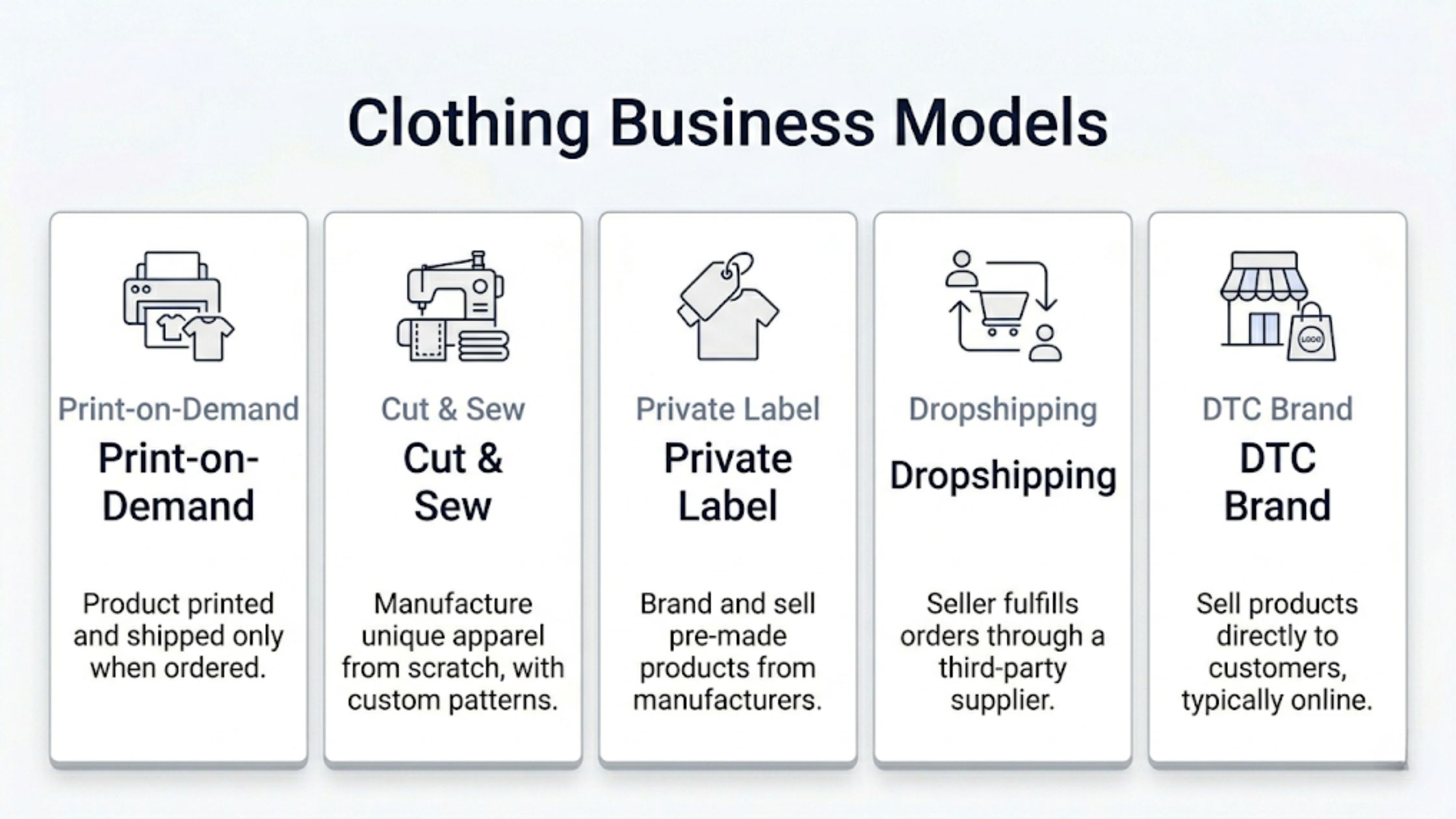
The most significant strategic choice you will make is to understand what type of clothing business model will fit your goals, budget, and risk-taking behavior. The implications of each model to your startup costs, quality control, margins, and scalability vary.
| Business Model | How It Works | Best For | Key Tradeoff |
| Print-on-Demand | Design + prints on demand and delivers. Zero inventory. | Novices, graphic tee companies. | Poor margins, smaller product lines. |
| Cut & Sew Manufacturing | Complete custom manufacturing of garment fabric to finish. | Premium, design-led brands | Higher MOQ, longer lead times |
| Private Label | White blank clothing + your branding and labels added. | Fast-to-market brands | Not so unique, intermediate differentiation. |
| Dropshipping | List supplier products; they ship directly to the customer. | Market testing, low-risk entry | No brand differentiation, thin margins |
| DTC Ecommerce Brand | Own products sold directly via your website/marketplace. | Scaling brands, brand builders | Requires traffic investment |
| Multi-Vendor Marketplace | A platform hosting multiple clothing sellers | Entrepreneurs & aggregators | More complex to manage & curate |
Which Model Should You Choose?
The correct model is based on three considerations: the amount of capital you have, the degree of brand differentiation you want to achieve, and how quickly you need to reach the market.
- Minimum risk entry: Print-on-demand or dropshipping as a way of determining demand before investing in inventory.
- Optimal brand management: Cut-and-sew production of original, high-quality products.
- Fastest development strategy: DTC ecommerce and marketplace existence (through SPXCommerce) to ensure the greatest number of people are reached at the very start.
How Does a Business Loan Help to Start a Clothing Business?
One of the most prevalent reasons business founders of clothing brands hesitate to start is capital constraints. The design is ready. The manufacturer is recognized. The website’s concept is charted. But the money isn’t there yet.
A clothing brand business loan bridges the gap between the vision and the execution. There are strategies in which external funding will give you a faster start, enable you to order at the lowest possible MOQs, and invest in the marketing infrastructure required to make sales on day one. Here are the key areas a business loan supports:
-
Initial Inventory Investment
At higher orders, the manufacturers are normally willing to sell at lower per-unit prices. Through a business loan, you can satisfy those MOQs and minimize your COGS at the initial stage.
-
Branding and design
The development of a professional brand identity logo, packaging, photography, and website should be an initial investment that will reap benefits for the brand’s life.
-
Working Capital
Clothing brands tend to experience a cash flow gap between placing orders (cash out) and receiving customer payments (cash in). The gap in this cycle is filled by a working capital loan.
-
Marketing & Customer Acquisition
Paid advertising, influencer campaigns, and content production require an initial investment before delivering a payoff. This investment is financed by a loan at the critical stage of launching.
-
Technology & Platform
Establishing an ecommerce platform, photography gear, design software, and marketplace tools will be required to make a professional launch.
How to Strengthen Your Loan Application
Banks and NBFCs assess loan applications for clothing businesses on several dimensions. To get maximum approval and favourable interest rates:
- Formally register your business as Pvt. Ltd., LLP, or Sole Proprietorship with GST.
- Prepare a detailed business plan for a clothing brand, including 3-year financial projections.
- Have good personal and business credit and no defaults.
- Demonstrate that it has pre-orders or social media followers, signed retailer contracts, or previous sales.
- Register under eligible government schemes where the rates are lower.
Why Start a Clothing Brand in 2026?
The worldwide apparel market is estimated to reach more than $2 trillion in 2028. More to the point, consumer behavior has significantly changed, with shoppers now actively pursuing brands that possess a story, a purpose, and an identity that reflect themselves. This is your opportunity.
Today, a brick-and-mortar shop or a 10,000-unit order is no longer a requirement to compete as it used to be ten years ago. The direct-to-consumer (DTC) model has democratized fashion. Independent brands are competing effectively with legacy retailers by being quicker, more genuine, and closer to their respective communities.
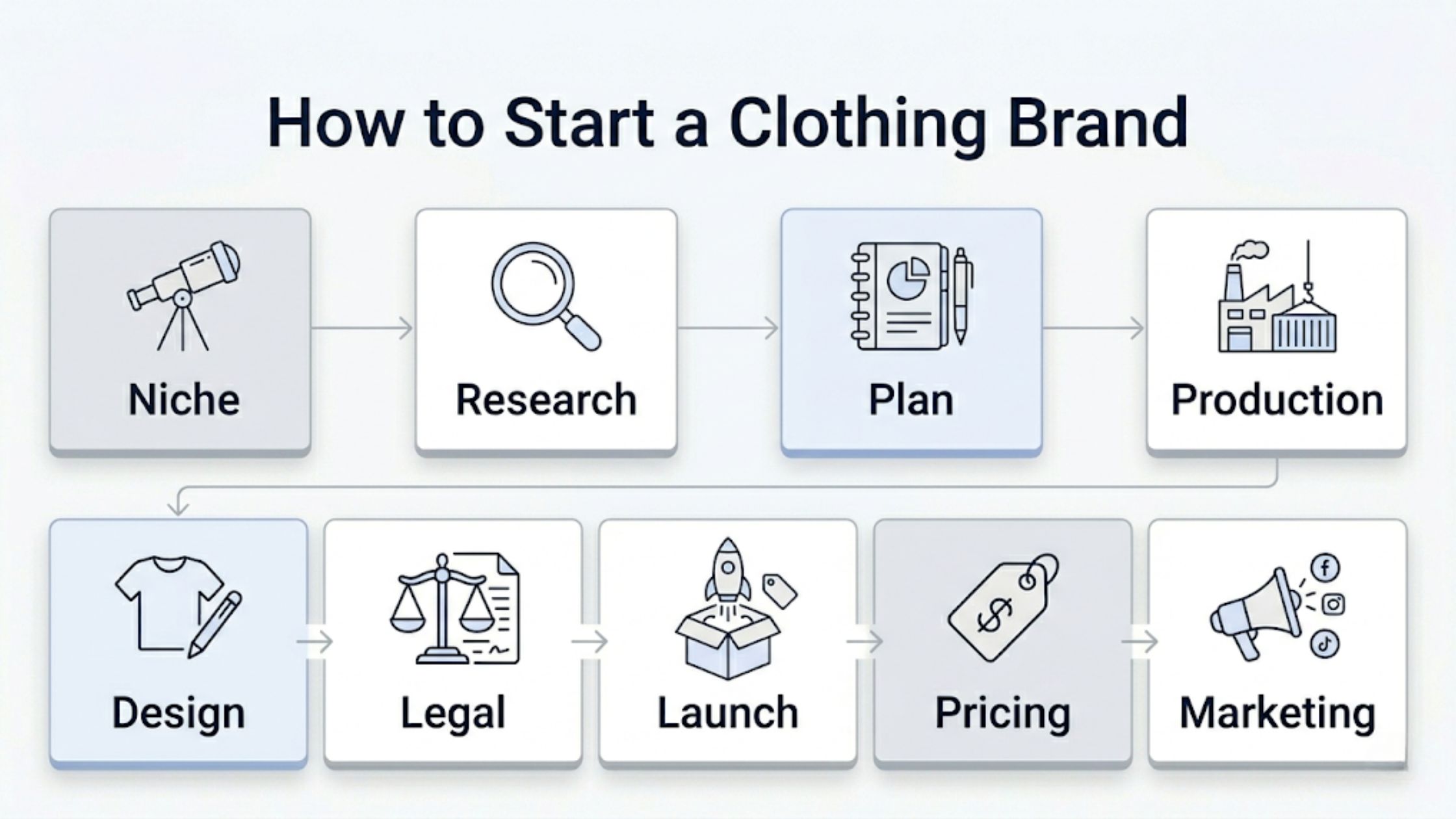
Step 1: Find Your Niche & Define Your Brand Identity
The greatest error that clothing newcomers make is to sell to everyone. When you sell everybody, you sell no one. An excellent brand name starts with indiscriminate attention to a given niche.
How to Identify Your Clothing Niche
There are three important questions that you have to ask yourself before you spend a rupee on inventory:
- Who is my customer? Age, life, values, income level, and what they are not interested in other than fashion.
- What is the problem I am solving, or am I creating? Trust, inclusion, permanency, prestige, nostalgia, self-identification.
- What is the position of my brand in the market? Budget, middle-priced, premium, or luxury?
Build Your Brand Identity Framework
Your brand identity is the unseen power that causes customers to prefer you to the cheaper version. It must include:
- Brand name: It is memorable and simple to spell, and it can be used as a domain name and social handle.
- Brand story: What is the purpose of this brand? What is the founder’s truth?
- Visual identity: Logo, color scheme, typography, and packaging design.
- Brand voice: The way you write captions, product descriptions, and emails.
- Values: Sustainability, inclusiveness, craftsmanship, boldness, etc.
Step 2: Conduct Market Research
Good design without marketing is merely expensive art. Get time to know the market you are venturing into before committing funds to samples and inventory. This is the foundation of any solid fashion startup guide.
Research Your Target Audience
- You can visit the social networks of Reddit and Facebook groups, and Discord servers where your target customers can be found.
- Examine the trend in Instagram and Pinterest within your niche. What kind of aesthetics are increasing?
- Conduct a survey of prospective customers with the help of tools such as Google Forms or Typeform.
- Review other competitor brands on their websites and social media.
Market Research Framework
| Research Area | What to Find Out | Tools to Use |
| Audience Demand | Search volume, trending keywords, customer pain points | Google Trends, Ahrefs, SEMrush |
| Competitor Analysis | Pricing, bestsellers, marketing channels, customer reviews | SimilarWeb, Social Blade, Manual review |
| Trend Research | Fashion micro-trends, color forecasts, style movements | Pinterest Trends, WGSN, Instagram Explore |
| Pricing Intelligence | Average selling price, discount patterns, perceived value | Manual competitor research |
Step 3: Write Your Clothing Brand Business Plan
A clothing brand business plan is not just a document for investors, but it’s your operational compass. It makes you think of all aspects of your business before spending money. An effective plan has the following main sections:
- Summary: Brand idea, mission, and short-term objectives on a single page.
- Brand & Product Description: What you are selling, your niche, and what makes you different.
- Market Analysis: Demographics of the target audience, market size, and market trends.
- Competitive Analysis: Your positioning and the major competitors.
- Production & Operations Plan: How you will produce, purchase, and operate inventory.
- Marketing Strategies/ Sales: This is how you will get customers and keep them.
- Financial Projections: Startup expenses, price model, sales project, break-even, analysis.
Startup Cost Estimate for a Clothing Brand
| Expense Category | Budget Range (USD) |
| Sampling & Prototyping | $180 – $600 |
| First Production Run (50–200 units) | $960 – $3,600 |
| Branding & Logo Design | $60 – $360 |
| Ecommerce Store Setup | $0 – $240/yr |
| Photography & Content | $120 – $480 |
| Initial Marketing Budget | $240 – $1,200 |
| Business Registration & Legal | $60 – $180 |
| Packaging & Hangtags | $120 – $480 |
Step 4: Choose Your Production & Sourcing Model
One of the most decisive actions you will make is how your clothes are made. All the models imply varying implications for your startup costs, quality control, minimum order quantities, and scalability.
-
Print-on-Demand (POD):
You design it; one is printed and shipped each time it is ordered by a third party. No risk inventory, minimal start-up cost. Most suitable when starting out and for graphic tee brands.
-
Cut & Sew Manufacturing:
Cloth is obtained, and clothes are tailored to your specifications. Complete command of fit, material, and finish. Best when associated with high-quality brands that have exclusive silhouettes.
-
Private Label:
You buy ready-made blank clothes and label and brand them yourself. Quick to launch and reduced investment. Best where the speed and consistency are significant to the brands.
-
Dropshipping:
You place items on the list of a supplier; they do all the deliveries. Most suitable for market testing with the lowest risk.
Step 5: Create Your Designs & Product Line
What customers fall in love with are your designs. The ecommerce growth strategy of developing a cohesive product line would be the same whether you are an employee designer or an entrepreneur with a creative nature who outsources the design work.
Build a Focused Launch Collection
Don’t try to launch 50 SKUs. Begin with a small, handpicked set of 6-12 products that are able to convey your brand aesthetic clearly. A focused range:
- Better to photograph and sell at all times.
- Minimizes inventory and financial risk.
- Tells a clearer brand story.
- Invokes a sense of urgency and scarcity, two potent sales motivators.
Step 6: Handle Legal, Licensing & Registration
Legal groundwork may not be glamorous, but skipping it can lead to costly problems. The first step is choosing a business structure. Solo founders can start as a sole proprietorship, while co-founders may form a partnership with a written agreement. Most clothing brands benefit from an LLC, which protects personal assets and is easy to manage. If you plan to scale aggressively or raise funding, a corporation (C-Corp or S-Corp) may be appropriate.
Next, register your business with your state and file a DBA (Doing Business As) if you operate under a brand name. Obtain an EIN from the IRS, required for hiring, opening a business bank account, and filing taxes. Most states also require a sales tax permit, and a resale certificate allows you to purchase inventory tax-free.
Protect your brand by registering your name, logo, and tagline with the USPTO. You must also follow FTC labeling laws, which require fiber content, country of origin, brand/manufacturer name, and care instructions.
Finally, consider insurance: general liability protects against customer claims, while product liability is critical for clothing defects or allergic reactions. Optional but helpful steps include registering as a wholesale vendor and checking state-specific textile and labor laws in places like California and New York.
Step 7: Launch Your Clothing Brand Online
Learning how to start a clothing brand online is fundamentally about choosing the right platform architecture. Your web shop is your most valuable advertising property as it operates 24 hours, requires no extra personnel, and it is absolutely under your control.
When you decide to start an ecommerce business, you face a foundational choice: build a standalone store, sell on established marketplaces, or do both.
Standalone Store vs. Marketplace: The Key Differences
| Factor | Standalone Store | Marketplace (via SPXCommerce) |
| Initial Traffic | You must drive all traffic | Built-in audience & discovery |
| Brand Control | Full control over experience | Within marketplace guidelines |
| Trust Factor | Must build from scratch | Inherits platform trust |
| Fees | Platform subscription + payment fees | Commission-based model |
| Scalability | Requires active marketing investment | Network effects accelerate growth |
| Best for | Long-term DTC brand building | Fast market entry & validation |
Step 8: Set Pricing That Actually Makes Money
Most first-time clothing brand founders make expensive errors with pricing, either underpricing because of fear of killing the margins or overpricing because the brand is not well-established to support the prices (killing conversions).
The Keystone Pricing Formula
The pricing conventionally used in the clothes retail business is the industry keystone price: sell at twice your wholesale price, and your wholesale price is usually twice your Cost of Goods Sold (COGS).
Pricing Factors to Consider
- Pricing by your competitors in your niche.
- Brand positioning value received.
- Commissions and payment gateway charges.
- Shipment costs (charged or charged to customer)
- Estimate of the return rate (usually 15-30% of online clothes)
- Target gross margin (sustainable growth goal is 50-70%)
Step 9: Build Your Clothing Brand Marketing Strategy
Without distribution, the world cannot have the best clothing brand. Clothing brand marketing in 2025 is a multi-channel game, but you don’t need to be everywhere at once. Enhance by starting with 2-3 channels and perfecting them before increasing.
1. Social Media Marketing
The key visual discovery apps used in fashion are Instagram and Pinterest. Brand consistency, authenticity, and storytelling are more active and effective than refined but impersonal advertising messages at TikTok targeting Gen Z.
- Repeatedly 4-5 times a week on feed, Stories, and Reels.
- Combine product content (40%), lifestyle/brand story content (40%), and community content (20%).
- Your most converting social proof is UGC (User Generated Content).
2. Influencer & Creator Marketing
You don’t need celebrities. Micro-influencers (10K-100K followers) within your particular niche will always be more engaging and genuine with endorsements than macro-influencers at a tenth of the price. Begin with gifting campaigns, then commit to paid partnerships.
3. Email Marketing
Email has the best ROI of any online platform in ecommerce. Construct your list on day one by use of a lead magnet ( first-order discount, style guide download ) and use automated flows to notify welcome messages, abandoned cart messages, and post-purchase nurturing.
4. Ecommerce SEO Strategies
Investing in ecommerce SEO strategies is the single most powerful long-term growth lever for clothing brands. SEO traffic does not vanish when you cease to pay, like the paid ads, and builds and builds.
- Maximize product pages on long-tail keywords (e.g., sustainable linen kurta for women).
- Design Web page content that appeals to category-level search terms.
- Create a brand blog that focuses on informational questions that your customers are trying to find.
- Gain backlinks by being featured in the press, influencer campaigns, and industry directories.
5. Paid Advertising
Growth can be achieved in a very brief period by doing paid advertising on Meta (Instagram/Facebook) and Google after you have validated products and a good creative asset. Begin with a test budget of $1000 to $30,000/month. The creatives on tests 5-8 per campaign to make your winners and then scale spend.
Why SPXCommerce Is the Smart Choice for Fashion Brands
We help you turn your fashion dream into an online business that is scalable and hassle-free. When you have established your brand, our platform will take your business to the next level and will make sure that you expand more quickly than before with less loss of earnings.
We also offer an on-demand marketplace platform, whether it be your own brand or an inter-brand fashion district. Onboard, manage, and scale. You can onboard, manage, and scale sellers across a single dashboard with our vendor management features.
We have built-in payments, excellent logistics, and order fulfillment, which means you can focus on growth rather than operations. Also, our optimized architecture is SEO-friendly and will increase your exposure and organic flow on the first day.
Created with simplicity and size in mind, SPXCommerce eliminates the complexity developers don’t need. We take care of the backend, and you develop your brand, meet customers, and grow with a feeling of security.
Conclusion
Launching a clothing brand in 2026 is not exclusive to companies with huge capital bases. Heavy investment is an open opportunity for creators, entrepreneurs, and visionaries who think strategically. The tools, platforms, and business models available today have eliminated many traditional obstacles, but clarity, execution, and consistency are still necessary to succeed.
Winning brands are not those that aim to please everybody. They are the ones that know their audience, create a solid identity, and bring products into the world that satisfy both style and purpose. Whether selecting the right niche and production model, pricing wisely, or marketing effectively, each step is essential to shaping your brand’s course.
The fashion industry advances through iteration, customer feedback, and continuous improvement, not through indefinite planning.
When you focus on creating a brand, not just a line of clothes, you build something more valuable than inventory. You create trust, community, and long-term demand. Keep things small, consistent, and high-quality as you expand. The initial sale is never the end of the road; it marks the beginning of your brand’s story.