Omnichannel is one of the buzzwords that has been used most of all recently in the field of contemporary commerce and, consequently, misinterpreted the most. The difference is not subtle. Customers want a flawless mobile-to-web-to-in-store experience, but often receive a disconnected system, conflicting messages, and broken journeys.
Consumers today do not reason in terms of channels, and they reason in terms of experiences. They may find something on social media, learn more about it on your website, check availability in-store, and make the purchase in an app.
That is, the brands are not failing because they do not comprehend omnichannel; they are failing because they are erecting it on the false premise.
This guide breaks down to the very point of where things go wrong, and more so, what can be done to correct it.
Between the real-world omnichannel challenges, root causes, and proven frameworks and infrastructure solutions, you will have a clear, actionable direction for transforming omnichannel not as a costly project but as a quantifiable growth driver.
What Is Omnichannel Marketing?
Omnichannel marketing refers to the act of providing a smooth, customized experience in all of the mediums in which your customers experience your brand online, in-store, mobile, social, and more.
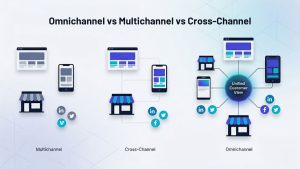
Omnichannel marketing integrates channels, unlike multichannel marketing, where each channel is autonomous, with its own data, communication, and a complete understanding of the customer experience.
Each interaction, whether it is visiting a website, opening a message, or going to a store, is based on the customer’s history and preferences.
The outcome is an experience that flows together, and the brand understands that, and each touchpoint provides context, and decisions are made on the whole picture rather than piecemeal. That is what transforms omnichannel marketing not only into a strategy, but also into an engine of growth of contemporary businesses.
Omnichannel Statistics That Define the Urgency
It is worth basing the discussion on data before identifying certain omnichannel challenges. These omnichannel statistics demonstrate not only how large the opportunity is, but also how wide the gap between theoretical and actual executions is that most companies are experiencing now:
| Metric | Statistic | What It Means |
| Customer retention | Omnichannel brands have an 89% higher retention rate | The payback of resolving the omnichannel dilemma will compound |
| Revenue impact | Customers who are omnichannel are 30% more likely to spend | Resolving these issues directly raises the average order value |
| Execution failure rate | Omnichannel projects miss ROI targets in the first year (55%) | With the appropriate architecture, most failures can be foreseen and avoided |
| Consumer expectations | One underwhelming cross-channel experience causes 73% to switch brands | Customer churn is a cost of inaction, and not an opportunity cost |
| Omnichannel retail statistics | 63% of shoppers examine online inventory before going to stores | Revenue-critical omnichannel challenges include inventory visibility only |
| Mobile influence | Mobile interactions influence in-store purchases by 80% | Lack of connection between mobile and in-store annihilates last moment conversion |
| Data integration | Only 14% of the companies are completely integrated with customer data | The very issue of data fragmentation that this guide is dealing with is exactly what 86% of businesses face |
What these omnichannel marketing statistics tell us?
The disconnect between omnichannel ambition and omnichannel implementation is not a strategy issue – it is an infrastructure, data, and organizational fit issue.
The brands that resolve these underlying issues always perform better than those that invest in channel activation without addressing integration.
It is not that the statistics are merely compelling context, but they are a diagnostic map of precisely where the failures lie.
The 8 Most Common Omnichannel Challenges (With Fixes)
These are the common omnichannel challenges that are recurrent across industries, business sizes, and maturity levels. Both have a diagnosis and a definite solution to the problem, since no one can solve a problem without knowing about it.
Challenge 01 | DATA FRAGMENTATION
Siloed Customer Data: The top reason why Omnichannel is a failure.
This is the most commonly mentioned challenge in omnichannel, and for good reason: it is the root cause of almost all other failures.
When your CRM, e-commerce platform, POS system, marketing automation tool, and support platform each hold their own customer records, you have five versions of the truth that do not quite align.
A customer who has just made a call about a faulty order is offered a promotion for the same product within 2 hours, since the marketing platform itself does not see the support interaction. It is a trust-killer experience.
The Fix:
Install a Customer Data Platform (CDP) or a unified commerce infrastructure that serves as the single source of truth for all customer data. All systems have to read and write to this central layer.
The architecture must be event-based – that is, a support ticket, a purchase, a return, or a browse event in any channel should update the customer profile in real time in all channels at the same time.
Challenge 02 | INVENTORY VISIBILITY
Inventory Blindness Cross Channel Kills Conversions.
One of the most harmful statistics of the omnichannel retail: 63% of consumers search online inventory and visit a store, and 45% drop the purchase altogether when they don’t see what they saw on the site available in the store.
Detached inventory systems result in a lose-lose situation: customers feel cheated, and the business loses a sale it was about to make. This is particularly acute in the context of multi-channel ecommerce and multi-channel retail, where stock is located in warehouses, stores, and fulfillment centers at the same time.
The Fix:
Introduce a centralized Order Management System (OMS) and real-time inventory visibility across all locations and channels. All channels (your site, mobile application, marketplace listings, and in-store POS) need to share the same live inventory feed.
Overselling and availability mismatches, which erode customer credibility, are avoided through safety stock buffers, channel-based allocation policies, and automated reorder signals.
Challenge 03 | ORGANIZATIONAL SILOES
When Teams owns: Channels but not the Customer.
It is also the least considered challenge across all omnichannels, as it is not addressable by technology alone.
Having every department, email team, paid media team, in-store team, and customer service team work toward their respective channel metrics, open rates, ROAS, foot traffic, or time to resolve a ticket, they are all creating a disjointed experience, even in cases where each channel is doing well.
Your email team or your store team does not deal with the customer, as such, but with your brand. Those interactions often accumulate and can go unnoticed in channel-level reporting when they are at odds.
The Fix:
Organize by the stages of the customer lifecycle, not by channel ownership. Form cross-functional teams that would own certain journey phases and be responsible for customer results – not channel results.
Create an Omnichannel Center of Excellence (CoE) to establish common standards, maintain the customer journey map, and ensure cross-channel consistency. Executive sponsorship is a must-have condition, without which omnichannel transformation cannot occur.
Challenge 04 | COMPLEXITY OF TECHNOLOGY INTEGRATION
A Fragmented Tech Stack Becomes an Omnichannel Ceiling.
Most enterprises find their omnichannel issues are fundamentally architectural: old systems that do not support real-time communication, point solutions with no APIs, and technical debt that makes each new integration a costly, bespoke effort.
The typical company has 91 marketing tools. Where such tools do not interchange data, the omnichannel promise needs manual intervention always – and that creates delays and errors, and the very gaps in context that create a sense of a disjointed customer experience.
The Fix:
Check the compatibility of your existing tech stack with the new acquisition. Give precedence to platforms with solid APIs, ready-made connectors, and real-time data sharing.
In scenarios where replacing legacy systems is not possible, a middleware layer (iPaaS) should be used to establish two-way data flows.
For companies, selecting a marketplace developer such as SPXCommerce that provides an integrated commerce platform initially eliminates the need to integrate individual systems that serve channel-specific functions.
Challenge 05 | PERSONALIZATION AT SCALE
Personalization That Purports to be personalized is worse than none at all.
86% of consumers report that personalization determines whether they buy a product. Yet two-thirds of them are irritated by personalization that misses the mark -suggesting a product they have already bought, offering deals that are not sensitive to their price, or addressing them with formality in one medium and informality in another.
The problem with omnichannel marketing and personalization is not content but the timing of data. The personalization would never be in sync with customer behavior without a real-time, unified profile; it sometimes lags by days.
The Fix:
Personalization should be built on a live behavioral data stream rather than a daily data update. The customer profile should refresh within minutes of any meaningful interaction in any channel.
Introduce AI-based recommendation tools, which are based on all purchase, browse, and engagement history – not only the last session. Use frequency capping and cross-channel suppression to avoid over-messaging, which is like stalking instead of service.
Challenge 06 | CONSISTENT BRAND EXPERIENCE
Inconsistency Wastes Trust More Quickly Than a Competitor.
A customer who has viewed an Instagram advertisement offering a 20% discount goes to your site to use the offer and sees the identical product at its usual price has just encountered one of the most corrosive omnichannel failures: brand inconsistency.
This occurs when channels are operated by different teams using different tools, and there is no shared governance layer.
Pricing, promotions, tone of voice, visual identity, and customer commitments should be consistent across the board, not only in the brand style guide, but in the actual working reality of each customer contact.
The Fix:
Develop a cross-channel brand governance structure addressing pricing regulations, cross-channel promotional eligibility, content standards, and customer promise standards.
Introduce automated notifications of pricing differences across channels. Adopt a centralized Digital Asset Management (DAM) system to ensure all teams use approved assets.
To marketplace operators, impose brand-level requirements at the vendor contract level – your brand is no more consistent than the least-consistent seller.
Why Omnichannel Fails: The Root Cause Map
It is necessary to look beyond the symptoms to the root cause to understand the reasons why omnichannel implementations fail. The majority of patterns of failure can be linked to one of five root causes:
| Root Cause | Common Symptom | Failure Pattern |
| Data architecture failure | Isolated customer profiles, sluggish personalization | Channels have no commonality in context; each interaction begins afresh |
| Technology debt | Slowness in integrations, data pipelines are brittle, and sync errors are frequent | This halts innovation because each new capability would have to be custom-built at a high cost |
| Organizational misalignment | Channel teams are self-optimizing; no collective journey ownership | Satisfactory individual channel performance covers a bad overall customer experience |
| Insufficient executive commitment | Omnichannel as a marketing program, not a company change | Cross-functional change that marketing cannot generate on its own slows down projects |
| Measurement failure | Last-click attribution; no channel customer lifetime value tracking | Budget is channeled in the wrong areas; investment at the top of the funnel was defunded gradually, even though it brought most of the revenue |
Omnichannel Mistakes to Avoid
In addition to the eight key Challenges of omnichannel marketing, these are the particular omnichannel mistakes to avoid – tactical errors that persist in every implementation that are directionally correct and operationally flawed:
1. Enabling channels preceding data consolidation
The most costly error in omnichannel. Creating channels for fragmented data means each personalization effort is partial, each attribution report is deceptive, and each customer support interaction is not contextualized. First, fix the data architecture.
2. Getting multichannel presence and omnichannel integration mixed up
Presence in ten channels is not omnichannel. Omnichannel demands that such platforms exchange data and context. Brands that confuse channel quantity with omnichannel maturity will always fail customers, even when channel investment is high.
3. Omnichannel as a project instead of a company change
The channels can be activated through marketing. It is only through executive leadership, where IT, operations, and finance are aligned, that the data architecture, organizational structure, and measurement systems that omnichannel actually needs may transform.
4. Failing to pay attention to the in-store experience in a digital-first strategy
Two-thirds of buying experiences include both digital and physical interactions. The omnichannel retail statistics continue to show that physical store experiences, when combined with digital data, are consistently superior to both channels. Do not underinvest in the physical aspect of omnichannel.
5. Personalizing too soon before getting the right to
Intrusive personalization can harm the brand relationship it is meant to strengthen, such as using information the customer did not explicitly provide or referencing a conversation from several months ago in an unexpected context. Build trust gradually, and ensure personalization stays within the customer’s comfort zone.
6. Omnichannel construction without scale construction
Most companies develop their original omnichannel implementation to address current complexity, only to find it unable to support expansion, new channels, or global expansion. Develop with triple the size in mind.
Omnichannel Statistics and Trends in 2026
Three macro forces shape the landscape of omnichannel trends 2026. According to the data on the omnichannel statistics and trends, this is what the bar is heading towards:
1. AI-Powered Personalization
Real-time AI personalization is no longer the preserve of the enterprise but is now available to mid-market brands. In 2026, 76% of customer interactions will incorporate some form of AI-based personalization. Those brands that do not invest in this capability now will have a quantifiable conversion divide.
2. Zero-Party Data Priority
With the demise of third-party cookies, brands will have to collect data directly from customers through preference centers, quizzes, and interactive content. Zero-party data strategies are going to be an omnichannel issue that needs to be addressed instead of a perk.
3. Social Commerce Maturation
The TikTok Shop, Instagram Shopping, and buyable pins on Pinterest are becoming awareness platforms for purchase. The brands should not consider social commerce inventory and order data as a separate experiment and integrate it into the omnichannel infrastructure.
4. Unified Commerce Platforms
The move toward unified commerce platforms is sped up through 2026. The trend directly responds to the technology integration issues described in this guide.
5. Voice and Conversational Commerce
40% of product searches are affected by voice search. WhatsApp, Messenger, and integrated chat are becoming a source of revenue. Architectures of omnichannels designed in 2025-2026 should support conversational touchpoints without modification.
6. Omnichannel Retail Statistics: Physically Revived
Post-2024 omnichannel retail data indicate that physical retail returns rates are returning to their pre-pandemic levels, and BOPIS and curbside pickup are here to stay. Those brands that failed to tie together digital and physical platforms during the pandemic are re-establishing it as a strategic priority.
How Successful Brands Solved Their Omnichannel Challenges
Real-life examples explain how the solution of omnichannel challenges is in the real world. The following are examples of particular challenges and the architectural solutions to them:
NIKE: Solving Data Fragmentation and Attribution
The transformation of Nike into an omnichannel began with a decision in data architecture: the NikePlus membership program served as the identity layer across all channels.
Whenever a member makes a purchase in-store, opens up the app, or participates in a social campaign, the behavior is attributed to a single profile.
Nike is now able to visualize the entire customer experience, such as social impression to app usage, and in-store purchase, and is able to accurately attribute revenue to each touchpoint.
The outcome: Nike Direct-to-consumer sales increased by 40%+ in response to the change, made possible by the ability to respond to unified customer information in real time.
NYKAA: Resolving Inventory and Brand Consistency at Scale
The main challenge faced by Nykaa as an omnichannel brand was ensuring a consistent brand experience and accurate inventory across the website, mobile app, and its expanding network of physical stores.
The answer was a centralized OMS that provided all the channels with access to the same live inventory feed, both digital and physical.
Online customers who checked a product’s availability and visited a store found correct information 96%+ of the time.
The centralized content management system was used to maintain brand consistency by pushing product-approved content to all channels simultaneously.
The combination of these two fixes saw Nykaa increase its Net Promoter Score by 18 months from 48 to 71.
The Fix Framework: Step-by-step Recovery Plan
Being new or having an unsuccessful experience with an omnichannel initiative, this step-by-step framework can answer the question of why omnichannel implementation fails at any given stage and offers you the precise measures to take so that the failures do not happen again:
1. Before You Build Diagnose.
Evaluate your present condition in five dimensions: data architecture, technology integration, organizational structure, measurement, and channel consistency. Rate each dimension on a truthful basis. The audit will inform you where to invest first.
2. Fix the Database First
Determine what your customer identity resolution strategy is – How are you going to associate a customer app session, email open, in-store visit, and support ticket with a single profile? Consider CDP solutions or integrated commerce platforms with this built in.
This is an action that should not be delayed or avoided. All the other omnichannel capabilities rely on it. Spend 30-40% of your total investment in data infrastructure on the omnichannel within the first 12 months.
3. Consolidate Inventory and Order Management
Install a centralized OMS that has real-time inventory information across everything and everywhere. Specify your channel-based inventory allocation. Set the safety stock buffers to avoid overselling.
Test inventory accuracy across channels with a formal QA procedure before going live. For marketplace operators, it is a requirement for platform participation that vendors maintain real-time inventory feeds.
4. Reorganize Customer Journey
Form cross-functional customer lifecycle ownership. Create cross-channel KPIs that go beyond channel performance, customer lifetime value, cross-channel conversion rates, and cross-channel journey completion rates.
Select an executive sponsor of omnichannel transformation. Establish a Center of Excellence that controls standards, oversees the customer journey map, and has cross-channel consistency. Retrain channel employees on contributing to a journey, not channels alone.
5. Implement Multi-Touch Attribution
Implement an attribution model based on data or time decay, which credits all the touch points within the conversion path.
Integrate your CDP with your analytics platform to add offline interactions to attribution. Start recording CLV by acquisition channel as well as regular channel performance indicators.
Rely on attribution data to make quarterly budget reallocation decisions as opposed to falling back on historical patterns of channel spending.
6. Activation of Channels Incrementally Before Scaling.
After you have this data and measurement infrastructure, you can turn channels on in priority order, beginning with those that your most valuable customers rely on the most.
Test each new channel as an incremental control: compare true lift with a hold-out group and then scale spend. This method helps to avoid the most frequent error of scaling channels that may seem to work better in isolation but cannibalize more valuable channels when they are evaluated correctly.
How SPXCommerce Helps You Overcome These Challenges at the Infrastructure Level?
We address the challenges in the omnichannel by addressing the root causes rather than adding additional tools. Our platform consolidates the customer data, inventory, orders, vendors, and analytics into one system, which is real-time, eliminating fragmentation.
Each interaction is recorded in a single live customer profile, allowing accurate personalization and consistent experiences across channels. Our in-built order and inventory system provides real-time visibility so that there is no mismatch in stock and lost sales.
We can minimize technical debt by swapping multi-tool stacks with a single, integrated infrastructure and removing expensive integrations. Teams work with common data and metrics and are centered around the customer, not channels.
Scaled at the beginning, SPXCommerce enables growth without re-architecture, transforming omnichannel into a seamless, high-performance engine of growth.
Conclusion
Overcoming omnichannel challenges does not imply being everywhere but rather being connected everywhere. The brands that triumph are not the ones that open up the highest number of channels, but rather those that develop the greatest base under them. Having a single view of data, combined with integrating systems and aligning teams towards the customer, rather than channels, all other aspects are exponentially more effective.
The fact of the matter is that the majority of omnichannel failures are foreseeable as they are caused by the same underlying factors: poor data integration, unconnected technology, and decision-making in silos. Mend those, and you are not only enhancing customer experience but also achieving quantifiable retention, conversion, and lifetime value growth.
The customer expectations are ever-increasing, and therefore, there is no room to play with. A single failed touch can spoil a decade of good ones. However, the chance is equally great: those brands that master the omnichannel correctly provide the experience that seems to be effortless, intuitive, and trustworthy, and those are the brands that customers come back to.
The way is evident. Diagnose sincerely, mend the premises, and scale deliberately. Omnichannel is not a campaign or ability; it is a model of operating. When it is constructed properly, it can cease to be a difficulty to manage, and it can be a competitive advantage that you can compound.