Customers today have a variety of ways to touch the brand, such as social media, email, mobile applications, websites, and stores. Nevertheless, many companies continue to treat each channel as an individual campaign. This usually causes confusion, missed opportunities, and lost marketing budgets.
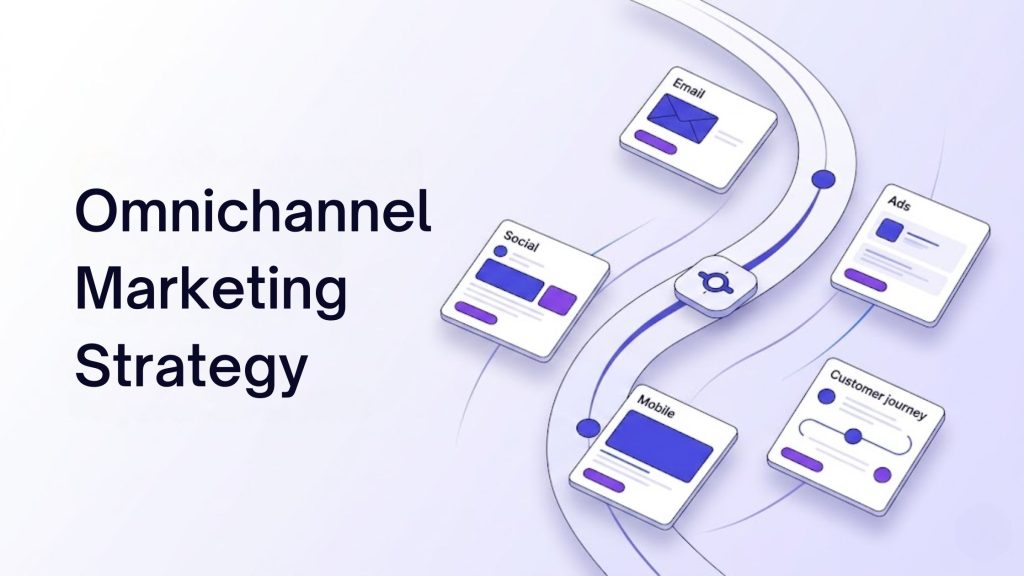
This can be solved through an omnichannel marketing strategy that integrates all the touchpoints into a unified experience. Being on numerous platforms is not enough, but coordinating them is. Each stage, from the initial advertisement to after-sales support, becomes part of a personalized, interrelated experience.
The advantages are obvious. Strong omnichannel strategies result in improved conversion rates, customer retention, and efficient marketing by brands. When you connect data, personalize messages, and coordinate channels, businesses will be able to transform disjointed efforts into genuine growth.
This guide will step-by-step explain how to build an omnichannel marketing strategy, starting with understanding your customers, selecting the right channel, managing channels, and measuring results. This playbook provides the framework to build seamless customer experiences and achieve real business outcomes, whether you are new or ready to grow.
What Is Omnichannel Marketing?
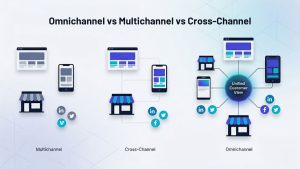
Omnichannel marketing puts the customer at the center by providing a seamless, integrated experience across online and offline channels. Unlike traditional multichannel marketing, where channels are independent of one another, omnichannel marketing ensures that all interactions are interconnected and consistent, wherever the customer may be.
Consider it in the following manner, like multichannel marketing is a choir with sections singing separately. Omnichannel marketing is the same choir singing in perfect harmony. The contrast is strong and vivid.
What Is an Omnichannel Marketing Strategy?
An omnichannel marketing strategy is a plan in which omnichannel marketing is implemented. It gives all customer touchpoints a single, clear journey, so each touchpoint knows the data, maintains context, and sends information to the customer based on the stage of the buying process they are in.
Integration is the key, rather than being available on numerous channels. An omnichannel strategy will unify channels to ensure that each message, suggestion, and experience will assist the customer in moving through the path.
Omnichannel vs. Multichannel Marketing
And now we can dive into the framework of the omnichannel strategy, but it is essential to understand what makes omnichannel a step beyond older methods and why that difference is relevant to your marketing.
| Dimension | Multichannel Marketing | Omnichannel Marketing |
|---|---|---|
| Core Focus | Channel reach and presence | Customer journey continuity |
| Data Architecture | Siloed per channel | Unified, shared customer profile |
| Messaging | Consistent brand tone, inconsistent context | Context-aware, journey-stage relevant |
| Personalization | Basic (name, segment) | Deep (behavior, history, intent) |
| Channel Relationship | Independent, parallel | Interdependent, sequential |
| Attribution | Last-click or single-channel | Multi-touch, cross-channel |
| Customer Effort | High context resets each channel | Low context carries seamlessly |
| ROI Visibility | Per-channel metrics only | Full journey ROI |
The Omnichannel Strategy Framework
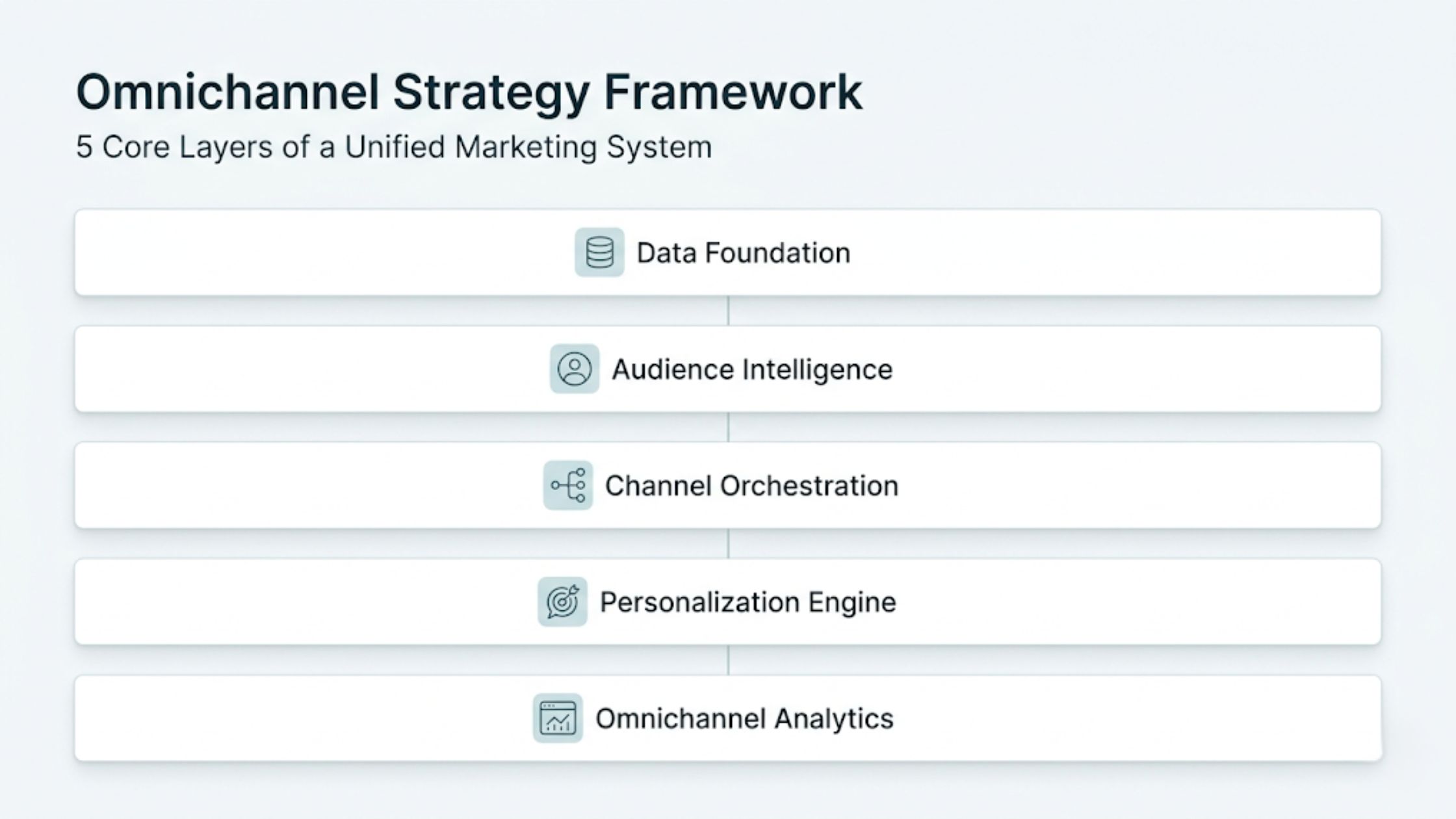
A good omnichannel strategy is developed in layers. Being aware of these layers helps you identify gaps in your existing strategy and determine what to focus on when developing or enhancing it. The following is the 5-layer omnichannel strategy model:
LAYER 1 – DATA FOUNDATION
It is based on a single Customer Data Platform (CDP), CRM integration, behavioral tracking, and identity resolution across all touchpoints. The other part of the strategy will not be effective without this foundation.
LAYER 2 – AUDIENCE INTELLIGENCE
This layer comprises segmentation, persona development, journey mapping, and predictive behavioral modeling. It transforms raw data into helpful information on your customers.
LAYER 3 – CHANNEL ORCHESTRATION
The distribution channels, such as email, SMS, push notifications, paid social, SEO, in-store, and marketplace, are coordinated by a central automation system. This system transmits messages depending on the customer behavior rather than fixed schedules.
LAYER 4 – PERSONALIZATION ENGINE
This layer leverages dynamic content, product recommendations, custom offers, and messages that respond to customer real-time behavior and the historical behavior of each customer across all channels.
LAYER 5 – OMNICHANNEL ANALYTICS
This layer includes cross-channel attribution, customer lifetime value analysis, customer journey analysis, and reporting that connects marketing efforts to revenue across the customer journey.
The layers are layered on top of each other. Without a proper data foundation (Layer 1), the results of any business effort to personalize (Layer 4) will not be effective. An omnichannel strategy requires all five layers to collaborate.
Step-by-Step Omnichannel Strategy Playbook
It is time to implement the strategy now. The following step-by-step guide to an omnichannel strategy is applicable to a business on any level
Step 01: Audit Your Existing Channels and Customer Touchpoints
Chart what you already know before you start to build. Name all the channels that your customers will use your website, app, email, SMS, social media, live chat, physical venues, and marketplaces. Record the data captured, the systems holding the data, and the availability of the data to other channels. This audit will show you the gaps in your integration to date and where your customer experience falls short.
Step 02: Build Unified Customer Profiles (The CDP Layer)
Your strategy has a backbone in the form of a Customer Data Platform (CDP) or a similar unified data layer. It consolidates identity, behavioral, transactional, and preference data across all channels into a single enduring customer record. Once one of your customers who clicked an email yesterday visits your site today, your CDP knows, and your entire marketing stack reacts.
Step 03: Map the Full Customer Journey All Stages, All Channels
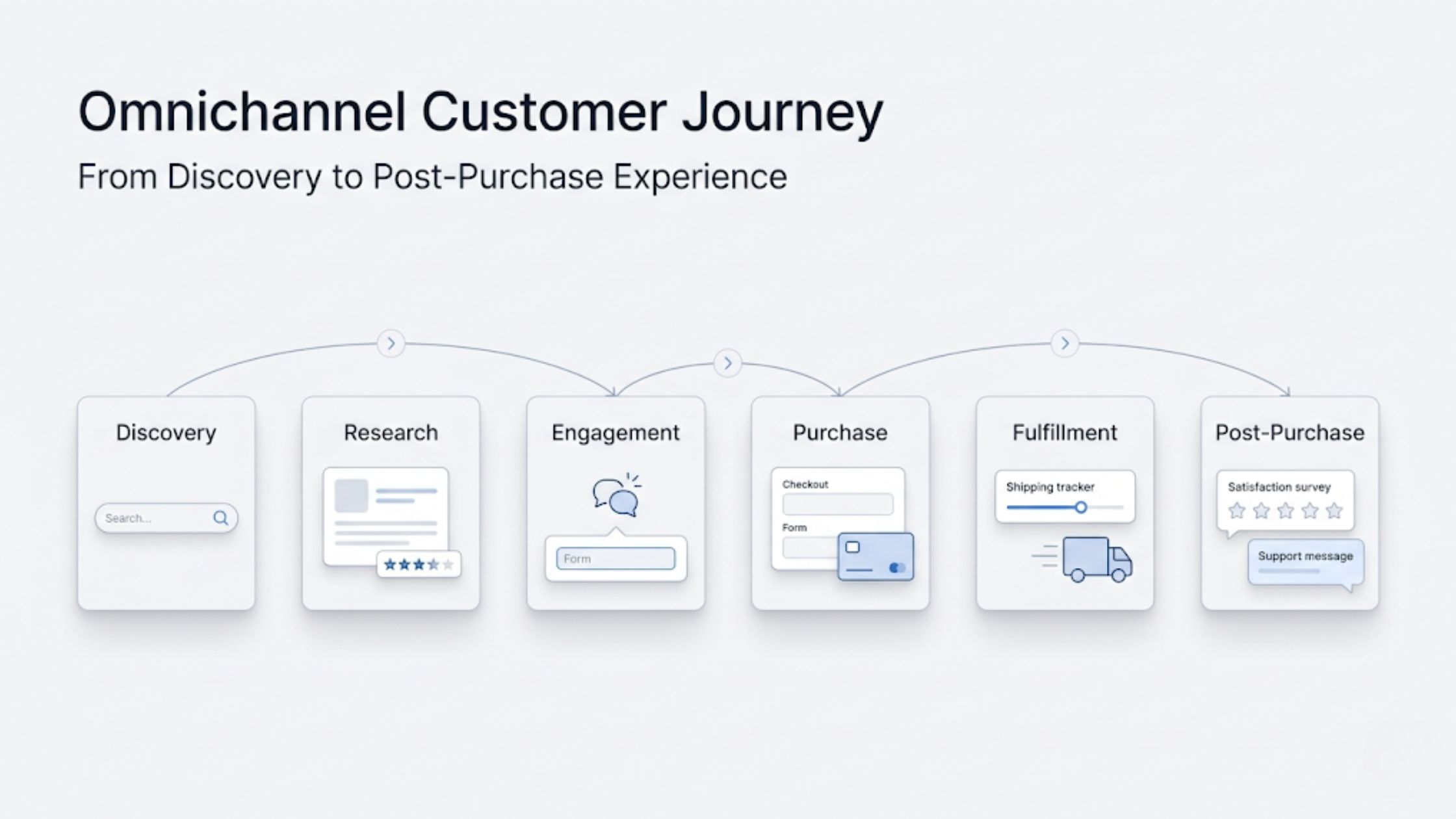
An omnichannel strategy, Customer journey mapping is more than a funnel. You should record achievable journeys: discovery through social → desktop research: cart abandonment => retargeting => purchase on mobile: post-purchase support: chat. There are timing, intent, and message requirements unique to each route.
Step 04: Define Consistent Brand Voice and Messaging Across All Channels
The tone in which you speak, the words you use, the visual language, and your positioning of values must be consistent regardless of whether a customer has engaged with you on TikTok, via a transactional email, on your product page, or through a support agent. Produce a cross-channel content and messaging guide that is used by each team and channel.
Step 05: Build Segmentation and Behavioral Triggers
Successful omnichannel marketing is not calendar-based but behavior-oriented marketing. Instead of mass sending, you can establish behavioral triggers: a cart abandonment can trigger a personalized email in an hour; a high-value customer who has not made a purchase in 60 days can receive a win-back SMS; a customer who has looked at a product three times can receive a targeted retargeting ad.
Step 06: Orchestrate Channels Don’t Just Activate Them
Channel orchestration refers to the active control of the channels fired, in what order, and with what message, as a result of customer behavior and stage. A converting customer on email should not be retargeted in real time. When a customer calls support, they must be sent a follow-up survey, not another promotional SMS. This organization needs a marketing automation platform that links to its single data layer.
Step 07: Personalize at Scale Using AI and Dynamic Content
Manual personalization cannot be done on scale. The recommendation engines that are powered by AI, dynamic email content, predictive product suggestions, and personalized landing pages can enable you to offer a personalized experience to thousands of customers at the same time. In a complete omnichannel approach, personalization means displaying the appropriate product, at the appropriate price, through the appropriate channel at the time of maximum purchase intention.
Step 08: Measure with Cross-Channel Attribution and Omnichannel Analytics
Omnichannel cannot be done with standard channel analytics. You require multi-touch attribution models, which assign credit to all channels that influenced a conversion, customer lifetime value metrics by channel mix, and multi-session, multi-device funnel analysis. This is the self-improving omnichannel analytics layer.
Real-World Omnichannel Marketing Examples
These concepts are understood with examples. The following are examples of real-world omnichannel marketing by brands that have successfully done so:
SEPHORA BEAUTY RETAIL
Sephora has a loyalty program, Beauty Insider, which connects purchases in stores, the application, and e-commerce into a single customer profile. When the customer tries a product sample in store, the app and email recommendations update immediately. The Color IQ tool helps customers identify the foundation they match in-store and purchase online later. Consequently, omnichannel customers at Sephora spend 15-30% more than one-channel customers.
DISNEY ENTERTAINMENT & PARKS
The My Disney Experience app is an excellent example of omnichannel marketing by Disney. Visitors book their stay online, make reservations through the app in the park, receive personalized push notifications depending on their location, and receive follow-up emails with photos and offers after their visit. All digital, physical, and post-visit interactions are linked to a single customer profile.
NIKE D2C OMNICHANNEL
The Nike app, NikePlus membership, and retail stores are all linked through the Nike omnichannel marketing. Members are rewarded online and in stores. The application allows the customer to access scan-to-learn features in shops. The app sends personalized product releases and early-access offers based on each person’s sports preferences. This strategy contributed to a more than 40% increase in direct-to-consumer revenue at Nike.
Omnichannel Analytics: Measuring What Matters
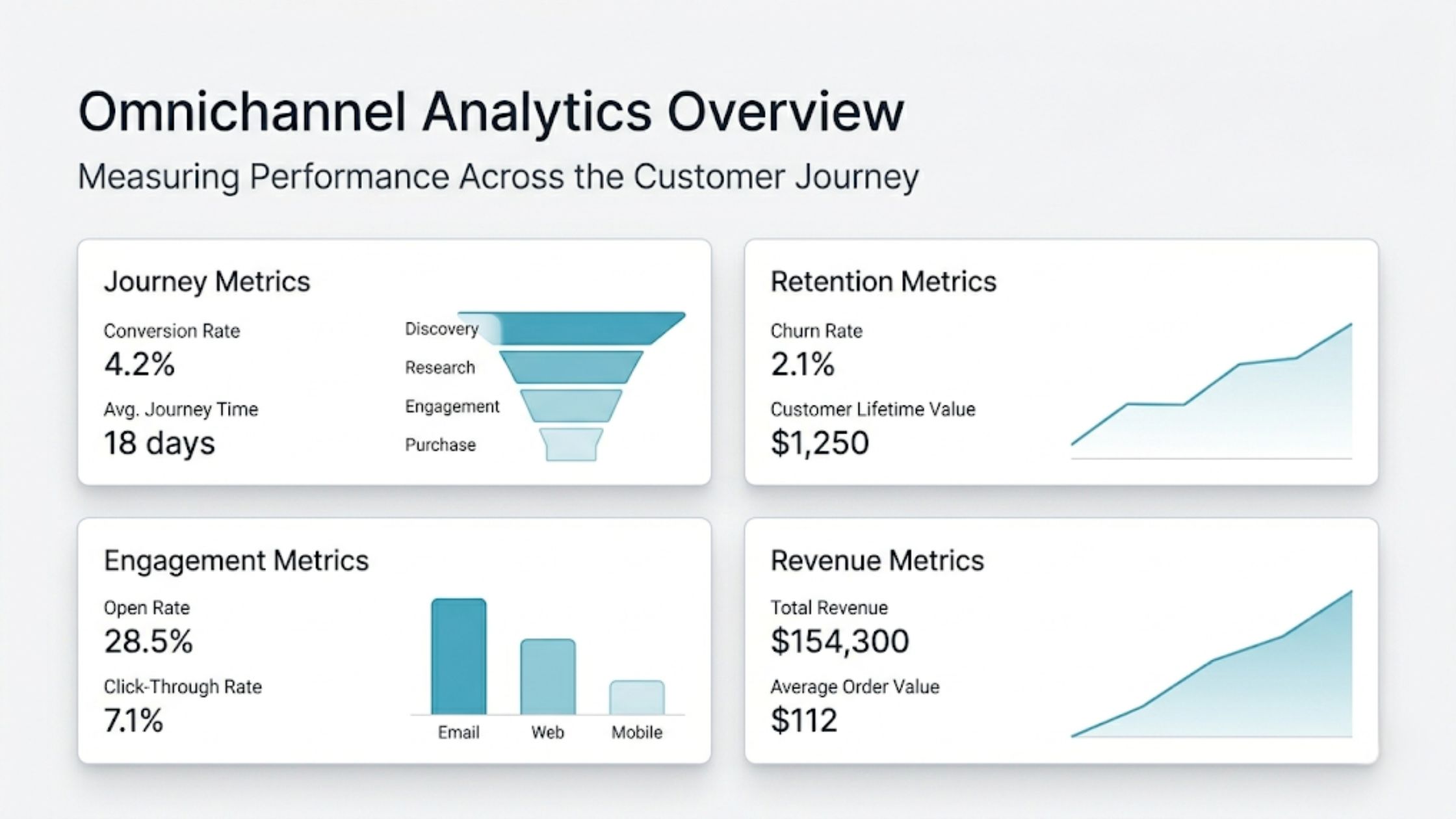
Omnichannel analytics is defined as a measurement of the entire customer experience across all channels and the connection of those measurements to business outcomes. In its absence, you may witness metrics such as increased email opens and, in many instances, a general loss of revenue, as one channel cannibalizes the higher-intent traffic of another.
A fully grown omnichannel analytics system monitors performance in four distinct categories:
1. Journey Metrics
These are indicators of customer flow through your funnel and engagement with various touchpoints:
- Cross-channel conversion rate
- Time to first purchase by channel path
- Stage drop-off of the journey.
- Multi-touch attribution weight
2. Retention Metrics
Retention indicators are concerned with retaining customers and making them loyal:
- Customer Lifetime Value (CLV)
- Channel mix repeat purchase rate.
- Churn prediction score
- Win-back campaign ROI
3. Engagement Metrics
These demonstrate the way your customers are engaging with your brand on channels:
- Cross-channel engagement score
- Segment channel affinity.
- Message fatigue indicators
- Channel Net Promoter Score (NPS)
4. Revenue Metrics
Marketing activity is directly linked to business outcomes:
- Channel sequence revenue per customer.
- Revenue per campaign incremental.
- Marketing-influenced pipeline
- Cross-channel mix Return on Ad Spend (ROAS)
Through monitoring all these metrics, a business can have a more holistic picture of performance, friction points in the customer journey, and is better able to optimize marketing spend across channels.
⚠ COMMON OMNICHANNEL ANALYTICS MISTAKE
The attribution of last-clicks in a multi-channel setting is a gross underestimation of your investments at the top of the funnel, and your channel budgeting choices. Invest in data-driven, linear, or time-decay multi-touch attribution models that capture the entire journey. When a customer viewed your social advertisement, retargeting banner, received an email promotion, and converted using direct visit last-click credits, only the direct visit is credited.
The Omnichannel Analytics Stack
An operational omnichannel analytics stack combines your CDP, marketing automation platform, e-commerce or marketplace platform, and a layer of business intelligence (BI). The aim is to have a single dashboard where you can track revenue back to the exact sequence of channels that generated it, regardless of the number of touchpoints used.
Choosing the Right Omnichannel Platform
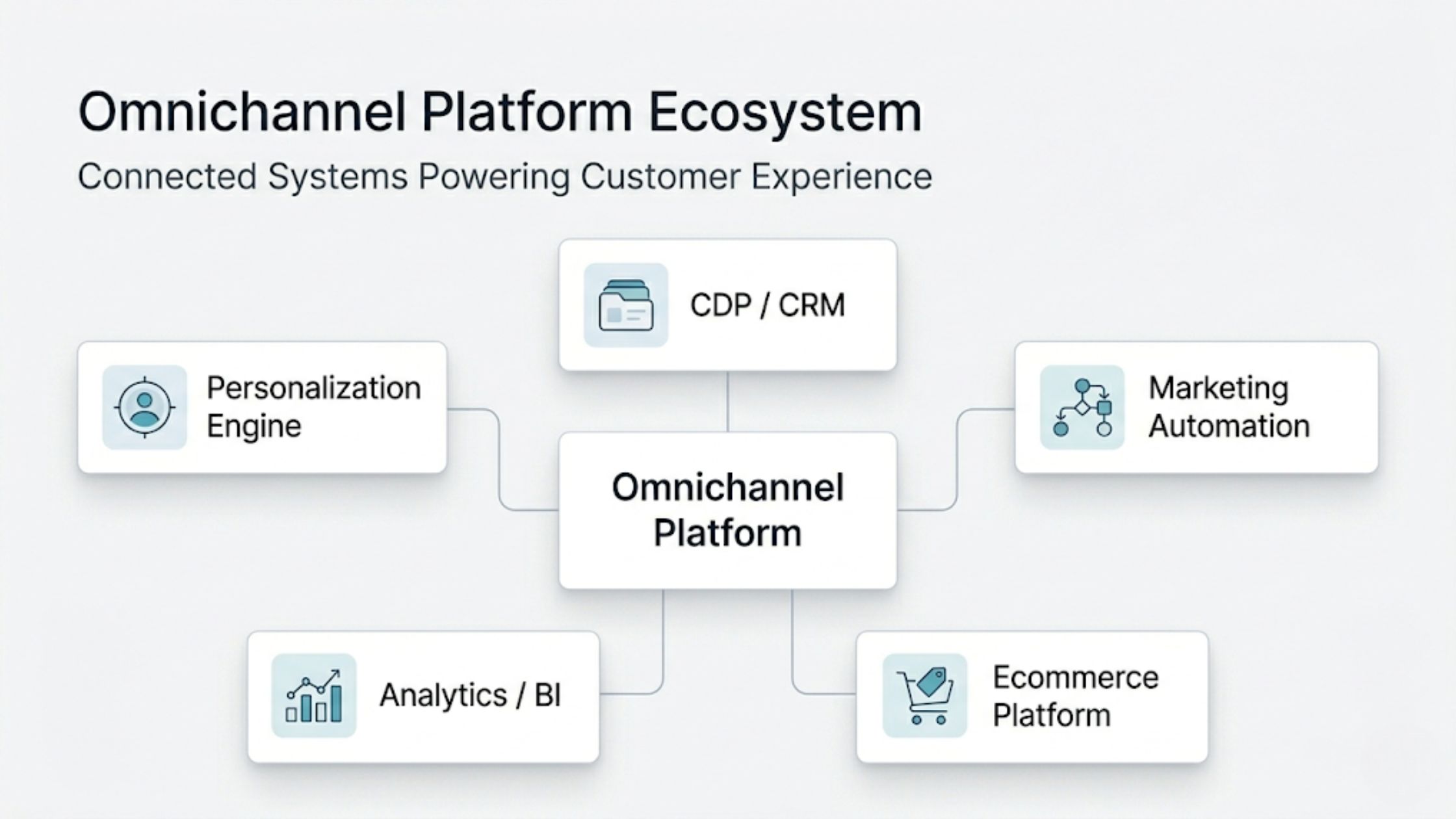
An omnichannel platform is a technology platform that helps your strategy unify data, coordinate channels, automate processes, and enable analytics. The right one determines what is possible by choosing the right one.
What to Look for in an Omnichannel Platform?
- Native CDP or CRM integration: The platform should be able to combine customer data in real time, not to combine it in batch syncs.
- Multi-channel activation: One interface allows email, SMS, push, paid ads, and in-app messaging to be managed.
- Behavioral trigger logic: The capability to configure event-based, complex automation without using developer resources.
- Cross-channel suppression and frequency controls: avoid over-messaging, and this kills customer relationships most quickly.
- AI-driven personalization: Adaptable content that changes depending on real-time behavioral indicators.
- Multi-touch attribution reporting: Displaying channel contribution based on the entire journey, not just on last-click.
- Integration with commerce and marketplaces: Marketplace business is particularly sensitive when information about vendors, buyers, and products must flow into the marketing layer smoothly.
Leading Omnichannel Platform Categories
| CUSTOMER DATA PLATFORMS
Segment, Tealium, mParticle, Bloomreach |
MARKETING AUTOMATION
MoEngage, Braze, Klaviyo, HubSpot |
E-COMMERCE & MARKETPLACE
SPXCommerce, Shopify Plus, Salesforce Commerce |
| ANALYTICS & ATTRIBUTION
GA4, Northbeam, Rockerbox, Looker |
PERSONALIZATION ENGINES
Dynamic Yield, Nosto, Yotpo |
LOYALTY & RETENTION
Talon.One, LoyaltyLion, Smile.io |
Best Practices for Omnichannel Marketing
To execute an omnichannel marketing strategy successfully, discipline is needed across technology, content, and team structure.
1. Design for the Customer, Not the Channel Team
The top killer of omnichannel strategies is organizational siloes. When your email, paid media, and in-store teams work in isolation, they will maximize individually, and the customer experience will suffer. Redesign around customer lifecycle phases and set up cross-channel governance, focusing on journey coherence and not channel metrics.
2. Unify Before You Personalize
Most brands are moving to AI personalization without having data consolidated. The outcome is personalization that lacks product recommendations on what the customer has recently purchased, and messages that do not take into account previous support contacts. Build your database, and then personalization quality is directly proportional to data completeness.
3. Test Channel Sequences, Not Just Creatives
Does email → SMS outperform SMS → push? Is a 3-touch sequence better than a five-touch sequence in your mid-funnel segment? The improvements that are compounded over time with journey-level A/B testing cannot be achieved with creative testing.
4. Respect the Channel’s Context
Social contracts are found in different channels. An SMS ought to be short, urgent, and of high value, as it enters the personal space of an individual. An email can be more informative. A push notification has a few seconds to capture attention. Your omnichannel strategy should adjust messaging formats to each channel’s norms, not copy-paste across channels.
5. Build Suppression Logic Before Scaling
The more channels you switch on, the more you run the risk of over-messaging. Capping frequency and cross-channel frequency: day one: recent buyers should not be shown acquisition ads; customers who have recently opened your email should not receive the same SMS the same day. Poor suppression logic erodes trust faster than nearly any other omnichannel error.
6. Treat Post-Purchase as a Marketing Channel
The post purchase stage confirmation of the order, shipping confirmation, delivery confirmation, product onboarding, review requests, and reorder request is usually overlooked. However, this is where customer loyalty is gained or lost. A carefully planned after-sales experience boosts repeat purchase rates by 30-50% and elicits additional reviews, recommendations, and higher CLV.
Build a Customized Marketplace and Drive Omnichannel Growth with SPXCommerce
We give you the power to build a marketplace that is truly your brand and fulfilling for your customers at SPXCommerce. You can build a completely customized marketplace with flexible product catalogs, multi-vendor management, and custom workflows using our platform. It allows you to easily control vendors, automate inventory and payouts, and ensure a cohesive brand experience between storefronts and checkout pages.
However, a marketplace is not just a collection of listings but rather a platform that provides customers with unique experiences. That is why we incorporate omnichannel marketing into your marketplace. We combine customer data, monitor channel interactions, and automatically send emails, SMS, push notifications, and promotions. Recommendations powered by AI and dynamic content ensure each customer sees relevant offers, while analytics and multi-touch attribution tie marketing activities directly to revenue.
Using SPXCommerce, your marketplace is an intelligent ecosystem where all vendors, customers, and marketing touchpoints collaborate to accelerate your business growth and deliver quantifiable outcomes.
Conclusion
In a modern, highly-connected environment, customers demand seamless, personalized, and consistent experiences across all touchpoints. The omnichannel marketing approach is no longer a luxury, but a necessity for brands that aim to achieve growth, loyalty, and ROI. The process of consolidating customer data, mapping customer journeys across every channel, orchestrating interactions intelligently, and leveraging AI-driven personalization can transform fragmented marketing efforts into a unified, revenue-driving engine.
The path towards omnichannel success requires careful planning, execution, and measurement. Whether it is building a strong database or learning to cross-channel orchestrate and analyze, each layer of the strategy will help create a customer experience that is seamless yet highly personalized. The brands that adopt this strategy, whether in retail, entertainment, or marketplaces, experience greater interaction, higher conversion rates, and greater customer retention.
The final aspect of omnichannel marketing is the customer-focused approach in all decisions. By basing your strategy on how individuals engage with your brand across devices, channels, and moments, you not only sell products or services but also create experiences that will be felt, connect, and expand your business in a sustainable way.