You have a customer browsing your site on their phone. They add three items to their cart, but get distracted and leave.
The next day, they visit your physical store, but the salesperson has no idea what they are interested in. Later, they received an email promoting a product they had already bought last week. Frustrated, they walk away.
This is the fundamental issue of disconnected commerce: each channel operates in isolation, each with its own data, its own messages, its own image of the customer. The outcome is a strained relationship, and a strained relationship costs businesses revenue, loyalty, and trust.
Omnichannel solves this by unifying every customer touchpoint online, offline, mobile, and in-person into a single, coherent experience. The customer will be recognised wherever s/he appears. Their trip does not stop, no matter what channel they go to next.
In this complete beginner’s guide, we break down exactly what omnichannel means, how it differs from multichannel, and its key components, giving businesses the infrastructure to execute it without building a complex integration stack from scratch.
What Does Omnichannel Mean?
Omnichannel is a customer experience strategy that integrates every sales and communication channel, physical stores, websites, mobile apps, social media, email, and more into one unified, data-connected system, so that a customer’s journey is consistent, personalised, and uninterrupted regardless of which channel they use.
The name itself is of the Latin omni (all) and channel to work together as a channel. But the omnichannel meaning goes deeper than just being present everywhere. It implies that each channel knows what transpired in all the other channels.
The omnichannel definition hinges on three pillars:
- Integration: Channels are directly interconnected, and they exchange data on the fly.
- Continuity: No channel reset, no friction. The customer journey is carried through channels.
- Personalisation: Every interaction is based on the customer’s entire history and preferences.
The Key Differences Between Omnichannel vs. Multichannel
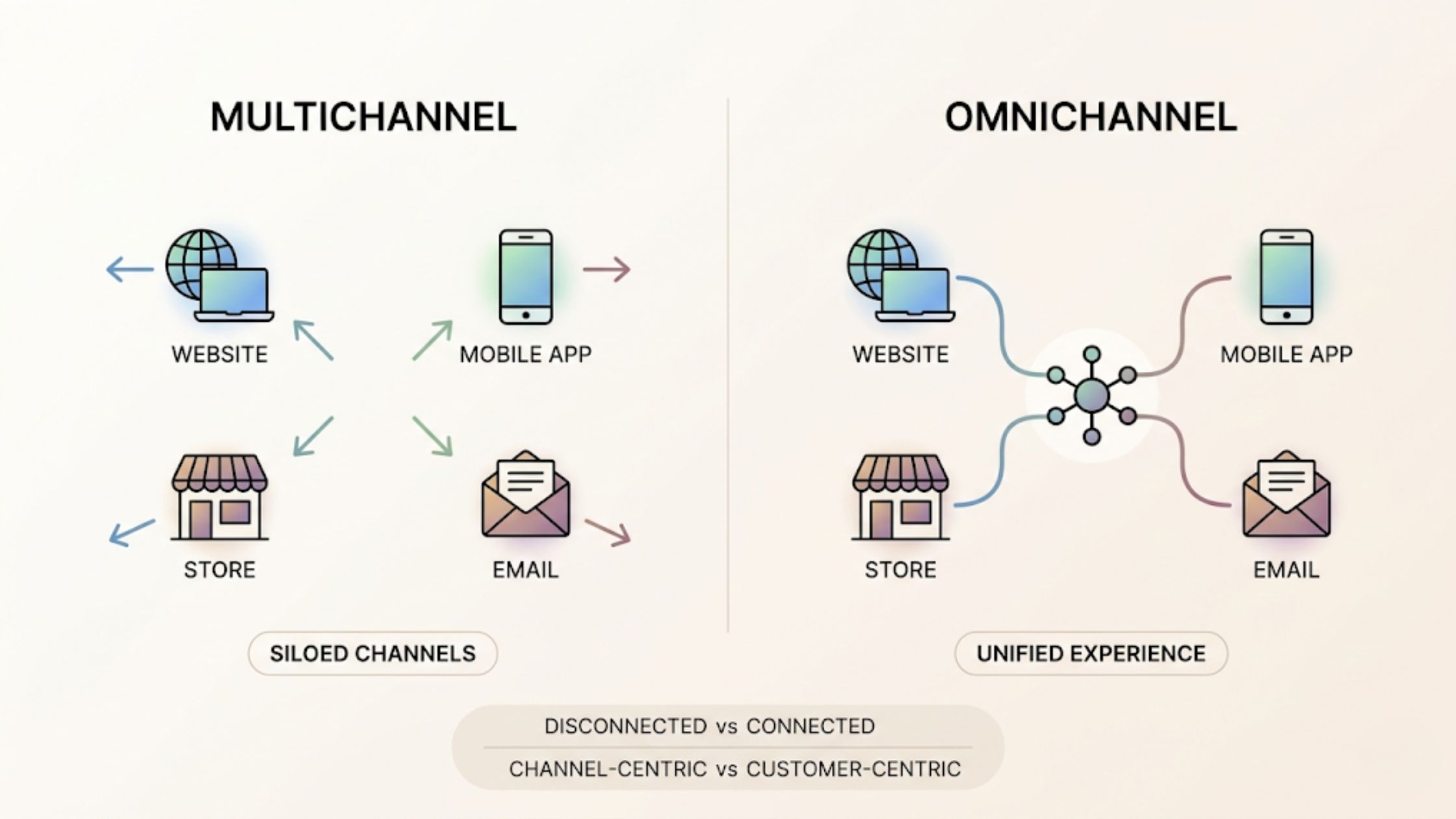
The most common source of confusion in this space is the difference between omnichannel and multichannel. They resemble each other and share common features, yet they are different philosophies at their essence.
Multichannel refers to the existence in many channels. You own your site, an Instagram page, a real-world store, and an email list. Each works. Nonetheless, they do not collaborate frequently with different information or messages, and they are unaware of others.
Omnichannel means those same channels are unified. Email will be aware of what the customer was viewing on the app. In-store employees can view online purchases. The entire history of all past interactions is available to your chatbot.
The table below captures the defining differences:
| Feature | Multichannel | Omnichannel |
|---|---|---|
| Customer focus | Channel-centric | Customer-centric |
| Data sharing | Siloed per channel | Unified data layer |
| Experience | Consistent per channel | Seamless across all |
| Personalization | Limited | Deep & real-time |
| Messaging | May repeat/conflict | One coherent voice |
| Integration | Loosely connected | Tightly integrated |
| Goal | Reach more channels | One frictionless journey |
Layers of Omnichannel Architecture
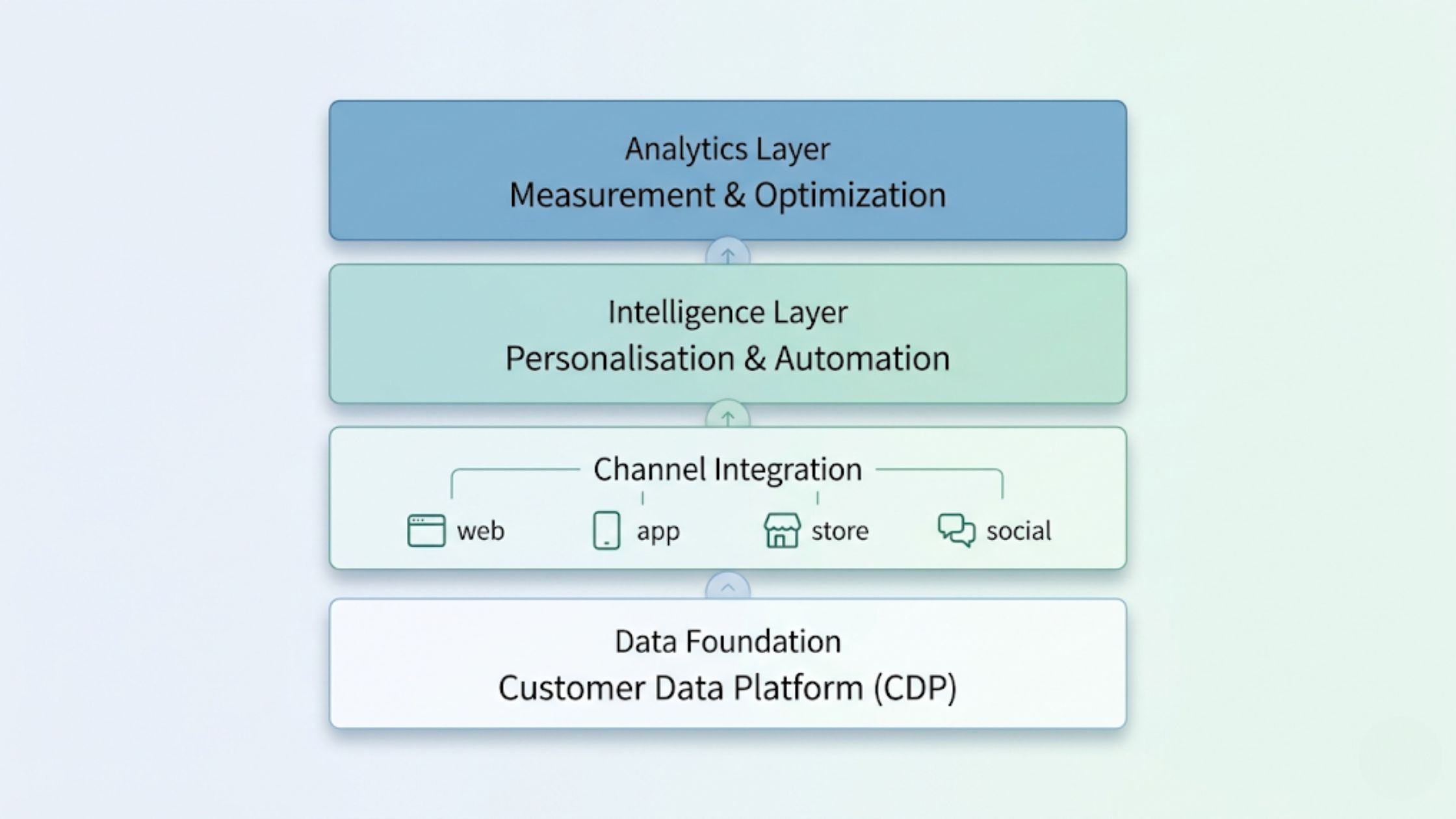
Understanding what omnichannel actually means at a technical level helps businesses make better decisions about implementation. At its core, an omnichannel architecture has four layers:
1. Data Foundation – Unified Customer Data Platform (CDP).
The foundation of any omnichannel system is a single, centralised customer record. All the relationships a web visit, a store purchase, a support ticket contribute to this profile. Without unified data, omnichannel is impossible. Usually, the backbone here is a CDP (Customer Data Platform) or a sufficiently integrated CRM.
2. Channel Integration – Connected Touchpoints
All channels (web, app, store, social, email, SMS) should be linked to the central data layer technologically. This is normally done by means of APIs, webhooks, and middleware of integration. All the touchpoints should have products, inventory, customer identity, and order history synced in real time or near real time.
3. Intelligence & Personalisation – Behaviour-Driven Responses
The intelligence layer then takes effect once the data is brought together and the channels are linked, triggering automations, personalised recommendations, dynamic pricing, and contextual messaging generated based on the customer’s behaviour across channels. This is where omnichannel commerce moves from functional to exceptional.
4. Measurement and Optimisation – Cross-Channel Analytics
True omnichannel requires visibility across the entire journey, not just per-channel metrics. The influence of cross-channel activity should be considered in attribution models. A customer may find the product on Instagram, investigate it via email, and then pick it up in-store. These three channels are all credited.
How Omnichannel Commerce Actually Works?
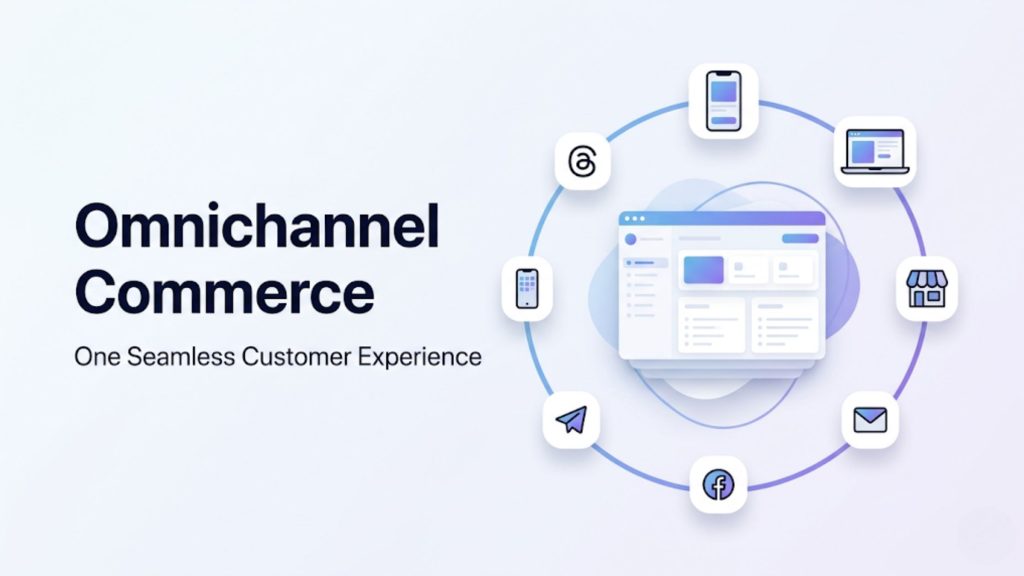
To understand omnichannel explained at a technical level, it helps to visualize the data flow. Think of it as a hub-and-spoke model, where a central integration layer connects all customer touchpoints.
At the heart of this architecture is a commerce integration platform, often a marketplace engine or headless commerce backend, that serves as the connective tissue. Every channel feeds into it, and every channel pulls from it. This is precisely where a marketplace developer like SPXCommerce comes into play, providing the infrastructure for these channels to communicate fluidly.
The Customer Journey in an Omnichannel Flow
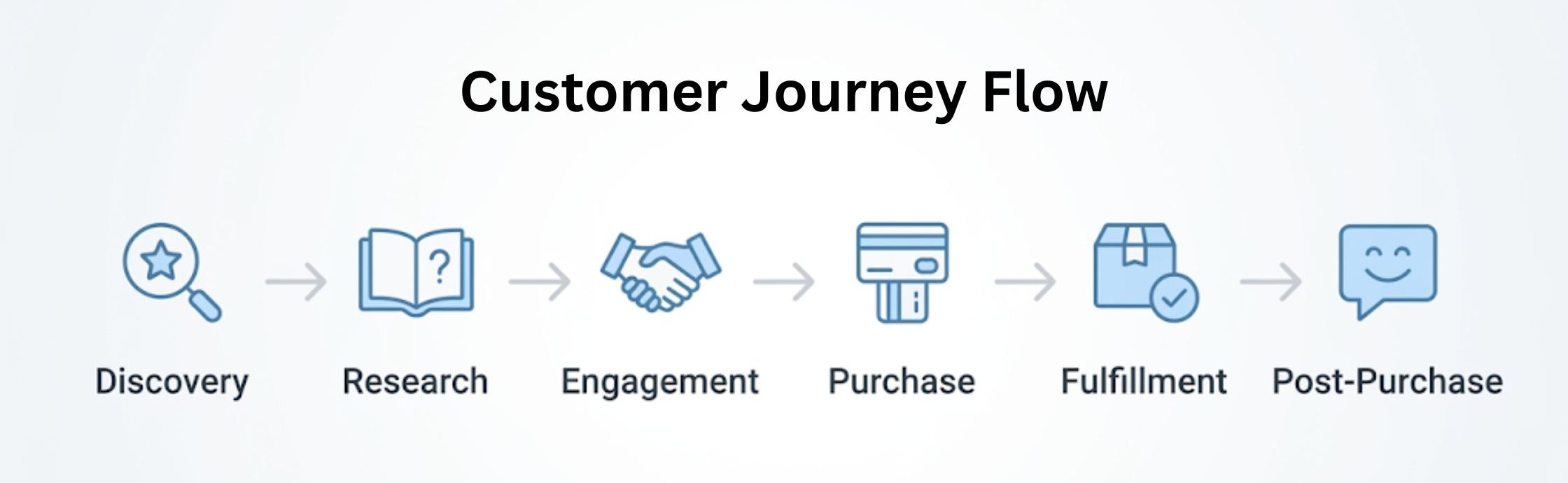
Here’s how a modern omnichannel customer journey looks in practice:
1. Discovery
Customer sees your product in a social media ad and taps through to your website. Their behavior is captured and attributed.
2. Research
They switch to a desktop to compare products. Their cart and wishlist follow them seamlessly.
3. Engagement
They use live chat to ask a question. The agent can see their browsing history and previous orders.
4. Purchase
They complete checkout via a saved payment method. Inventory is decremented in real time across all channels.
5. Fulfillment
They chose “pick up in-store.” The store gets notified. A personalized email with directions and pickup instructions is sent.
6. Post-Purchase
A follow-up is triggered based on their purchase, not a generic blast, but a recommendation tied to what they actually bought.
Key Channels in an Omnichannel Strategy
An omnichannel strategy doesn’t require every channel, but requires the right channels, deeply integrated. Here’s how the most common channels contribute to the omnichannel ecosystem:
| Channel | Role in Omnichannel | Key Integration Point |
|---|---|---|
| Website / eCommerce | Central hub for product info & purchase | Synced cart, unified login, order history |
| Mobile App | On-the-go engagement & loyalty | Push notifications, location-based offers |
| Physical Store | Tactile experience & fulfilment | Click-and-collect, in-store inventory sync |
| Triggered, personalised nurturing | Behaviour-based sequences from CRM | |
| Social Media | Discovery, retargeting & community | Shoppable posts, DM support integration |
| Live Chat / Chatbot | Instant support & lead capture | CRM context passed to every session |
| Marketplace | Expanded product reach & new audiences | Centralised order & catalogue management |
| SMS / WhatsApp | High-open-rate transactional alerts | Order updates, abandoned cart recovery |
Core Benefits of Going Omnichannel
The business case for omnichannel is well-documented and consistently strong across industries. The main advantages that make it be adopted are:
1. Increased Customer Loyalty and Customer Value
Omnichannel shoppers make purchases more frequently and generate higher revenue per interaction. Research consistently shows that businesses with strong omnichannel engagement achieve 91% higher year-over-year customer retention than those with weak cross-channel strategies.
2. Minimal Friction = Maximum Conversion
Any point of friction during a customer journey can be a point of departure. Omnichannel removes the friction of having to start over remembered carts, recognised identities, and pre-filled forms, which translates directly into improved conversion rates across channels.
3. Greater Individualisation on a Large Scale
Personalisation is truly effective when all channel data is fed to one customer profile. You are not merely typing a first name into an email about how to deliver the right product, at the right time, on the right channel, based on the entire behavioural image.
4. Competitive Differentiation
The majority of businesses are operating in silos across multiple channels. A brand that offers a genuinely smooth experience can shine particularly when the categories are highly populated, and product and price equality is the rule. Experience will be the differentiator.
5. Operational Efficiency
Single stock, order control, and shared customer information minimise redundant effort across teams. The work of sales, marketing, and support all operate on the same information, which reduces miscommunication, redundancy, and errors that customers face.
Real-World Omnichannel Examples
Theory is useful. Examples are better. Here’s how leading brands execute omnichannel commerce in practice:
Nike: Loyalty Programme as Integration Spine
Nike’s NikePlus membership programme is the service that unites the brand app, the website, and 1,000 physical stores into a single ecosystem. The history of purchases made by a member, his/her preferences, and loyalty points can be seen everywhere.
In-store staff can access customer profiles to provide personalised service. The application opens a store with unique products through the QR code. Each channel supports another channel.
Starbucks: Mobile-Store Continuity
Starbucks mobile application enables its customers to place their order and pay in advance before reaching any store. The points earned are based on purchases made in the app, on the card, and in-store. Offers are personalised according to the order history and location.
The application is aware of your preferred drink and will recommend it to you even before you open the menu. This is omnichannel commerce explained through everyday experience.
IKEA: Continuous Research-to-Purchase
IKEA links its planning systems (online room planner) and mobile application to its outlets so that a customer can design a room online, save it, and, at any store, with the same list, walk to the fulfillment department.
The design that has been saved in the app is pulled into the in-store kiosks. The inventory system displays the real-time stock at the particular location. The trip that began at home culminates easily in-store.
What Omnichannel Commerce Means for Marketplaces?
Omnichannel commerce takes on a unique dimension for marketplace operators. A marketplace has to provide a seamless experience across not only channels with its customers, but also among various vendors, suppliers, and fulfilment partners, all under one roof as opposed to a single-brand retailer.
This creates three distinct omnichannel challenges that are specific to marketplace models:
- Catalogue consistency: Information about products, price, and availability should be consistent when a customer discovers a product through search, social, email, or direct on the marketplace.
- Vendor-level order routing: As an order is received via any channel, website, app, or social shop, it should be routed to the correct vendor and delivered without any human intervention.
- Single post-purchase experience: Tracking of orders, returns, and customer service should be unified irrespective of the vendor used to deliver the order or the channel used to make the purchase.
A marketplace that solves these three problems delivers what omnichannel actually means in a multi-vendor context, the customer always feels like they’re dealing with one brand, even though dozens of suppliers are working behind the scenes.
Best Practices for Building an Omnichannel Strategy
The translation from idea to action requires disciplined effort. These are the practices that consistently separate successful omnichannel implementations from expensive failures:
1. Map the customer journey first
Before introducing technology, trace all customer interactions with your brand. Determine the location of the handoffs between channels. These are the most frequent points where the experience is most likely to break.
2. Thrash out your data before your channels
No channel integration solution corrects a broken database. Connecting additional channels should proceed with investing in a unified customer data layer (CDP or integrated CRM).
3. Start with two channels, done perfectly
A common omnichannel mistake is trying to connect too many channels at once. Begin with the two most popular channels that you typically use, by having (website and email) or (website and mobile app), and implement that integration to perfection before you start expanding.
4. Create channel-independent customer identity
Customers should be recognizable between channels, either by logging in, loyalty ID, email, or device recognition. Personalisation cannot occur without identity resolution.
5. Measure cross-channel, not on a channel basis only
The establishment of attribution models and cross-channel dashboards to display the customer journey across channels. Per-channel measures give an illusion of reality. The actual conversion path is shown by cross-channel analytics.
6. Make it a personalised stage of the journey
Not all customers are in the same stage. Omnichannel personalisation means recognising where someone is in the journey and serving content accordingly, discovery-stage messaging for new visitors, and loyalty offers for repeat buyers.
7. Train your offline teams
Omnichannel breaks down at the in-store counter if your staff can’t access or use the unified customer data. Technology is just one of the ingredients, and operational training and process design are also important.
How to Choose the Right Omnichannel Platform?
The technology layer is critical to omnichannel success. Using a platform that is not the optimal choice leads to technical debt that gets larger over time. Assess any platform based on the following five criteria:
1. Native multi-channel integration
The platform is intended to be integrated with your major channels (website, mobile, POS, social, email), and it requires only simple custom work to integrate.
2. Single data model
Customer, order, inventory, and product data are to reside within a single system or be reliably synchronized between closely-integrated systems. One anti-pattern is data silos.
3. API-first architecture
Omnichannel evolves. An API-first platform lets you add new channels and tools without rebuilding the core system.
4. Inventory and order management in real time
Overstocking or channel discrepancies kill customer confidence immediately. There is no compromise on real-time sync.
5. Multi-vendor support
When you are creating or managing a marketplace, your platform needs to support multiple sellers, separate dashboards, commission structures, and fulfilment processes.
6. Level of analytics and reporting
You require more than channel-only reports. Search platforms that have journey analytics and native attribution.
How is building an Omnichannel Marketplace seamless with SPXCommerce?
We are a specialized marketplace development platform designed to help businesses build powerful, scalable multi-vendor marketplaces with omnichannel commerce built into the architecture from the ground up.
You need to start a B2B procurement marketplace, a D2C multi-brand platform, or a full-scale retail marketplace. We give you the integration infrastructure that unites your sellers, buyers, inventory, and customer experience, and creates a single unified system.
No siloed channels. No fragmented data. Contemporary consumers just need a marketplace that functions as they feel it should.
Conclusion
The omnichannel meaning is deceptively simple: make the customer’s experience seamless, no matter which channel they use. However, the implementation behind that simplicity involves a single data strategy, extremely integrated channels, intelligent personalisation, and the appropriate technology backbone.
What omnichannel actually means for your business is a competitive advantage that compounds over time. Each contact builds the customer profile. Each interaction supports the previous one.
The more closely you can provide an experience that is connected, the more loyalty and lifetime value you develop, and the less easily competitors can imitate it.
The question isn’t whether to go omnichannel. That has already been responded to by research, customer behaviour, and competitive pressure. The question is the speed at which you can develop the infrastructure to make it a reality.
SPXCommerce is the infrastructure designed to meet the needs of marketplace operators and ecommerce businesses willing to develop it.