When you’ve succeeded, there is more traffic, more orders, more clicks on ads. However, when you check over your P&L at the end of the month, the numbers reveal shrinking profitability. Revenue is increasing, but profits are continuing to decline. Sound familiar?
This is the hidden problem that challenges thousands of eCommerce businesses in 2026. Even the most ambitious operators face rising customer acquisition costs (CAC), variable platform fees, and unpredictable shipping costs, not to mention razor-thin product margins. Scaling an inefficient operation only amplifies existing profitability issues.
eCommerce profitability is the result of a well-designed system, not chance. Having your customer strategy, order operations, product data, and pricing intelligence focused on profit, not just revenue, is a path to sustainable growth.
In this guide, we’ll break down the exact levers that profitable online stores pull, and show you how platforms help marketplace operators do it at scale.
What Is eCommerce Profitability?
Many eCommerce operators mistakenly assume that revenue growth automatically leads to higher profits. Profitability in eCommerce is the ability to consistently generate net profit after accounting for all direct and indirect expenses related to the cost of goods sold (COGS).
True Profitability is defined by:
- Cost of goods sold (COGS): manufacturing, sourcing, and packaging costs
- Fulfillment & shipping: last-mile delivery, returns, warehouse fees
- Customer acquisition cost (CAC): paid ads, influencer spend, affiliate commissions
- Platform & marketplace fees: Amazon FBA, Shopify plans, payment processing
- Overhead: Tech stack, headcount, customer support
Key insight: A 60% gross margin store that has 60% of its gross margin eaten away by acquisition costs, returns, and platform fees can still be extremely unprofitable. The first step toward profitability is gaining full visibility into costs, not focusing solely on gross profit.
Tracking the right eCommerce KPIs, contribution margin, net margin, LTV: CAC ratio, is the foundation before you can improve anything.
Understanding Contribution Margin in eCommerce
The contribution margin eCommerce is arguably the single most important profitability metric you’re not tracking closely enough. It indicates how much revenue from a product or order remains after deducting variable costs to cover fixed costs.
The Formula
Contribution Margin = Revenue – Variable Costs
Variable Costs are: COGS + shipping + returns + payment fees + variable ad spend per order
Why is this more important than gross margin? It helps businesses identify which SKUs, categories, and customer segments generate profit and which reduce overall margins. A high-volume SKU with a poor contribution margin can appear successful while quietly eroding profitability.
Contribution Margin by Channel
Contribution margins vary significantly across sales channels due to differences in fees, acquisition costs, and fulfillment expenses. Fees and ad costs generally result in marketplace sellers on Amazon or Walmart having a lower contribution margin (8-15%) than DTC channels. That’s why it is essential to have a multi-channel ecommerce analytics framework that provides channel-level visibility, not blended averages.
| Channel | Typical Gross Margin | Variable Cost Drag | Net Contribution Margin | Profitability |
|---|---|---|---|---|
| DTC (Own Website) | 55–70% | CAC, fulfillment | 25–40% | High |
| Amazon FBA | 45–60% | FBA fees, PPC, referral | 12–22% | Medium |
| Wholesale / B2B | 30–50% | Low CAC, volume-based | 18–30% | Medium–High |
| Social Commerce | 50–65% | Creator fees, returns | 15–28% | Variable |
ROAS vs ROMI: Which of the two are you measuring?
This discussion establishes the difference between advanced eCommerce operators and the rest. ROAS (Return on Ad Spend) is not the same as ROMI (Return on Marketing Investment), and optimizing for the wrong one is a quick route to unprofitable growth.
| Metric | Formula | What It Tells You | Limitation |
|---|---|---|---|
| ROAS | Revenue ÷ Ad Spend | The amount of revenue generated for every dollar spent on advertising | Fails to consider returns, fulfillment, and COGS aspects of the business |
| ROMI | (Revenue – Marketing Cost – COGS) ÷ Marketing Cost | Realized profit earned per marketing dollar | Requires complete cost data integration |
A campaign delivering a 4x ROAS may appear successful, but a 55% COGS and a 15% return rate can eliminate profitability. Your ROMI could be negative. Smart eCommerce business owners set minimum ROMI (return on marketing investment) goals rather than ROAS goals and develop bidding strategies based on the contribution margin per order.
Expert Perspective
The ROAS-to-contribution margin-based bidding is one of the most impactful changes an eCommerce team can make. As soon as you know what your margin floor per SKU is, you can set smart bidding rules to automatically stop your bidding on unprofitable traffic, even if you’re bidding on a large scale.
6 Key Levers to Improve eCommerce Margins at Scale
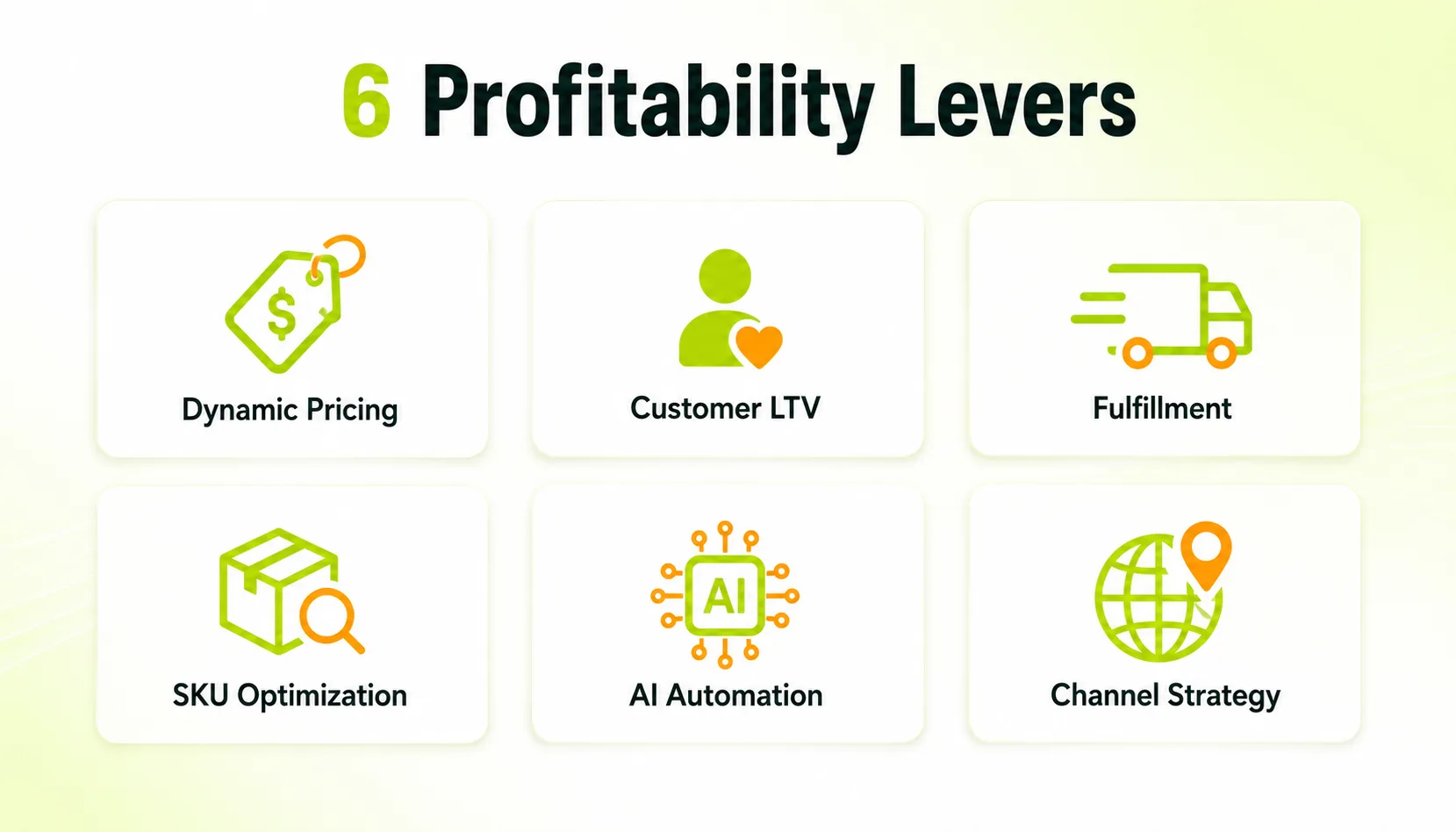
This is where profitability strategies begin delivering measurable business results. Let’s go over the six most effective ways to increase eCommerce margins and do so in a way that’s more fundamental than incremental.
1. Optimize Pricing Intelligence with Dynamic Pricing
In highly competitive markets, static pricing often reduces profitability. AI-powered ecommerce pricing strategy tools track competitor pricing, demand signals, and inventory levels in real time and automatically adjust prices to maximize potential margins while maintaining conversion rates. On low-margin products, a 1% increase in average selling price will double net profit.
2. Reduce CAC Through Lifetime Value Optimization
Instead of constantly acquiring new customers, LTV: post-purchase email flows, loyalty programs, and subscription models are great ways to invest in a profitable store. Even if the two customers have the same revenue, the 3x LTV-to-CAC customer makes much more money. Implementing upselling and cross-selling tactics during checkout and after purchase can boost average order value by 15–30%.
3. Streamline Fulfillment and Returns Management
Often, the single largest hidden margin leak is in fulfillment costs. Effective order management software optimizes carrier selection, eliminates duplicate processing, and minimizes mispicks, thereby reducing per-order fulfillment costs. By automating returns management, you can recover 3–8% of the lost margin.
4. Rationalize Your SKU Portfolio
Not all SKUs are equal. If a product rationalization audit is conducted based on contribution margin data, it is likely that 20% of the SKUs create 80% of the profit, whereas the bottom 30% actively destroy the margin through a combination of storage costs, markdowns, and support overhead. Manage product data to ensure it is clean, complete, and feeds smarter decisions on product retention, bundling, and discontinuation with a product information management platform.
5. Automate Operational Costs with AI
Unless automated, headcount increases with ecommerce volume, but ecommerce automation software manages all catalog updates, repricing, inventory sync, and order routing without human involvement, helping keep operational costs flat. This allows high-growth retailers to scale operations while maintaining healthy profit margins.
6. Build a Smarter Multi-Channel Strategy
Not every channel is creating revenue for you. Do not evaluate the channel mix only based on revenue, but also on contribution margin. Prioritize higher-margin channels and deploy a marketplace strategy to grow customer count without compromising DTC margins. A channel-profitability matrix is always part of a good eCommerce Growth Strategy.
The Role of Technology: OMS, PIM, and AI Automation
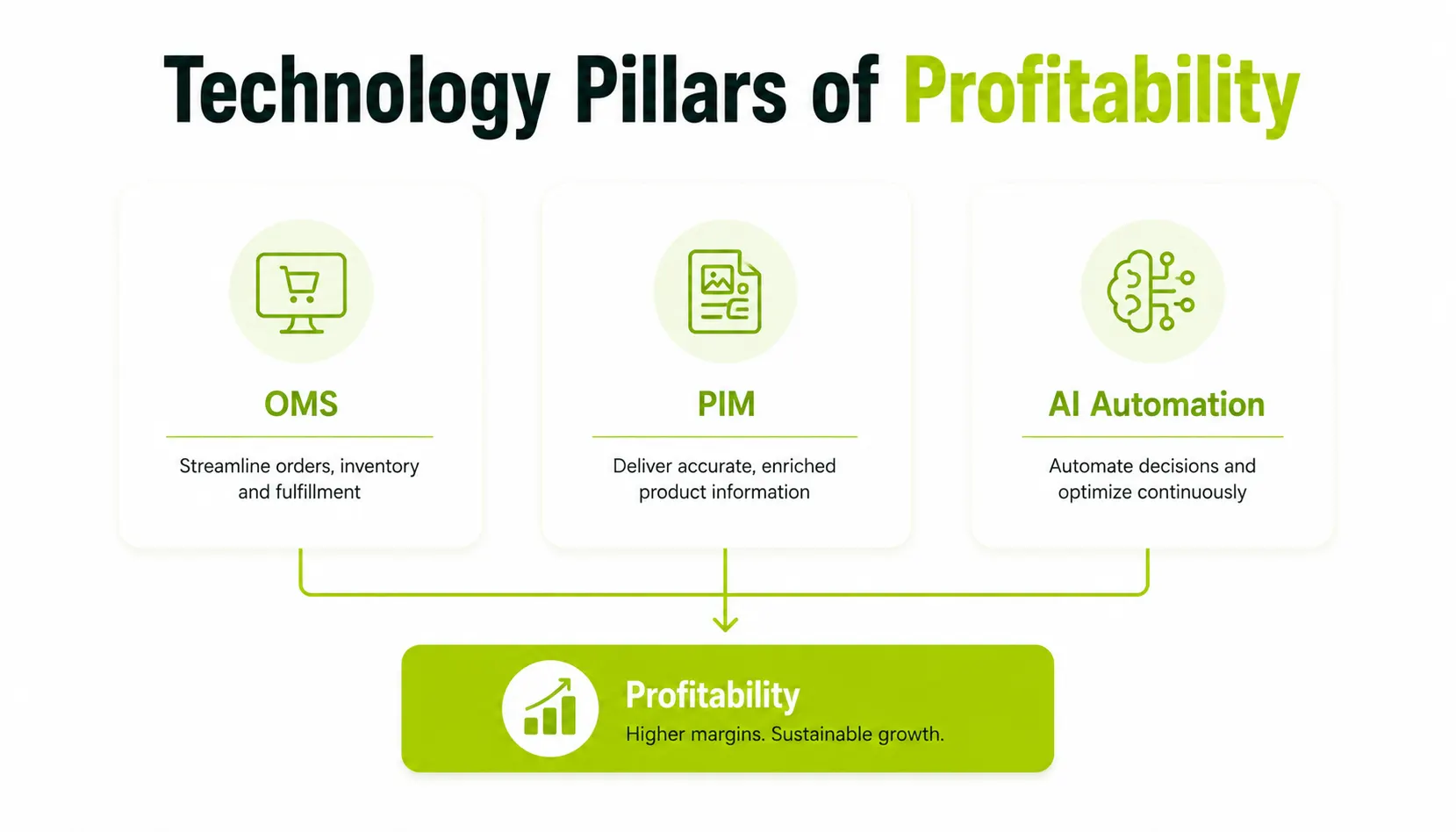
Many eCommerce owners attempt to solve the profitability issues using manual processes and disconnected spreadsheets. The best stores address them through the proper technology architecture. Three technology pillars play a critical role in margin optimization:
1. Order Management System (OMS)
An order management software is the nerve center of your business. It controls order routing, inventory allocation, fulfilment selection, and returns, ensuring that each order is shipped through the most efficient channel. Intelligent OMS platforms can reduce cost-per-fulfillment by 12-20% by automating carrier selection and warehouse routing rules at scale.
2. Product Information Management (PIM)
One of the most overlooked causes of margin erosion is inaccurate or inconsistent product data. This leads to higher return rates (surprising customers), delays the listing process, and hinders the product management system’s cross-channel capabilities. A product information management platform stores all product information, streamlines publishing across multiple channels, and reduces costly data inaccuracies.
3. AI-Powered Pricing & Automation
AI-powered pricing and automation is the new competitive battleground. Machine learning models are used to analyze the demand curve, competitor pricing, inventory velocity, and margin floors to inform SKU-level pricing decisions. This, when paired with AI-based retail inventory management, helps prevent stockouts and overstocking, both of which cost the business money.
How SpxCommerce Is Built for eCommerce Profitability?
We understand that developing a profitable eCommerce marketplace isn’t simply about growing sales, but it’s about selling smarter. SpxCommerce is a marketplace development platform that enables eCommerce operators to create an ecosystem where profitability is intrinsic, and not an afterthought.
Our system enables margin improvement through a multi-vendor, profitable platform architecture that includes commission management, vendor performance scoring, and margin-aware catalog controls. We help you integrate Order Management Systems (OMS) and streamline order fulfilment routing to minimize per-order processing expenses.
SpxCommerce provides a PIM-ready product infrastructure that guarantees clean, structured product data for quicker and more precise multi-channel publishing. Our AI-powered automation layer optimizes pricing and margins dynamically by SKU, across your catalog, and our analytics-first approach offers deep visibility into contribution margin by channel, vendor, and SKU.
From launch to expansion, SpxCommerce helps businesses scale without sacrificing profitability.
Conclusion
The profitability of eCommerce is no longer measured by the number of visitors you can generate or the amount of ads you can run. Instead, it depends on how effectively you manage every rupee behind each order that comes in. Sustainable growth is about controlling the entire cost stack and not just boosting revenue, from the visibility of the contribution margin to smarter pricing strategies, from operational efficiency to channel-level decision making.
As competition and acquisition costs continue to rise, businesses that rely on operational discipline and financial visibility will gain a lasting advantage. For protecting and maximizing margins at scale, technologies such as OMS, PIM, and AI-driven automation are becoming essential business tools, not optional.
Profitability is not a one-time achievement. It is an ongoing process of optimization. With margin-first thinking, you can scale with confidence, without compromising your financial health, by organizing your operations, data, and technology