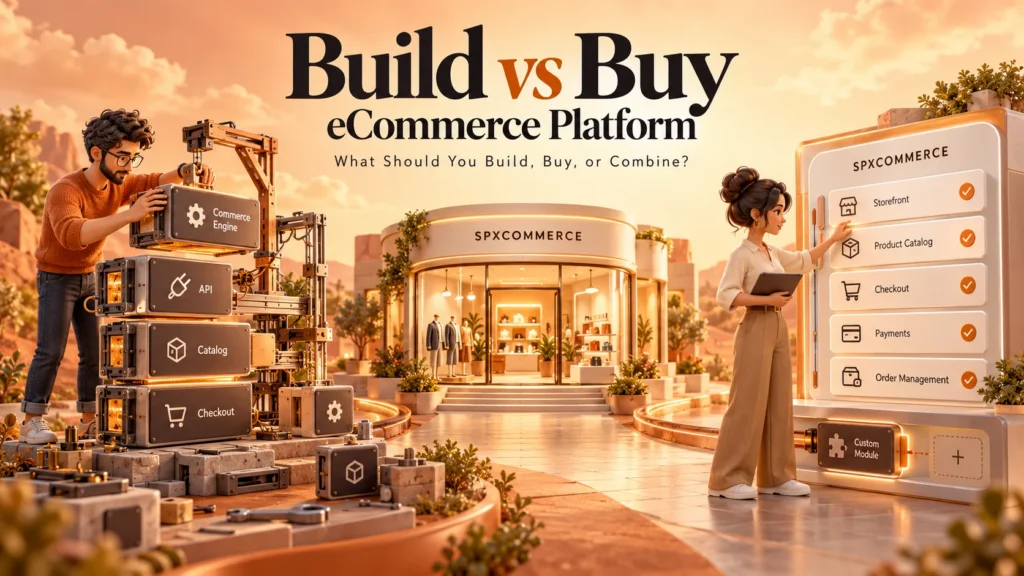
The same thing happens with most entrepreneurs looking to create a marketplace platform: they choose a generic SaaS tool, hit the cap within 6 months, and pay a progressively higher revenue cut for features they can’t even tweak. If you’re nodding your head, it’s most likely not the business concept itself that is at fault, but an architectural mismatch between the platform and the actual requirements of a P2P business model.
Peer-to-peer marketplaces operate differently from traditional retail models because independent users provide the products or services. The platform does not own inventory or set prices, but it provides an environment for two parties to meet, conduct their business safely, and return to the platform. From the day the platform launches, getting that infrastructure right means the onboarding costs, trust mechanics, and potential for the platform to grow without rebuilds all change:
This guide explains what a P2P marketplace is, the differences between its models, the technical components, and what to review when choosing the marketplace platform.
What Is a Peer-to-Peer Marketplace?
A peer-to-peer marketplace is an online platform that enables people to deal directly with one another rather than with businesses. The platform itself does not own or sell the products and services exchanged by users. Rather, it offers features such as listings, search, payments, reviews, and dispute resolution. It’s like a virtual, transaction-earning marketplace that helps otherwise unmatched individuals connect.
The usual analogy is a farmer’s market. The market organizer does not grow or sell the produce, and they just construct stalls, set the rules, and accept a fee from vendors to attend the market. That is the “market organizer” role that can only be software-based in a P2P marketplace.
By 2025, the global sharing economy (with P2P marketplaces as a key driver) is expected to reach $335 billion. Internet platforms such as Airbnb and Etsy have proved that making connections on a large scale is not only possible but also one of the most cost-effective business models today. (Source: PwC Global)
The difference between a genuine P2P marketplace and a normal e-commerce website is the people who provide the items or services. Businesses (or Amazon) are sellers on Amazon or Walmart.com. In a P2P marketplace, supply is offered by people on the street, independent tutors, used-goods sellers, homeowners, and freelancers. The whole idea of the platform is to make those connections between users trustworthy and seamless.
How Does a P2P Marketplace Work?
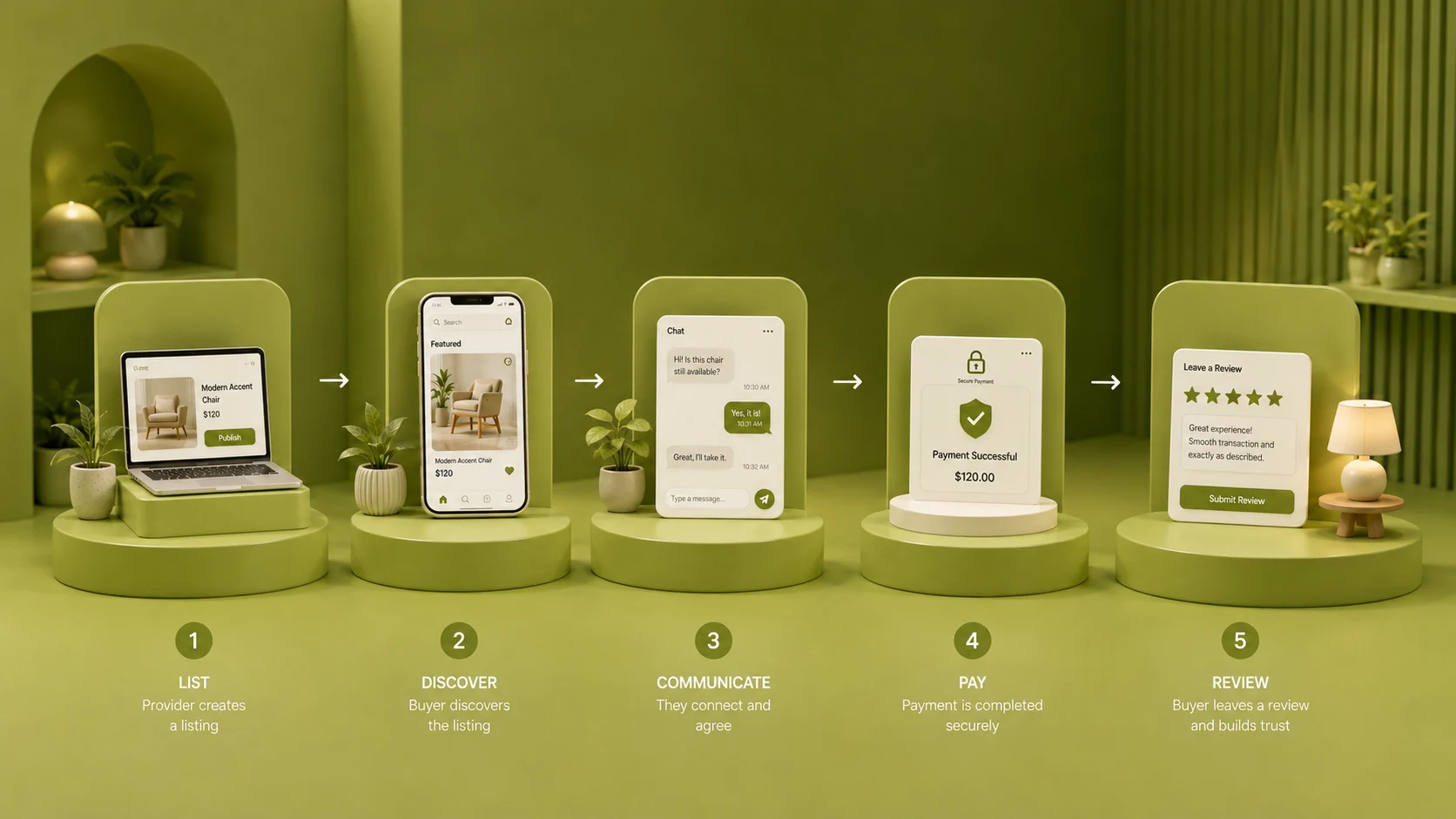
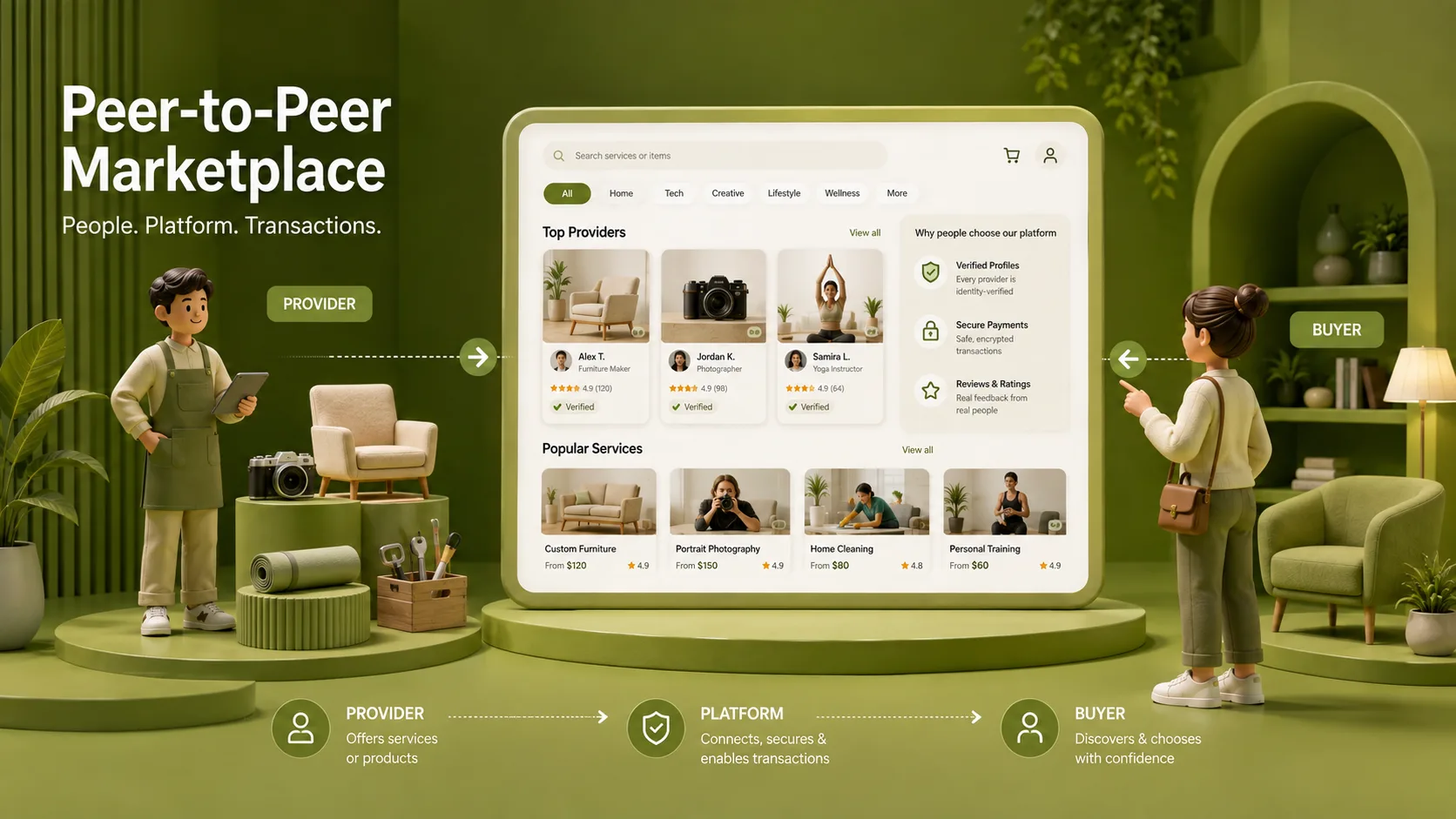
It’s not as complicated as it seems. The actors in this role play are the platform, the provider (also known as the seller, host, or lender), and the consumer (also known as the buyer, renter, or client). This is the typical flow of transactions:
- Provider onboarding: User registers on the platform, passes identity verification (KYC), and adds a product, service, or asset.
- Discovery: A Customer can search, filter by category, location, price, or rating, and match a listing.
- Communication: Buyer and provider communicate via in-platform messaging, with no personal data being exchanged until booking is finalized.
- Transaction: It captures the amount and keeps it secure until delivery is made, thus safeguarding both parties.
- Fulfillment & Review: The exchange occurs, both parties leave reviews, and the platform releases funds after deducting its commission.
Trust is a core product requirement. No buyers want to do business without being certain of the identity of the person they are doing business with, how to handle payments, how to determine whether the person is reputable, and without the providers listing their services. This one fact underlies all the architectural decisions in a P2P marketplace platform.
What Are the Key Components of a Peer-to-Peer Marketplace?
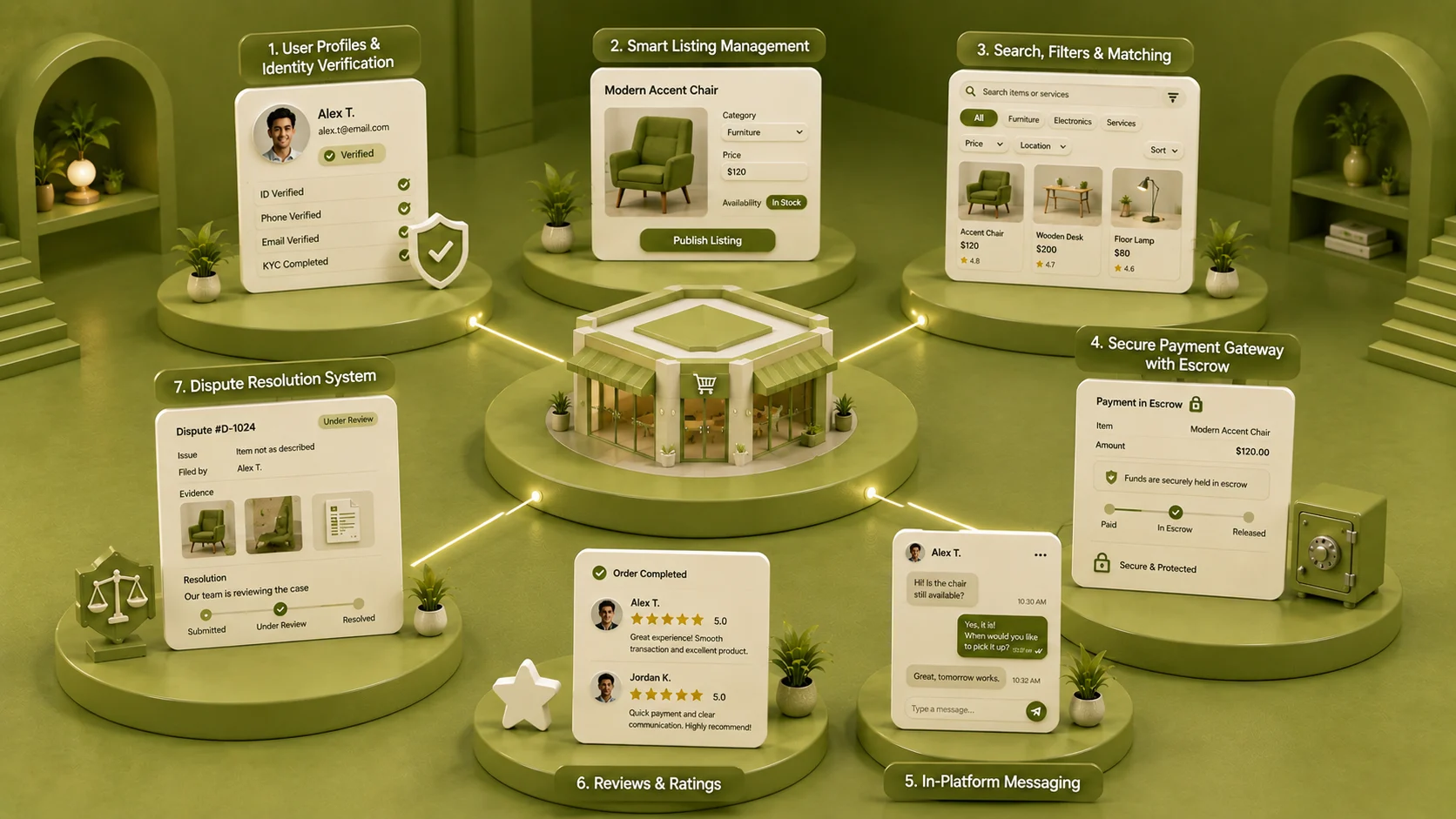
A thriving p2p marketplace centers more than merely linking purchasers and sellers. Together, these building blocks foster trust, simplify transactions, and deliver the user experience people expect.
1. User Profiles & Identity Verification
Verified profiles can display appropriate identity information, ratings, and transaction history while protecting sensitive user data. KYC (Know Your Customer) checks minimize fraud during the sign-up procedure.
2. Smart Listing Management
The provider should be equipped to generate enhanced listings that offer photos, price, availability calendars, location, and category tags. The better the listing is, the higher the conversion rate will be. Moderation rules (both auto and manual) ensure catalog consistency.
3. Search, Filters & Matching
People are searching for what they want using keywords, category filters, and very specific filters like price range, distance, ratings, availability, and more. Good matching reduces the time it takes to make a sale and helps keep customers coming back.
4. Secure Payment Gateway with Escrow
The platform processes payments for the products or services exchanged between users. Escrow can reduce transaction risk by holding funds until defined conditions for fulfillment are met. Multi-currency and localized payment methods add to the geographical reach.
5. In-Platform Messaging
Communication between both parties is necessary before they commit. This ensures everyone is safe and that the operator can sense any disagreement within the platform.
6. Reviews & Ratings
Bidirectional reviews (mutual ratings) create accountability, and it is natural that more reliable providers will come to the surface. The predecessor of a quality control department in P2P.
7. Dispute Resolution System
Even in a well-designed platform, there are always edge cases. The distinction between trusted and non-trusted platforms is that there is a clearly defined, documented dispute process and admin tooling to review evidence and results.
What Are the Main P2P Marketplace Models?
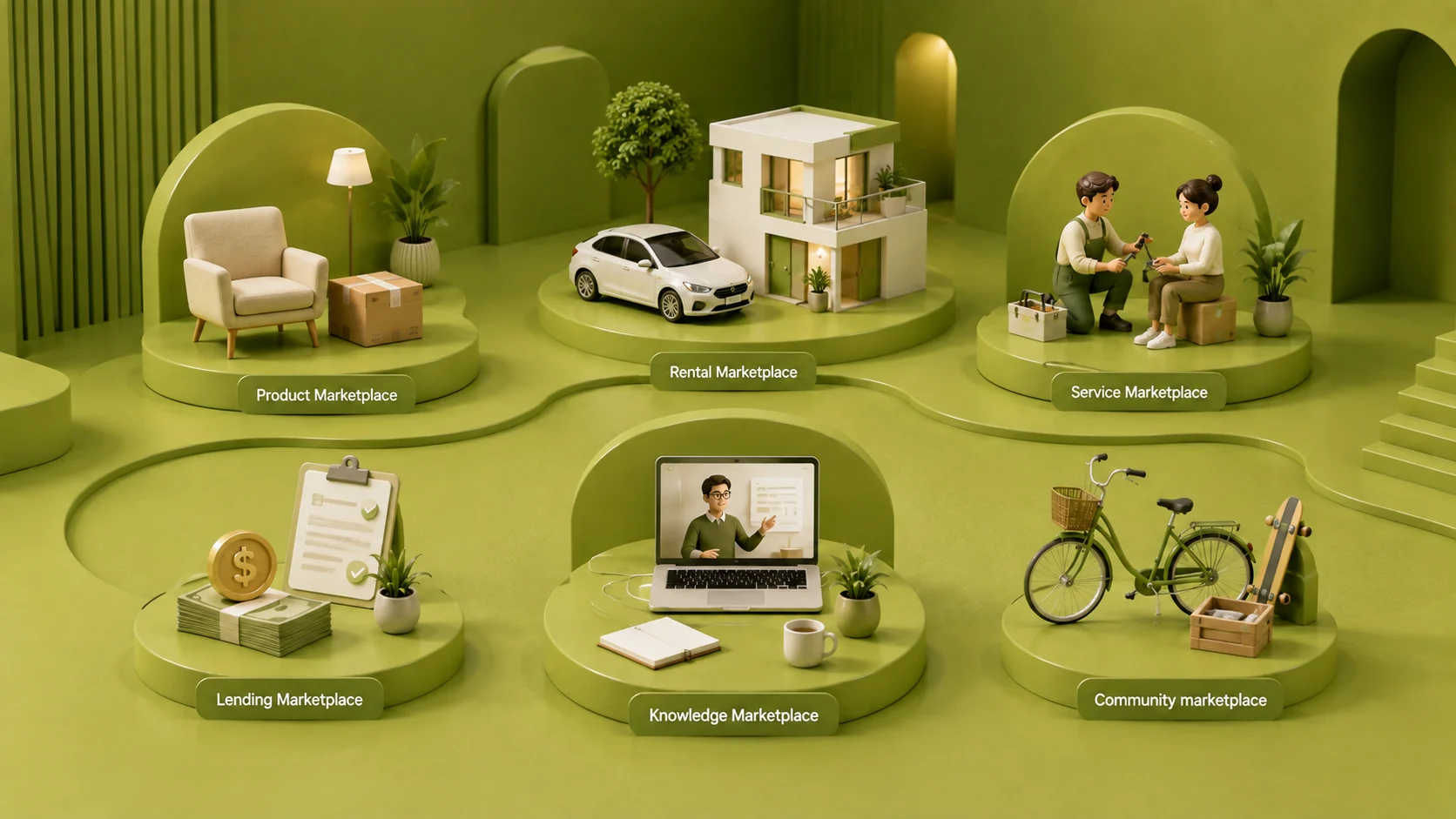
Not all P2P sites are created equal. Whatever you sell, how you sell it, how you get new customers, how you build trust, they’re all influenced by your model.
1. Product Marketplaces
Buyers and sellers exchange real and virtual goods. The biggest problems being faced are coordinating shipping and product authenticity.
2. Rental & Asset Sharing
Those who own property, vehicles, or equipment let them out on hire to others. The big design questions are what to do about insurance and liability for damage.
3. Service Marketplaces
Professional individuals offer design, writing, and handyman services and tutoring. Common types of payouts are milestone payments and time tracking.
4. Lending & Finance
Loans are made directly to persons or small enterprises without the involvement of banks. The most difficult design constraint in this model is regulatory compliance.
5. Knowledge & Skill Sharing Marketplace
People are taught through courses, tutorials, or live sessions. Content quality, content moderation, and accuracy of instructor payments are users’ primary concerns.
6. Community Lending / Gifting
Free exchange of goods, such as micro-lending, skill-swapping, etc. They typically run on trust rather than money, relying on subscriptions or donations for revenue.
Important note: A P2P (peer-to-peer) marketplace is not the same as a C2C (consumer-to-consumer) marketplace, although they are often confused. C2C refers to a consumer-to-consumer commercial relationship. The concept of P2P is more general and refers to an architecture in which a P2P system provides the means for transactions, but it is part of the architecture, not the transaction itself.
Real-World P2P Marketplace Examples
The most successful P2P marketplaces worldwide demonstrate the viability of highly scalable businesses by connecting people. The examples demonstrate how different marketplace models can be realized and effective strategies for doing so.
Airbnb
The homeowner lists rooms or an entire home and reserves the room or home. The platform generates revenue through service fees, with the applicable fee structure varying by booking and participant.
Etsy
Craft and vintage products, handmade items are sold to the world by artisans and small manufacturers. There is a 6.5% transaction fee per sale.
Upwork
Freelancers are contracted by businesses and individuals. The platform charges a service fee on freelancers’ income.
Turo
Cars are rented out directly to travelers by private car owners. Turo takes a 25-35% commission and covers the insurance policy.
Poshmark
Second-hand clothes and accessories are sold. If the purchase is under $15, Poshmark will charge a 20% commission off the sale price.
TaskRabbit
A “Tasker” is someone who is hired by a local to run errands, move furniture, assemble furniture, and do home repairs. A service charge will be taken from the platform for every successful completion.
What do these platforms have in common? None of these platforms has in their possession what they sell. It’s not about the hardware, and it’s about the infrastructure. It is the power of the P2P model and how it differs from traditional retail.
P2P vs. Traditional Marketplace: What’s the Difference
| Factor | P2P Marketplace | Traditional B2C Marketplace |
|---|---|---|
| Who supplies? | Individual users (providers) | Businesses, brands, or the platform itself |
| Inventory ownership | Platform owns none | Platform may own or hold inventory |
| Quality control | Review systems, community moderation | Supplier vetting, returns policies |
| Trust mechanism | Ratings, KYC, escrow | Brand reputation, refund guarantees |
| Revenue model | Commission on transactions, subscriptions | Retail margin, listing fees, ads |
| Scale driver | Network effects (more users = more value) | Inventory breadth, price competition |
| Capital requirement | Lower (no inventory cost) | Higher (inventory, warehousing) |
How Do P2P Marketplaces Make Money?
One of the first and most crucial decisions to make when building a P2P marketplace platform is determining the income model you’ll use. The model you choose affects your pricing decisions, your provider’s actions, and your competitiveness relative to other providers.
| Revenue Model | How It Works | Best For |
|---|---|---|
| Commission / Transaction Fee | Platform takes a % of each successful transaction (typically 5–20%) | Most P2P models align platform incentives with provider success |
| Subscription / Membership | Providers pay a monthly/annual fee for access or premium features | Service marketplaces, professional platforms |
| Listing Fees | Charge per listing or for featured placement | High-volume goods marketplaces (classifieds, equipment) |
| Freemium | Free basic access, paid tiers for analytics, promoted listings, or lower fees | Early-stage platforms building provider supply |
| Lead Generation | Platform charges providers per qualified inquiry or connection | Service marketplaces where projects vary in scope |
Most successful P2P platforms begin by adopting a commission-based system, which eliminates the entry barrier for providers joining the platform, as providers pay no fees unless they earn a commission. The platform increases tiers or premiums over time, allowing for a more consistent revenue stream without cutting back on supply.
How to Build a P2P Marketplace Platform That Lasts?
It is not so much about the features as about the sequencing when creating a P2P marketplace. The platforms that don’t make it tend not to fail because they built the wrong thing, and they fail because they built too much too soon and didn’t have enough liquidity to become a self-sustaining marketplace.
Phase 1: Nail the Core Loop First
The core loop is: provider lists → buyer finds → transaction completes → both parties return. All your features you create in the first 6 months should help or enhance this loop. Try not to add social features, referral programs, or advanced analytics before this loop runs reliably.
Phase 2: Build Trust Infrastructure
When business is being conducted, identity verification, a dispute system, and a credible review system are essential. This is where most SaaS marketplace tools fall short, as they provide generic review widgets but lack admin tooling to investigate disputes or take enforcement action against bad actors.
Phase 3: Optimize for Liquidity
Liquidity is the condition in which a buyer with a particular product in mind is assured they can acquire it. This needs to involve category depth, geographic reach (or an intentional geographic focus), and sufficient active providers to avoid “stale” listings. Liquidity is enhanced by tools such as automated re-listing, provider health scores, and liquidity-enhancing supply-side incentives.
Phase 4: Scale Revenue & Retention
Once you’ve established a steady stream of liquidity in your business, you can start using a lot more retention tools: loyalty programs, repeat-purchaser discounts, provider-analysis dashboards, and diversification across subscription or premium levels.
In a real-world scenario, when you are developing a multi-vendor marketplace platform, opt for software that allows you to own the code and make changes to each stage of your development. Platforms that lock you into a roadmap of features will limit your growth when you’re most prepared for it.
How to Choose the Right P2P Marketplace Software?
Choosing the wrong platform can be costly beyond licensing fees, as developer time is often spent working around platform limitations. When assessing P2P marketplace software, these are the really important factors:
| Evaluation Criteria | What to Look For | Red Flags |
|---|---|---|
| Code Ownership | Delivers full source code and allows deployment on your own server. | SaaS-only solution with no access to the source code. |
| Customization Depth | Provides flexibility to customize workflows, user experience, and commission rules without relying on the vendor. | The only customization option is to “Submit a feature request.” |
| Multi-vendor Architecture | Supports seller dashboards, commission splits, seller-specific payout management, and true multi-vendor functionality. | A single-vendor storefront repackaged to appear as a marketplace. |
| Payment Infrastructure | Supports escrow payments, multiple currencies, split payouts, and refund management. | No escrow support and only a single payment method available. |
| Scalability | Proven architecture capable of handling thousands of concurrent sellers and listings. | No evidence of successful large-scale deployments. |
| Pricing Model | One-time or predictable development costs with no revenue-sharing requirements. | Per-transaction fees that increase with Gross Merchandise Value (GMV), making growth more expensive. |
Why SPXCommerce for Your P2P Marketplace?
Most platforms require you to choose between limited SaaS solutions that share revenue and expensive custom marketplace development. With a fully customized marketplace you own, SPXCommerce fills that void.
Installed on your servers, SPXCommerce provides 100% ownership of the source code and no recurring revenue. As your marketplace expands and transaction volume increases, your potential commission revenue can grow accordingly.
Designed for P2P marketplaces, it features customizable seller onboarding and KYC, flexible seller and buyer commission management, escrow and split payouts, and AI-powered dashboards for admins, sellers, and buyers.
If you are planning to build any fashion marketplace, digital products platform, or services marketplace, SPXCommerce works for you.
The outcome is a scalable, viable marketplace platform that doesn’t have any subscription limits, any vendor lock-in, and no platform fees with growing GMV.
Conclusion
Led by blockchain, ‘peer-to-peer’ markets are changing how people sell, buy, rent, or provide services to each other via a trusted digital platform. However, a successful long-term outcome requires more than just a good idea, as it includes proper technology, trust mechanisms, payment infrastructure, and a platform that can scale with user growth.
Any software that offers future expansion, secure transactions, multi-vendor capabilities, and customization will be a good choice, whether you are launching a product marketplace, a rental site, or a service-based marketplace. Building a great foundation creates a greater opportunity to build your community rather than rebuild your tech.
SPXCommerce offers the scalability and control needed to build, launch, and grow your marketplace on your own terms, without ongoing revenue-sharing fees, complete source code ownership, and flexible workflows.