Customer acquisition costs across ecommerce marketing channels continue to rise. Plus, not every customer makes a second order because of poor retention. The standard dashboards look well-maintained. However, they fail to showcase the hidden operational challenges that are actively restricting your business’s ability to scale.
The average ecommerce customer retention rate still stands at nearly 30%, according to Trypoprel.ai. This is significant because retention determines whether marketing investment compounds or disappears. Strong, consistent purchase behavior minimizes dependence on increasing acquisition costs.
Low customer retention forces brands to rely heavily on customer acquisition, increasing marketing costs while churn remains high.
The solution is a connected system built from loyalty, personalization, and lifetime value management.
This guide explains the strategies, metrics, and frameworks for improving customer retention, maximizing lifetime value, and increasing repeat purchases.
What Is Ecommerce Customer Retention?
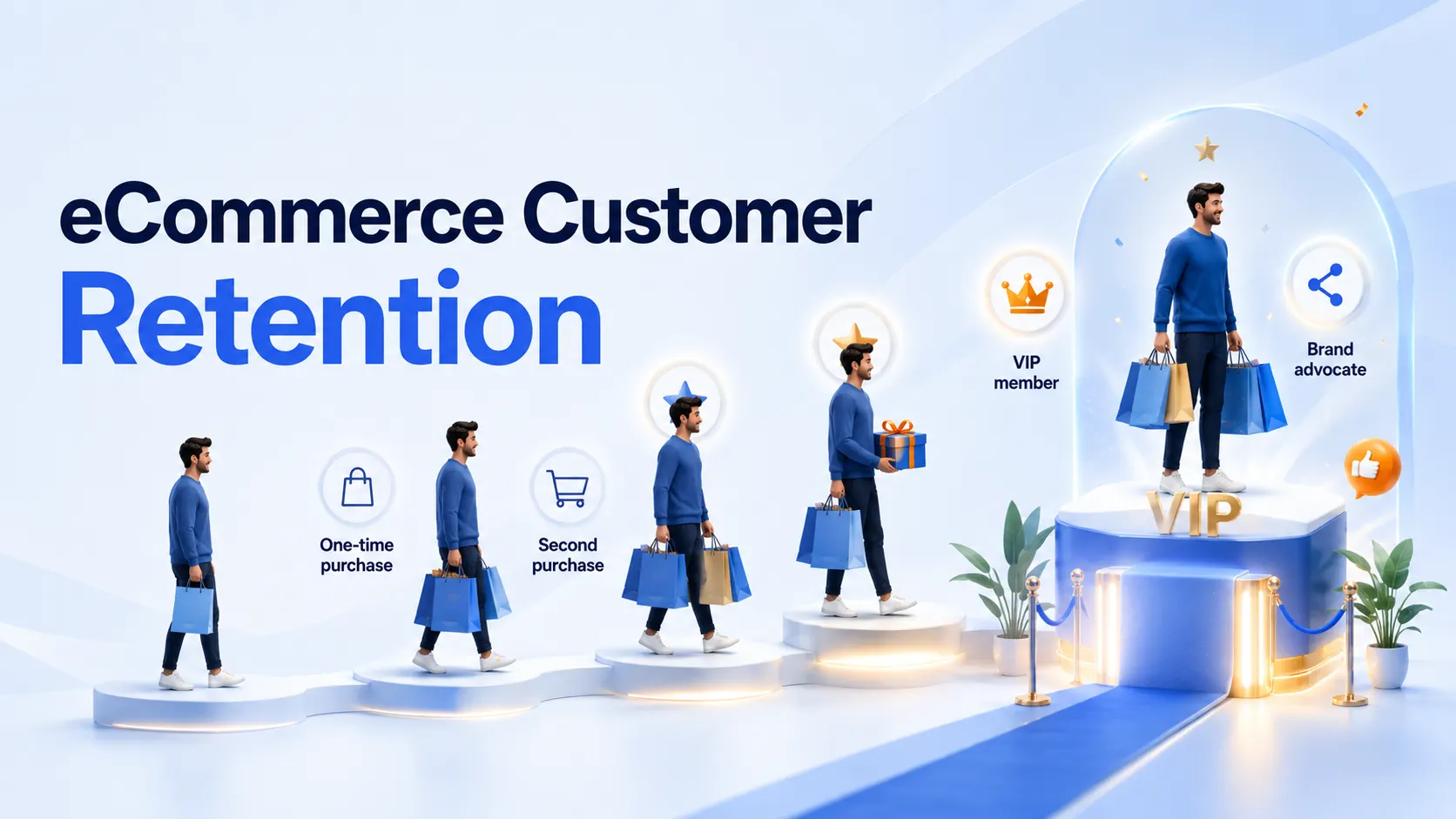
Ecommerce customer retention measures a brand’s ability to turn one-time buyers into loyal customers. It signifies the rate at which customers return within a specified period.
Retention is totally different from acquisition. While acquisition focuses on attracting first-time buyers, retention focuses on increasing customer lifetime value after the initial purchase.
Effective customer retention is reflected through the following customer actions:
- The customer places a second order within a reasonable period.
- A customer joins a subscription or replenishment program.
- When a customer engages with referrals or loyalty rewards
- A customer’s average order value increases over time.
It results from deliberate onboarding, communication, and post-purchase strategy.
Why Customer Retention Matters More Than Ever
Rising Acquisition Costs
Acquisition costs have increased roughly 60% over the last five years, per Genesygrowth’s 2026 data. Paid channels have grown more expensive and less predictable across most categories.
Profit Impact of Small Retention Gains
eCommerce customer retention delivers outsized profit impact compared to acquisition spend. A 5% improvement in retention can lift profits by 25% to 95%, per Harvard Business Review. This multiplier effect makes retention one of the highest-return investments available.
Loyalty Economics and Spend Behavior
Returning customers spend measurably more than first-time buyers. Bain & Company found apparel customers spent 67% more after 31 months. Trust and familiarity remove friction from every subsequent purchase decision.
Referral and Advocacy Effects
Loyal customers refer others, and referrals convert at no additional acquisition cost. Retained customers are more likely to leave reviews and recommend the brand. This advocacy effect compounds the impact of retention well beyond direct repeat purchases.
Overview of Customer Lifetime Value (LTV)
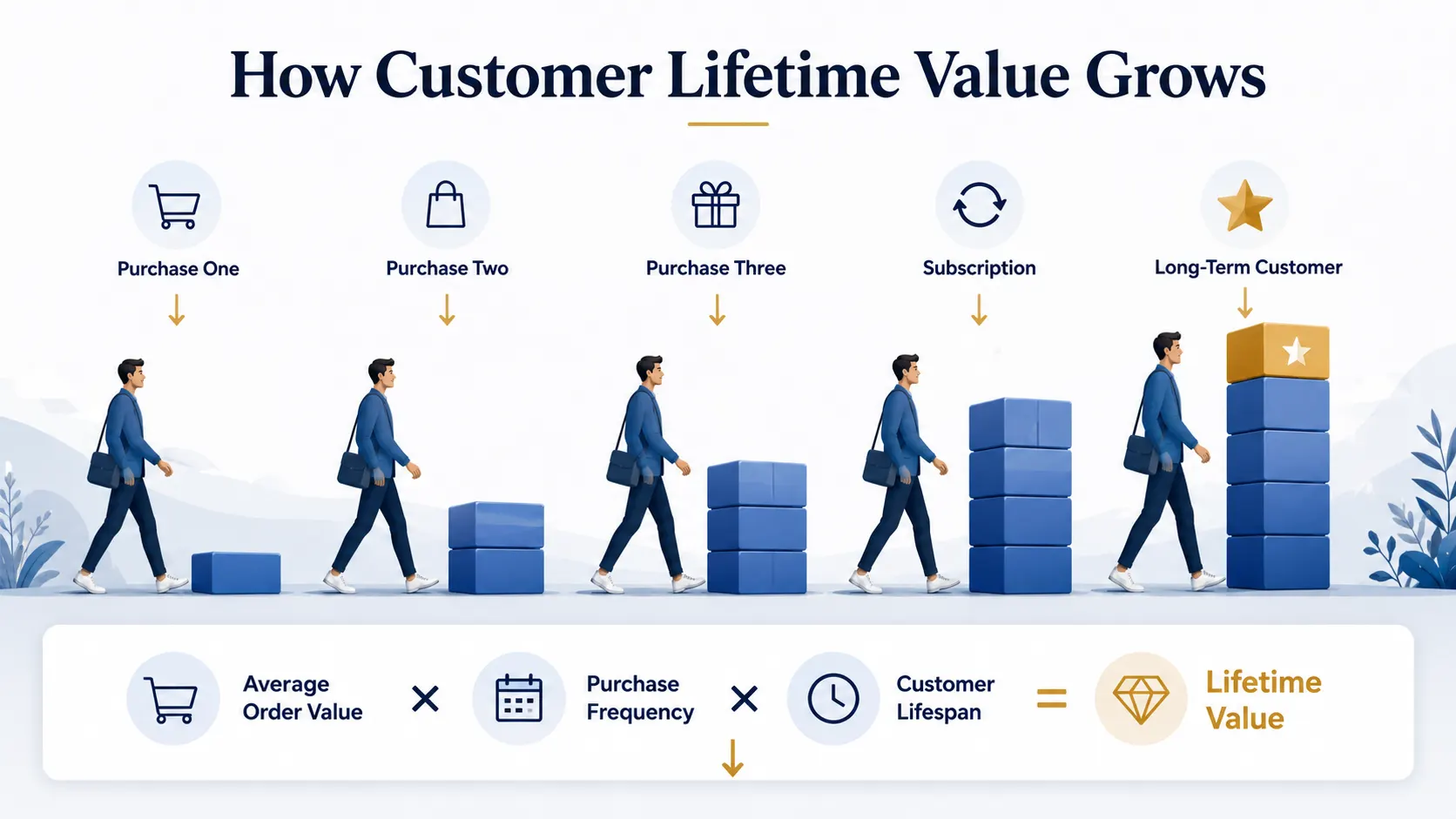
Customer Lifetime Value (LTV) represents the total revenue a business expects to generate from a customer throughout the relationship. It converts loyalty into a specific financial metric for leadership review.
LTV Formula
LTV = Average Order Value × Purchase Frequency × Average Customer Lifespan
More advanced models incorporate gross margin and discount rates. This baseline formula still informs acquisition and retention budget decisions.
Average LTV Optimization
Average customer lifetime value varies significantly across product categories. Consumables and beauty brands tend to have higher LTV due to repurchase habits. Electronics and furniture have lower LTV due to infrequent buying cycles. Subscription businesses typically post the strongest LTV figures overall.
Factors Affecting LTV
- Product category and repurchase cycle
- Average order value and cross-sell effectiveness
- Retention rate and churn rate
- Acquisition channel, since referred customers carry higher LTV
- Loyalty program participation
- Quality of post-purchase support
Ways to Increase LTV
- Increase purchase frequency through replenishment reminders and subscriptions
- Grow average order value through strategic bundling
- Extend customer lifespan through loyalty tiers and personalization
- Reduce churn through proactive support and win-back campaigns
Example of LTV Calculation
A skincare brand averages a $60 order value. Customers place an average of 3.2 orders per year. The typical customer lifespan runs 2.5 years.
For example: $60 × 3.2 × 2.5 = $480 LTV
This figure should directly inform acceptable acquisition spend and retention investment.
Customer Lifetime Value Metrics Comparison
| Metric | What It Measures | Typical Ecommerce Benchmark (2026) |
|---|---|---|
| Average LTV, transactional retail | Revenue per customer, non-subscription model | Highest among consumables and beauty brands |
| Average LTV, subscription ecommerce | Revenue per customer, recurring model | 60–85% annual retention drives multi-year LTV |
| Revenue concentration | Revenue share from top customers | The top 5% of customers generate approximately 35% of revenue |
| Repeat purchase rate | Share of customers who buy twice | 28.2% average across Shopify stores |
| Referred customer LTV premium | LTV lift versus non-referred customers | +16% higher LTV |
The Most Important eCommerce Customer Retention Metrics to Track
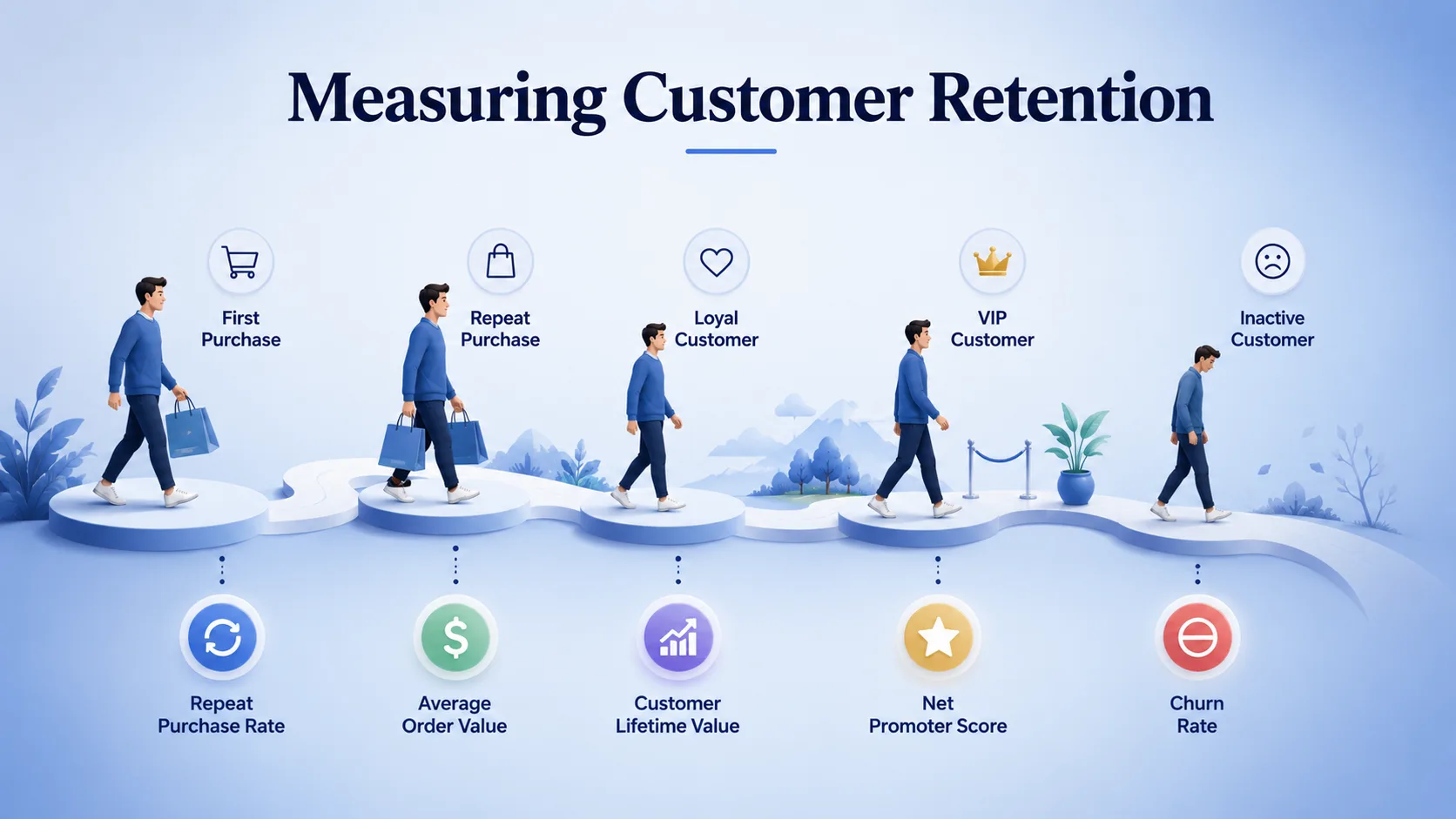
Accurate measurement is the foundation of any retention program.
- Customer Retention Rate: It measures the percentage of customers kept over a defined period.
Formula: [(customers at end − new customers) ÷ starting customers] × 100
- Repeat Purchase Rate: RPR measures the percentage of customers who buy a second time. If 1,000 customers buy in January and 250 return by March, RPR equals 25%.
- Churn Rate: CR measures the percentage of customers lost during a specific period. Rising churn signals problems in onboarding, product fit, or communication, and it’s usually the first metric churn prevention ecommerce brands should target.
- Average Order Value (AOV): It measures the average transaction size across all orders. Returning customers typically post higher AOV than first-time buyers.
- Net Promoter Score: NPS indicates customer loyalty and likelihood of referrals. Higher NPS scores correlate closely with stronger long-term retention.
Proven Customer Retention Strategies That Increase Repeat Purchases
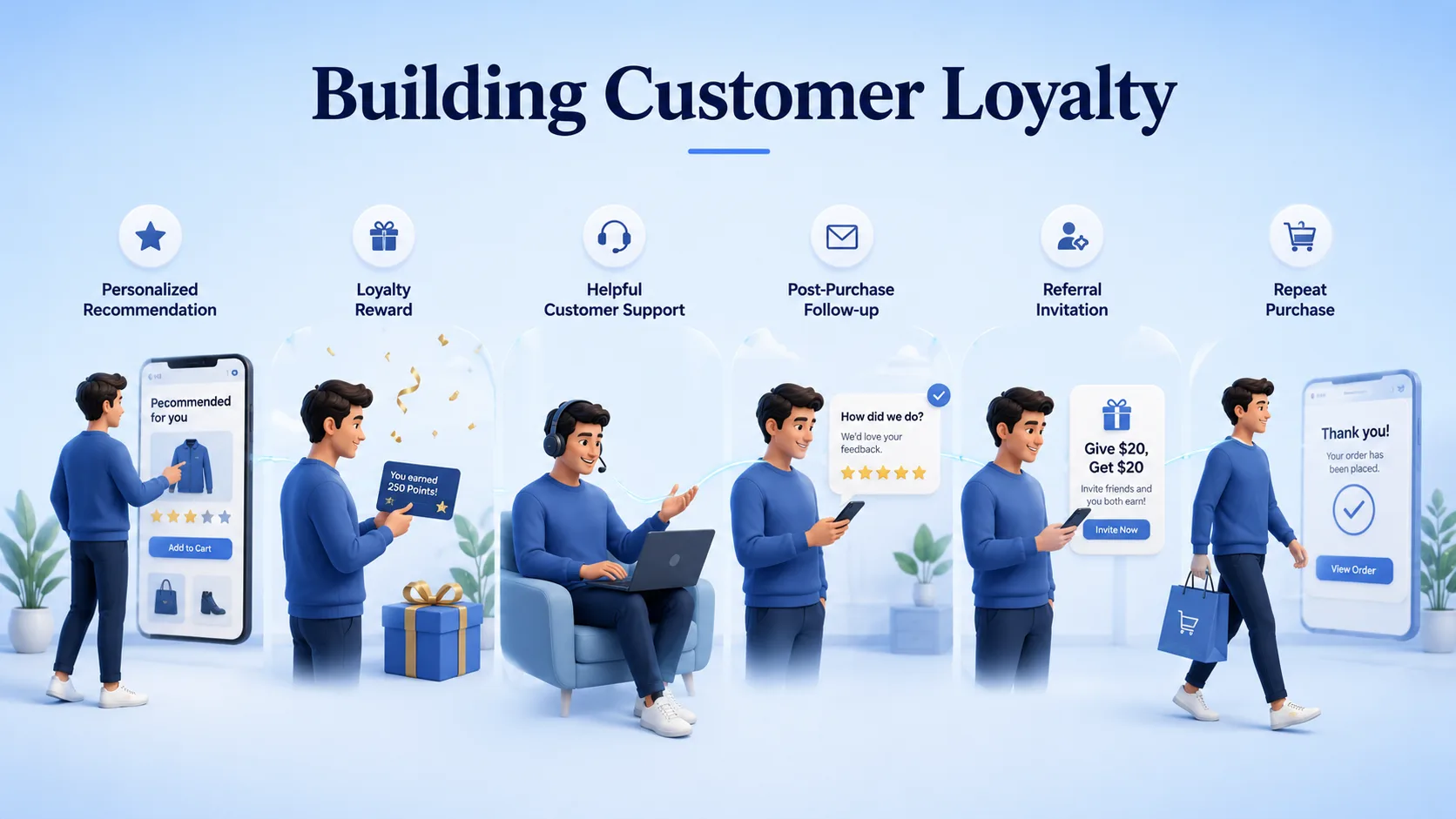
eCommerce customer retention tactics should match the business model, category, and purchase frequency.
- Deliver an exceptional omnichannel customer experience: Fast, accurate fulfillment prevents silent churn before it starts.
- Personalize every shopping journey: Personalized shopping experiences have become a baseline customer expectation. 71% of consumers expect it; 76% report frustration without it, per McKinsey.
- Build an effective loyalty program: Best suited to brands with frequent repeat purchases. Loyalty programs generate an average ROI of 5.2x industry-wide.
- Optimize post-purchase communication: The first 30 to 90 days carry the highest retention leverage. Automated post-purchase emails reduce 90-day churn by roughly 14%.
- Launch referral programs: It is effective only after establishing strong customer satisfaction and loyalty. Referral programs convert loyal customers into an acquisition channel.
- Improve customer support: 95% of consumers say service quality drives loyalty. Poor support remains one of the fastest paths to churn.
- Reward VIP customers: Tiered recognition protects your highest-value segment. Top customers often generate a disproportionate share of total revenue.
Loyalty Programs That Actually Increase Customer Retention
Program structure should match your purchase frequency, margin, and average order value. A well-matched customer loyalty program ecommerce brands drives measurably more repeat purchases than a generic, copy-paste setup.
- Points-based loyalty rewards every purchase with redeemable points, suiting high-frequency, lower-AOV categories where points accumulate at a satisfying pace.
- Tiered loyalty unlocks stronger perks as spend increases and works best for brands with a wide range of order values across their customer base.
- Paid memberships charge a fee for benefits like free shipping or exclusive pricing. Premium loyalty members are 60% more likely to increase their spend compared to 30% for free-tier members, and premium members show roughly 2.7x higher lifetime value despite being a smaller share of the member base, per McKinsey’s loyalty program analysis.
- Cashback programs return a percentage of spend as store credit. It is simple to understand, but it requires careful margin modeling to remain sustainable.
- Referral rewards compensate existing customers for bringing in new ones and depend on already-strong customer satisfaction to work well.
- Gamification layers challenges and rewards onto core loyalty mechanics, performing particularly well with younger, digitally engaged audiences.
Personalization Tactics That Increase Customer Loyalty
- Product recommendations based on browsing and purchase history drive incremental revenue when placed on product pages, in the cart, and in post-purchase emails.
- Predictive churn analysis flags disengagement signals before a customer fully lapses, allowing brands to intervene before complaints arise.
- AI-driven personalization is now mainstream rather than experimental. 92% of businesses report using it for customer engagement, according to McKinsey research cited by Envive. AI-driven personalization specifically is associated with a 10–15% lift in retention rates among adopters.
- Behavioral segmentation groups customers by actions rather than demographics alone, producing sharper targeting than broad, generic segments.
- Dynamic offers adjust promotions based on individual purchase probability, replacing blanket storewide discounting with more targeted, margin-conscious incentives.
Retention Marketing Channels: Email, SMS, Omnichannel
Retention depends heavily on the automated flows customers experience after purchase. The retention marketing tactics below are the highest-leverage starting points for most ecommerce brands.
- Welcome series: A short sequence that introduces the brand beyond the initial transaction and sets expectations for what comes next.
- Abandoned cart recovery: Automated messages sent to shoppers who added items to their cart but didn’t complete checkout, recovering hesitant near-conversions.
- Post-purchase emails: Follow-up messages share order status, usage tips, and easy access to support if something goes wrong.
- Replenishment reminders: Timely reminders are sent close to when a customer is likely to run out of a consumable product.
- Win-back automation: A targeted sequence aimed at customers who haven’t purchased in a while, ideally triggered by inactivity rather than a fixed calendar date.
Omnichannel ecommerce platform consistency compounds the effect of every individual channel.
Common Customer Retention Mistakes
- Over-discounting: Relying too heavily on sales and coupons trains customers to wait for a discount rather than buy at full price, which steadily erodes margins over time.
- Poor onboarding: Customer churn is roughly linked to inadequate onboarding, according to industry research compiled by Opensend.
- Ignoring customer feedback: Reviews, surveys, and support tickets contain early churn signals that most brands never systematically act on.
- Perceived indifference: Customers who leave a brand say they left because they felt the company didn’t appreciate them, per NewVoiceMedia research, not because of price or a better competitor offer.
- Weak or slow customer support: A single negative service interaction can undo months of brand-building goodwill, since churn is minimized through better service.
- Complicated returns: Friction at the return stage damages customer trust more than the original issue that caused the return.
Quick self-check: If your business experiences several of these challenges, hidden retention gaps may be reducing long-term revenue growth.
Retention Tools and Platforms: What to Look For
Most enterprises require an integrated commerce technology stack rather than relying on a single B2C ecommerce platform.
| Tool Category | Purpose | What to Look For |
|---|---|---|
| Email/SMS automation |
|
Behavioral triggers. |
| Loyalty platforms |
|
Flexibility to match your specific program model. |
| Customer Data Platform (CDP) |
|
Real-time syncing across marketing and support tools. |
| Analytics / BI tools |
|
Cohort-level reporting, not just aggregate totals. |
| Customer support software | Resolve issues quickly across channels. | Omnichannel ticketing and fast response times. |
Buying guidance: Start with email/SMS automation and analytics before layering in a loyalty platform or full CDP. Foundational data visibility should come before program complexity.
A Step-by-Step Procedure to Build Your Retention Strategy
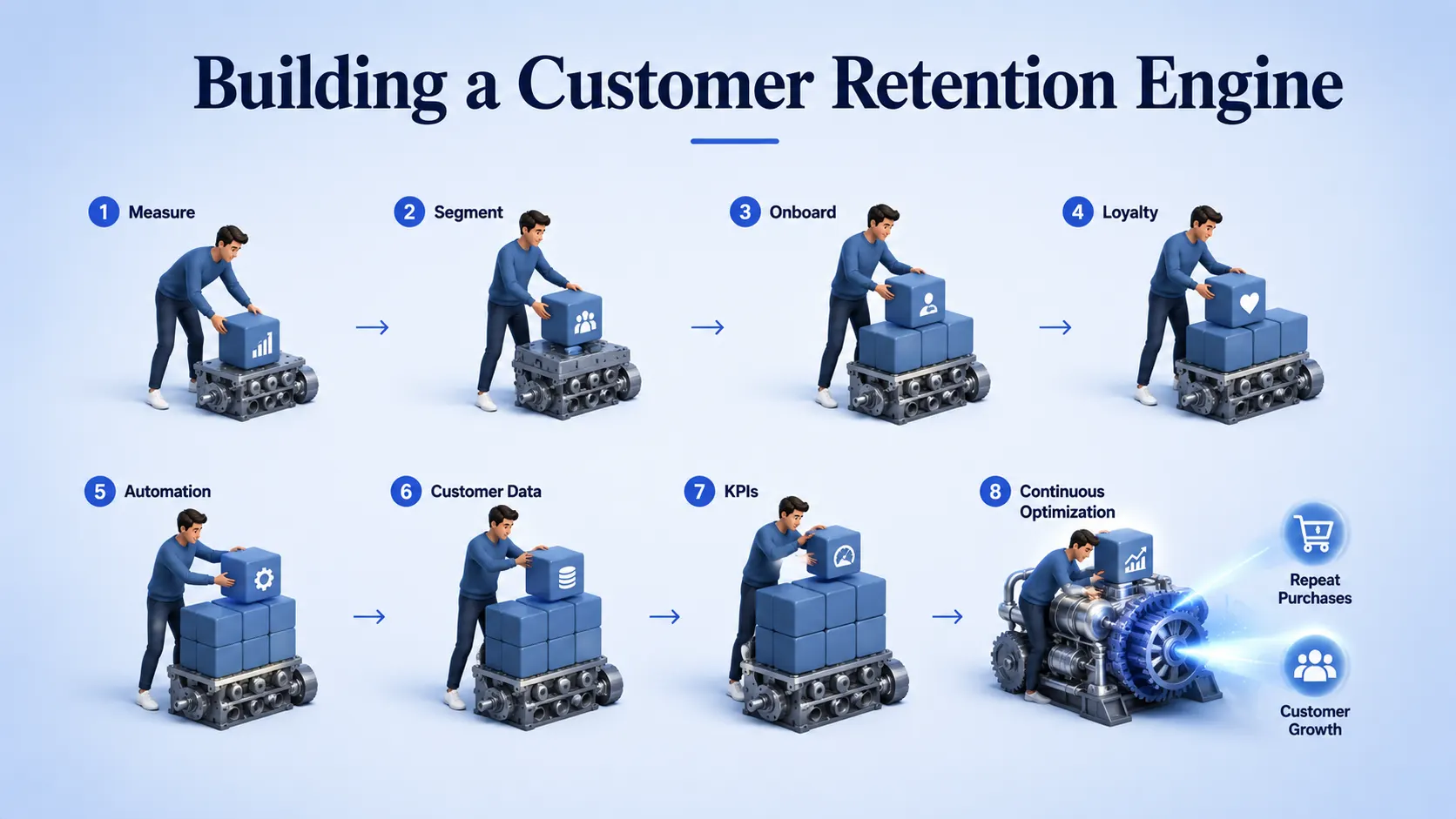
Follow these eight effective steps so that you can prepare the best retention approach.
Step 1: Measure Current Retention
Before making any changes, establish an accurate baseline for your customer retention rate, repeat purchase rate, and churn rate. Pull this from order history over a consistent window, such as the last 90 or 180 days, so later comparisons stay meaningful. Without this baseline, there’s no reliable way to know whether later changes are actually working or are just a coincidence.
Step 2: Identify Customer Segments
Break your customer base into clear groups: one-time buyers, repeat customers, and top-tier or VIP customers, using purchase frequency, total spend, and recency rather than guessing. A one-time buyer needs a different message than a customer who has already ordered five times, and treating them the same wastes the data you already have.
Step 3: Improve Onboarding
Audit what a new customer experiences in the first 30 days, from order confirmation through delivery and first product use. Fix gaps such as unclear shipping updates or a missing welcome sequence.
Step 4: Select a Loyalty Model
Choose a loyalty structure that matches your purchase frequency, margin, and average order value, using the comparison table earlier in this guide as a starting point. A high-frequency, lower-margin brand needs a different model than a low-frequency, high-AOV brand, and copying a competitor’s program without checking your own numbers rarely works.
Step 5: Automate Communication
Build the core automated flows:
- Post-purchase updates,
- Replenishment reminders,
- Win-back sequences for lapsing customers.
These should run automatically once set up, so retention continues working even when your team’s attention shifts elsewhere. Start with one or two flows and expand once they’re performing.
Step 6: Strengthen Data Collection.
Add preference centers, account creation incentives, and short post-purchase surveys to collect zero-party data directly from customers. This matters more each year as third-party tracking becomes less reliable, and it directly improves the customer personalization work from Step 5. Be transparent with customers about why the data benefits them.
Step 7: Track KPIs Monthly.
Review retention rate, repeat purchase rate, churn, and LTV every month rather than only at quarter-end. A monthly review catches problems, like a sudden drop in repeat purchases after a shipping delay, while there’s still time to respond.
Step 8: Optimize Continuously.
Manage retention as an ongoing optimization program by continuously testing offers, messaging, and customer journeys. Retention improves through continuous, deliberate testing.
Future Trends in Ecommerce Customer Retention
Here are some upcoming trends regarding customer retention in e-commerce.
- AI-driven churn prediction: AI-powered retention tools are increasingly capable of flagging at-risk customers with high accuracy, moving churn management from reactive to proactive.
- Zero-party data collection: As third-party tracking restrictions continue to tighten, data that customers share directly and willingly is becoming essential to effective personalization.
- Premium and paid loyalty tiers: Paid membership models are gaining ground as brands look for ways to lock in commitment and fund richer benefits.
- Omnichannel is the default expectation: Fragmented experiences increasingly cost brands retention, making a consistent cross-channel experience a baseline requirement rather than a differentiator.
- Usage-based and flexible offers: Subscription models that let customers skip, pause, or adjust frequency are showing meaningfully lower churn than rigid, fixed structures.
Conclusion
Ecommerce customer retention is a measurable, controllable growth lever, not a soft metric that lives only in a quarterly report. Brands that treat it as core infrastructure, rather than an occasional campaign, are better positioned to grow profitably as acquisition costs keep climbing.
Acquisition will always bring new customers into the funnel, but retention decides whether that growth is actually profitable over time or simply expensive. The strategies, metrics, and framework covered in this guide offer a practical starting point, though the real impact comes from consistent monthly execution rather than a one-time setup.
Ready to Turn Retention Into Your Growth Engine?
Retention requires infrastructure, not isolated tactics or one-off campaigns. Data must flow cleanly between your storefront, your AI-powered ecommerce platform, and your marketing stack.
SPXCommerce is built for exactly this layer of the business. Our solution combines an AI-driven product-suggestion system with business intelligence to determine high-value customer segments and optimize retention strategies.
If you’re ready to strengthen your repeat purchase rate, let’s talk. Book a walkthrough with our team, based on your store’s actual performance data, to deliver AI product recommendations and real-time customization.
Practical Recommendations
- Prioritize onboarding and post-purchase communication before adding new acquisition spend.
- Choose a loyalty model that fits your purchase frequency and margin structure.
- Segment customers by cohort before applying broad personalization or discounting.
- Track retention metrics monthly, not quarterly, to catch churn signals early.