If you are handling enterprise operations, procurement, or IT, vendor management becomes more complicated as supplier ecosystems expand. Agreements often remain disorganized across numerous inboxes and separate systems, creating compliance gaps. Former contractors and vendors may retain unauthorized access to systems after project completion, increasing security and compliance risks. These problems get worse as vendor networks grow across operational functions.
Manual tracking often lacks the transparency modern organizations need.
The global vendor management software market will grow from $10.4 billion in 2025 to $11.47 billion in 2026. It is expected to reach $18.76 billion by 2031, according to Mordor Intelligence.
This growth reflects rising vendor dependency and increasing operational risk. Organizations need stronger governance across every vendor relationship. Vendor management software addresses this requirement through centralized control and visibility.
A vendor management system creates a single source of truth. It organizes vendor records, contracts, system access, compliance, costs, and performance. Decision-makers gain greater visibility across the entire vendor lifecycle.
This guide explains a vendor management system for e-commerce businesses. It covers platform types, core capabilities, and key evaluation criteria. Plus, by the end, you will be able to choose the perfect VMS solution that aligns with your operational requirements.
| TL;DR |
|---|
|
Understanding Vendor Management System eCommerce
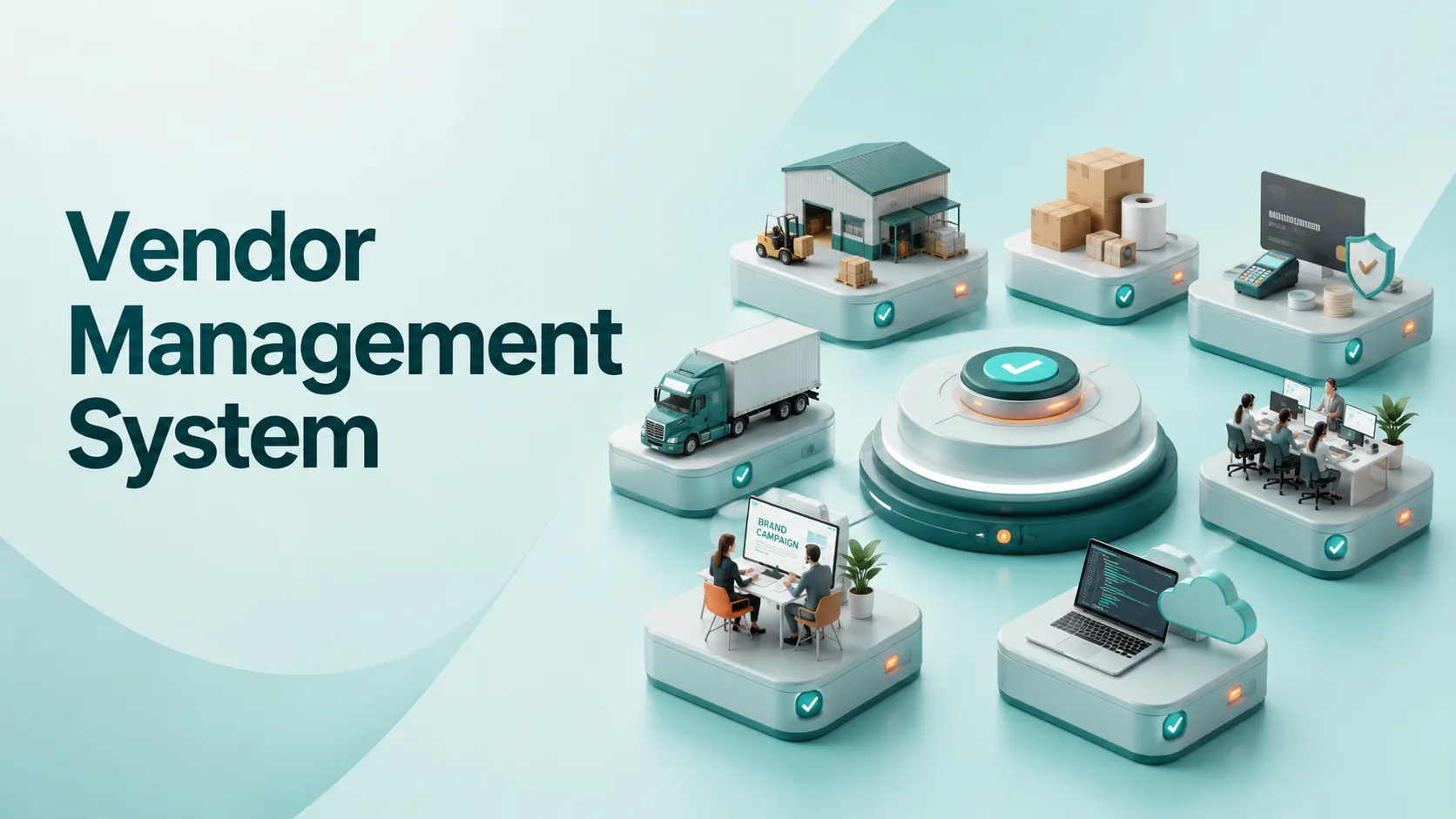
A vendor management system is software that centralizes the external processes. It manages contractors, suppliers, onboarding, contracts, payments, and vendor evaluations.
For eCommerce businesses, vendor ecosystems often span multiple operational functions.
- Fulfillment partners
- Freight carriers
- Payment processors
- Packaging suppliers
- Marketing agencies
- App developers
- Customer service contractors
- Seasonal warehouse staff
Without a VMS, this information typically lives across email threads, shared drives, accounting software, and with whoever happens to remember the details.
Managing hundreds of vendors significantly increases operational and compliance risk. Organizations lose visibility into system access, compliance documents, and contract renewals.
Most systems also include a dedicated vendor portal platform. It allows suppliers to self-submit documentation and track their own onboarding status instead of routing everything through email.
Procurement teams can instantly verify insurance certificates, contract status, and compliance documentation from a centralized repository.
The system strengthens operational resilience, customer confidence, and business continuity.
Types of Vendor Management
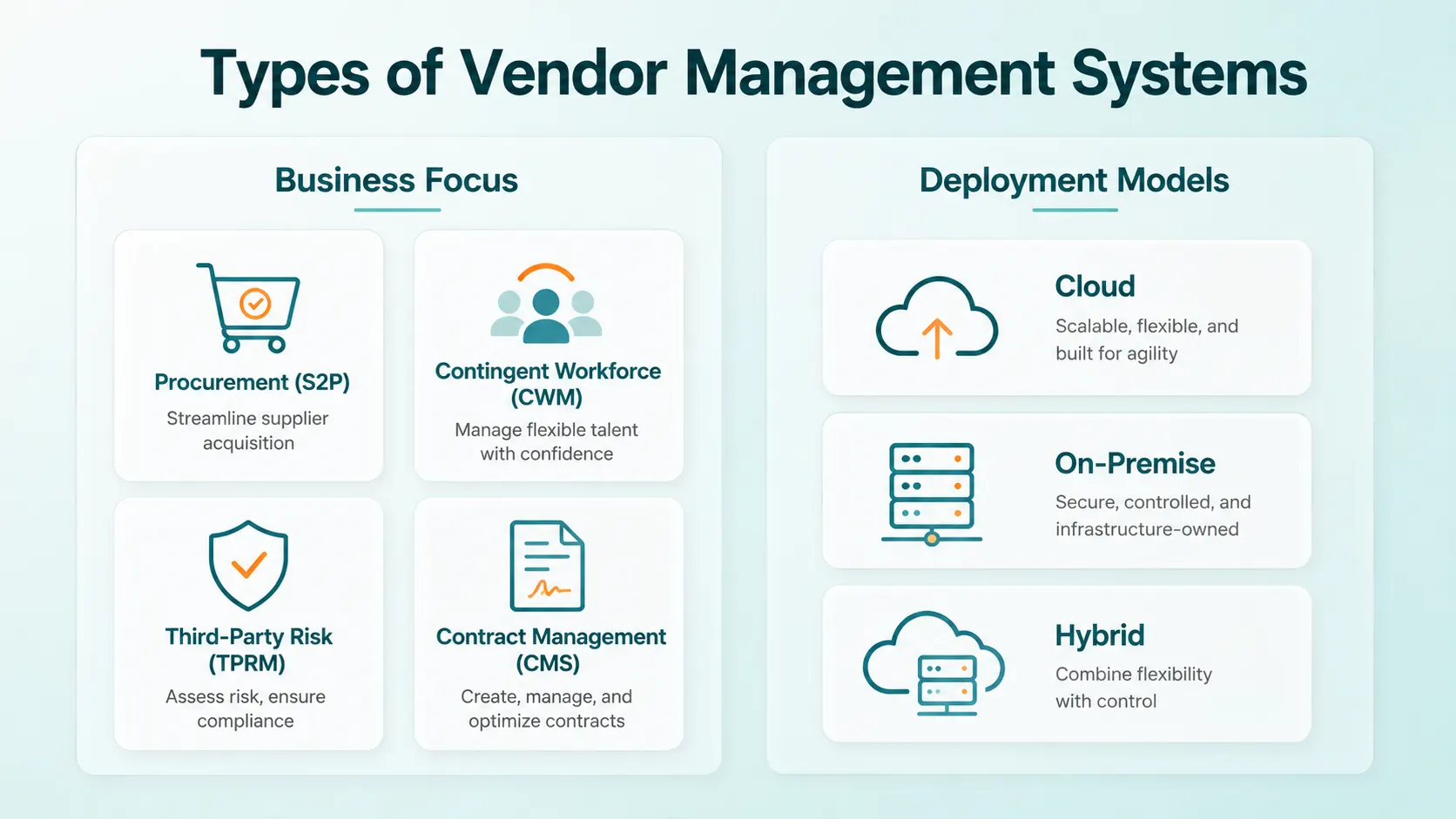
Vendor management platforms address different operational requirements. Most vendor management platforms fall into two categories based on business function or deployment model.
Understanding both categories simplifies platform evaluation.
1. By Business Process & Focus
A. Procurement/Source-to-Pay (S2P) Systems
These platforms manage the full purchasing lifecycle, such as sourcing suppliers, negotiating terms, issuing purchase orders, and processing invoices.
S2P platforms improve procurement efficiency, spend control, and supplier visibility. They are well-suited for organizations managing large supplier networks and recurring procurement.
B. Contingent Workforce Management (CWM) Systems
CWM platforms manage non-employee labor, such as freelancers, contractors, and temporary staff.
Enterprise retailers rely heavily on contingent workforce management during seasonal demand spikes to scale operations efficiently. These systems handle sourcing, time tracking, classification compliance, and payment.
Worker misclassification exposes organizations to regulatory penalties, legal disputes, and unexpected labor costs.
C. Third-Party Risk Management (TPRM) Systems
TPRM tools assess and continuously monitor the security and compliance posture of vendors with access to systems or data.
98% of organizations now have a relationship with a third party that has experienced a breach, according to SecurityScorecard. TPRM has become a standard practice for any business handling customer payment data.
D. Contract Management Systems (CMS)
CMS platforms store, track, and manage vendor agreements, such as drafting, redlining, e-signature, renewal alerts, and obligation tracking.
These platforms reduce unintended renewals and strengthen contractual governance.
2. By Deployment Type
A. Cloud-based (SaaS)
Teams access the system through a browser, updates happen automatically, and there’s no hardware to maintain.
This is the default choice for most growing eCommerce businesses because it scales without added IT overhead.
B. On-Premise
The software runs on the company’s own servers. This model still shows up in industries with strict data residency rules.
For most retailers, operational costs exceed the benefits of deployment.
C. Hybrid
A mix of cloud convenience and on-premise control, often used by larger retailers that need certain vendor data to stay within specific areas.
This tends to be the right fit for businesses operating across multiple countries with different data residency requirements.
Why Do Enterprises Need a Vendor Management System in 2026?
Real-Time Risk Mitigation
Third-party vendors have become one of the largest sources of operational, financial, and cybersecurity risk across enterprise supply chains. The average cost of a third-party data breach now runs around $4.91 million, above the global average of $4.44 million reported in IBM’s 2025 Cost of a Data Breach Report.
A VMS with built-in risk monitoring flags expired certifications, compliance gaps, or security incidents early, before they become the retailer’s problem, too.
Unified Contingent Workforce Management
Peak-season hiring, app development cycles, and customer service overflow all rely on contract labor.
Modern multi-vendor marketplace software gives HR, procurement, and finance a shared view of who’s working, what they’re being paid, and whether classification rules are being followed. This improves workforce governance and reduces audit risk.
Automated Contract and Spend Control
Manual contract tracking misses renewal dates and rate increases more often than most teams admit.
Automated contract management flags these events in advance, giving procurement teams the leverage to renegotiate rather than being locked into unfavorable terms by default.
Deploying Agentic AI for SLA Enforcement
Newer VMS platforms use AI agents that continuously monitor vendor performance against service-level agreements, including shipping times, defect rates, and response times.
Breaches are flagged automatically rather than waiting for a quarterly manual review. This matters more as vendor networks scale faster than the staff available to monitor them.
Integrating Contingent Workforce Capacity Planning
A forward-looking B2B marketplace platform connects workforce data with demand forecasting, helping retailers plan seasonal staffing based on historical sales patterns rather than guesswork.
Effective workforce planning improves fulfillment capacity, customer experience, and revenue during peak demand periods. Getting this planning right has a direct impact on revenue.
How a Vendor Management System Works in eCommerce?
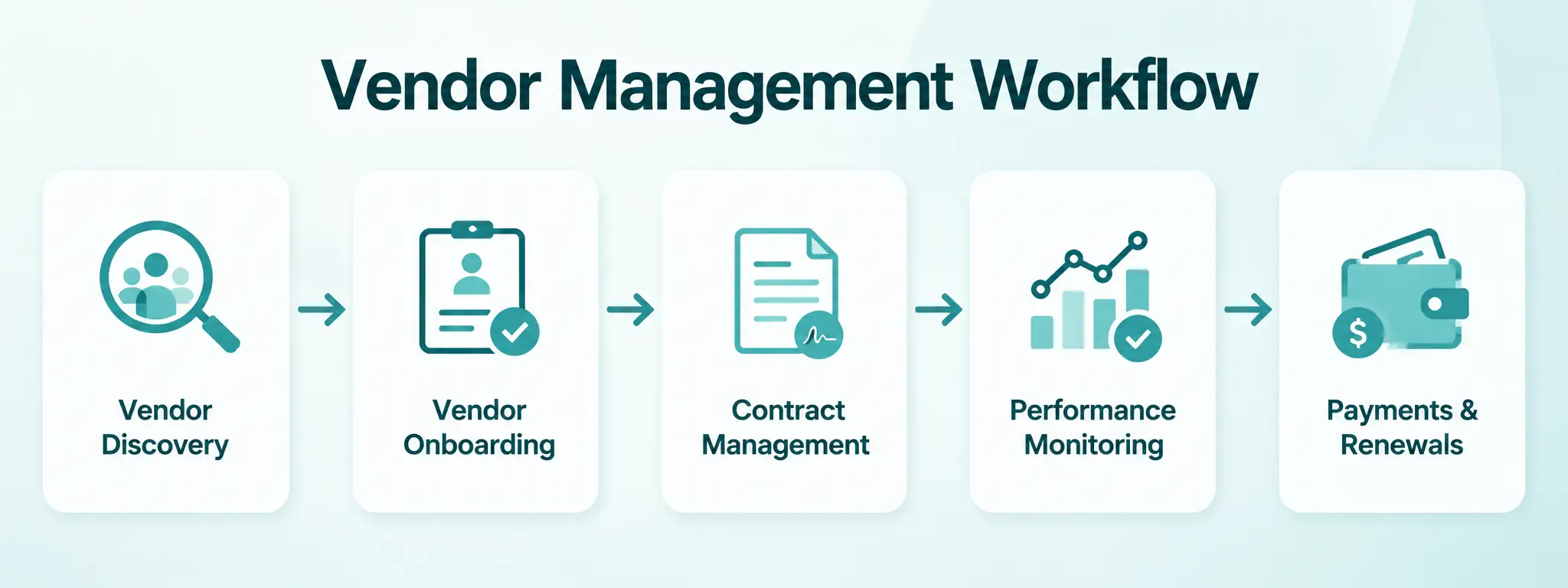
A VMS generally moves vendors through five connected stages, each building on the last.
Sourcing and Selection: Centralizes vendor discovery, RFP management, and bid comparison. Replaces scattered spreadsheets with a structured evaluation process.
Onboarding and Compliance: New vendors submit tax documents, insurance certificates, and compliance attestations, often through a self-service vendor portal platform. Automated checks confirm everything is current before access is granted. Smooth vendor onboarding ecommerce workflows are one of the clearest early wins of moving off spreadsheets. What used to take weeks now takes days.
Contract Management: Agreements are stored, version-controlled, and tied to renewal or expiration alerts. Nothing slips through unnoticed.
Performance Tracking: Dashboards track delivery times, quality metrics, and SLA compliance. Procurement teams get objective data to inform renewal or termination decisions, rather than relying on memory.
Invoicing and Payments: Approved invoices route automatically based on contract terms. This reduces manual reconciliation and late payment disputes.
Vendor Management vs. Supplier Management
The terms get used interchangeably, but they aren’t identical. Both fall under the broader umbrella of supplier relationship management, but they serve different parts of the business.
| Aspect | Vendor Management Software | Supplier Management Software |
|---|---|---|
| Primary focus | Relationships, contracts, performance, and risk across all third parties, including services and labor | Sourcing and procurement of physical goods and raw materials |
| Typical scope | Software vendors, agencies, contractors, logistics partners, and contract labor | Manufacturers, raw material providers, wholesalers |
| Core metrics | SLA compliance, contract value, risk score, satisfaction | Cost per unit, lead time, quality defect rate |
| Common owner | Procurement, IT, or operations | Supply chain or merchandising |
| eCommerce relevance | Manages the full third-party ecosystem behind the storefront | Manages the physical inventory pipeline |
Key Features of a Vendor Management System for eCommerce
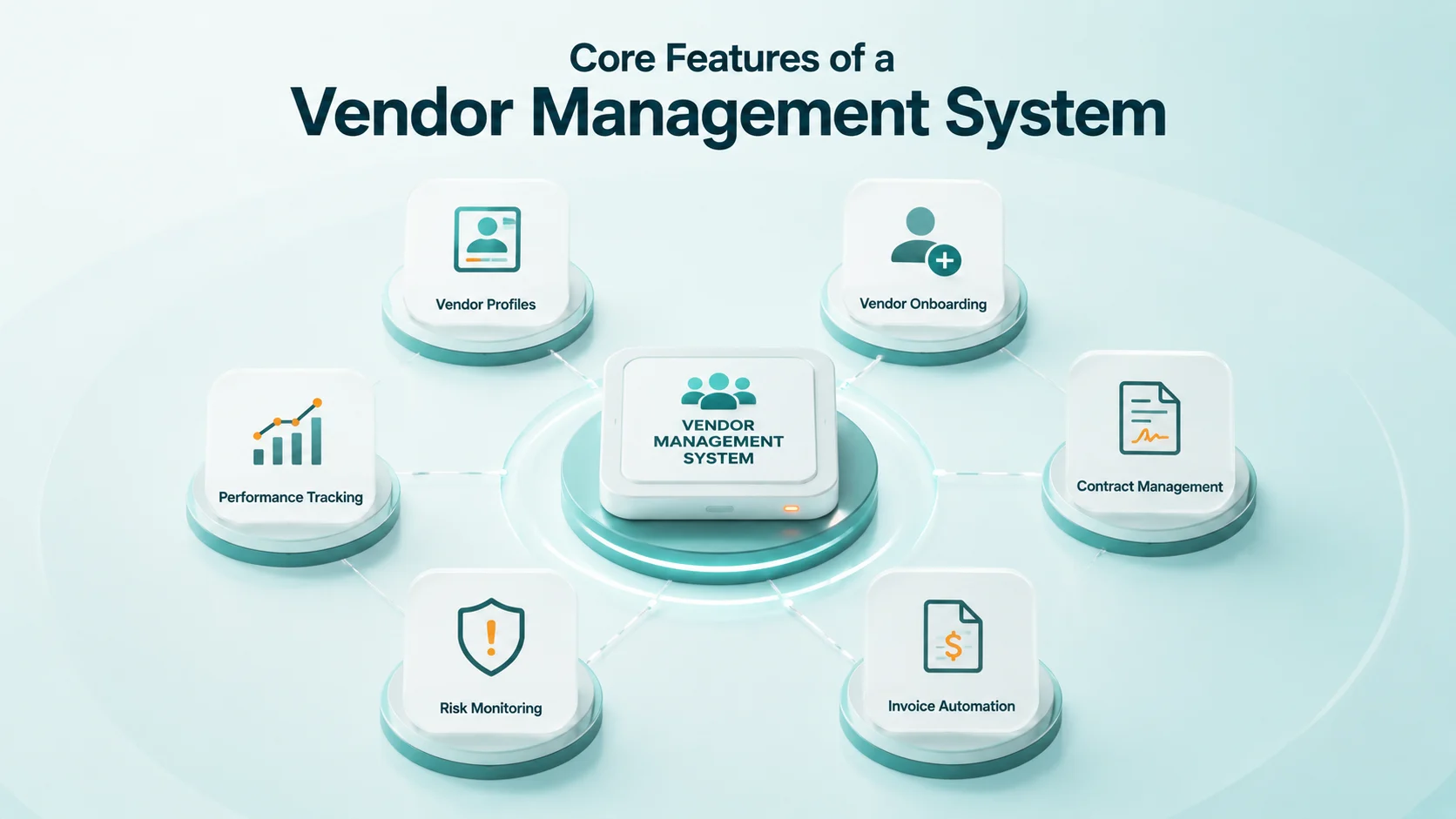
Top multi-vendor marketplace platforms built for eCommerce should include:
- Centralized vendor profiles and documentation. Contract, certificate, and contact details live in one record instead of being scattered across email and shared drives, so any team member can find what they need.
- Automated onboarding and compliance workflows. New vendors submit documents directly into the system, and automated checks flag missing or expired paperwork before access is ever granted, cutting onboarding time from weeks down to days.
- Contract lifecycle management with renewal alerts. The platform tracks every agreement’s terms and expiration date, surfacing renewals well in advance so procurement has time to renegotiate rather than being locked into unfavorable pricing by default.
- Performance reports and SLA tracking. Delivery times, defect rates, and response times are logged automatically, giving teams hard data for renewal or termination decisions rather than relying on memory or whoever last dealt with that vendor.
- Risk scoring and continuous monitoring. Security posture, insurance status, and compliance standing get checked on an ongoing basis rather than once at onboarding, catching problems before they turn into breaches or contract disputes.
- Invoicing and payment automation. Approved invoices are routed automatically in line with agreed contract terms, reducing manual reconciliation and late-payment disputes that quietly damage otherwise solid vendor relationships.
These VMS features deliver the greatest value when deployed as an integrated vendor management framework. Strong contract tools without risk monitoring still leave a retailer exposed to the third-party breach scenario described earlier.
Benefits of a Vendor Management System eCommerce
Retailers that consolidate vendor management onto one platform typically see:
- Fewer compliance gaps. Automated checks catch expired certificates, lapsed insurance, and missing documentation before they turn into audit findings or security exposures, instead of someone discovering the gap only after a vendor relationship has already gone wrong.
- Faster onboarding. New suppliers move from initial contact to active status within days rather than weeks, as self-service portals and automated verification replace the back-and-forth email chains that once slowed the process.
- Better negotiating leverage. Spend data finally lives in one place instead of being buried across departments, which means procurement can see total vendor spend clearly and negotiate from actual numbers instead of rough estimates.
Procurement teams stop chasing paperwork and start spending time on supplier strategy. Finance gets cleaner audit trails that hold up under scrutiny. Security teams get an earlier warning when a vendor’s risk posture changes.
Implementation Process in Vendor Management System for Ecommerce
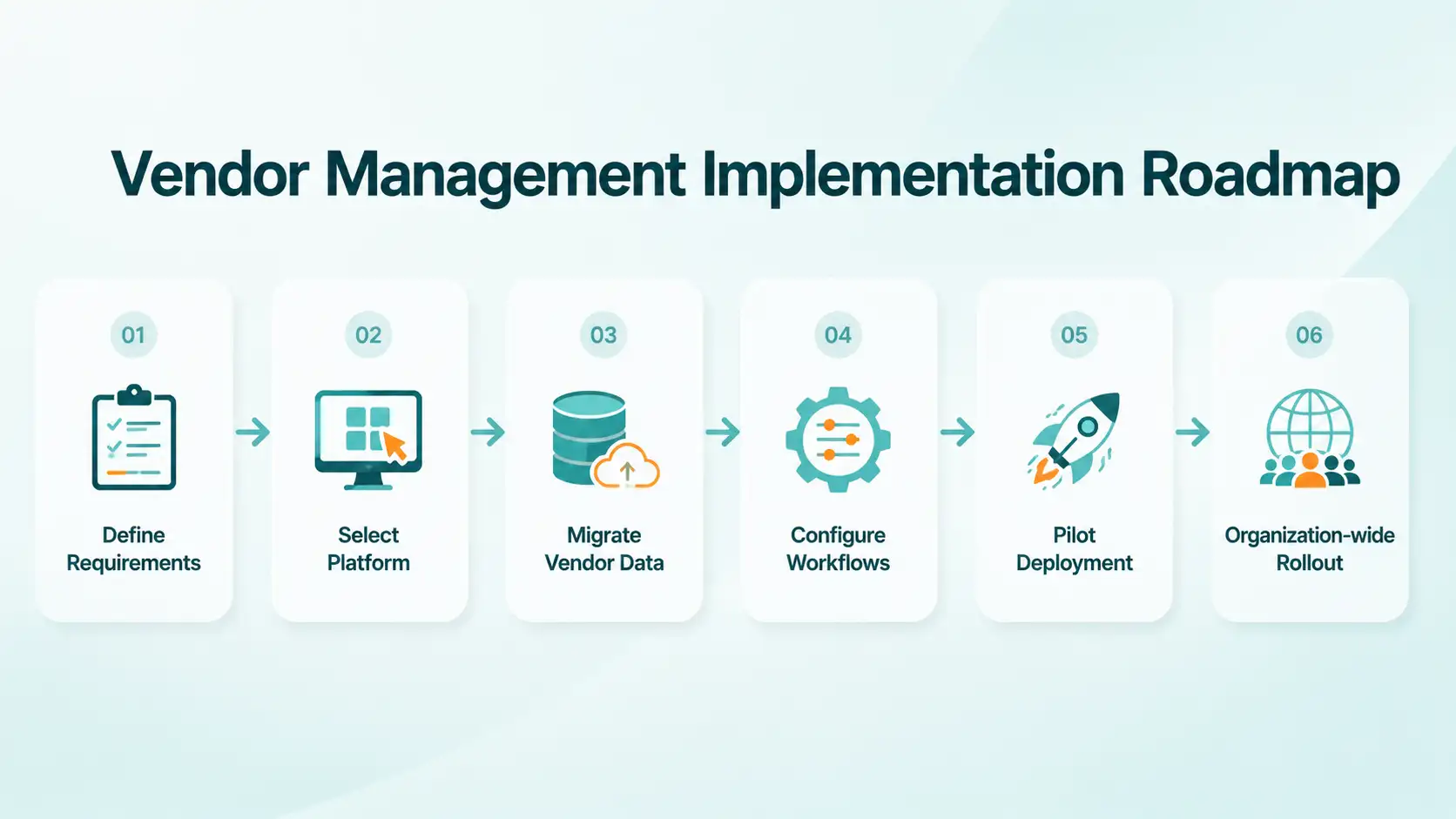
Most implementations follow a similar arc:
- Define requirements and stakeholders. Pull in procurement, finance, IT, and operations early to agree on the problems the system needs to solve. Early stakeholder alignment reduces implementation risks, scope changes, and adoption challenges.
- Select a platform. Shortlist providers based on integration fit, risk monitoring maturity, and pricing that scales with vendor count. Then, verify claims against references from similar eCommerce or retail customers.
- Migrate and clean existing vendor data. Audit current records for duplicates, outdated contracts, and missing documentation before moving anything into the new system. So, the platform starts with accurate data instead of inheriting old spreadsheet problems.
- Configure workflows and approval chains. Set up onboarding steps, approval routing, and renewal alerts to match how your teams actually operate.
- Run a pilot with a subset of vendors. Test the full workflow on a smaller, lower-risk vendor group first to catch configuration issues and gather internal feedback before committing the entire vendor network to the new process.
- Train internal teams. Walk procurement, finance, and operations through the new workflows directly, since adoption depends far more on comfort with the system than on how many features it technically offers.
- Roll out company-wide with ongoing optimization. Expand to the full vendor base once the pilot proves out. Then continue refining workflows and reviewing performance data as the vendor network and business needs grow.
Timelines vary by company size, but a mid-market eCommerce business should expect a few months from launch to full rollout.
Data migration is usually the longest single step. Skipping a proper data audit here is the most common reason implementations stall once they’re live.
Common Implementation Challenges and Solutions
| Challenge | Why It Happens | Practical Solution |
|---|---|---|
| Messy old vendor data | Years of varying records across spreadsheets and email. | Run a data audit before migration and assign ownership for cleanup. |
| Internal challenges to a new workflow | Teams default to familiar manual processes. | Involve procurement, finance, and IT early; pilot with a willing department first. |
| Integration gaps with existing ERP or accounting tools | Platforms are chosen without checking technical compatibility. | Confirm API or native integrations during the evaluation stage. |
| Underestimating onboarding time for vendors | Vendors aren’t prepared for new documentation requirements. | Communicate requirements and deadlines well ahead of the cutover date. |
| Lack of clear ownership after launch | The project team is divided once the system goes live. | Assign a permanent system owner responsible for ongoing governance. |
What to Look for in a Vendor Management System Provider
A few questions are worth asking before signing with any provider:
- Does the platform integrate cleanly with your existing ERP, accounting, and procurement systems without creating data silos or duplication?
- How advanced is its risk monitoring? Does it continuously check vendor security posture, or only at onboarding?
- What does implementation support actually include? Is data migration handled by the vendor or left to your team?
- Can pricing scale with your vendor count without becoming prohibitively expensive as you grow?
- Does the provider have verifiable references from eCommerce or retail customers specifically?
Providers that answer these clearly, with specifics rather than marketing language, tend to be the ones worth shortlisting. A vague answer to any one of these is usually a preview of how implementation will go.
Common Mistakes to Avoid
A few patterns show up repeatedly when VMS rollouts underdeliver:
- Buying before defining the problem. This leads to a tool that looks impressive in a demo, but nobody fully adopts it six months later.
- Migrating incomplete or outdated data. The new system simply inherits the same gaps as the old spreadsheet, with a nicer interface around them.
- Skipping vendor communication during the transition. Suppliers get confused about new documentation requirements, which slows onboarding right when speed matters most.
Avoid these three, and most implementation difficulties disappear before they start.
Expert Tips and Best Practices
- Start with your highest-risk and highest-spend vendors rather than migrating everyone at once.
- Set a recurring quarterly review of vendor performance data instead of letting dashboards go unused.
- Tie contract renewal alerts to a 60-day lead time so there’s room to renegotiate rather than auto-renew under pressure.
- Build vendor risk monitoring into onboarding from day one rather than changing it later.
Conclusion
The vendor management system in ecommerce has shifted from a simple procurement task to a critical, board-level priority. It has become a board-level priority as third-party risk, cybersecurity threats, and contingent workforce management have grown in strategic importance.
A well-implemented VMS gives procurement, finance, IT, and operations an accurate picture of every vendor relationship the business depends on.
The retailers getting this right in 2026 treat vendor management as infrastructure by consolidating fragmented tools. Plus, they build risk monitoring into onboarding rather than bolting it on later and use performance data to negotiate from a position of strength.
For retailers running a marketplace model, this discipline matters even more. Explore our marketplace management platform options if your vendor base is really a network of sellers rather than a handful of suppliers.
Work With SPXCommerce
Choosing the right vendor management approach can streamline procurement workflows, ERP integrations, compliance requirements, and your operations team’s day-to-day work.
SPXCommerce has spent years helping eCommerce businesses manage exactly this kind of operational complexity, from platform evaluation through to rollout and ongoing optimization.
Whether you’re evaluating a new VMS or modernizing your existing vendor operations, our specialists can help you identify the right strategy to achieve your business objectives.
Reach out to SPXCommerce to talk through what a vendor management strategy built for your specific operation could look like.