You’ve experienced this before: with just three weeks until Black Friday, your highest-selling SKUs are running critically low on stock, and your team is frantically manipulating spreadsheets to understand what went wrong. In the meantime, a competitor is sending replacement orders based on a model that detected the demand signal weeks ago.
This is the typical scenario for thousands of ecommerce businesses that continue to plan manually, make static predictions, and access data in isolation. Delays in stocking directly impact revenue. Too much inventory siphons cash flow. Businesses suffer from a lack of visibility into suppliers, which has a cascading effect on the end customer.
These are all the pain points that AI supply chain ecommerce solutions can address. AI continuously processes demand signals, supplier performance data, inventory levels, and logistics data to create a proactive and self-adjusting supply chain. The benefits are measurable: lower stockout rates, reduced carrying costs, faster fulfillment, and higher margins are all gains retailers realize when they switch.
In this guide, you will discover how AI is transforming ecommerce supply chains, with a focus on demand forecasting, inventory management, procurement, and logistics. We will delve into some of the most critical AI applications and tools, and the tangible ROI retailers are seeing through fewer stockouts, lower inventory expenses, faster fulfillment, and optimized operations.
What Is an AI Supply Chain?
In the context of supply chain, an AI supply chain is the use of artificial intelligence, such as machine learning models, predictive analytics, and intelligent automation, across all aspects of the supply chain, from supplier to customer. An AI-powered solution continuously monitors signals across procurement, inventory, logistics, and demand to identify issues and suggest solutions in real time, rather than waiting for a monthly report.
Think of a relay race where the baton carries supplier, warehouse, and carrier data, and each participant waits for the next handoff before taking action. In an AI supply chain, every stakeholder responds to the same real-time data, dynamically adjusting operations to keep the entire ecosystem synchronized.
Why AI in Supply Chain Matters Right Now?
The pace of ecommerce growth has driven customer expectations that most people now assume they can get products within a day or two. Meanwhile, the global disruption has also led to much more volatile supply chains.
The information that your business generates daily for every order, shipment scan, supplier invoice, and cart abandonment has signals in it that can enhance every decision you make. Without AI, businesses struggle to analyze and act on most of these valuable data signals.
AI in retail is far from a differentiator, and it’s becoming a standard for running a competitive ecommerce business these days. Not only are retailers missing out on efficiency, but they are also accumulating decision-quality debt.
What are the Top AI Supply Chain Use Cases for Retailers?
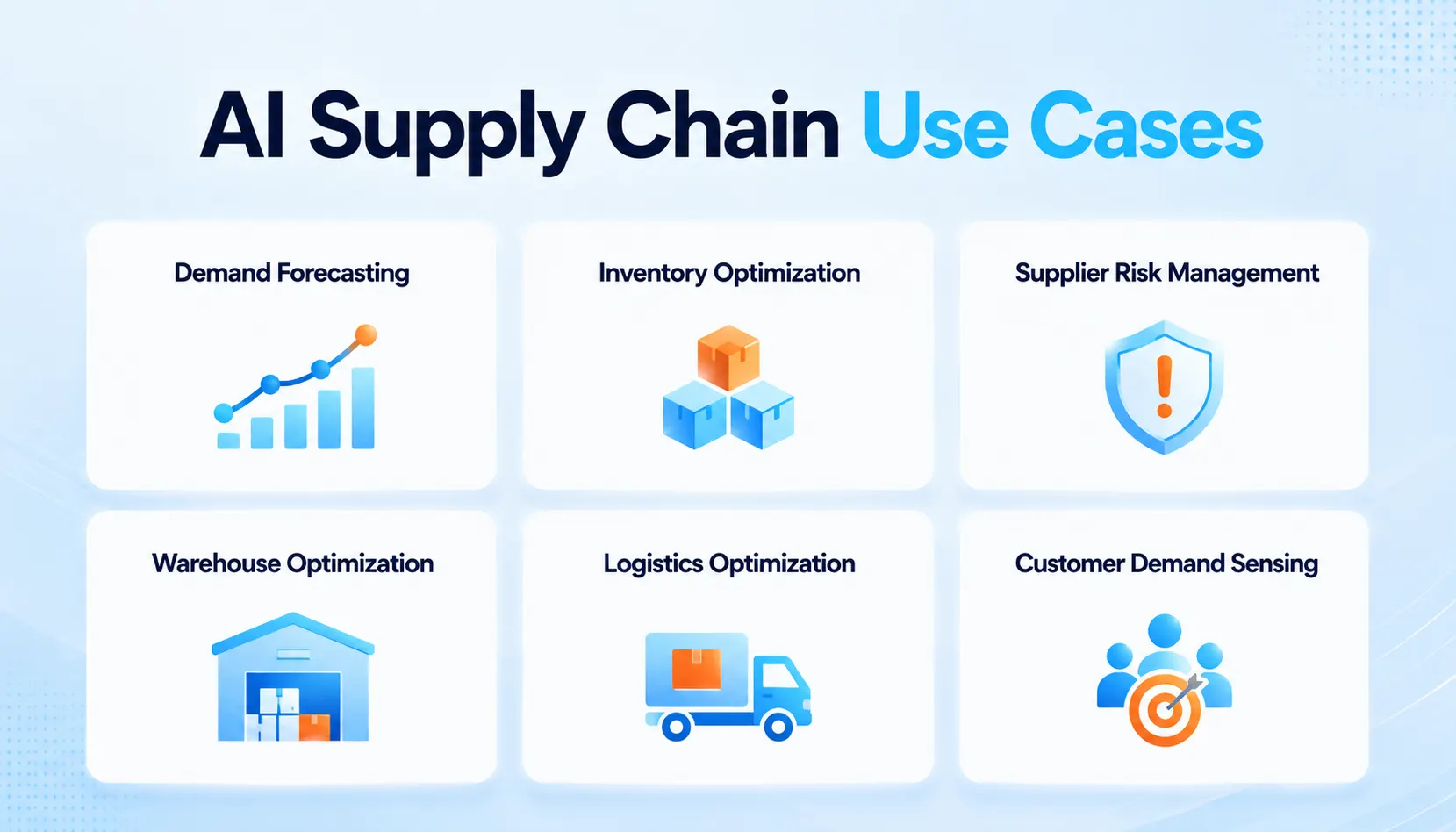
AI is revolutionizing the retail supply chain, from demand forecasting to logistics and returns. The use cases illustrate how retailers can apply AI to boost efficiency, cut costs, and enhance resilience.
1. AI Demand Forecasting
AI demand forecasting utilizes historical sales, website data, seasonal trends, promotions, and market indicators to produce highly accurate forecasts. AI is dynamic and continuously learns from evolving conditions, enabling retailers to keep their inventories at peak levels and prevent pricey stockouts.
2. AI Inventory Optimization
AI can assist retailers in identifying the optimal reorder points, safety stock levels, and inventory distribution among warehouses. This allows businesses to maintain optimized inventory levels, optimize working capital, and achieve higher product availability without investing in additional capacity.
3. Logistics & Route Optimization
AI analyzes shipping routes, carrier performance, delivery limitations, and traffic situations to determine the most efficient shipping methods. This helps retailers reduce fulfillment costs, minimize delivery errors, and increase customer satisfaction through timely, accurate deliveries.
4. Supplier Risk Monitoring
AI tracks supplier performance metrics, lead times, quality, and external factors such as weather conditions, economic fluctuations, and geopolitical events. By identifying risks early, procurement teams can take proactive action before supply chain disruptions affect operations.
5. Warehouse Automation
AI-powered warehouse systems prioritize tasks such as picking, packing, and replenishment based on urgency and operational efficiency. Retailers can improve their throughput, reduce unnecessary travel time, improve order accuracy, and scale without a substantial increase in labor by streamlining workflows.
6. Returns & Reverse Logistics
This involves using AI to analyze historical return data, customer behavior data, and product-specific data to forecast returns and identify common reasons. Retailers’ restocking, refurbishment, or liquidation decisions can be automated, thereby minimizing operational costs and improving reverse logistics efficiency.
Why Is AI Demand Forecasting Essential for Modern Supply Chains?
Demand forecasting forms the foundation of every supply chain decision. If you’re incorrect, your inventory is incorrect, your purchasing is incorrect, and your fulfillment is strained. Unlike static spreadsheet-based approaches, AI demand forecasting dynamically models changing customer behavior and adjusts forecasts before products reach store shelves.
AI demand forecasting models, for instance, can identify the web signal when it triggers a sudden surge of interest in a particular product category, and instruct replenishment triggers in mere hours. A regular monthly cycle forecast would not even have an opportunity to take place.
How Does Predictive Analytics Transform Retail Decision-Making?
Predictive analytics retail applications don’t just apply to demand; they also apply to pricing optimization, assortment planning, markdown timing, and customer lifetime value modeling. When fed back into the supply chain, these signals create a system that not only reacts to customer purchases but also predicts future demand and stocks products accordingly.
| Tool / Platform | Primary Function | Best For | AI Capability |
|---|---|---|---|
| SpxCommerce OMS | Order & Marketplace Management | Multi-channel retailers & marketplaces | Intelligent order routing and AI-powered fulfillment capabilities |
| Blue Yonder | Demand & Inventory Planning | Enterprise retailers | ML-driven forecasting and replenishment |
| o9 Solutions | Integrated Business Planning | Mid-market to enterprise organizations | Machine learning planning engine built on a graph-based architecture |
| RELEX Solutions | Unified Retail Planning | Grocery and FMCG retailers | AI-driven replenishment and allocation |
| Llamasoft (SAP) | Supply Chain Design & Simulation | Network optimization and supply chain modeling | Digital twin technology and scenario modeling |
| Spreadsheets + Manual Planning | Ad-hoc Planning | Very early-stage operations | No predictive or AI capabilities |
For ecommerce and marketplace businesses in particular, the most important layer is a system that integrates demand signals directly to order orchestration. This is where an intelligent order management system comes in handy, tracking orders and intelligently routing them according to AI-driven fulfillment logic.
Measuring ROI: What Retailers REALLY Get?
ROI from an intelligent supply chain can be measured in three ways: cost savings, revenue safeguarding, and working capital utilization. Here are the results of those, in real terms:
- Reduction in Inventory Carrying Cost (15–35%): AI Inventory Optimization establishes smarter safety stock levels, reducing cash tied up in surplus inventory without increasing the risk of stockouts.
- Stockout reduction (up to 65%): Inventory forecasting with ML can reduce stockouts by up to 65%, allowing replenishment before stock runs out.
- Accuracy gains (20–50%): Models that leverage real-time signals achieve higher overall forecasting accuracy and significantly higher accuracy for promotions and seasonal peaks.
- Logistics cost reduction (10 – 20%): AI route and carrier optimization provides more timely insights on shipping decisions, not after they’re made.
- Labor efficiency gains (15–25%): Warehouse AI reduces unnecessary movement and takes over repetitive decision-making for employees.
Best Practices for Implementing AI in Your Supply Chain
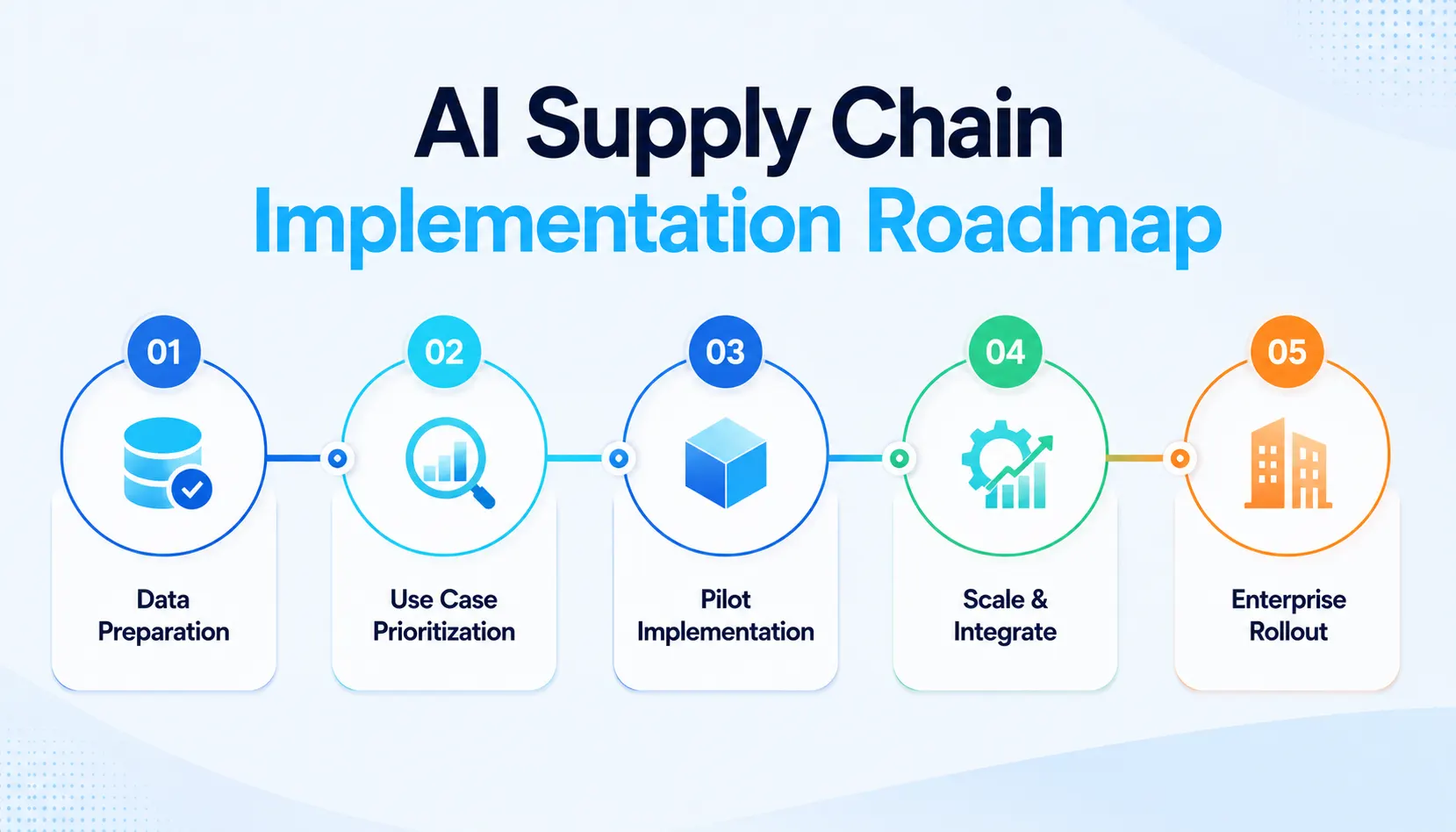
The key to implementing AI in the supply chain is to have the right data, goals, and people working together. Retailers who adopt a strategic, phased approach to implementation can not only achieve the highest ROI but also accelerate adoption and ensure sustainable operations.
1. Start with Data Quality, Not AI Tooling
Poor-quality data prevents machine learning models from generating reliable insights. Before implementing any AI platform, audit historical sales data, SKU master data, supplier lead-time records, and inventory accuracy. The 90-day data clean-up exercise can often be several times more valuable for model performance.
2. Prioritize Connected Systems Over Point Solutions
AI delivers maximum value when demand signals, inventory data, supplier information, and order management operate within a unified ecosystem rather than across disconnected platforms. When assessing technology, ask: Is the solution natively integrated with my OMS, ERP, and ecommerce platform?
3. Implement Incrementally
Avoid attempting to change the supply chain at once. Begin with AI demand forecasting for the top 20% of SKUs (by revenue). Test, verify improvement in accuracy, and gain stakeholder confidence before expanding the scope. It’s a good way to maintain organizational momentum with quick wins.
4. Keep Human Planners in the Loop
AI augments human judgment, not replaces it. The best examples of intelligent supply chain implementations are those that leave planners with a supervisory role. They review model results, make decisions based on their domain knowledge, and use system feedback to drive continuous improvements.
5. Choose a Platform Built for Ecommerce Scale
The SKU explosion, channel complexity, and ecommerce velocity can be stiff challenges for enterprise supply chain platforms for brick-and-mortar retailers. Select solutions specifically engineered for AI in a multi-channel, multi-warehouse, and marketplace environment, and where the data model aligns with the realities of the marketplace.
How SpxCommerce Powers an Intelligent Supply Chain?
The platform is designed specifically for businesses operating multi-vendor marketplaces and complex ecommerce ecosystems. The AI-driven supply chain solution on the platform integrates with every sales channel and feeds into an order orchestration layer that ensures the right products from the right supplier reach the right customer via the right fulfillment method.
The backbone is an intelligent order management system that not only places orders but also proactively routes them based on real-time inventory positions, carrier performance data, and fulfillment cost logic.
For marketplace operators, this enables automatic order routing based on seller performance and real-time inventory availability, allowing teams to focus more on customer experience.
From direct-to-consumer brands and third-party marketplaces to hybrid retailers, we provide the infrastructure needed to power intelligent supply chains at ecommerce speed.
Conclusion
AI is the game-changer in ecommerce supply chain management. AI can help businesses make faster, smarter, and more accurate decisions at scale, from demand forecasting to inventory optimization, logistics and supplier management, to fulfillment operations. Manual processes are increasingly unsustainable as customers’ expectations continue to grow and the supply chain becomes more complex.
Notably, the retailers who benefit from a competitive edge will be those who successfully use AI to translate data into insights and build more agile, resilient businesses.
The key to these benefits lies in establishing a robust data foundation, using AI strategically, and investing in connected systems, which can lead to substantial ROI for businesses. AI is driving a smarter, more predictive future for ecommerce supply chains.