A $500/month platform can cost more than a $2,000/month platform once development, integrations, apps, support, and scaling enter the picture. For marketplace builders, the gap gets wider: seller onboarding, commissions, vendor management, multi-store operations, and custom workflows can quickly turn a low platform fee into a high operating cost.
That is why eCommerce Total Cost of Ownership (TCO) matters. It shows what your platform will actually cost not just to launch, but to run and scale over the next 3–5 years.
In this guide, you’ll learn how to calculate eCommerce TCO, identify hidden costs, understand CapEx vs. OpEx, compare SaaS, open-source, headless, and marketplace platforms, and build a realistic budget. We’ll also examine how platform architecture can directly influence long-term TCO.
What is eCommerce Total Cost of Ownership?
Total Cost of Ownership (TCO) in eCommerce is the full financial cost of owning, operating, and growing an online selling platform, typically measured over a 3- to 5 year horizon.
It goes beyond the platform license or monthly subscription fee. TCO captures every dollar your business spends: initial development to integrations, infrastructure, maintenance, staffing, marketing tools, and platform upgrades.
The TCO Formula:
TCO = Initial (CapEx) Costs + Ongoing (OpEx) Costs + Hidden/Unexpected Costs
The result is expressed as a percentage of Gross Merchandise Value (GMV). Industry benchmarks suggest a healthy TCO-to-GMV ratio should stay below 1%. If your platform is consuming more than that, it signals either inefficiencies in your tech stack or scaling limitations inflating your cost-per-order.
A 2025 study found that 92% of eCommerce businesses listed cost savings as their top priority, but most failed to address the root cause: unmanaged TCO across a bloated tech stack.
The difference between a business that scales profitably and one that gets stuck is rarely the product, and it is the cost structure underneath.
Why Does TCO Matter More Than the Sticker Price?
A platform that looks affordable at $299/month can become your most expensive asset once you add integrations, developer retainers, plugin subscriptions, and transaction fees at scale.
Here is why TCO thinking matters:
- Platform comparisons are meaningless without it. Two platforms at the same monthly price can differ by 3x in 3-year TCO once you account for integrations and maintenance.
- Budget overruns cause scope cuts. When teams underestimate TCO, they cut design, QA, and features, weakening the platform’s foundation.
- Premature replatforming is expensive. Forced migrations due to rising costs are one of the biggest budget killers in eCommerce.
- Investor and CFO confidence depends on it. For any funded business or marketplace, a credible TCO analysis is essential for financial planning.
For anyone building or scaling a B2B or B2C marketplace platform, the stakes are even higher. A marketplace adds vendor management, commission processing, multi-seller logistics, and multi-currency complexity, each of which adds to your TCO if the platform was not built for it from the start.
The 8 Core Cost Components of eCommerce TCO
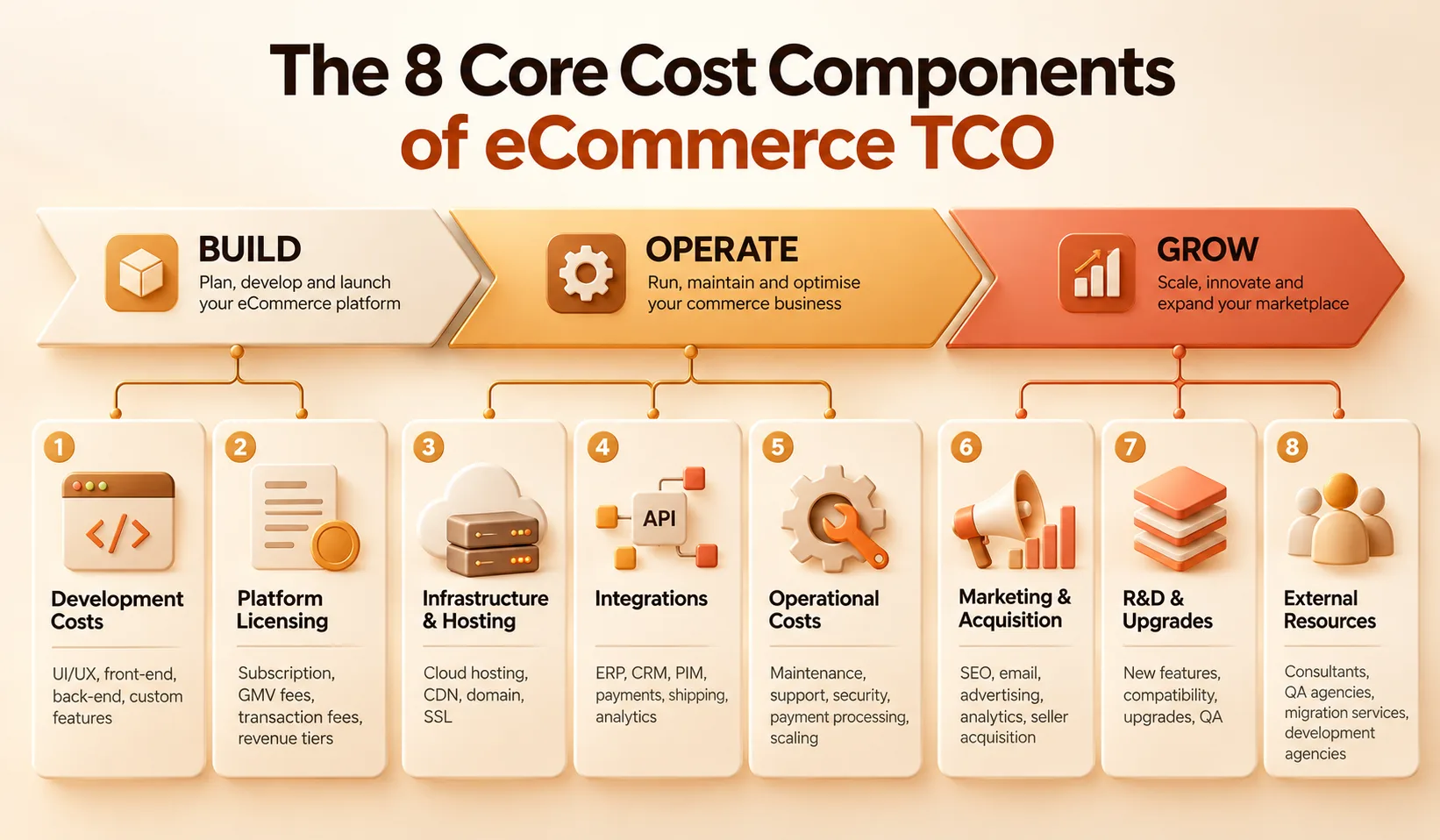
Calculating Total Cost of Ownership (TCO) requires looking far beyond initial platform development fees. Understanding these eight foundational cost centers helps you forecast accurately, protect profit margins, and avoid unexpected budget overruns.
1. Development Costs
Development is typically the largest upfront expense. It includes:
- UI/UX design: from templates to fully custom digital storefronts
- Front-end development: storefront build, responsive design, performance optimization
- Back-end development: business logic, integrations, API connections
- Plugin or app development: filling feature gaps not native to the platform
Custom builds range from $25,000 for an MVP to $300,000+ for a full-scale enterprise marketplace with native mobile apps. Marketplace development on generic platforms carries the highest overhead because multi-vendor features aren’t built in.
2. Platform Licensing
Licensing costs vary dramatically by model:
| Licensing Model | How It Works | Key Risk | Best For |
|---|---|---|---|
| GMV % fee | Percentage of all revenue | Compounds at scale | Early-stage brands |
| Revenue tier | Fixed fee per revenue bracket | Forced tier jump risk | Mid-market merchants |
| Transaction fee | Per-transaction percentage | Volume-sensitive | High-ticket catalogs |
| Flat SaaS subscription | Monthly or annual fixed fee | Feature ceiling | Predictable scaling |
3. Infrastructure and Hosting
Hosting costs scale with traffic volume and uptime requirements:
- Shared hosting: $10 to $50/month (suitable for early stage only)
- Cloud hosting (AWS, GCP, Azure): $200 to $2,000+/month for enterprise deployments
- Domain registration: $10 to $50/year (premium domains can cost significantly more)
- SSL certificates: Free via Let’s Encrypt to $200/year for extended validation
- CDN services: $50 to $500/month depending on traffic volume
4. Integrations
Every eCommerce platform needs to connect to ERP, CRM, PIM, payment gateways, shipping providers, and analytics tools. Each integration typically costs $1,000 to $10,000 to implement, plus ongoing API fees and maintenance overhead.
For marketplace platforms, integration complexity multiplies: you also need vendor onboarding systems, commission management, and seller analytics, areas where generic eCommerce platforms require significant custom work. This is why a custom-built marketplace solution carries meaningfully lower integration TCO.
5. Operational Costs (Ongoing)
Day-to-day operational costs are consistently underestimated in initial budgets:
- Platform maintenance: bug fixes, performance patches, security updates
- Customer support tooling and staffing costs
- Content management and merchandising resources
- Payment processing charges typically 1.5% to 3.5% per transaction
- Seasonal infrastructure scaling for Black Friday and major sales events
6. Marketing and Acquisition Costs
Your platform TCO does not end at the tech layer. SEO tooling, email marketing platforms, paid ad management, and eCommerce analytics solutions all factor into the cost of growing your store. For marketplace operators, seller acquisition and retention add a budget line that single-vendor stores don’t have.
7. Research, Development, and Upgrades
High R&D costs usually signal platform inflexibility. When a platform cannot be extended without expensive custom work, even minor feature additions become costly engineering projects.
Legacy monolithic platforms are particularly vulnerable major version upgrades can require full compatibility retesting, integration rebuilds, and weeks of QA time. SaaS and headless platforms handle upgrades automatically, keeping this cost low.
8. External Resources
Few businesses run entirely on internal talent. Common external resource costs include:
- SEO consultants for technical and content optimization
- QA agencies for release testing
- Data migration services during replatforming projects
- Agency retainers for ongoing front-end development and feature work
Rule of thumb: budget a 15% to 20% contingency for unexpected costs. Scope creep and integration surprises are the rule, not the exception.
CapEx vs. OpEx: How the Cost Split Actually Works
TCO breaks into two categories that any CFO or operations lead needs to understand:
| CapEx (Capital Expenditure) | OpEx (Operating Expenditure) | |
|---|---|---|
| Definition | One-time investments to build the platform | Ongoing costs to run and maintain it |
| Examples | Platform build, design, setup fees, initial integrations | Hosting, licenses, support, marketing, transaction fees |
| When it peaks | Pre-launch and launch phase | Grows with business volume |
| How to track | Project budget vs. actuals | Monthly or quarterly burn rate |
A healthy eCommerce business should see its TCO as a percentage of GMV remain stable or decrease as it scales. If your OpEx is growing faster than your GMV, something in your cost structure needs attention, usually integrations, platform inefficiencies, or staffing tied to manual processes.
How to Calculate Your eCommerce TCO?
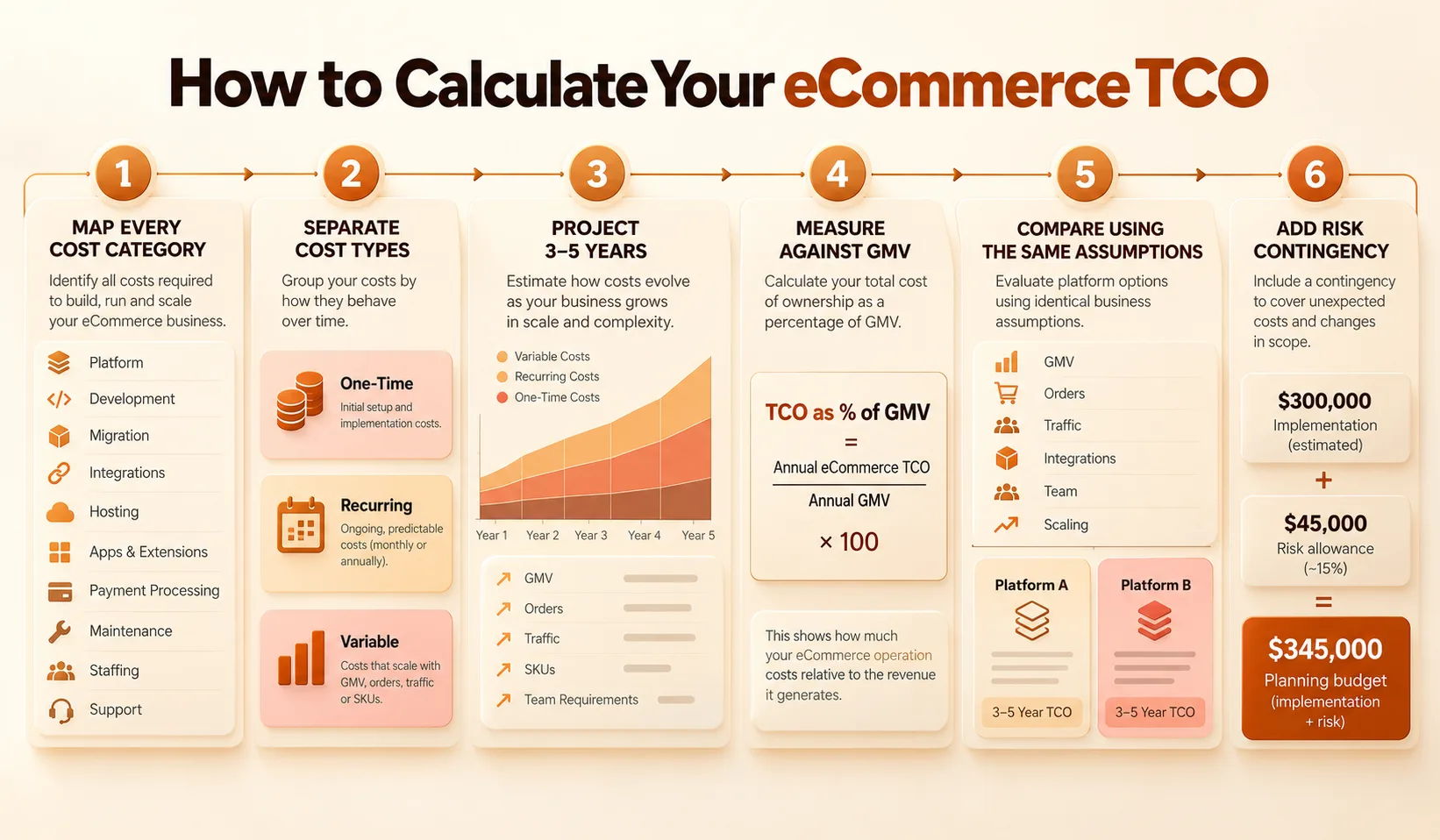
Calculating eCommerce TCO is more than adding up your platform subscription and implementation quote. A realistic calculation should account for the cost of launching, operating, maintaining, scaling, and eventually changing the platform over a defined period.
Step 1: Map Every Cost Category
Start by listing every cost involved in running the ecommerce operation, including platform fees, implementation, design and development, migration, integrations, hosting, apps, payment processing, maintenance, security, internal teams, and support. Also account for less visible expenses such as training, upgrades, new feature development, and future migration or exit costs.
Step 2: Separate One-Time, Recurring, and Variable Costs
Not every ecommerce expense behaves the same way. Separate one-time costs such as implementation and migration from recurring expenses such as platform licenses, maintenance, hosting, and support, and identify variable costs tied to orders, GMV, traffic, API usage, or transaction volume.
This makes it easier to understand which costs will remain fixed and which ones could increase as the business grows.
Step 3: Project Costs Over 3 to 5 Years
A platform that looks affordable in year one may become significantly more expensive over five years. Project your costs across a 3–5 year period and factor in expected increases in GMV, order volume, traffic, SKUs, markets, storefronts, integrations, development requirements, and team size.
For example:
- 3-Year TCO = Initial Costs + 3 Years of Recurring Costs + Planned Development + Scaling Costs + Exit/Migration Allowance
- 5-Year TCO = Initial Costs + 5 Years of Recurring Costs + Planned Development + Scaling Costs + Exit/Migration Allowance
Step 4: Measure TCO Against GMV and Other Business Metrics
Absolute TCO alone does not show whether the technology investment fits the size of the business. One useful metric is TCO as a percentage of GMV:
TCO as % of GMV = (Annual eCommerce TCO ÷ Annual GMV) × 100
You can also track metrics such as TCO per order, TCO per customer, or technology cost per storefront. These provide additional context when comparing platforms with different pricing and operating models. Don’t treat a fixed percentage, such as 1%, as a universal target because acceptable technology costs vary by business model and complexity.
Step 5: Compare Platforms Using the Same Assumptions
When evaluating platforms, use the same business assumptions for each option. Compare implementation, licensing, integrations, development, maintenance, infrastructure, internal resources, scaling, and other costs over the same 3–5 year period rather than comparing subscription prices alone.
Step 6: Add a Contingency Based on Project Risk
Ecommerce projects rarely follow the original scope perfectly. Integration complexity, data-quality issues, legacy-system dependencies, customization requests, and changes discovered during implementation can all increase the final cost.
Instead of automatically adding a fixed 15–20% to every project, use a contingency that reflects the project’s complexity and uncertainty. For example, a $300,000 implementation with a 15% risk allowance would require an additional $45,000, bringing the planning budget to $345,000.
TCO Comparison: SaaS vs. Open-Source vs. Headless vs. Marketplace Platforms
Platform architecture is the single biggest driver of long-term TCO. Here is how the main categories compare:
| Platform Type | Upfront Cost | 3-Year TCO | Flexibility | Best For |
|---|---|---|---|---|
| SaaS (e.g., Shopify) | Low | Medium-High (% fees + apps) | Limited | Small to mid B2C stores |
| Open-Source (e.g., Magento) | Medium | High (dev + maintenance) | High | Large enterprises with dev teams |
| Headless/API-first | High | Medium (once built) | Very High | Custom experiences, global scale |
| Marketplace Platform (SPXCommerce) | Medium | Low-Medium (built-in vendor tools) | High | Multi-vendor marketplace operators |
For businesses building a multi-vendor marketplace, purpose-built platforms like SPXCommerce deliver materially lower TCO because seller management, commission engines, and vendor onboarding are native features, not add-ons built via expensive custom development.
Hidden Costs That Silently Kill Your Margins
These are the costs that almost never appear in vendor pricing pages and that tend to cause the most budget shock:
- Transaction fees that compound at volume. Some platforms charge 0.5% to 2% per transaction on top of payment gateway fees.
- App and plugin subscription creep. A typical Shopify store runs 15 to 25 paid apps at $30 to $200/month each.
- GMV-based tier jumps. Revenue-based pricing models can force you into a significantly higher cost bracket when you cross a threshold, sometimes doubling your platform cost overnight.
- Replatforming costs. When a platform cannot scale, migration costs 3 to 12 months of disruption plus significant engineering investment.
- Support and SLA gaps. Slow support on complex setups adds cost through lost sales and developer troubleshooting time.
- Upgrade incompatibility. Legacy platforms often break existing integrations during major version updates, requiring full retesting and rebuild cycles.
A frequently cited industry analysis found that support costs (equipment and software) can run 5 to 8 times the initial purchase price over an asset’s lifetime. In eCommerce, this ratio often compresses into a 3-year window. (Source: BetterCommerce)
Best Practices for Keeping TCO Under Control
These are decisions that directly reduce your 3-year spend:
- Choose a platform where core functionality matches your model natively. Every feature added via plugin or custom code costs 5 to 10 times more than if it were built in.
- Audit your integration layer annually. Unused integrations still carry maintenance and licensing overhead.
- Track TCO as % of GMV quarterly, not just at launch. Catching cost drift early prevents expensive remediation later.
- Negotiate licensing early. GMV-based and tier pricing can often be locked in at better rates with a 2 to 3 year commitment.
- Invest in automation over headcount. Every manual process your team runs to compensate for platform limitations is a hidden OpEx cost.
- Plan upgrade cycles proactively. Reactive upgrades under production pressure cost significantly more than planned maintenance windows.
For marketplace operators, one additional lever stands out: seller onboarding automation. Every hour of manual seller setup is a recurring OpEx cost. Platforms with OCR-powered onboarding and AI automations can cut this cost by 60% to 70%.
How to Choose the Right Platform for Your Budget?
When evaluating platforms through a TCO lens, ask these questions before you sign anything:
- What does the pricing model look like at 3x my current GMV? GMV-based pricing that looks reasonable today can become untenable as you grow.
- What integrations does my business need that are not native to the platform? Every integration gap is a future cost line.
- What does the upgrade path look like? Platforms with painful major version upgrades will cost you repeatedly over a 3 to 5 year horizon.
- What does the vendor support SLA cover at my price tier? Slow support on a complex setup creates hidden costs in lost revenue and engineering time.
- What is the platform TCO as % of GMV for businesses similar to mine? Ask for case studies, not just demos.
- Is my business model natively supported? A marketplace operator running on a platform designed for single-vendor B2C will always pay a premium in customization costs.
For businesses building or scaling a marketplace, the most important question is whether the platform natively handles multi-vendor commerce, seller management, and commission workflows, or whether you will build those from scratch at high cost.
Why SPXCommerce Delivers a Lower TCO for Marketplace Builders?
SPXCommerce is a purpose-built, AI-powered marketplace platform designed to reduce total cost of ownership through its architecture and native capabilities, not simply lower pricing. Its native marketplace infrastructure includes seller management, vendor onboarding, commission management, and multi-store controls, reducing the need for costly custom development.
Its microservices and headless architecture let you scale, upgrade, or replace individual components without disrupting the entire platform, helping reduce long-term maintenance and upgrade costs. Built-in AI capabilities support OCR-based vendor onboarding, inventory forecasting, and demand planning, potentially reducing reliance on third-party tools and manual processes.
With transparent pricing and rapid deployment, businesses can model costs more predictably and reduce lengthy implementation cycles. Whether you’re building a B2B, B2C, D2C, or omnichannel marketplace, SPXCommerce provides purpose-built capabilities without requiring expensive workarounds for core marketplace functionality.
Conclusion
The platform that looks cheapest on day one is rarely the cheapest platform to operate. eCommerce Total Cost of Ownership gives you the visibility to see past launch pricing and understand what you are actually committing to over a 3 to 5 year period.
The calculus is straightforward: know your CapEx, model your OpEx, account for hidden costs that don’t appear on pricing pages, and measure everything against your GMV. When you do that analysis honestly, the right platform becomes clearer.
For marketplace builders specifically, the additional question is whether your platform was built for your business model. Generic platforms carry hidden costs that native marketplace development solutions do not, in development time, integration overhead, and operational complexity. Running a thorough TCO analysis before you commit is the most valuable investment you can make before you build.