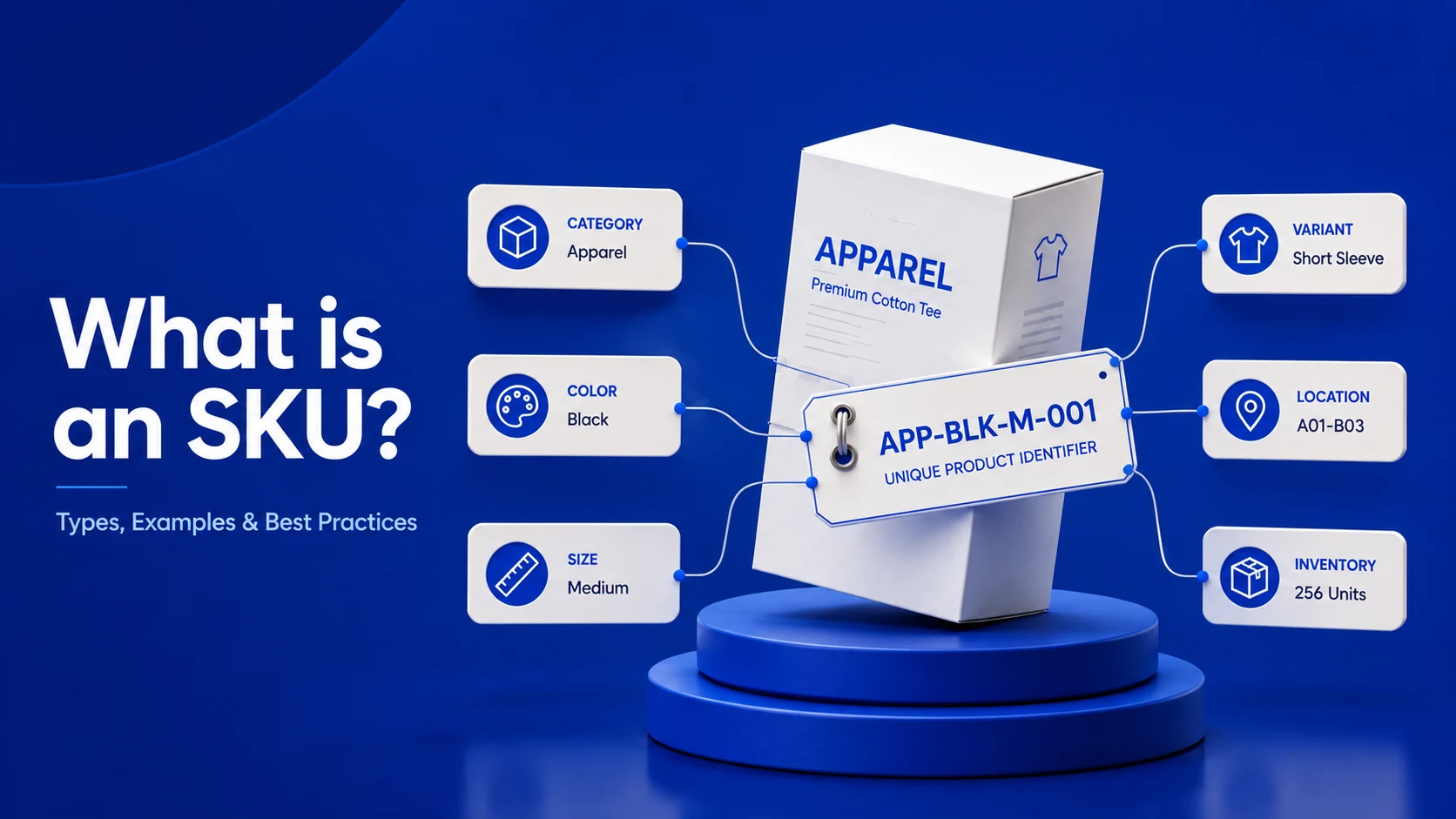
Most inventory issues actually come down to one thing because products can’t be recognized fast enough. Using multiple product codes or incorrectly managing product variants often results in fulfillment errors, such as shipping the wrong color or size.
As product catalogs grow into thousands of SKUs, spreadsheet-based inventory management becomes inefficient. The sales data is returned as a single dataset, and no one knows which one is actually selling and which one is languishing on a shelf. These challenges become increasingly common as product catalogs expand beyond what teams can manage manually.
A stock-keeping unit addresses this at the source by providing a unique identifier for each unique product, to the smallest detail of size, color, packaging, and more. With that, a warehouse team can scan rather than estimate, a buyer can pull sales-by-variant reports instead of estimates, and a platform can automatically send the appropriate item to the appropriate order. The payoff is immediate: reduced picking mistakes, more precise reordering, and a far more transparent view of what’s actually impacting revenue.
This guide delves into the definition of a SKU, the various types of SKUs used by businesses, how a SKU number is structured, and how to create a scalable system that will not be overwhelmed by an expanding catalog.
What is an SKU?
SKU (stock-keeping unit) is a unique alphanumeric code assigned by the business to a specific product or product variant to track that product among all other products in the catalog. Unlike a manufacturer’s part number, the SKU is an internal part. Therefore, the same physical product can have two different SKUs at different retailers depending on the structure of each retailer’s product catalog.
Each of the different ways an item can be stored, priced, or shipped (such as size or color, material, or bundle configuration) has its own SKU. Each product variation is tracked as an individual SKU rather than a simple spreadsheet entry. There are 12 different SKUs, each with its own stock count, cost, and sales history.
This is a problem that affects far more people than most would imagine. A small minority, typically the top fifth of SKUs, accounts for a large proportion of the revenue for retailers whose product offerings are structured the same way year after year, while a long tail of underperforming SKUs silently consumes space, labor, and system resources. In the absence of SKU-level data, that pattern remains unseen, and businesses continue to carry unsold inventory and order unsold inventory.
What Does SKU Stand For?
A stock-keeping unit is a literal term for a unit used to identify a product for stocking. It is the smallest unit a business holds in stock and records as its own product, or it could be a case of twelve that sells as one unit, or a single product on a shelf. The abbreviation stands for Stock Keeping Unit and is widely used across retail, ecommerce, warehousing, and supply chain operations.
For some, SKU is defined as a product, but this isn’t exactly the same. The product is a category of all running shoes, for example. It is the specific, orderable version that’s black, size 9, laced, and an SKU. This distinction becomes important as all inventory systems, purchase order systems, and sales reports are based on SKU rather than product.
Key Components of a SKU Number
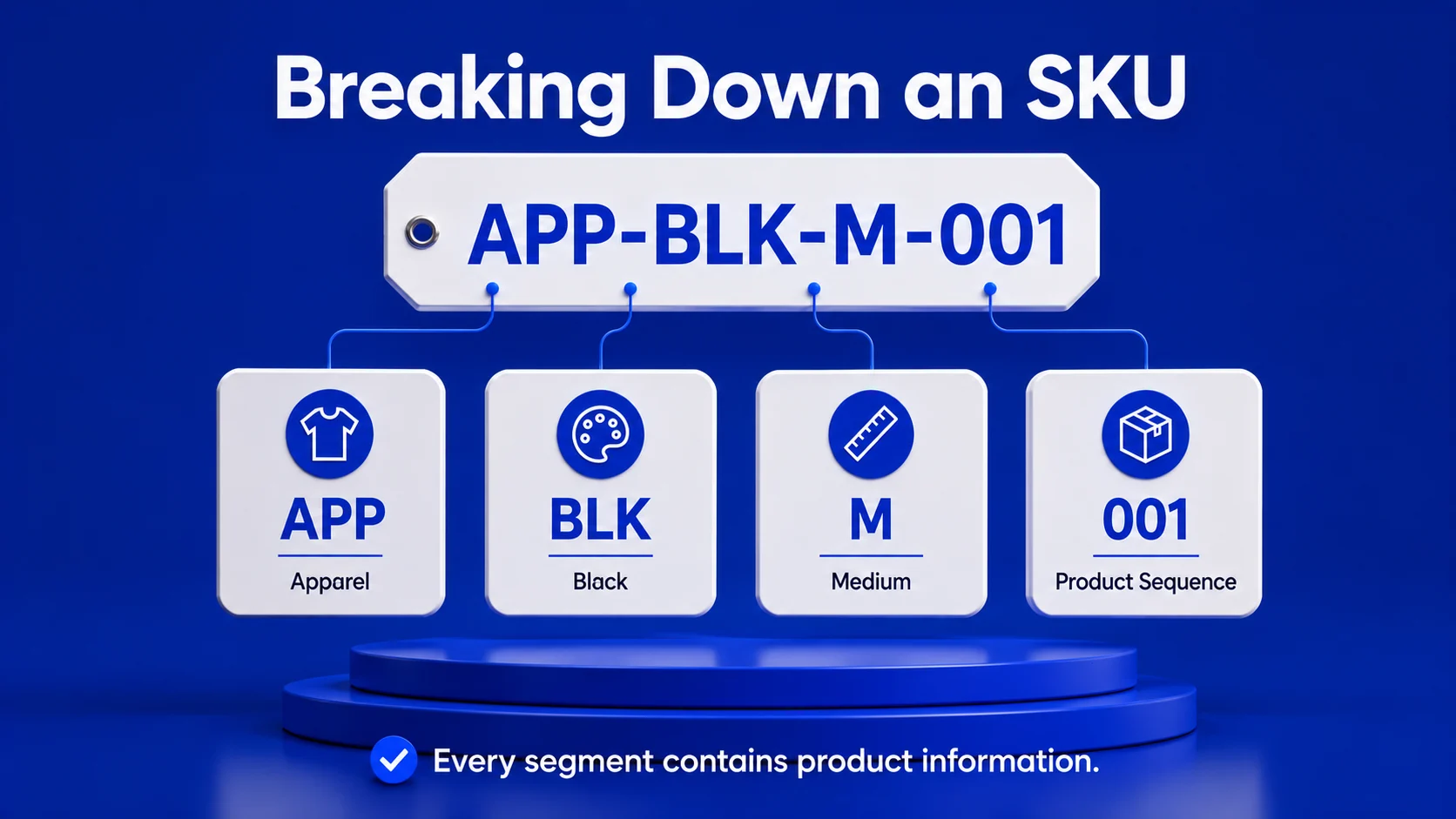
An effective SKU structure follows a logical and standardized format. It is typically organized so that someone familiar with the code can extract basic product data without opening the system. Most SKU formats are designed as a collection of a few building blocks:
- Category or Department Code: A general category or department code such as Apparel, Electronics, or Home Goods.
- Brand or supplier code: helps identify the product’s brand or supplier and is useful when a catalog includes multiple brands.
- Product attributes: size, color, material, or model are anything that makes this specific variation of the product different from a similar product.
- Sequential or unique identifier: a running number or short code that ensures that no two SKUs will be the same when all other segments are the same.
- Location code (optional): for stores with more than one warehouse, this means that a SKU will also refer to where the stock is physically located.
An online shoe shop might, for instance, have the SKU SHO-NIK-BLK-09-WH2: shoes, Nike, black, size 9, WH2 (warehouse two). That can be deciphered by anyone on the floor, and that’s the idea.
What are the Main Types of SKUs?
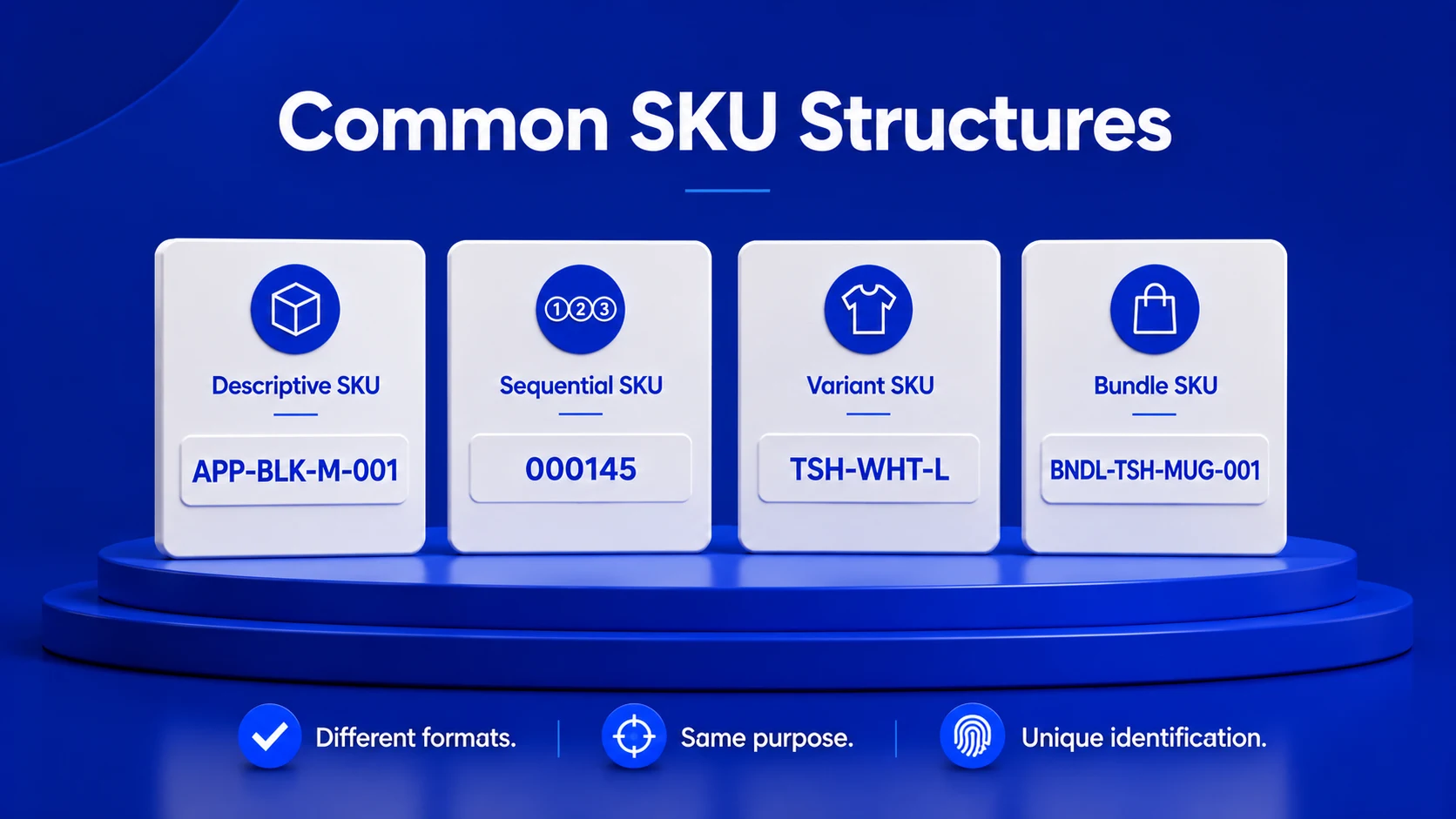
Not all businesses require a similar SKU structure. It will depend on the catalog’s organization and the number of sales channels it supports.
1. Simple Sequential SKUs
They may be a sequence of numbers or a brief code with no inherent significance, such as SKU-000482. They’re quick to create, and they’re easy to use for small catalogs, but they don’t provide any information to the warehouse worker without a lookup.
2. Descriptive (Encoded) SKUs
The above example, SHO-NIK-BLK-09-WH2, is built directly using category, attribute, and variant information. They have to be planned in advance, but are beneficial as the catalog expands, as staff may be able to recognize a product just by the code alone.
3. Variant-Based SKUs
Often utilized in the apparel and consumer goods sector, where a single “parent” product generates numerous “child” SKUs in terms of size, color, or pack size, etc. If a retailer offers one hoodie design in five colors and six sizes, the retailer manages 30 unique SKUs for a single product design.
4. SKUs for bundles or kits
Designed for a collection of products that are marketed and sold as a single package, such as a gift set or a start-up kit. The bundle is given its own SKU, not the individual items within the bundle, which allows for both the kit and its components to be tracked.
5. Channel-Specific SKUs
Common to sellers that sell the same product on multiple eCommerce marketplaces with different internal SKUs, but the same master stock product reference.
What is the difference between SKU, UPC, and Barcode?
These three terms are often confused, leading to inventory management errors. The actual difference is as follows:
| Aspect | SKU | UPC | Barcode |
|---|---|---|---|
| Assigned by | The wholesale or commercial business involved | A standards body (GS1) linked to the manufacturer | Depends on whether it can encode an SKU, UPC, or other identifier |
| Uniqueness | Unique within a single business’s system | Unique worldwide across all retailers | N/A, it is a format, not an identifier |
| Changes between sellers? | Yes, different retailers can assign different SKUs to the same product | No, the UPC remains the same for the product worldwide | Yes, the barcode changes if it is programmed to represent a different identifier |
| Main purpose | Inventory tracking, stock management, and internal reporting | Standardized product identification for retail and supply chains | Machine-readable representation of product information for scanning |
The UPC is the unique identifier assigned to the product once and for all and is used throughout its entire journey. The SKU is its internal filing tag for a particular business. The barcode is simply the symbol printed or scanned, and it contains a code that a scanner can read in half a second.
Popular Tools & Technologies for SKU Management
Having a few dozen products is fine, since you can maintain them on a spreadsheet. Beyond that, most businesses rely on separate systems:
- Inventory and warehouse management software: Monitors inventory per SKU in real time and automatically notifies when reorder points are reached.
- Point-of-sale (POS) systems: Connect each sale to an SKU to ensure real-time, accurate stock deductions.
- Product Information Management (PIM) systems: Pool all information about a product at a single level (SKU) and distribute it across all sales channels.
- Barcode and RFID scanning: Transforms SKU lookup and stock counting from a manual process to just a few seconds of scanning.
- Marketplace / multi-vendor platforms: When businesses sell across multiple channels or host multiple sellers, the platform must synchronize SKUs across all channel storefronts and ensure stock levels don’t go over or under.
This is the final point where many growing sellers face difficulty. If you allow each vendor to upload an online catalog to your business platform and you end up with dozens or hundreds of merchants, duplicate listings and SKU collisions can quickly become a problem. Without a structured product information management strategy, duplicate listings and SKU conflicts become increasingly difficult to manage.
What are the Best Practices for Creating SKU Numbers?
Having a SKU system that works on day one doesn’t necessarily mean it will continue to do so by year two if it’s not designed for growth. Some of the ways it remains durable:
- Make it brief and easy to read. Maintain SKU lengths between 8-16 characters, which is enough to convey meaning without being immediately comprehensible to everyone.
- Do not guess or use random codes. Descriptive segments (category, attribute, variant) help save time on each subsequent lookup.
- Don’t use a retired SKU. Historical sales information remains linked to the product as long as it is in use. If it is reissued, it invalidates the record.
- Avoid special characters that may cause problems for scanners. Use only letters and numbers, and do not use spaces, slashes, or symbols that some types of barcodes don’t recognize.
- Normalize in all channels. When the same product is available both in-store and online, the SKU mapping should remain the same otherwise, stock counts will become out of sync.
- Review the catalog regularly. Duplicate, near-duplicate, or abandoned SKUs slowly build up. They are caught before they cause a fulfillment error with a quarterly review.
How to Choose the Right SKU System for Your Business
While there is no one particular SKU format that works for all businesses, a few questions help narrow it down quickly:
What is the number of product variations you sell?
If the number of SKUs is limited (less than a few hundred), a simpler, semi-descriptive code can be used for a catalog. For larger catalogs, a completely organized, segment-based format is required.
Are you going to sell on several channels?
Then, the SKU system requires a mapping layer to maintain a single master product record across all stores, rather than maintaining separate product codes per channel.
Is there more than one warehouse that you manage?
Location-aware SKUs (or a system that tracks location independently of the SKU) prevent stock from going “missing” between facilities.
Will non-technical staff be reading these codes every day?
When it is necessary for warehouse or store personnel to look at a product to determine its identity, choose descriptive, human-readable segments over sequential numbering.
Most growing retailers will say the answer is that it’s not so much the SKU format that matters as the system that enforces it. Even with a solid design on paper, if any of these people can circumvent it, they will end up with duplicate or inconsistent code, which will break.
Why Businesses Choose SPXCommerce for SKU & Inventory Management?
Establishing and maintaining a clean SKU structure becomes much more difficult when a business hosts multiple sellers with their own catalogs or offers the same products across multiple stores simultaneously.
SPXCommerce is designed as a marketplace development platform for such a scenario, in which the centralized Product Information Management layer ensures that SKU data is consistent across all channels. The Order Management System automatically routes orders to the correct SKU and location, and AI-driven analytics and demand forecasting reveal which SKUs are generating actual revenue.
That combination makes SKU management no longer a manual and error-prone process for businesses planning to launch a multi-vendor marketplace or expand an existing catalog.
Conclusion
The right SKU design is not just about the labels, and it’s about efficient inventory control, quicker order processing, and informed business decisions. As your catalog expands, unique and consistent SKUs can help you track each product variation, avoid fulfillment errors, maintain accurate inventory, and identify the most profitable products.
The secret comes down to having an easy-to-operate, scalable SKU system and adhering to it in every sales channel and every warehouse. When coupled with effective inventory and product management systems, an effective SKU system empowers your team with insights, reduces costs, and supports sustainable business growth.
Whether you’re running a small online store or a large multi-vendor marketplace, a good SKU strategy now will save you countless hours of manual work, streamline inventory management, and establish a solid foundation for future growth.