Most enterprise retailers face fragmented systems, with inventory in one system, customer data in another, and storefront performance affected by complex integrations. This is the basic checkout flow that many corporations haven’t touched in the last five years, and their return process is still handled by email.
It’s not a technology issue. This is a sequencing issue. eCommerce digital transformation can only be successful when you have a clear idea of which layer to tackle first, and when all the downstream decisions flow from one source of truth for your customers, products, and operations. But it has long been forgotten in the backlogs of “digital transformation initiatives” and is constantly being pushed to the bottom of the stack due to a lack of consensus on how to get started.
If eCommerce digital transformation is executed properly, the ROI is tangible with improved conversion by up to 15% and a reduction in operational costs as automated systems manage fulfillment and returns. Along this, it provides the ability to quickly add new channels without the time and engineering of a six-month project.
This guide reveals what digital transformation in eCommerce entails, what tools enterprise teams are leveraging, and how eCommerce development platforms are helping retailers transition from brittle legacy stacks to composable, AI-ready commerce infrastructure.
What is eCommerce Digital Transformation?
eCommerce digital transformation involves reimagining business processes around connected data, composable technology, and automated workflows to improve customer experiences, support better decisions, and scale operations more efficiently.
It’s not about re-platforming or going headless, but it’s about going on a journey. You can move to a new storefront and even retain siloed data, broken supplier integrations, and no personalization engine. Digital ecommerce transformation affects the entire value chain from catalog management and pricing to fulfillment, customer experience, analytics, and the teams that support each.
According to McKinsey research, companies that have developed an advanced digital commerce system, which includes a unified data platform and API-first architecture. AI-powered personalization, experience a 1.5x increase in growth compared to peers who do not view digital commerce as an operating system. This gap is growing each year.
Why Can Enterprise Retailers No Longer Afford to Wait?
It’s not the rush of trend chasing. There are 3 important forces that are shortening time for enterprise teams:
1. Customer expectations are set by the fastest companies in any category
Shoppers increasingly compare digital experiences with the convenience and speed offered by leading ecommerce platforms such as Amazon. Cart abandonment remains high across ecommerce, with friction points such as slow page loads, complex checkout processes, and limited payment options contributing to lost conversions.
2. Legacy systems have compounding maintenance costs
As you put off modernization, integration debt piles up year after year. In 2019, the platform was ‘good enough’ and now demands special workarounds for each new channel, payment method, and fulfillment partner. Those workarounds break. Maintaining teams can be costly. And each new capability can become significantly more expensive to implement as integration debt accumulates.
3. AI capabilities are only accessible if your data is unified
Enterprise retailers are seeing AI influence search, merchandising, pricing, and customer service. However, an AI is only as useful as the data it works with. Without real-time integration with product catalog, customer records, and order history, you can’t reap any benefit from any of these.
What Are the Key Pillars of Digital Commerce Transformation?
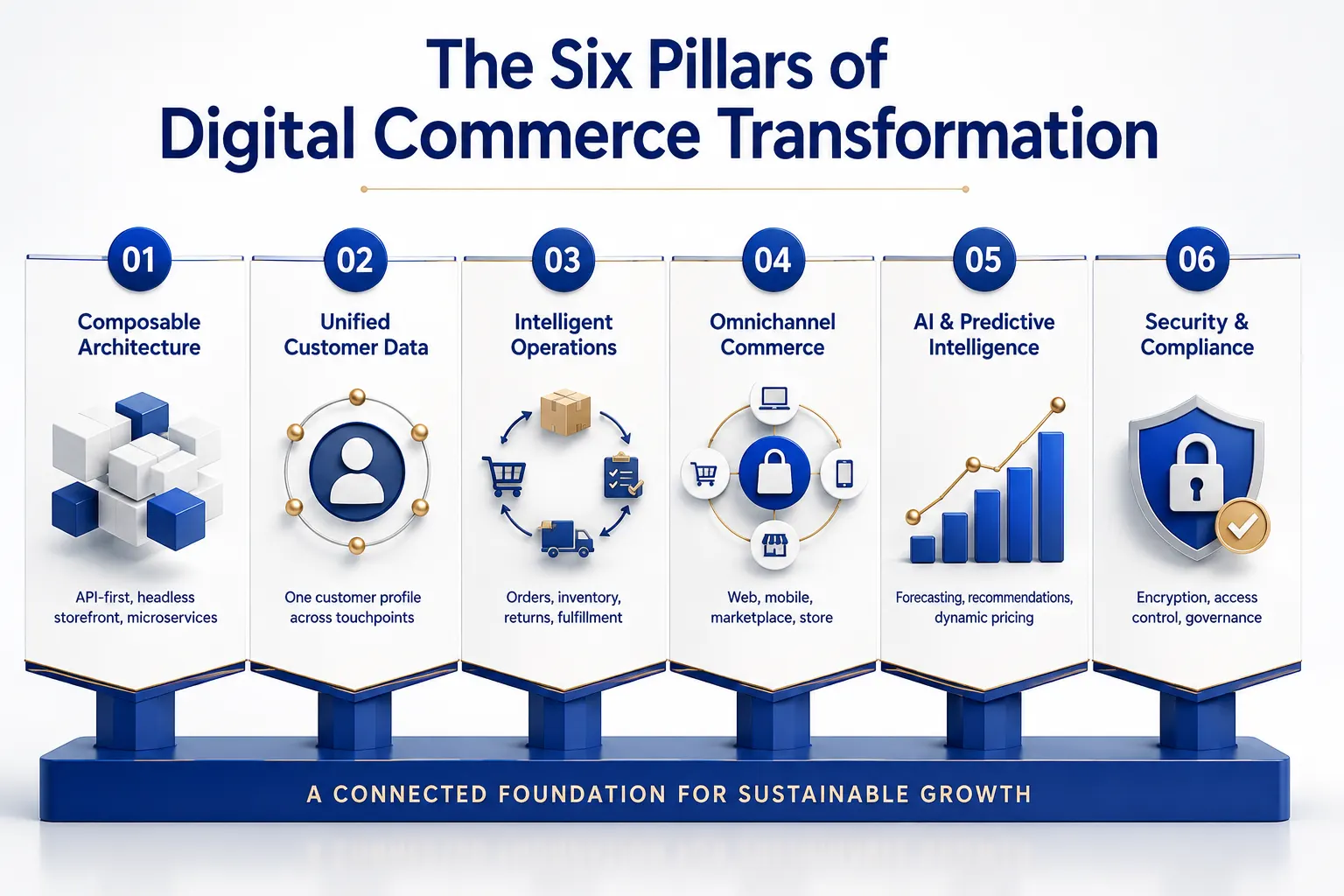
Consider these the six layers of enterprise change that all must tackle. Not doing one does not save time, but only postpones the task until later, when the building has been constructed on an insecure basis.
| Pillar | What It Covers | Transformation Outcome |
|---|---|---|
| Composable Architecture | API-first with headless storefront and microservices backend. | Empower new channels and capabilities in days, not months |
| Unified Customer Data | One customer profile, multi-channel/multi-touchpoint customer interactions. | When the personalization is based on actual purchase history and intent. |
| Intelligent Operations | Automated Order Management, Inventory, returns, and fulfillment. | Reduce cost to serve, manual error reduction, and delivery SLAs |
| Omnichannel Commerce | Seamless experiences on web, mobile, app, marketplace, and in-store. | Customers are free to purchase, return, and interact anywhere. |
| AI & Predictive Intelligence | Demand forecasting, recommendation engines, and dynamic pricing. | Increased conversion, decreased inventory, and less markdown spend. |
| Security & Compliance | Data encryption, access governance, PCI DSS, GDPR | Customer risk safeguarded; regulatory risk mitigated. |
What Does a Realistic 6-Phase Digital Transformation Roadmap Look Like?
The main reason enterprise transformation projects fail is not that they are using the wrong technology, but that the sequence is wrong. This phase structure accurately reflects what has been proven to work for big retailers.
1. Audit & Baseline
Understand your current tech stack, identify some integration debt, and define key metrics: conversion rate, cart abandonment, cost-to-serve, and time-to-launch for new features. Without measuring what’s broken, you can’t know what to fix.
2. Data Foundation
Integrate customer, product, and order information into a single, accessible layer. This is the basis of all subsequent uses of AI. Personalization and forecasting go hand in hand, but without clean, connected data, they just make bad decisions faster.
3. Architecture Migration
Head into API-first, composable infrastructure: headless storefront, microservices backend, modern Order Management System with an API that can communicate with all channels. This is usually concurrent with maintaining the current platform.
4. Pilot High-ROI Use Cases.
Avoid making all the changes in one single go. Identify two or three use cases that have clear, measurable payoff (e.g., checkout optimization, personalized recommendations, automated returns), and get that simple stuff working before going further.
5. Scale & Integrate
Scale up successful pilots, leverage new channels (Marketplace, Mobile App, In-store), and integrate your Product Information Management and Seller Management System for one unified operational view.
6. Continuous Intelligence
Enable AI-powered forecasting, dynamic pricing, and real-time BI dashboards. Your commerce infrastructure goes from being reactive to proactive, from adjusting inventory before going out of stock to finding margin opportunities before they’re gone.
What are the Ecommerce Digital Transformation Tools Enterprise Teams must consider?
Truthfully, there is no such thing as “one size fits all” when it comes to stacks. What is important is that your instruments are composable, that is, they can be replaced or extended without affecting everything else. With that in mind, enterprise retailers are investing most of their transformation dollars in the following areas today.
| Tool Category | What It Does | Enterprise Use Case |
|---|---|---|
| Headless Commerce Platform | Decouples storefront from backend using APIs | Start new stores and channels without internal re-architecture |
| Multi-Vendor Marketplace Engine | Seller Onboarding, Catalog Management, Commission Logic | Offer more variety without stocking up on products. |
| PIM (Product Information Management) | Rich Media, centralized catalog, data syndication | Product data standardized across all channels and regions. |
| OMS (Order Management System) | Order routing, fulfillment, returns automation | Minimize order errors and post-order hassles |
| AI & BI Analytics | Predictive forecasting, Customer Lifetime Value, Demand Planning | Simplify overstocking, better targeting, and eliminate margin leakage. |
| Mobile Commerce App | Android and iOS native Push and Offline support. | Capture the mobile-first shoppers with higher conversion than mobile web. |
How Do Leading eCommerce Digital Transformation Vendors Compare?
It’s difficult to sum up the vendor landscape, but it can be broken down into three groups: legacy monoliths with API layers bolted on (slow to change, but familiar to large IT teams). Pure MACH-architecture platforms that offer flexibility, but are difficult to implement, and full-platform solutions that combine composable architecture with native marketplace solutions, AI, and analytics features.
| Vendor Type | Strengths | Limitations | Best For |
|---|---|---|---|
| Adobe Commerce / Magento | Strong enterprise feature depth and a large partner ecosystem. | High TCO, complex upgrades, slow release cycles | Many big retailers are already entrenched in an Adobe environment. |
| Salesforce Commerce Cloud | CRM integration, plus strong B2C personalization. | Expensive licensing, few features native to the marketplace | Retailers who are already on Salesforce CRM |
| Commercetools | Highly composable pure MACH. | Has a lot of SI/implementation needs | Organizations with strong engineering resources. |
| BigCommerce | Great mid-market attributes, B2B assistance. | Restricts the flexibility for builds with multiple vendors in a marketplace. | These mid-market retailers are taking steps toward enterprise. |
| SPXCommerce (Multi-Vendor Marketplace) | No need to wait for 24 hours to set up your native marketplace, headless eCommerce, and AI BI in a single platform. | Newer platform; building the ecosystem. | Enterprise retailers introducing or expanding marketplace strategies that prioritize AI-powered operations. |
How Does SPXCommerce Transform eCommerce for Businesses?
Whether you’re a retailer or a brand, you need a marketplace, not just a storefront. For retailers and brands that need a marketplace, not just a storefront, SPXCommerce is the answer. The distinction matters.
A marketplace model enables enterprise retailers to offer more products without holding inventory, integrate 3rd-party sellers, and collect commissions, all while giving consumers more choice. This is a different way of doing business than a typical eCommerce solution, and the infrastructure needs to support that type of operation.
Let’s look at why SPXCommerce is relevant for an enterprise digital transformation roadmap:
- Headless eCommerce architecture: API-first, decoupled storefront with a React front end so that the front-end team can ship new experiences without having to do anything on the back end.
- Multi-vendor marketplace engine: Built natively in the platform and not bolted on, seller onboarding, commission management, catalog control, and vendor analytics.
- ProactiveAI: Conversational analytics, predictive demand forecasting, and AI-powered multilingual content that enables teams to make decisions on natural language queries, not wait for analyst reports.
- Centralized PIM: Scale and manage, enrich and syndicate product catalog data from one place to all channels and regions.
- Integrated OMS: Real-time inventory-based order routing, automation of order fulfillment and customer notification.
- ISO 27001:2022 security: Enterprise-level encryption and self-hosted deployments for teams who have data governance requirements.
- Microservices architecture with 2-second average load time: Built to handle the increased demand during peak season without compromising customer experience. Microservices architecture is designed to support performance during peak demand, with platform performance depending on implementation and workload.
SPXCommerce is a strong option for enterprise teams evaluating an omnichannel eCommerce platform. It offers the composability of a MACH-architecture platform, alongside out-of-the-box marketplace and AI features typically provided by multiple vendors and requiring months of integration.
How Do You Choose the Right eCommerce Transformation Platform for Your Enterprise?
The most important evaluation factors that impact enterprise teams do not often appear in the vendor pitch deck. Now, here are the steps for pressure-testing:
Does the architecture support your growth model or just your current model?
If you’re thinking of starting a marketplace, expanding regions, or introducing B2B self-service in addition to B2C, ensure the platform was built for marketplace functionality and/or B2B self-service, not just a marketplace. A monolithic platform with a marketplace add-on will create the same integration debt you are trying to avoid.
How does the platform handle your data and who controls it?
Most of the enterprise retailers are looking for self-hosted or private cloud deployments, particularly in regulated markets. Know where your customer and transaction information is stored, how it’s protected at rest and in transit, and what would happen to your information if you left.
What does the total cost of ownership actually look like?
License fees are not necessarily the primary expense. The cost of the platform is merely a small fraction of the implementation, integration, continuous customization, and engineering costs of a complex stack. Platforms that are straightforward to implement and have clear pricing, such as SPXCommerce’s pricing, have a lower TCO than enterprise platforms with lower headline fees but higher implementation costs.
Can you get to value fast enough to justify the investment?
In most enterprise transformation projects, the 18-month timeline to results is not long enough for the results to last once the project is finished. Find platforms that offer incremental deployment, so you can establish a successful marketplace or new eCommerce storefront within weeks and gradually roll it out as you build trust in it.
Where Should Enterprise Retailers Start Their Digital Transformation?
Start with the honest audit and identify the cost of your current stack in engineering effort, lost sales, and customer friction. That audit typically identifies 2 or 3 key interventions that have high leverage, typically at checkout, order management, or data unification, and that can deliver meaningful results in a quarter.
The overall shift comes next. These work alongside a strong base provided by architecture migration, marketplace expansion, and AI-driven merchandising.
If enterprise retailers are considering platforms that can support the current patch and the future vision, then SPXCommerce’s marketplace solutions, such as headless commerce, multi-vendor infrastructure, and ProactiveAI, should definitely be taken into consideration. The platform was built around the premise that marketplace capabilities can play an important role in modern enterprise commerce.