
A shopper visits an eCommerce product page, compares variants, has a question about size or delivery, and then leaves without adding the product to their cart. Size guide not found. No live support. No follow-up. The sale was lost in the chasm between thought and deed.
Conversational commerce is designed to address that disconnect. Where consumers are torn between options on a static website, conversational AI fills the void, answering questions, highlighting relevant options, and steering them toward a purchase, all without friction. The results are tangible: Brands with AI chat report a purchase completion rate of 12.3%, whereas brands without conversational support on their sites achieve only a 3.1% purchase completion rate (Rep AI, 2025).
The guide outlines the facets of conversational commerce, its technical aspects, the most effective use cases, and how platforms such as SPXCommerce integrate it seamlessly into the marketplace stack.
What Is Conversational Commerce?
Conversational commerce is the practice of using messaging platforms, such as AI chatbots, voice assistants, WhatsApp, SMS, and social DMs, to enable the entire shopping experience. This includes everything from product discovery and personalized recommendations to order handling, checkout, and after-sale support.
Uber’s Chris Messina coined the term in 2015, but the idea has grown far beyond its origins in convenience customer service chatbots. Today’s conversational commerce systems are inference engines, meaning they read the implications of real-time customer behavior, pull data from a single customer profile, and use machine learning to decide the next best action, rather than the next scripted reply.
How Does Conversational AI Commerce Work?
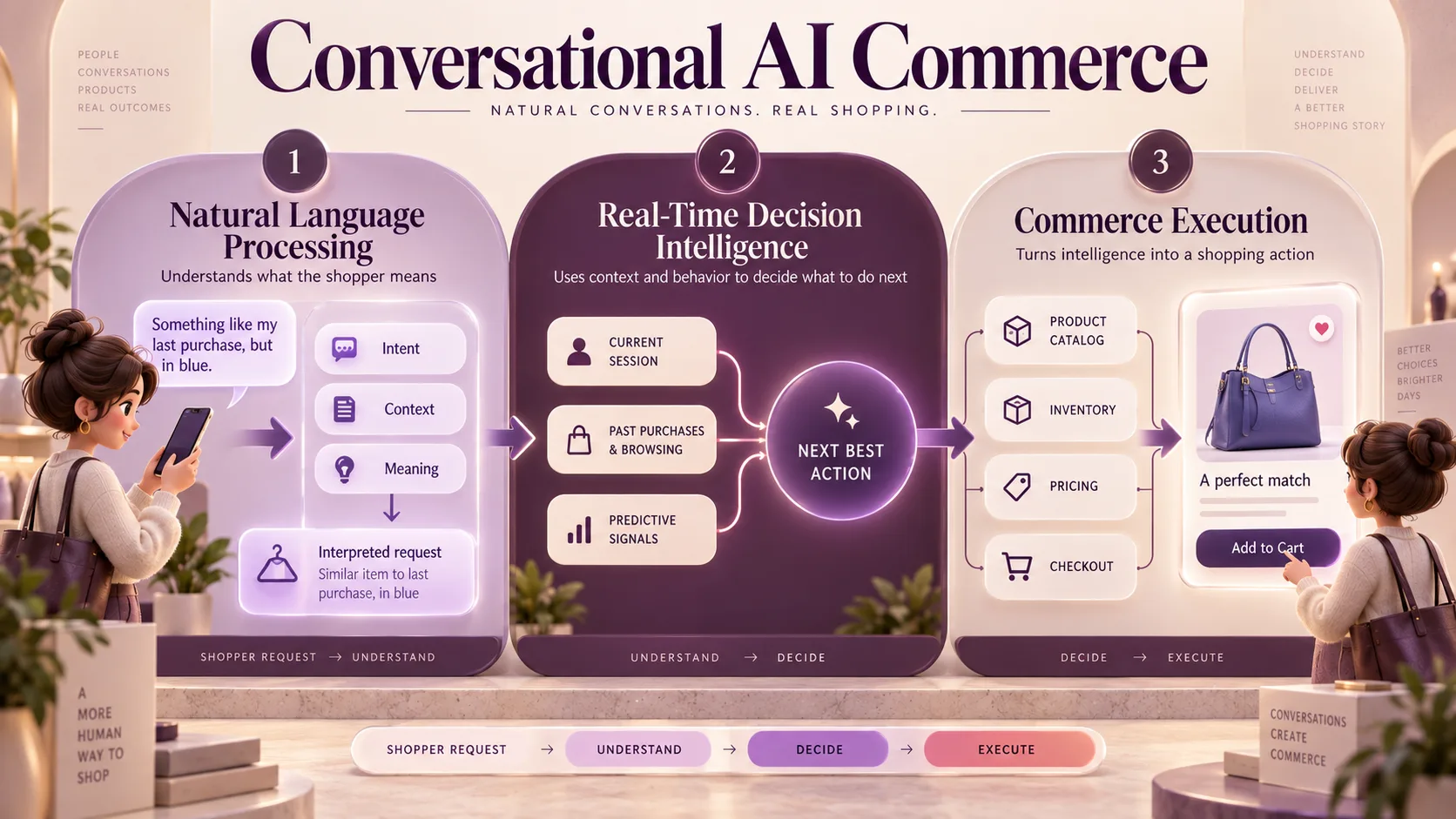
The technical aspects of conversational AI commerce include three layers that function together: language understanding, decision intelligence, and commerce execution.
Layer 1: Natural Language Processing (NLP)
The system doesn’t merely pattern match on the keywords when a shopper types in something like “I want something similar to what I bought last time but in blue. NLP tokenizes the input, tags its grammatical roles, and performs semantic analysis to determine intent. The output is not a keyword match, but an understood request with context.
Layer 2: Real-Time Decision Intelligence
Conversational AI does so much more than just chatbots. Once the system understands the user’s intent, it then cross-references it with real-time behavioral data (current session), data from previous sessions (past purchases, browsing), and predictive models (conversion probability, upsell likelihood). It then calculates numerous possible future moves in the game and picks the one that it thinks will be most beneficial.
Layer 3: Commerce Execution
The response isn’t the end of a decision. The system can be seamlessly connected to product catalogs, inventory management systems, pricing engines, and checkout processes. Shoppers can browse, compare, and transact in the conversational interface without page jumps or opening new tabs for forms.
Conversational Commerce vs. Agentic Commerce
This distinction is important in 2026, but not as much as 2 years ago, since both terms are being used interchangeably in vendor marketing, and sometimes inappropriately.
Conversational commerce is an interactive form of eCommerce. A customer starts a dialog, the AI replies with appropriate information, a recommendation, or a checkout call to action, and the customer takes the next step. The human remains in control of all decisions. The purpose of the AI is to minimize friction within that process.
Agentic commerce is a task-driven, mostly independent approach. The AI agent is given a goal and autonomously carries out the entire workflow from browsing, comparing, deciding, to ordering without the human agent needing to confirm each step.
| Dimension | Conversational Commerce | Agentic Commerce |
|---|---|---|
| Who initiates? | The shopper initiates the discussion. | The agent works on a “standing goal/trigger” |
| Human involvement | High, all important decisions are the shopper’s | Low: agent performs end-to-end fully independently |
| Interaction style | Back-and-forth dialogue | Single instruction → multi-step execution |
| Trust requirement | Moderate, shopper will refuse any suggestions | High, agent can make real actions (buys, places orders) |
| Best suited for | Product discovery, directed purchase, support. | Replenishment, Price Monitoring, Auto Purchase |
| Current maturity | Used on a large scale | Early adopters (mainly B2B and subscription applications) |
What Are the Different Types of Conversational Commerce?
Conversational commerce isn’t a single channel, but it’s a collection of interaction models, each designed for different shopper situations and business objectives. This difference matters because what works well for a “WhatsApp-first” market differs from what works for a B2B procurement process. Let’s look at how each one does work in the real world.
AI-Powered Chatbots

AI chatbots can help shoppers find products, answer frequently asked questions, provide size and fit advice, resurface carts, and qualify leads. Most AI chatbots can better process specific requests and comprehend conversational context, unlike rule-based bots.
Messaging App Commerce

Shopping has moved to where customers are most comfortable with WhatsApp Shopping, Instagram Shopping Direct Messages, and Telegram Direct Shopping. Customers can find products, ask questions, get suggestions, find their carts, and interact post-purchase, all within the messaging context.
Voice Commerce

Voice commerce lets customers search for products, make repeat purchases, and reorder using voice assistants like Alexa, Google Assistant, and Siri, without using their hands. It works best for regular purchases and subscription services, but is less effective for comparison shopping.
Live Chat with AI Assist

Live chat blends human expertise with AI support. With AI’s help, product knowledge can surface, ideas can be suggested, upsell opportunities can be identified, and churn cues can be noticed, while humans remain engaged in the conversation and final customer interaction.
What Are the Key Features of Conversational Commerce?
Conversational commerce merges conversation and shopping, using AI to guide customers in finding, evaluating, and buying products. Key features include:
- Real-time personalization: Recommendations change in real time based on what the shopper is doing, not what they did last month.
- Continuity across channels: A conversation that begins on a website continues on WhatsApp without losing cart, preferences, or previous context.
- Intent detection: The system detects purchase intent signals (dwell time, comparison, return visits) and initiates an appropriate response before the shopper leaves.
- In-conversation checkout: Customers check out without leaving the chat interface, streamlining the checkout process and eliminating drop-off points.
- Human escalation with context: Once AI switches to the live agent, the entire conversation is passed on, with no “could you please repeat that?”
- Post-purchase engagement: Order tracking, returns, upsells, and review requests are all part of the same conversation.
- Voice and SMS support: Conversational commerce isn’t just about chat; voice assistants (Alexa, Google Home) and SMS can reach customers on all devices.
How Conversational AI Boosts Conversions and AOV?

Conversion rate and AOV gains with conversational AI aren’t arbitrary—they’re based on clear logic. Conversational AI can affect various parts of the purchase experience by reducing friction, creating personalized recommendations, recapturing high-intent shoppers, and streamlining the path to purchase.
Frictionless Journeys Remove Drop-Off Points
An unanswered question may cause a shopper to stop purchasing: “Does this fit wide?” “Will it be here before Thursday?” or “What’s your return window?” In the shopping journey, conversational AI can answer these questions immediately, ranging from delivery times, sizing, return policies, payment options, and even trust issues before they cause consumers to abandon their carts.
Context-Aware Personalization Drives Precision Upsells
Conversational AI can offer specific product suggestions and complementary products, rather than generic “you may also like” recommendations, based on real-time signals such as product views, searches, comparisons, and product variants. This supports upselling without feeling intrusive, improving conversion and average order value.
Cart Recovery Captures Warm Intent
AI can identify abandoned shopping carts in real time and use the right answer, the right cart, or incentives to reach users on chat, WhatsApp, or other channels before purchase intent declines.
In-Conversation Checkout Shortens the Path to Purchase
With native checkout, there are no needless redirects or steps to take, keeping momentum and minimizing any distractions. Together, these capabilities make conversations tangible revenue generators, not just customer support.
How to Implement Conversational AI for eCommerce Success?
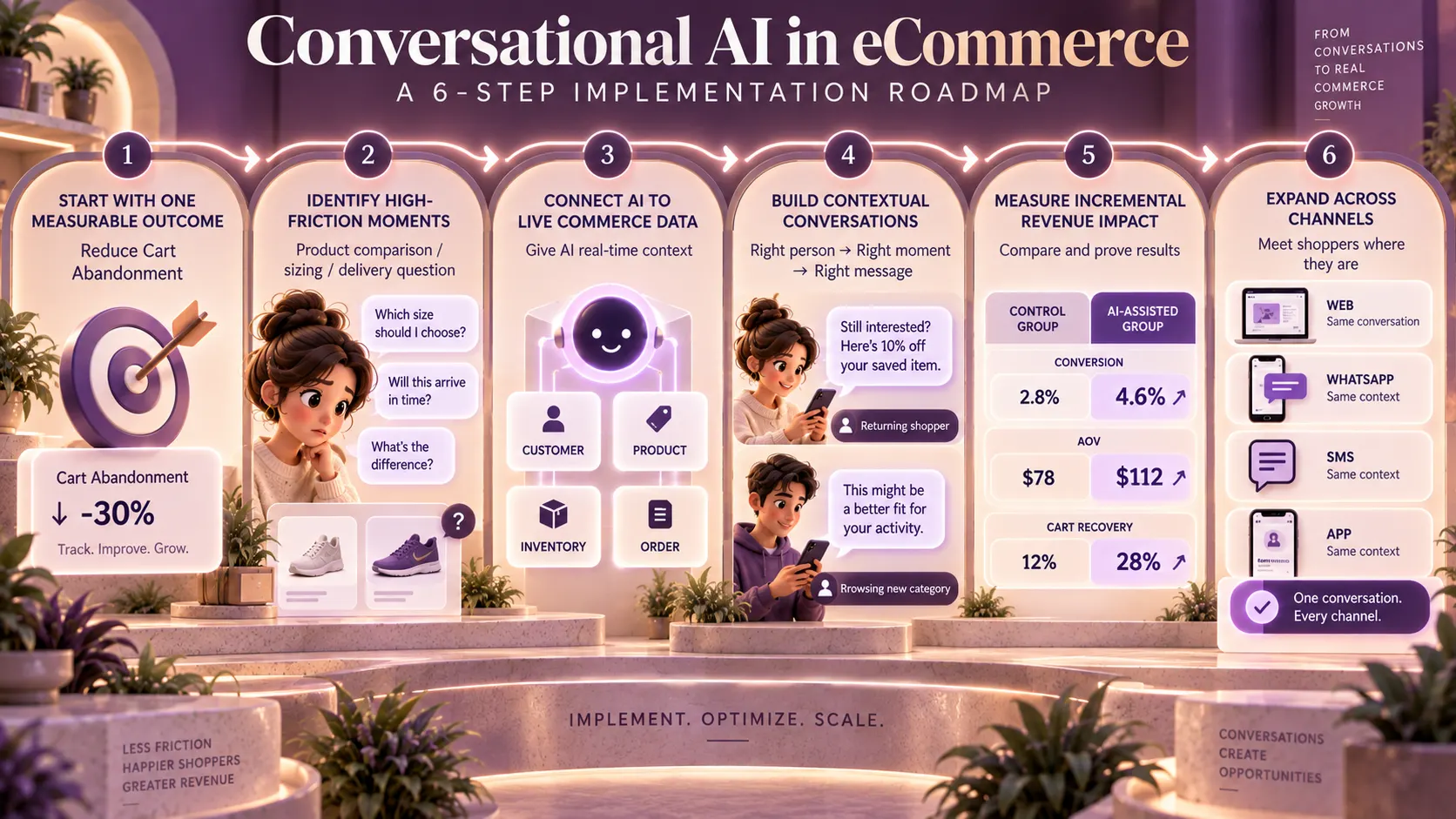
Most conversational AI deployments fall short because teams treat them as chatbot implementations instead of commerce decision systems. The first step to success is to define a clear goal, align AI initiatives with real-time customer data, and assess results by measuring revenue impact.
Step 1: Start With One Measurable Outcome
Select one target, like reducing cart abandonment, increasing first-purchase conversion, or improving retention. A focused use case clarifies the signals, triggers, and success metrics for the initial expansion, and the rest follows.
Step 2: Identify High-Friction Moments
Outline the buying process to understand where customers stall or abandon. Common opportunities include product comparisons, size selection, and post-purchase payment and delivery questions. Use AI where it can make a tangible difference to these obstacles.
Step 3: Connect AI to Live Commerce Data
To deliver accurate and personalized responses, AI must have access to customer profiles, real-time behavior, product catalogs, inventory, and order data. These integrations can be offered at the platform level, such as AI-powered eCommerce platforms like SPXCommerce.
Step 4: Build Contextual Conversations
Avoid generic pop-ups and use behavioral triggers instead. One individual comparing options might need help, while another shopping for a second time might not. Keep interventions timely, brief, and genuinely helpful.
Step 5: Measure Incremental Revenue Impact
Compare conversion rates, AOV, cart recovery rates, and drop-off rates with control groups. It’s not just about engagement; see if conversations actually impact buying behaviors.
Step 6: Expand Across Channels
Implement core flow, then expand it to WhatsApp, SMS, and in-app messaging. Keep conversation history across channels so shoppers don’t have to repeat themselves. This continuity turns isolated AI interactions into a connected commerce experience.
What Are the Real Benefits of Conversational Commerce for eCommerce Brands?
Conversational commerce helps eCommerce brands revolutionize the shopping experience: faster, easier, and more personalized. Brands can guide shoppers through the purchase process with AI-powered conversations across customer service and sales.
- Better conversions: Instant support aids customers in making informed purchasing decisions.
- Personalized shopping: AI suggests items based on customer preferences and requirements.
- Fewer cart abandonments: Quick answers to solve concerns before customers leave.
- 24/7 support: Customers get assistance anytime, without waiting for an agent.
- Higher order value: Useful cross-selling and upselling prompts further sales.
- Interactive conversation: Shopping experience is more convenient.
- More loyal customers: Customized, engaging communications create customer satisfaction.
Common pitfalls and how to avoid them
Often, conversational commerce failures stem not from the technology, but from the people behind it. They’re almost always about deployment. These are the patterns that don’t deliver, and what you should do.
| The Pitfall | Why It Fails | What to Do Instead |
|---|---|---|
| Deploying a rule-based bot and calling it “conversational AI” | Fails with unexpected questions | Use AI-powered intent detection |
| Triggering the chat widget too aggressively | Annoys shoppers | Use behavior-based triggers |
| Running conversational AI without connected data | Leads to generic answers | Connect product and customer data |
| Treating every channel as a separate conversation | Customers repeat themselves | Maintain cross-channel context |
| Measuring success by conversation volume | Doesn’t reflect revenue | Track conversions, AOV, and recovery |
| No human escalation path | Complex issues get stuck | Enable seamless human handoff |
| Skipping localization for multi-market deployments | Poor experience in local markets | Offer multilingual AI support |
Conversational Commerce Use Cases and Examples
Theory is great, but it doesn’t necessarily apply. Let’s look at how conversational commerce is applied across industries and what makes each successful.
Fashion & Apparel
Bloomingdale’s provides 1:1 live chat and video size suggestions, which reduce size-related returns and boost basket size. The conversational layer is designed to respond to the question of “will this fit me?” which can’t be answered by any static size chart.
Beauty
Sephora created a seamless social layer to engage customers in a community and guide them from discovery to purchase through the power of conversation. Product suggestions, color matching, and loyalty points emerge from the discussion.
Specialty Retail
Birk Sport (Norway) launched a customer-centric conversational AI chatbot that guides customers through a highly complex product catalog to identify the specific product they want, aiming to turn a search query into a conversation.
Which Conversational Commerce Platforms Should You Know?
Many conversational commerce platforms are available, so the best option depends on your business size and scope, the channels you use to sell your products, and your customers’ needs. Below are some popular platforms and tools to consider, depending on the type of eCommerce application.
| Platform / Tool | Primary Use | Best For | Key Strength |
|---|---|---|---|
| SPXCommerce ProactiveAI | Marketplace + eCommerce AI | Multi-vendor marketplaces, B2B & B2C brands | Conversational analytics, predictive intelligence, built into the commerce platform |
| Shopify Inbox | Storefront chat | Small to mid-size DTC brands | Native Shopify integration, simple product recommendation sharing |
| Salesforce Commerce Cloud | Enterprise omnichannel commerce | Large enterprise retailers | Deep CRM integration, Einstein AI personalization |
| IBM watsonx Orchestrate | AI agent workflows | Complex B2B and regulated commerce | NLP precision, enterprise-grade governance |
| WhatsApp Business API | Messaging commerce | Brands with strong mobile audiences | 2 billion+ user reach, chat-to-checkout flows |
| BigCommerce AI Tools | Storefront personalization | Mid-market eCommerce stores | Headless flexibility with AI-assisted merchandising |
What Are the Biggest Conversational Commerce Trends in 2026?
2026 is the year when conversational commerce is no longer just about chatting with chatbots, but also about initiating proactive, intelligent, and personalized shopping experiences. From voice to social media, customer service to analytics, AI’s influence is growing and is helping brands connect with shoppers at every stage of the purchase journey.
Generative AI Moves from Response to Initiative
AI is moving beyond answering questions and into taking action. It can leverage real-time shopping signals to provide personalized messages, recommendations, and offers based on customer behavior.
Voice Commerce Gains Momentum
Voice is emerging as a big product discovery avenue. Brands require voice-enabled product content, conversational product descriptions, and straightforward voice-to-checkout conversion.
Social Channels Become Shopping Channels
Social platforms WhatsApp, Instagram, and TikTok are becoming shopping channels. The conversational features enable customers to get to know the products, ask questions, and buy while on the platform.
AI-Human Collaboration Becomes Standard
Brands are changing to AI-first support with seamless human escalation. AI handles routine queries, while human agents handle complex or high-value ones.
Conversational Analytics Grows
Business data can be queried with natural language, and insights become available quickly without advanced analytics skills.
How to Choose the Right Conversational Commerce Solution
The right platform depends on your specific problem. Let’s take a practical approach:
| Your Situation | What to Prioritize | Red Flags to Avoid |
|---|---|---|
| Running a multi-vendor marketplace | Platform-native AI with seller + buyer support flows, unified customer data | Bolt-on chat tools that don’t integrate with your OMS or product catalog |
| High cart abandonment rates | Real-time intent detection, WhatsApp/SMS recovery flows, in-chat checkout | Rule-based bots that can’t adapt messaging based on abandonment reason |
| Scaling AOV on a DTC brand | Predictive recommendation models, contextual upsell triggers, cross-sell logic | Generic “you might also like” carousels with no behavioral signal input |
| B2B with complex buying cycles | Lead qualification flows, CRM integration, human escalation with context | Consumer-grade chatbots not built for multi-stakeholder decision processes |
| Expanding to new markets (UAE, India) | Multilingual AI, regional compliance, local payment gateway support | English-only chatbots with no localization capability |
Consider three questions before you put your money where your mouth is: What if the AI doesn’t have access to your actual product catalog and customer information, or can only access information in a silo? Can it continue conversations across channels (web, WhatsApp, and email) without losing context? Can you compare the incremental lift of conversational interactions with a control group?
Why SPXCommerce for Conversational AI in Retail and Marketplace Commerce
Conversational AI is often treated as a plugin, with most eCommerce platforms using third-party chat widgets added to commerce stacks that weren’t built for chat. By embedding conversational AI into the commerce infrastructure, SPXCommerce helps retailers and marketplaces turn customer interactions into tangible business results. Its AI capabilities aren’t limited to standalone chatbots; they integrate with product catalogs, customer data, inventory, orders, and real-time shopping behavior to deliver context-driven, relevant interactions.
For marketplaces, this means supporting both buyers and sellers during product discovery, recommendations, order queries, and post-purchase support. Brands can use SPXCommerce to identify high-intent shoppers, make tailored interventions, win back abandoned carts, and showcase relevant upsell opportunities.
It’s also uniquely platform-native, meaning that it can support cross-channel continuity, so conversations can flow across web, messaging, and other channels without losing context. SPXCommerce helps businesses move beyond customer support by integrating conversational intelligence, commerce execution, and analytics to drive AI-driven personalized shopping experiences that improve conversion, AOV, and retention.
Conclusion
Conversational commerce is changing the game of eCommerce, making shopping more personalized, more responsive, and less friction. Initially, customer support has evolved into AI-driven experiences that can interpret shopper intent, suggest products, address concerns, recover abandoned carts, and help customers across channels.
Conversational technology will not only help businesses respond to questions as AI becomes more proactive and agentic, but also help them predict customer needs and drive meaningful actions. The main challenge for retailers and marketplaces is seamlessly integrating AI with real-time information about products, customers, inventory, orders, and user behavior.
One way that shows what is possible when conversational AI is integrated into commerce and not just a chatbot is by using platforms such as SPXCommerce. Intelligent conversations, with commerce execution and analytics, can help brands boost conversions, increase AOV, further support customer engagement, and create more fluid shopping experiences. The future of eCommerce is conversational and increasingly intelligent.