You’ve done the hard part of choosing the right product, marketing your store, and increasing sales. However, orders are piling up, shipping mistakes are happening, and your staff is spending more time packing boxes than building the business!
It’s where most growing eCommerce brands struggle. The 50 orders-a-day fulfillment infrastructure ends at 500. The consequences are serious: late deliveries, negative reviews, chargeback woes, and customers who simply don’t return.
The right eCommerce fulfillment company handles all of that. A qualified third-party logistics (3PL) partner can handle your returns, picking, packing, shipping, and warehousing so you can focus on growing your business. Not all providers fit your business model, order volume, or channel mix.
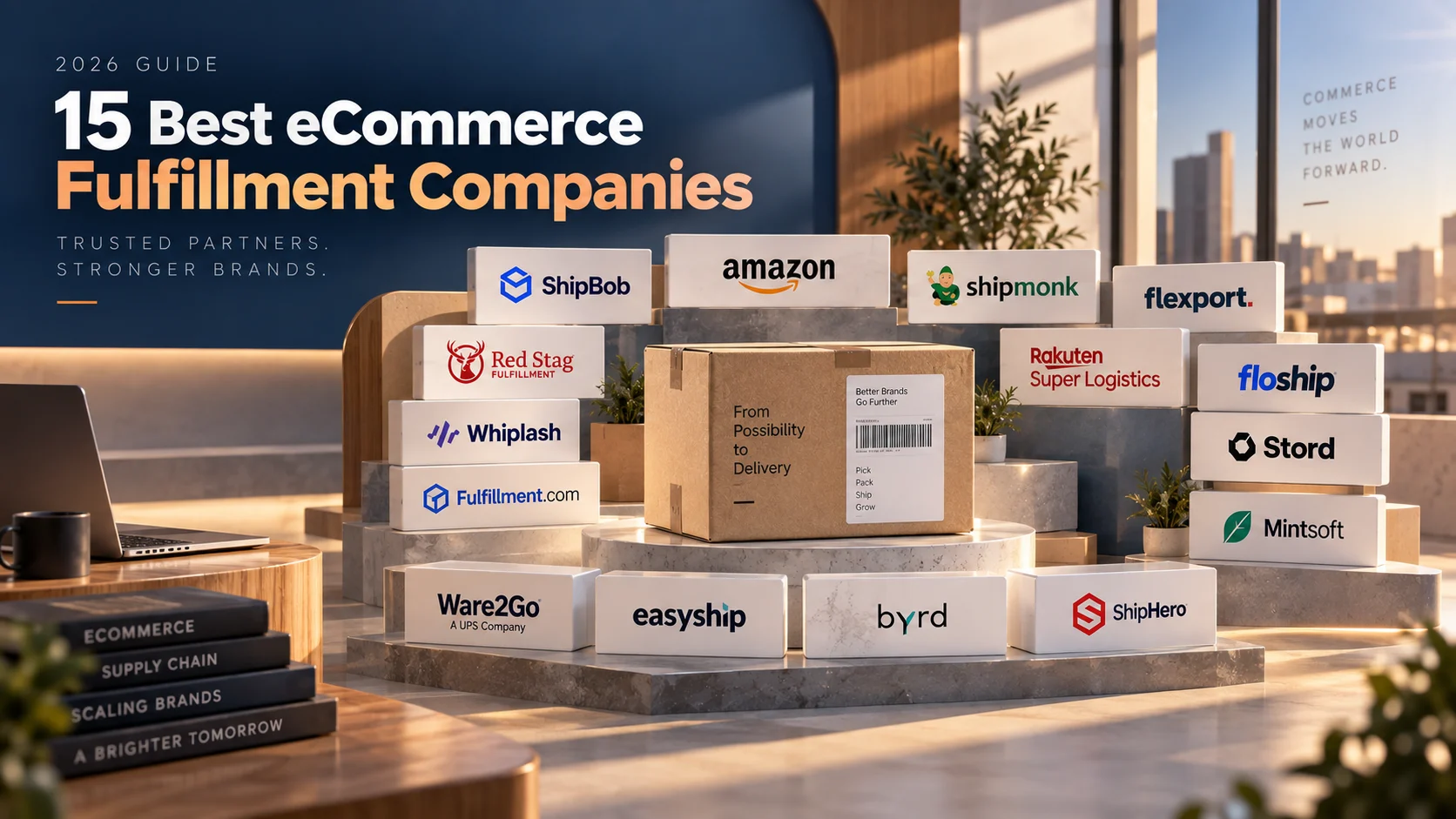
This guide breaks down the top 15 eCommerce fulfillment companies in 2026, explains each company’s key characteristics, provides a comparison table, and offers a selection framework. This helps users use the platform to connect with the best-fit fulfillment service.
What Is eCommerce Fulfillment?
eCommerce fulfillment is the complete process of receiving products, storing them in a warehouse, picking and packing goods, shipping them to customers, and handling returns. If you do it in-house, it is manageable at low volume. Once you outsource to a professional order fulfillment company, it becomes a real competitive advantage.
The facts speak for themselves. Statista predicts that eCommerce sales will surpass $4.91trillion worldwide by 2030. Meanwhile, a 2024 Convey survey found that 84% of shoppers said they would not shop with a brand again after a bad delivery. Fulfillment is no back-office task! It directly contributes to retention and revenue.
eCommerce warehouse fulfillment is more than just shipping boxes. It features live inventory tracking, multi-channel order synchronization, kitting and bundling, returns management, and carrier rate optimization. All the above, and more, are seamlessly managed by the best eCommerce fulfillment providers behind the scenes.
15 Best eCommerce Fulfillment Companies in 2026
We prioritize providers by capabilities, integrations, scalability, and reputation in the eCommerce industry. We include profiles for every business size, model, and geography, so read them thoroughly before you decide.
1. ShipBob – Best for Multi-Channel DTC Brands
Top Pick
One of the top brands in the fulfillment services sector, ShipBob is easily recognized. ShipBob has 50+ fulfillment centers worldwide, including in the United States, EU, Canada, and Australia, and can deliver orders to most customers in the United States within 2 days via ground shipping. This eliminates the need to pay for priority air on every shipment.
They have a proprietary WMS (Warehouse Management System) that connects with Shopify, WooCommerce, BigCommerce, Amazon, Walmart, and TikTok Shop. Inventory syncs to all channels in real time to avoid overselling. Their analytics dashboard provides detailed insight into days of stock on hand, reorder points, and shipping cost per order.
- 50+ global fulfillment centers
- All items ship from the US with 2-day shipping.
- Integrations with Shopify, Amazon, Walmart, etc.
- Real-time inventory sync
- Custom branded packaging
2. Amazon FBA (Fulfillment by Amazon) – Best for the Amazon First Sellers
Marketplace Leader
Fulfillment by Amazon is unbeatable if you are an Amazon dealer. You send your products to Amazon’s warehouses; they store, pick, pack, ship, and service. Having Prime eligibility is a huge conversion booster.
The Catch: FBA is best suited for the primary Amazon channel. FBA fees can accumulate faster for brands that rely on a storefront or other marketplaces that are predominantly their own brand, and it’s a major disadvantage for DTC brands without branded packaging.
- The Prime badge and 2-day delivery feature are available.
- Amazon-native customer service
- Massive warehouse network
- FBA Multi-Channel Fulfillment (MCF) is available.
3. ShipMonk – Best for Subscription Box & Kitting Brands
Kitting Specialist
ShipMonk has established a strong position in subscription box fulfillment and complex kitting. Their technology platform, HappiShip, automates much of the fulfillment process and provides merchants with highly granular reporting. They have warehouses in California, Florida, Texas, Pennsylvania, and abroad.
ShipMonk’s kitting workflow can greatly reduce the time brands take to assemble and ship multiple SKUs into a single curated box while minimizing manual assembly mistakes. They have a better onboarding process than most, with fewer surprises at go-live.
- Subscription box specialization
- Advanced kitting automation
- We have 5 warehouses in the United States and one internationally.
- Detailed merchant analytics
4. Deliverr (now part of Flexport) – Best for Fast Shipping Everywhere
Speed-Focused
Deliverr, which Flexport acquired, was created to get 2-day delivery badges on every channel you sell on, including Amazon. They have 80+ fulfillment centers, and their algorithm automatically assigns inventory to the ones closest to your customer base. This gives you faster shipping times, with no shipping-rate premium charges.
Flexport multi-channel fast fulfillment is a true differentiator for brands that sell heavily on Walmart, eBay, Target, and their own storefront. With Flexport’s freight services, you also have one solution for inbound freight and outbound fulfillment.
- 2-day delivery on Walmart, eBay, Target
- 80+ fulfillment centers
- Smart inventory distribution
- Flexport freight integration
5. Red Stag Fulfillment – Best for Heavy & Oversized Products
Heavy Goods Expert
Most 3PLs are geared toward small, lightweight parcels. Red Stag’s business is tailored toward clients shipping high-dollar, heavy, bulky items like fitness equipment, furniture, outdoor goods, and electronics. Their fulfillment centers have the floor space, racking, and freight dock capacity needed to accommodate oversized items.
Red Stag also backs its service with reliable guarantees, such as a zero-shrinkage guarantee and error compensation. That accountability is worth it for brands where a damaged or lost item costs $200+.
- Designed for heavy/oversized items
- Zero shrinkage guarantee
- Error reimbursement policy
- New Mexico & Oregon warehouse locations
6. Whiplash – Best for Omnichannel Retail Fulfillment
Omnichannel Ready
Whiplash sits at the intersection of DTC and retail. They’re not just for eCommerce fulfillment, but also for retail distribution, which makes them a great choice for brands selling through their own channel and into retail channels. They also offer EDI compliance for major retail routing guides, so you don’t have to do the work yourself.
Whiplash has 15+ warehouses and is integrated with all major eCommerce platforms. Their merchant portal provides real-time inventory visibility, and their system can handle complex retail orders as accurately as DTC shipments.
- DTC + retail distribution
- EDI compliance built-in
- 15+ warehouse locations
- Real-time omnichannel inventory
7. Fulfillment.com (FDC) – Best for International eCommerce
Global Reach
For brands targeting customers outside the US, Fulfillment.com has one of the most advanced international networks of independent 3PLs. They have fulfillment centers in the US, Canada, Europe, Australia, and Southeast Asia. Shipping to foreign countries without stores there is costly. With FDC, you can place stock near your overseas clientele.
They have a platform for multi-currency pricing, international customs documents, and regional carrier integration. FDC is an attractive choice for brands that want to expand into the EU and APAC markets but aren’t aiming to establish their own presence in these regions.
- The fulfillment process spans 6 continents.
- Multi-currency & customs support
- Regional carrier integrations
- GDPR-compliant EU operations
8. Rakuten Super Logistics – Best for High-Volume US Brands
High Volume
Rakuten Super Logistics (RSL) is known for its reliability, particularly at high volumes. RSL has 15 fulfillment centers strategically located throughout the US and can ship to 98% of the population by ground shipping within 2 days. They don’t claim 99.9% order accuracy like many companies, but they guarantee it through SLA commitments.
RSL works with more than 150 shopping carts and marketplaces. At the scale smaller 3PLs can experience, the tech infrastructure isn’t affected by load, and it avoids the integration hassles that can occur.
- 15 US fulfillment centers
- 99.9% accuracy guarantee
- 150+ platform integrations
- Same-day order processing
9. Floship – Best for Global DTC Crowdfunding & Launch Brands
Launch Specialist
Floship’s model is built for brands scaling products, especially those on Kickstarter or Indiegogo that need to ship worldwide in a short time. They have a global fulfillment platform that can manage complex, one-off large volumes as well as their regular DTC operations.
They are based in Hong Kong, giving Asian-made products a head start in freight as they cross the oceans to customers all over the world. Brands that produce in China and want to ship to any country in the world without having to send all their products through the first shipment center in the United States can use Floship’s model to save cost and transit time.
- Crowdfunding campaign fulfillment
- A world-class city based in Hong Kong, China
- Manufacturer-direct shipping
- 230+ countries covered
10. Ware2Go (UPS subsidiary) – Best for SMBs Wanting Carrier Leverage
UPS-Backed
Ware2Go is UPS’s “on-demand” warehousing and fulfillment solution. Ware2Go provides flexible warehousing and fulfillment services on UPS’s infrastructure for SMBs that prefer to avoid large-scale, long-term contracts. UPS support is also an added advantage, providing rates that small businesses cannot negotiate on their own.
They operate month-to-month, which minimizes brand risk when testing new markets or reducing volume in a traditional 3PL contract.
- UPS access to the carrier network.
- Flexible month-to-month terms
- On-demand warehouse network
- SMB-friendly pricing
11. Stord – Best for Enterprise Omnichannel Operations
Enterprise Grade
Stord doesn’t claim to be a 3PL, but rather a commerce enablement platform. The key distinction is that they marry software and physical fulfillment into one platform, giving enterprise brands real-time visibility across the entire supply chain instead of piecing together information from disconnected systems.
Large consumer brands use it, and it can handle multiple selling channels, compliance-driven retail orders, and large catalogs at once. If you’ve reached the point where visibility across the entire supply chain is critical, Stord is definitely worth considering.
- The ‘software + physical fulfillment’ integration was optimized.
- Full visibility across the entire supply chain.
- Enterprise retail compliance
- Can be scaled up to very high volumes
12. Easyship – Best for Simplified Global Shipping Rate Management
Rate Optimizer
Easyship’s mission is to provide a single dashboard that gives merchants access to 250+ courier options and automatically selects the best rate for each shipment. It is not a traditional 3PL, but more of a fulfillment intelligence layer that integrates with existing warehouses and couriers. Easyship seamlessly connects brands with warehouse relationships that want to make smarter carrier-selection choices.
Their tax and duty calculator supports 220+ countries and shows landed cost at checkout minimizing cart abandonment due to surprise customs charges for international customers.
- 250+ courier integrations
- Automated best-rate selection
- 220+ country duty calculator
- The checkout landed cost is displayed.
13. Byrd – Best for European eCommerce Fulfillment
EU Specialist
Based in Vienna, Byrd is a fulfillment house with offices in fulfillment centers throughout Germany, Austria, the UK, the Netherlands, Poland, and France. Local fulfillment within the EU eliminates customs clearance delays, VAT issues, and the cost of shipping from the United States to their European customers, which is ideal for eCommerce brands aiming to serve the European market.
They also have a platform that integrates with Shopify, WooCommerce, Magento, and major European marketplaces. For brands expanding into Europe from North America or within the EU, Byrd’s operational efficiency in handling GDPR data and its regional focus add real value.
- EU-based fulfillment network
- The hubs are located in Germany, the UK, France, and the Netherlands.
- GDPR-compliant operations
- European marketplace integrations
14. ShipHero – Best for Brands Running Their Own Warehouse + 3PL Hybrid
WMS + 3PL Hybrid
For brands who handle their own warehouses, ShipHero has a standalone WMS solution, while for brands looking to outsource their fulfillment, they have a 3PL fulfillment solution. For growing brands, the hybrid model is actually a great way to begin with their WMS while maintaining their own warehouse, and then move to their 3PL network as volume increases, without switching platforms or retraining employees.
Their WMS supports carrier integration, multi-location inventory, batch picking, and barcode scanning. It’s one of the more operationally complete platforms among brands that want control over their warehouse even as they expand into outsourced fulfillment.
- WMS + 3PL all in one
- Barcode & batch picking
- Seamless hybrid transition
- Multi-location inventory
15. Mintsoft – Best for UK & Australian eCommerce Fulfillment
UK / AUS Focus
Mintsoft is a cloud-based OMS and WMS company, serving 3PLs and eCommerce brands in the UK and Australia. Mintsoft’s local integrations, carrier support, and compliance capabilities are designed specifically for these markets’ regulations and are not US-centric.
They have a unified order management, inventory management, and shipping system that integrates with eBay UK, Amazon UK, and major local carriers such as Royal Mail, DHL, and Australia Post.
- Compliance with UK & AUS regulations
- Integrations with Royal Mail, DHL, and AusPost.
- Cloud-based OMS + WMS
- 3PL-friendly multi-client support
Quick Comparison: eCommerce Fulfillment Companies at a Glance
Compare key features, pricing, scalability, and services offered by leading eCommerce fulfillment companies. Find the right fulfillment partner based on your business needs, order volume, and growth goals.
| # | Provider | Best For | Warehouse Network | Key Strength |
|---|---|---|---|---|
| 1 | ShipBob | Multi-channel DTC | 50+ global | 2-day ground shipping |
| 2 | Amazon FBA | Amazon-first sellers | Massive US + global | Prime eligibility |
| 3 | ShipMonk | Subscription & kitting | 5 US + international | Kitting automation |
| 4 | Deliverr / Flexport | Fast shipping everywhere | 80+ US | Multi-channel 2-day badges |
| 5 | Red Stag | Heavy/oversized goods | 2 US | Zero shrinkage SLA |
| 6 | Whiplash | Omnichannel retail | 15+ US | EDI retail compliance |
| 7 | Fulfillment.com | International eCommerce | Global (6 continents) | Cross-border customs |
| 8 | Rakuten RSL | High-volume US brands | 15 US | 99.9% accuracy SLA |
| 9 | Floship | Crowdfunding/launch | HK global hub | Asia-origin shipping |
| 10 | Ware2Go (UPS) | SMBs, flexible contracts | UPS network | Flexible month-to-month |
| 11 | Stord | Enterprise supply chain | Enterprise-wide | Software + ops integrated |
| 12 | Easyship | Rate optimization | 250+ couriers | Automated best-rate routing |
| 13 | Byrd | European markets | EU (6 countries) | GDPR + EU localization |
| 14 | ShipHero | WMS + 3PL hybrid | Multi-location | Own warehouse + outsource blend |
| 15 | Mintsoft | UK & Australia brands | UK, AUS | Localized carrier & compliance |
How Do You Choose the Right eCommerce Fulfillment Provider?
Reading a list of providers is useful. But the real decision comes down to your business model, current order volume, geography, and where you’re headed in the next 12–18 months. Here’s the framework we’d use:
1. What channels do you sell on?
If Amazon is your primary channel, FBA makes sense. If you’re heavily DTC across Shopify, your own site, and several marketplaces, you need a provider like ShipBob or Deliverr with integrations that cover the full channel mix and real-time inventory syncing. A 3PL that can’t sync inventory across channels creates overselling risk every day.
2. What’s your average order profile?
Small, lightweight parcels have different warehousing and handling needs than large, heavy products. If you ship fitness equipment, furniture, or industrial gear, Red Stag is built for that. Trying to run oversized products through a standard eCommerce 3PL can lead to damaged goods, extra fees, and operational headaches.
3. Where are your customers?
Warehouse location directly impacts shipping cost and transit time. A single warehouse in New Jersey will serve East Coast customers well but cost significantly more to reach the West Coast. For brands with a nationally or globally distributed customer base, a multi-node fulfillment network (ShipBob, RSL, Deliverr) pays for itself quickly in carrier savings.
4. Do you have special handling requirements?
Subscription boxes, kitting, hazardous materials, cold chain, and retail compliance each require specific capabilities. Before signing anything, confirm your fulfillment provider has handled your exact product type at volume. Asking for references from brands with similar SKU profiles is the fastest way to validate this.
- Confirm real-time inventory sync across all your sales channels
- Ask for guaranteed order accuracy rates and what happens when they miss
- Verify warehouse locations align with your customer geography
- Check seasonal peak capacity if it can, can they handle 3-4x your daily volume?
- Confirm returns processing timelines and cost per returned unit
- Ask about technology integrations before signing, not after
- Understand all fee structures for storage, pick, pack, returns, setup
Why Your Fulfillment Stack Needs SPXCommerce?
The first step is to select a great fulfillment provider. The second step is ensuring your commerce platform can communicate effectively with it. This is where SPXCommerce comes in.
SPXCommerce is an AI-powered marketplace and eCommerce platform designed for businesses that require more than a storefront. No matter what type of eCommerce business you’re running, from a multi-vendor marketplace to a B2C eCommerce store to a wholesale B2B business, SPXCommerce’s infrastructure processes order traffic, ensuring order information is accurate and complete when it reaches fulfillment partners.
Its Order Management System brings together orders across all sales channels, so you don’t have to deal with inventory mismatches and order-routing issues that lead to customer complaints. When used with the Seller Management System, marketplace operators can give each seller visibility into their own fulfillment process without unnecessary “chaos” at the marketplace level.
SPXCommerce is also powered by ProactiveAI, a tool that provides demand forecasting, reorder point suggestions, and inventory distribution intelligence, directly impacting smarter fulfillment decisions. You don’t have to wait for flash sales; you look for them because you know they’re coming. Instead of over-stocking slow-moving SKUs, you shift inventory to where demand data indicates it should go.
If you’re expanding or building an eCommerce marketplace, schedule a demo of SPXCommerce to see how the platform integrates with your fulfillment system and helps you grow.
Conclusion
You don’t necessarily need to go with the largest eCommerce fulfillment company that you can find on this list. It’s the one whose warehouse network, technology integrations, specialty capabilities, and pricing model in fact fit where your business is and where it’s going in the coming year.
ShipBob and RSL serve high-volume, multi-channel brands. Red Stag is specially designed for heavy goods. ShipMonk is one of the best at creating subscription boxes. FDC and Byrd handle the global markets through real local infrastructure. Floship provides crowdfunding launches on a global scale.
But across all of these, the commerce platform that runs on top of your fulfillment determines whether orders move smoothly, inventory stays up to date, and customers get the experience they expected. That’s what SPXCommerce was designed for.
Do the homework, ask the right questions, and choose a fulfillment partner that can handle today’s volume and tomorrow’s.