You’ve invested months selecting a new eCommerce platform, evaluating demos, comparing pricing models, negotiating contracts. But now your CFO is asking the real question: what’s the actual ROI?
This is where most businesses get stuck. They switch platforms, see some improvements, but can’t quantify what those improvements are actually worth in revenue terms. The result? Hesitation before the next investment, stakeholder skepticism, and missed opportunities to optimize further.
Measuring eCommerce ROI isn’t complicated once you know which numbers to track, when to track them, and how to frame them against your total investment cost. A well-chosen platform doesn’t just save you money on hosting or maintenance; it also generates revenue through better conversion rates, lower cart abandonment, faster time-to-market, and smarter automation.
This guide breaks down exactly how to calculate, measure, and maximize your eCommerce return on investment with a specific focus on what changes when you switch to a purpose-built platform versus staying on a legacy system.
What Is an eCommerce Platform ROI?
eCommerce return on investment (eCommerce ROI) measures how much financial value your online store generates relative to what you spend running it. But when we talk specifically about eCommerce platform ROI, we’re asking a narrower question: does the platform itself its technology, architecture, and capabilities deliver measurable business value that justifies its cost?
This is different from marketing ROI, which focuses on campaign spend versus revenue generated. Platform ROI accounts for:
- Licensing or subscription costs vs. revenue uplift
- Development and integration costs vs. operational efficiency gains
- Time-to-market improvements vs. missed revenue from being slow
- Infrastructure costs vs. uptime and performance improvements
- Total Cost of Ownership (TCO) vs. lifetime business value delivered
Stat: Global eCommerce sales are expected to reach $4.91 trillion in 2030. For businesses running on outdated platforms, the cost of missing even a fraction of that opportunity dwarfs any platform investment.
Think of your eCommerce platform like the engine of a car. You can have brilliant marketing (the fuel), a great team (the driver), and strong products (the cargo), but if the engine is underpowered or constantly breaking down, none of that matters. Platform ROI measures how well that engine performs.
Why Do Businesses Struggle to Measure eCommerce ROI?
Most businesses measure marketing ROI and product margins with precision, but they lump platform ROI into vague IT budget conversations. Here’s why that’s a costly mistake:
Common measurement failures:
- Comparing platform cost in isolation rather than against value generated
- Ignoring opportunity costs: revenue lost due to downtime, slow load times, or limited functionality
- Failing to establish a pre-migration baseline, so there’s nothing to compare against post-launch
- Treating development/customization spend as one-time rather than ongoing
- Not tracking soft ROI drivers like team productivity and time-to-market
The fix is straightforward: treat your eCommerce platform as a revenue-generating asset, not a cost center, and measure it accordingly.
The Core eCommerce ROI Formula You Actually Need
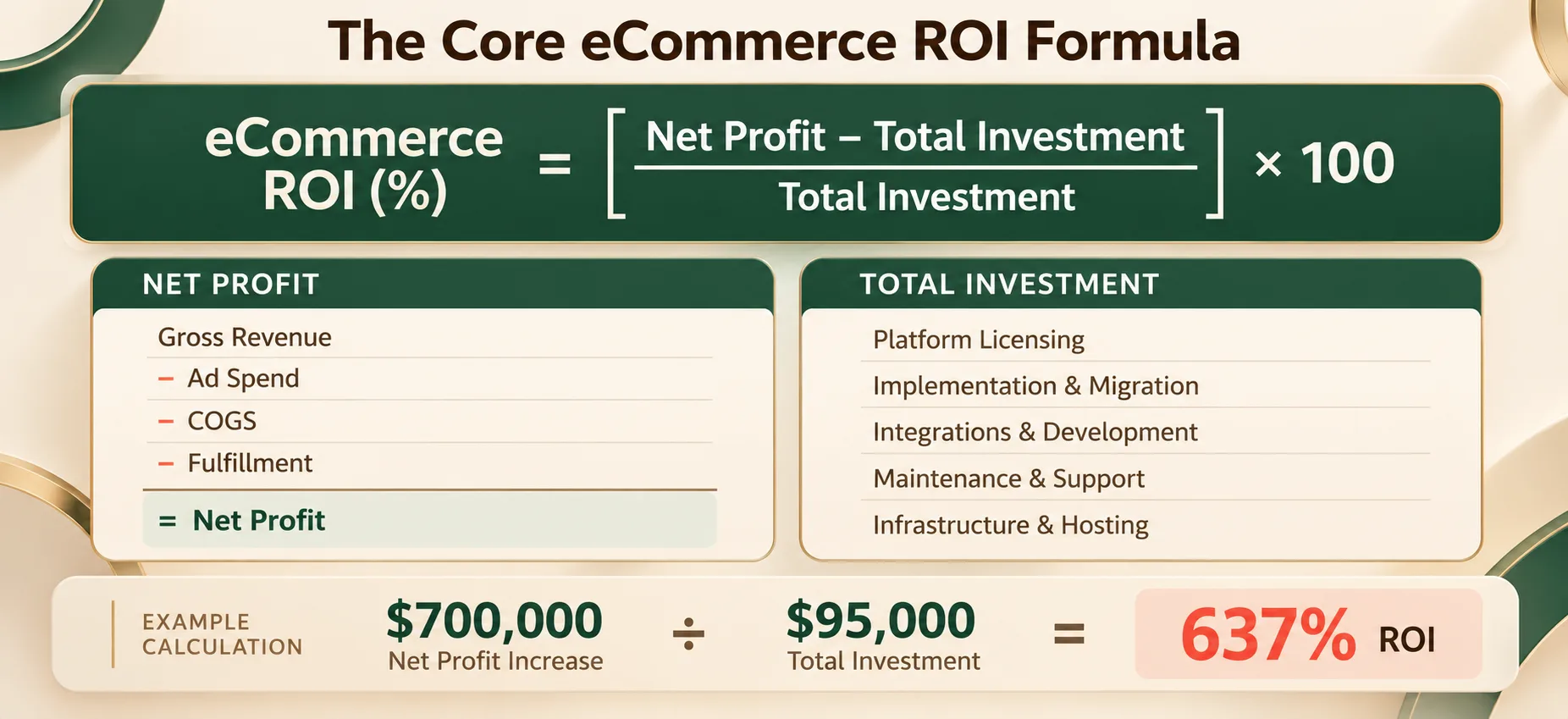
Calculate net profit by subtracting total costs, including ad spend, COGS, and fulfillment, from gross revenue, then divide by your total investment. This reveals your true, fully loaded return on every dollar spent rather than relying on misleading top-line ROAS metrics.
1. The Standard ROI Formula
eCommerce ROI (%) = [(Net Profit – Total Investment) / Total Investment] × 100
For eCommerce platforms specifically, Total Investment includes:
- Platform licensing or subscription fees
- Implementation and migration costs
- Third-party integration and development costs
- Ongoing maintenance, support, and staff training
- Infrastructure and hosting (if applicable)
2. A Practical Example
Imagine a B2B marketplace that switches to a modern, composable platform:
| Metric | Before New Platform | After 12 Months |
|---|---|---|
| Annual Revenue | $2.4M | $3.1M |
| Conversion Rate | 1.8% | 2.7% |
| Cart Abandonment Rate | 74% | 58% |
| Avg. Page Load Time | 4.2s | 1.8s |
| Platform + Dev Cost | $180K | $95K (new platform) |
| Net Profit Increase | NA | +$700K |
eCommerce ROI = [($700,000 – $95,000) / $95,000] × 100 = 637%
That’s the kind of number that makes a CFO pay attention.
Key Metrics That Drive eCommerce Platform ROI
ROI doesn’t live in one number. It’s the aggregate of multiple performance signals. Here are the metrics you should be tracking:
| Metric | What It Measures | Why It Matters for Platform ROI |
|---|---|---|
| Conversion Rate | Visitors who complete a purchase | A 1% lift on $2M GMV = $20K additional revenue |
| Cart Abandonment Rate | Sessions where checkout wasn’t completed | Lower abandonment = direct revenue recovery |
| Average Order Value (AOV) | Revenue per transaction | Platform tools like upsells/bundles drive this up |
| Customer Acquisition Cost (CAC) | Spend to acquire one customer | Better UX lowers CAC via improved word-of-mouth |
| Customer Lifetime Value (CLV) | Total revenue from one customer over time | Loyalty tools on modern platforms extend CLV |
| Page Load Time | Speed of storefront delivery | 1 second delay = 7% conversion drop (Google) |
| Operational Cost per Order | Cost to process and fulfill each order | Automation on modern platforms reduces this significantly |
| Time to Market | Speed to launch new features/campaigns | Faster iteration = more revenue cycles per year |
Your eCommerce platform directly influences every metric in this table. A platform that loads faster, automates manually, and integrates cleanly with your ERP, CRM, and marketing stack will move all these numbers in the right direction.
How to Calculate eCommerce ROI Before Switching Platforms (Pre-Migration Baseline)
You can’t measure improvement without knowing where you started. Before signing any new platform contract, document these baseline metrics for the previous 12 months:
- Monthly revenue (broken down by channel)
- Conversion rate per device (desktop vs. mobile)
- Cart abandonment rate
- Page load speed (use Google PageSpeed Insights or GTmetrix)
- Customer acquisition cost
- Average order value
- Support ticket volume related to platform issues
- Developer hours spent on maintenance vs. new features
- Downtime hours and associated lost revenue.
This baseline becomes your ROI reference point. You compare everything you measure after launch against it.
Hidden Costs That Kill Your eCommerce ROI
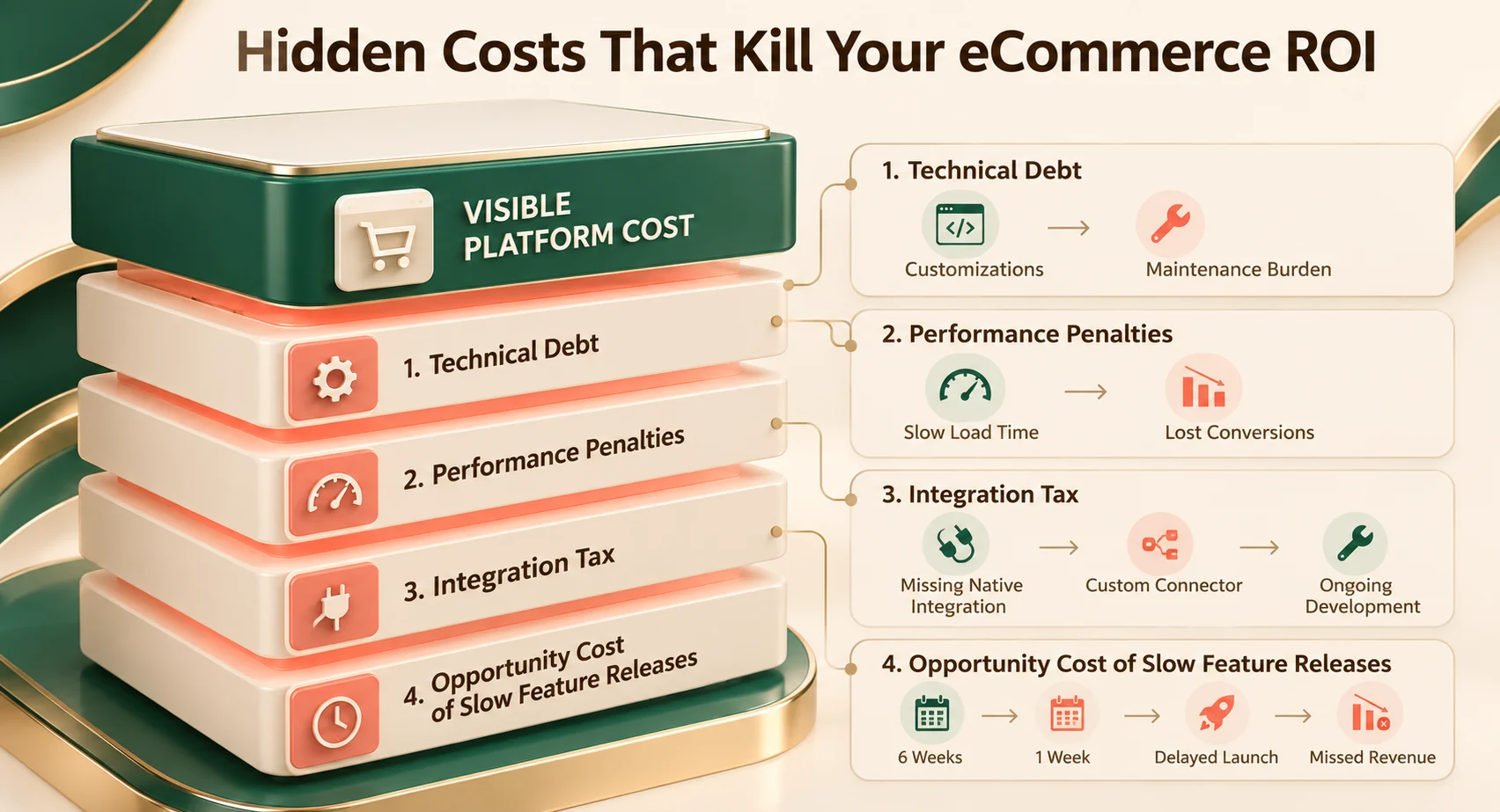
Most ROI calculations focus on obvious costs (licensing, hosting) and miss the expenses that quietly erode returns. Watch out for these:
1. Technical Debt
Legacy platforms often require increasingly expensive customizations just to maintain current functionality. That spend compounds, and every dollar going to maintenance is a dollar not going toward growth features. According to a survey, 77% of businesses reported a strong sense of urgency to replatform in 2025 specifically because of limited scalability and poor user experiences on their existing systems.
2. Performance Penalties
Slow load times are an invisible revenue leak. Google research shows a 1-second delay in mobile page load results in a 7% drop in conversions. If your platform averages 4-second load times instead of 2, you’re hemorrhaging revenue on every session.
3 Integration Tax
Every time your platform can’t natively integrate with a tool (your CRM, your 3PL, your PIM), you’re paying developers to build and maintain custom connectors. Multiply this across 5-10 integrations, and you have a high ongoing cost that modern API-first platforms eliminate.
4. Opportunity Cost of Slow Feature Releases
If it takes your team 6 weeks to launch a new campaign feature on your current platform but only 1 week on a modern platform, that’s 5 weeks of lost competitive positioning, missed traffic, and delayed revenue every single time.
Proven Strategies for Boosting eCommerce ROI on Your New Platform
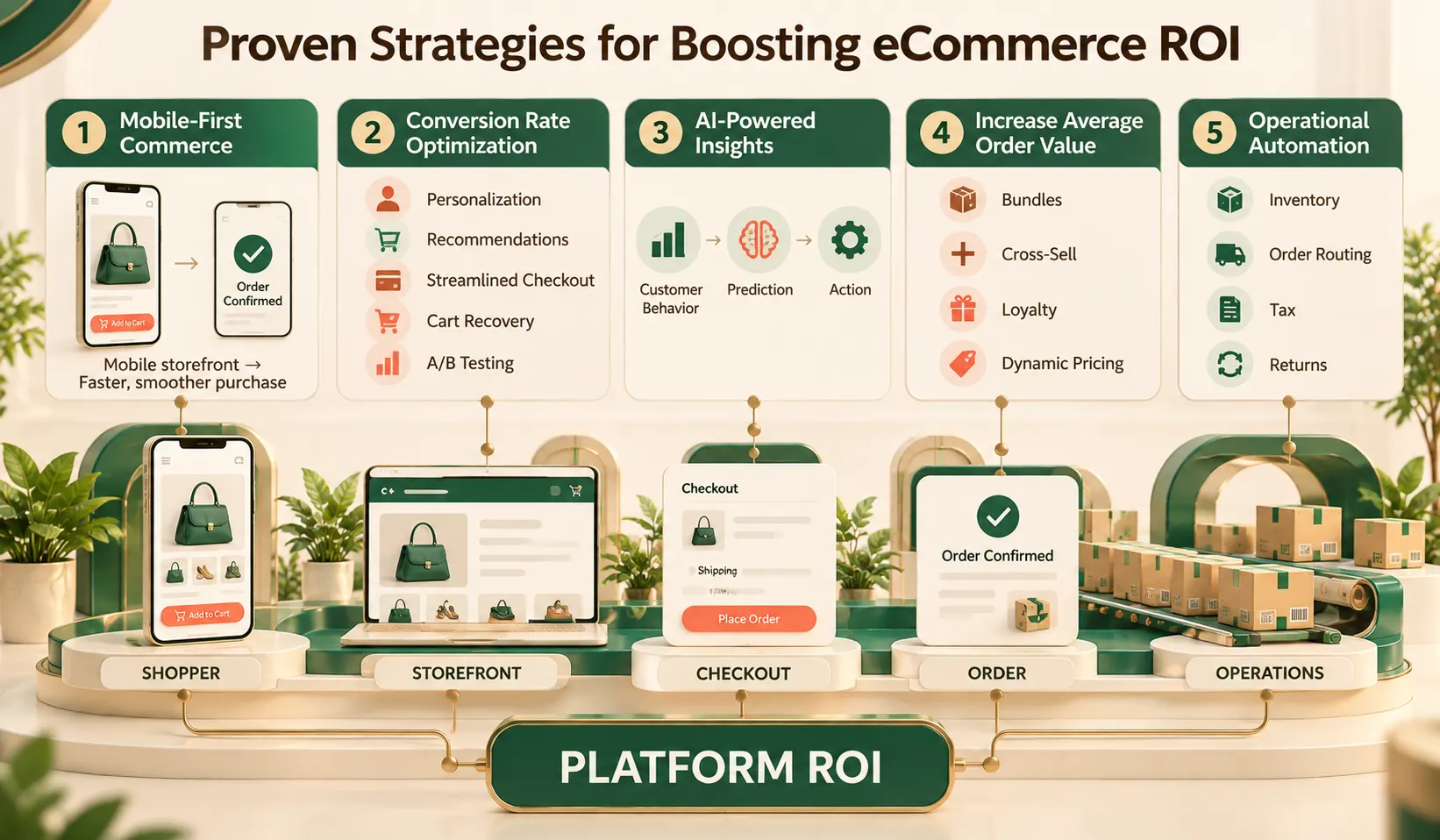
Switching to a better platform gives you the infrastructure, but you still need to execute. Here are the strategies that deliver the biggest ROI increases:
1. Optimize for Mobile-First Commerce
Mobile devices account for 74% of traffic to eCommerce websites and 63% of online purchases, per Statista. If your platform delivers a subpar mobile checkout, you’re losing the majority of your traffic. A modern platform with a composable storefront and native mobile app capability is the foundation of mobile ROI.
2. Improve Conversion Rate Optimization (CRO)
Conversion rate is where most eCommerce ROI is actually made or lost. Modern platforms give you tools that legacy systems can’t match:
- Real-time personalization based on browsing behavior
- AI-driven product recommendations
- Streamlined, one-page checkout flows
- Abandoned cart recovery with automated email triggers
- A/B testing on product pages and CTAs without developer dependency
Just improving conversion from 1.8% to 2.5% on a store doing $2M in annual revenue is worth $778,000 in additional revenue with zero increase in traffic spend.
3. Leverage AI-Powered Insights
The smartest platforms today don’t just process transactions they predict behavior. AI-powered tools help you identify which products to recommend, which customers are at risk of churning, which campaigns to double down on, and where your funnel is leaking revenue. This turns your platform from a passive transaction engine into a proactive revenue tool.
4. Increase Average Order Value (AOV)
AOV is one of the most direct levers for boosting eCommerce ROI without increasing your customer acquisition cost. Platform features that drive AOV include:
- Product bundling and cross-sell recommendations
- Volume-based discounts for B2B buyers
- Loyalty programs that reward higher spend
- Dynamic pricing that adjusts based on demand or customer tier
5. Streamline Operations with Automation
Operational costs are the quiet killer of eCommerce ROI. A modern platform that automates inventory updates, order routing, tax calculation, and returns processing doesn’t just save time it reduces error rates and the support burden that comes with them.
The ROI Comparison: Legacy Platform vs. Modern eCommerce Platform
Legacy platforms bleed budget through high maintenance costs, rigid infrastructure, and hidden developer fees, severely capping your net profitability. Modern platforms shift spend toward revenue-generating growth by reducing operating overhead and driving higher conversion rates out of the box.
| Factor | Legacy Platform | Modern Composable Platform |
|---|---|---|
| Time to Launch New Features | 6–12 weeks | 1–2 weeks |
| Customization Cost | High (custom dev required) | Low (API-first, modular) |
| Integration Capability | Limited, expensive | Open API, plug-and-play |
| Mobile Performance | Often poor | Native-optimized |
| AI & Personalization | Minimal or external | Built-in or easily integrated |
| Scaling Under Traffic Peaks | Risky (manual scaling) | Cloud-native auto-scaling |
| Analytics & Reporting | Basic, siloed | Unified, real-time dashboards |
| Total Cost of Ownership (3yr) | Often 30–50% higher | Lower with included features |
The pattern is consistent across businesses of all sizes: modern platforms cost less to operate, enable faster growth, and generate better returns. The upfront migration investment typically pays back within 12–18 months.
How to Choose a Platform That Maximizes ROI
Not every platform delivers the same ROI. When evaluating options, apply this decision framework:
1. What Business Model Does It Support?
B2C, B2B, D2C, and multi-vendor marketplaces have fundamentally different requirements. A platform built for B2C merchants won’t natively handle complex B2B pricing tiers, account hierarchies, or purchase order workflows. Match the platform to your model, not the other way around.
2. What Is the Total Cost of Ownership Over 3 Years?
Include: licensing fees, implementation, customization, integrations, support, training, and infrastructure. A cheaper platform that requires $200K in custom development annually is rarely cheaper than a more capable platform at a higher license price.
3. How Does It Scale?
Cloud-native, microservices-based architectures scale horizontally and handle traffic spikes without manual intervention. Legacy monolithic platforms often require expensive infrastructure upgrades and still crash during peak events, both of which destroy ROI in a single session.
4. What Is Its Track Record with Marketplace Businesses?
If you’re running or planning to run a marketplace model with multiple sellers, vendor management, commission structures, and catalog complexity, you need a platform purpose-built for that use case. Generic eCommerce platforms create expensive workarounds.
How SPXCommerce Helps You Maximize eCommerce Platform ROI
SPXCommerce is a purpose-built marketplace development platform that helps businesses build, scale, and monetize multi-vendor marketplaces without the cost and complexity of custom development.
Its modular architecture enables faster launches, reducing development time and costs while accelerating time to market. Built-in seller management, order routing, and product information management also streamline operations and reduce manual workloads.
ProactiveAI adds personalization, predictive insights, and automation to improve conversions and average order value. Native iOS and Android capabilities help businesses deliver mobile commerce experiences without separate development investments.
SPXCommerce supports B2B, B2C, and D2C marketplace models with pre-built functionality. Its open API architecture also enables seamless integration with ERP, CRM, payment gateways, and 3PL systems, minimizing expensive custom connectors and supporting scalable growth.
Conclusion
eCommerce platform investment isn’t a theoretical concept, but it’s a measurable, trackable number that should be part of every platform decision your business makes.
The formula is straightforward: establish your baseline, track the metrics that matter, account for both direct revenue impact and operational savings, and compare them to your total platform investment cost. Done right, the math usually tells a clear story modern, purpose-built platforms deliver returns that legacy systems simply can’t match.
More importantly, businesses that measure and optimize platform ROI continuously, not just at launch, compound gains over time. Each improvement in conversion rate, each reduction in operational cost, each new capability unlocked translates into a larger revenue base and a stronger competitive position.
Your platform is your most important infrastructure investment. Measure it like one.