Enterprise ecommerce is no longer just about selling products online. For modern businesses, it is a growth engine, offering global expansion, omnichannel experiences, operational efficiency, and long-term scalability.
As enterprises scale, their ecommerce needs become more complex: high traffic volumes, multiple storefronts, global customers, ERP and CRM integrations, advanced personalization, and automation at scale. This is where enterprise ecommerce platforms play a critical role.
In this guide, we explore the best ecommerce platforms that help businesses grow sustainably, starting with a modern, AI-driven solution built for today’s enterprise needs.
Why Enterprise Ecommerce Platforms Matter
As businesses grow, their ecommerce needs become significantly more complex. Enterprise ecommerce platforms are designed to support organizations operating at scale, handling high traffic, complex operations, and global expansion in ways that standard ecommerce solutions cannot.
Unlike basic platforms, enterprise solutions function as end-to-end commerce ecosystems, connecting sales, operations, and customer experiences. The right enterprise platform directly influences revenue growth, operational efficiency, customer satisfaction, and speed to market.
-
Built for Scale and High Performance
Enterprise ecommerce platforms are engineered to manage large product catalogs, high transaction volumes, and sudden traffic spikes during peak sales events. With cloud-native infrastructure and performance optimization, they ensure consistent uptime and fast experiences even under heavy demand, protecting both revenue and brand reputation.
-
Support for Complex Business Models
Enterprises often operate across multiple business models, including B2C, B2B, D2C, marketplaces, or hybrids. Enterprise platforms support advanced pricing, customer-specific catalogs, bulk ordering, approval workflows, and vendor management, capabilities essential for managing complexity within a single system.
-
Global Commerce Enablement
Expanding internationally requires more than launching a new storefront. Enterprise platforms offer built-in support for multiple languages, currencies, regional pricing, and compliance requirements, allowing businesses to scale globally while delivering localized customer experiences.
-
Deep Enterprise Integrations
To operate efficiently, ecommerce must integrate seamlessly with ERP, CRM, OMS, PIM, POS, and third-party systems. Enterprise ecommerce platforms are built with API-first architectures that enable real-time data flow, ensuring accurate inventory, streamlined fulfillment, and consistent customer data across the organization.
-
Automation for Scalable Growth
Manual processes don’t scale. Enterprise platforms use automation and AI to optimize pricing, personalize experiences, manage inventory, and streamline operations. This reduces overhead, improves accuracy, and enables businesses to grow faster without increasing complexity.
Key Criteria to Evaluate Enterprise Ecommerce Platforms
Selecting an enterprise ecommerce platform is a long-term strategic decision that affects not only online sales but also operations, customer experience, and future scalability. Before comparing platforms, businesses must clearly understand the criteria that determine whether a solution can support growth, complexity, and evolving market demands.
The following evaluation factors help enterprises assess platforms objectively, beyond surface-level features, to ensure the chosen solution aligns with both current requirements and long-term business goals.
| Evaluation Factor | What It Means for Enterprises |
| Scalability & Performance | Ability to handle high traffic, large catalogs, and peak sales events without downtime or performance loss |
| Customization & Flexibility | Freedom to tailor workflows, checkout processes, pricing logic, and storefront experiences |
| API-First / Headless Architecture | Backend and frontend can operate independently via APIs |
| B2C & B2B Support | Native support for consumer and business selling models |
| Omnichannel Capabilities | Ability to sell across web, mobile, marketplaces, social, and offline channels |
| Security & Compliance | Enterprise-grade security standards, data protection, and regulatory compliance |
| Integration Capabilities | Ease of connecting with ERP, CRM, OMS, PIM, POS, and third-party tools |
| Total Cost of Ownership (TCO) | Combined cost of licensing, development, hosting, maintenance, and scaling |
| Support & Ecosystem | Availability of technical support, partners, documentation, and community |
Top Enterprise Ecommerce Platforms in 2026
As enterprise commerce continues to evolve in 2026, businesses need platforms that are not only scalable but also flexible, intelligent, and future-ready. Below are some of the leading enterprise ecommerce platforms that support growth across complex business models, global markets, and omnichannel strategies.
-
SPXCommerce

SPXCommerce is a modern, cloud-native enterprise ecommerce platform designed to support large-scale, fast-growing businesses through AI-driven automation and composable architecture. Unlike traditional platforms that rely heavily on manual operations and extensive customization, SPXCommerce focuses on intelligence, efficiency, and rapid scalability.
The platform is built to support B2C, B2B, D2C, and marketplace models, making it well-suited for enterprises operating across multiple channels and regions.
Key Features
- AI-powered automation for pricing, inventory, personalization, and customer support
- API-first, composable architecture for easy integrations
- Multi-vendor and marketplace capabilities with rapid onboarding
- Multi-currency and multi-language support for global commerce
- Real-time analytics and predictive business insights
Pros
- Strong automation reduces operational complexity
- Flexible architecture supports future growth and innovation
- Designed for global and multi-model commerce
Cons
- Smaller ecosystem compared to long-established legacy platforms
Pricing
Custom enterprise pricing based on business size, use cases, and required modules.
Best For
Enterprises seeking automation-first commerce, faster go-to-market, and scalable global operations.
-
Shopify Plus

Shopify Plus is the enterprise-tier offering of Shopify, providing a SaaS-based ecommerce solution built for speed, reliability, and scale. It is widely adopted by fast-growing brands due to its ease of use and strong infrastructure.
Key Features
- Quick setup and intuitive admin interface
- Headless commerce support
- Extensive app and partner ecosystem
- High uptime supported by a global CDN
Pros
- Fast deployment and ease of use
- Strong brand reputation and large ecosystem
- Reliable performance during traffic spikes
Cons
- Limited native B2B functionality
- Heavy reliance on third-party apps for advanced use cases
Pricing
Starts at a high monthly subscription with additional costs for apps and customizations.
Best For
Rapidly scaling DTC and mid-to-large brands that prioritize speed and simplicity.
BigCommerce Enterprise

BigCommerce Enterprise is an open SaaS platform that balances enterprise-grade functionality with flexibility. It is known for strong native features and API capabilities that reduce reliance on third-party apps.
Key Features
- Multi-storefront and global selling tools
- Robust APIs and headless commerce support
- Built-in SEO and omnichannel selling features
Pros
- Lower total cost of ownership compared to some enterprise platforms
- Strong out-of-the-box capabilities
- Developer-friendly architecture
Cons
- Smaller theme ecosystem
- Frontend customization may require development effort
Pricing
Custom enterprise pricing based on revenue, features, and scale.
Best For
Businesses running multi-brand or multi-region ecommerce operations.
-
Adobe Commerce (Magento)

Adobe Commerce, formerly Magento, is a highly customizable enterprise ecommerce platform known for its flexibility and extensibility. It is often chosen by enterprises with complex workflows and unique requirements.
Key Features
- Advanced product catalog and B2B capabilities
- Deep integration with Adobe Experience Cloud
- Headless commerce and extensible architecture
Pros
- Unmatched customization and control
- Large extension and developer ecosystem
- Strong support for complex business logic
Cons
- High development and maintenance costs
- Requires experienced technical teams
PricingBes
Enterprise licensing plus significant development and infrastructure costs.
Best For
Enterprises with highly customized workflows and dedicated development resources.
-
Salesforce Commerce Cloud

Salesforce Commerce Cloud is a cloud-native enterprise platform tightly integrated with Salesforce’s CRM ecosystem. It focuses on customer-centric, data-driven commerce experiences.
Key Features
- AI-powered personalization using Einstein AI
- Omnichannel order and inventory management
- Unified customer data across Salesforce products
Pros
- Excellent CRM and data integration
- Strong personalization capabilities
- Scalable global infrastructure
Cons
- Higher cost compared to many competitors
- Implementation and customization can be complex
Pricing
Revenue-based pricing with additional costs for Salesforce integrations.
Best For
Global brands focused on personalization, customer data, and lifecycle marketing.
-
SAP Commerce Cloud

SAP Commerce Cloud is an enterprise-grade ecommerce platform designed to integrate deeply with SAP’s ERP and backend systems. It is built for large organizations with complex operational requirements.
Key Features
- Multi-site, multi-language, and multi-currency support
- Omnichannel commerce capabilities
- Strong backend and ERP integration
Pros
- Seamless integration with the SAP ecosystem
- Suitable for large-scale global operations
- Enterprise-level reliability
Cons
- Steep learning curve
- Longer implementation timelines
Pricing
Enterprise-level pricing is often bundled with SAP solutions.
Best For
Enterprises are already invested in the SAP technology ecosystem.
-
Oracle CX Commerce

Oracle CX Commerce is a SaaS-based enterprise ecommerce platform that is part of Oracle’s broader CX suite. It emphasizes analytics, customer insights, and enterprise integrations.
Key Features
- Advanced analytics and reporting
- Integration with Oracle ERP and CX tools
- Scalable cloud infrastructure
Pros
- Strong data and analytics capabilities
- Tight integration with Oracle systems
- Enterprise-grade performance
Cons
- High cost of ownership
- Less flexible outside the Oracle ecosystem
Pricing
Custom enterprise pricing, typically aligned with Oracle CX licensing.
Best For
Enterprises prioritizing analytics, reporting, and Oracle-based enterprise systems.
Enterprise Ecommerce Platform Comparison (Quick View)
| Platform | Architecture | AI & Automation | B2B Support | Best For |
| SPXCommerce | Cloud-native, composable | Strong | Yes | AI-driven global growth |
| Shopify Plus | SaaS | Moderate | Limited | Fast-scaling DTC brands |
| BigCommerce | SaaS + API | Moderate | Yes | Multi-brand enterprises |
| Adobe Commerce | Cloud / Self-hosted | Extensible | Strong | Custom enterprise workflows |
| Salesforce CC | Cloud | Strong | Yes | Personalization-led brands |
| SAP Commerce | Cloud | Moderate | Strong | SAP ecosystem users |
| Oracle CX | Cloud | Strong | Yes | Oracle-centric enterprises |
How to Choose the Right Enterprise Ecommerce Platform
Choosing an enterprise ecommerce platform is a long-term strategic decision that goes beyond features and pricing. The right platform must align with your business model, technical capabilities, growth ambitions, and operational ecosystem. A well-informed choice helps enterprises scale efficiently, reduce operational friction, and future-proof their digital commerce strategy. The following considerations provide a structured approach to evaluating and selecting the platform that best fits your organization’s needs.
-
Define Your Business Model
The first step in selecting an enterprise ecommerce platform is understanding your core business model. Enterprises may operate in B2C, B2B, D2C, marketplace, or hybrid environments, often simultaneously. Each model requires different capabilities, such as customer-specific pricing, bulk ordering, vendor management, or direct consumer engagement.
A platform that supports only one model can create limitations as the business evolves. Clearly defining your current and future business models ensures the chosen platform can support operational complexity without requiring costly migrations or workarounds.
-
Assess Technical Readiness
An enterprise platform must align with your organization’s technical capabilities. Businesses with strong in-house development teams may prefer highly customizable or headless platforms, while others may rely on implementation partners or system integrators.
It’s important to evaluate how much development, maintenance, and ongoing optimization the platform will require. A mismatch between platform complexity and technical readiness can increase costs, slow implementation, and reduce ROI. Selecting a platform that fits your internal resources ensures smoother deployment and long-term sustainability.
-
Plan for Long-Term Growth
Enterprise ecommerce platforms should support where your business is going, not just where it is today. This includes expansion into new regions, adding sales channels, launching new brands, or serving new customer segments.
The right platform should scale easily in terms of traffic, catalog size, and operational complexity. Planning for growth helps avoid future limitations that require platform changes or major re-architecture, both of which can disrupt operations and increase costs.
-
Evaluate Integration Requirements
Ecommerce platforms must integrate seamlessly with the broader enterprise technology stack, including ERP, CRM, OMS, PIM, logistics, payment systems, and analytics tools. Poor integration leads to data silos, manual processes, and operational inefficiencies.
Enterprises should evaluate how easily a platform connects with existing systems, whether through native integrations or APIs. A platform with strong integration capabilities enables real-time data flow, accurate inventory management, streamlined fulfillment, and a unified view of customers and operations.
-
Analyze Long-Term Total Cost of Ownership (TCO)
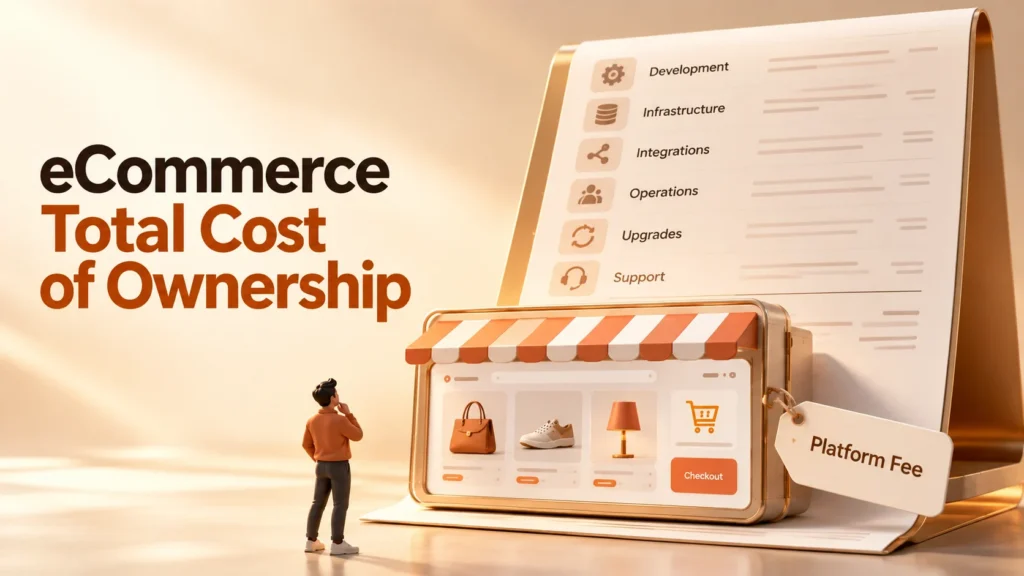
Enterprise ecommerce costs extend far beyond licensing fees. Long-term TCO includes development, hosting, maintenance, upgrades, integrations, and scaling expenses. Some platforms may appear cost-effective initially, but become expensive as customization and operational complexity increase.
Enterprises should evaluate costs over a multi-year horizon to understand the true financial impact. A platform with a higher upfront cost but lower long-term maintenance may offer better ROI than a cheaper alternative that requires constant investment.
-
Test Before Committing
Before making a final decision, enterprises should validate platform suitability through demos, pilots, or proof-of-concept implementations. This allows stakeholders to evaluate performance, usability, integration capabilities, and scalability in real-world scenarios. Testing also helps identify potential risks, limitations, or hidden costs early in the process.
A platform that performs well in controlled demonstrations but struggles in practical use may not be suitable for enterprise-scale operations. Thorough testing reduces risk and increases confidence in the final selection.
Conclusion
Choosing the right enterprise ecommerce platform is a strategic decision that shapes how a business grows, scales, and competes in an increasingly digital marketplace. As customer expectations rise and commerce models become more complex, enterprises need platforms that go beyond basic online selling to deliver scalability, flexibility, integration, and intelligence.
The platforms discussed in this guide each offer distinct strengths, from ease of use and rapid deployment to deep customization and enterprise-grade integrations. However, the most successful enterprises are those that align platform capabilities with their business model, technical readiness, growth plans, and long-term operational goals.
As ecommerce continues to evolve in 2026 and beyond, modern enterprises must prioritize solutions that are future-ready, capable of supporting global expansion, omnichannel experiences, and automation at scale. By evaluating platforms thoughtfully and planning for long-term value, businesses can build a resilient ecommerce foundation that supports sustainable growth and delivers meaningful customer experiences.