You know it’s a peak season. Your Shopify Store, Amazon, and a wholesale portal are receiving orders simultaneously. But your Warehouse staff cannot determine which orders to process first, as the stock is not up to date. Additionally, customers are waiting for their orders. Meanwhile, you still have to select carriers manually and haven’t reconciled returns from the previous month.
If it sounds like a familiar story, you know the issue all too well, which is operational fragmentation. But the hidden cost that growing ecommerce brands face is disconnected tools, siloed data, and manual handoffs that create inefficiencies at scale.
The right ecommerce fulfillment software can solve this fragmentation. It integrates order intake, inventory visibility, warehouse execution, carrier selection, and returns into a single automated operational loop to minimize the risk of misfulfillment, scale with confidence, and end the firefighting.
This guide takes you through the best fulfillment softwares of 2026, explains what truly makes a good fulfillment tool great, and assists you in selecting the right one for your operations. Whether you operate an in-house warehouse, work with 3PLs, or are building a multi-channel marketplace.
What is eCommerce Fulfillment Software?
eCommerce fulfillment software is the system that handles all operations after a customer places an order. It covers order routing, inventory management, warehouse management, carrier selection, shipping label generation, and return management, all integrated into a single system.
Think of it as an air traffic control system for your orders. ATC directs planes between runways, gates, and flight paths. Fulfillment software does the same for orders, routing them across channels, warehouses, carriers, and customers to ensure every package arrives on time and on target.
As customers demand same-day or next-day delivery and sales are conducted through six or more channels simultaneously, fulfillment software is no longer a nice-to-have for running a business. In 2026, it is a key driver of business growth. Today, brands that deliver consistently retain customers, while those that fall short quickly lose them.
What are the Key Components of an eCommerce Fulfillment Platform?
Not all fulfillment platforms are equal and generally fall into these five main layers:
| Component | Description |
|---|---|
| Order Management | Collects and processes orders from all sales channels into a unified queue for routing and processing. |
| Inventory Visibility | Provides real-time visibility of inventory levels across warehouse nodes, 3PL partners, and retail stores to prevent overselling. |
| Warehouse Management (WMS) | Optimizes picker routes, manages bin locations within the warehouse, and guides pick-pack-ship workflows. |
| Shipping & Carrier Selection | Calculates carrier rates, generates shipping labels, and selects the best shipping option based on cost and SLA requirements. |
| Returns Management | Streamlines return authorization, inventory replenishment, and refund triggers, making returns more efficient and manageable. |
| Analytics & Reporting | Monitors fulfillment accuracy, on-time delivery rates, cost per order, and carrier performance to support business decision-making. |
The top fulfillment platforms combine all six layers into a unified system. Weaker tools cover only two or three layers and rely on patchwork integrations that create data gaps and fulfillment errors.
What are the Different Types of eCommerce Fulfillment Software?
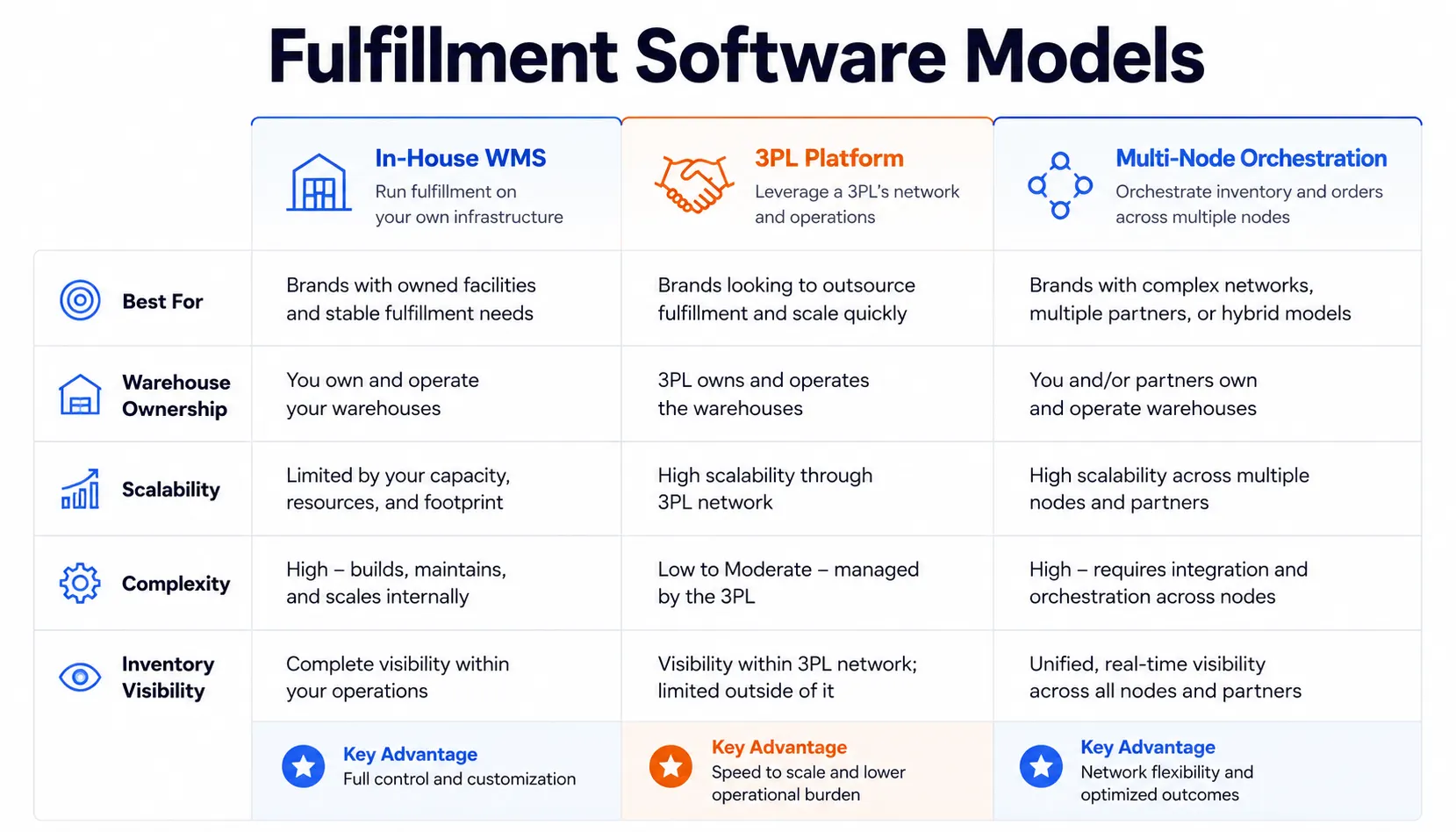
Before comparing specific tools, it’s important to understand the three primary models of fulfillment software, because the right type depends entirely on your operational structure:
1. Self-Fulfillment / In-House WMS Platforms
Ideal for brands that have their own warehouses. These platforms are very warehouse-centric, with a strong emphasis on warehouse execution, such as bin management, batch picking, barcode scanning, and dock scheduling. You have the hardware, and the software makes it function smoothly. Examples include Linnworks, Brightpearl, and Extensiv (formerly known as Skubana).
2. 3PL-Integrated Fulfillment Platforms
For brands that outsource fulfillment to third-party logistics providers. The tools are merchant-facing and are layered on top of the 3PL’s own WMS, providing real-time insights into inventory and orders without having to run a warehouse yourself. These include ShipBob, Whiplash, and ShipMonk.
3. Hybrid / Multi-Node Orchestration Platforms
These advanced platforms route orders through multiple fulfillment sources, including owned warehouses, 3PLs, retail stockrooms, and dropship suppliers. These are becoming more critical for brands with a multi-channel fulfillment strategy at scale. In the fulfillment category, SpxCommerce is active in the marketplace-driven segment.
Top eCommerce Fulfillment Software Comparison (2026)
Below is an in-depth comparison of 2026’s most popular fulfillment platforms across 6 dimensions that matter most for scaling ecommerce businesses.
| Platform | Best For | Order Routing | WMS Depth | Carrier Integrations | Returns | Pricing Model |
|---|---|---|---|---|---|---|
| ShipBob | DTC brands, SMBs | Multi-node | Managed 3PL | 40+ | Built-in | Per order + storage |
| Whiplash | Mid-market, apparel | Rule-based | Managed 3PL | 20+ | Built-in | Per order + storage |
| SpxCommerce | Marketplace builders | Orchestration | Marketplace-native | Custom | Automated | Custom enterprise |
| ShipStation | Lean ops, multi-carrier | Basic | None (shipping only) | 100+ | Limited | Monthly SaaS |
| Extensiv (Skubana) | In-house + 3PL hybrid | Advanced | Full WMS | 60+ | Robust | Monthly SaaS |
| ShipMonk | SMB subscription brands | Standard | Managed 3PL | 30+ | Built-in | Per order + storage |
| Linnworks | Multi-channel ops | Multi-node | Full WMS | 50+ | Standard | Monthly SaaS |
Pro Tip
Avoid judging fulfillment platforms by their features and functionalities. What really sets fulfillment platforms apart is the depth of integration with your warehouse management system, sales channels, and carriers. A platform with 100 features and fragile integrations will not perform as well as one with 40 features and rock-solid API integrations.
Top 2 3PL Software Review: ShipBob vs Whiplash
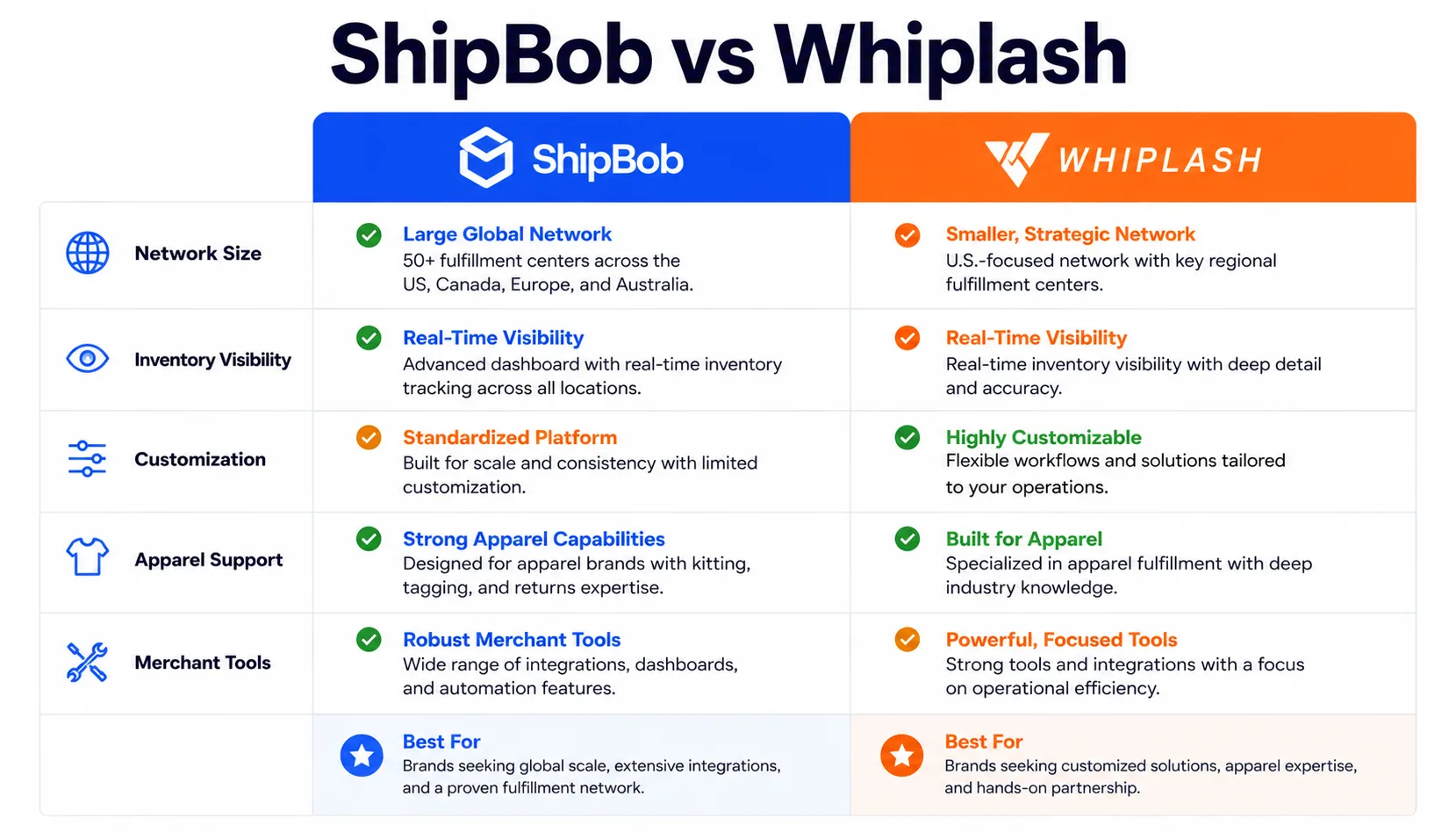
The most popular fulfillment companies to compare in the mid-market are ShipBob vs Whiplash. They cater to different operational profiles, both for ecommerce brands growing without the intention of operating their own warehouses.
ShipBob
ShipBob operates fulfillment centers located in the United States, the United Kingdom, the EU, Canada, and Australia. Their software provides real-time inventory analytics, helping distribute stock across multiple locations to reduce shipping distances and optimize both delivery speed and cost.
Along with this, their merchant dashboard is well designed and packed with content. Their integrations with Shopify, WooCommerce, and Amazon are equally well developed and carefully maintained.
Weaknesses: Limited inventory visibility, lack of owned technology, and opaque pricing model.
Limitations:Weaknesses: There is less flexibility for non-standard SKUs, apparel, or catalogs with high SKU counts than with a pure SaaS-based WMS.
Whiplash
Specifically strong with apparel, lifestyle, and subscription brands, Whiplash (acquired by Ryder in 2021) is a 3PL specializing in these categories. They offer stronger value-added services (VAS) than ShipBob, making them ideal for brands where the unboxing experience is part of the product.
Weaknesses: Fewer self-service tools, limited platform transparency, and greater dependence on Ryder’s logistics infrastructure.
Challenges: A smaller fulfillment network than ShipBob, fewer visible self-service options for merchants, and pricing may be less transparent when there are more complex SKU mixes
What are the Best Practices for eCommerce Fulfillment Software Implementation?
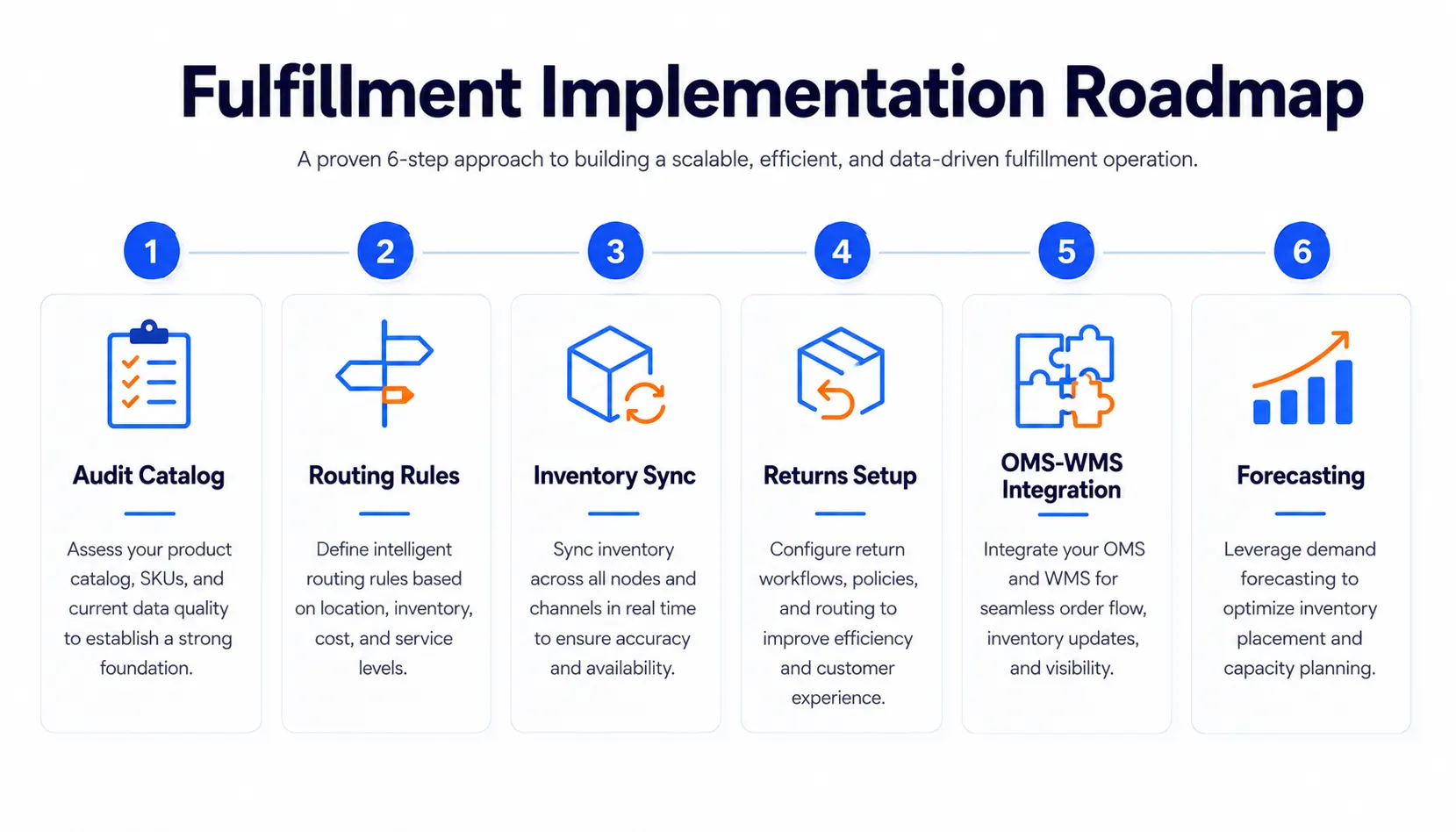
No matter how effective it might be, even the best eCommerce fulfillment software delivers poor results when teams implement it incorrectly. These practices are all repeatable ways to differentiate between successful and not-so-successful fulfillment operations at scale:
1. Audit your SKU catalog prior to the migration
Product data is the number one source of fulfillment mistakes if it’s missing or incorrect. Sanitize your catalog before loading it onto any new platform, including dimensions, weights, barcodes, and bundle relationships.
2. Map your order routing logic explicitly
Avoid setting the default options. Set routing criteria for all situations: SLA levels, carrier preferences, inventory limits, hazmat flags, channel-specific criteria. Document these rules prior to going live.
3. Integrate inventory in real time, not batch
A scheduled sync creates a “dangerous window” during which your inventory may appear in your storefront but not be available to sell. Always demand live or “near-live” feeds on inventory data from Day 1.
4. Build returns workflows before launch day
Many teams treat returns as a post-launch issue. That approach creates avoidable operational problems. A broken returns process can ruin customer confidence, create inventory discrepancies, and cause accounting confusion. Get it right from the beginning and use our returns management guide as a framework.
5. Connect your OMS and WMS before adding channels.
To expand into new channels, your inventory management software and order management layer must communicate without hindrance. Adding complexity prematurely will increase the risk for failure.
6. Invest in inventory forecasting from Month 1
Reactive inventory management results in overstocking and stockouts in tandem, a paradox that erodes margins and customer experience. Apply inventory forecasting tools that account for velocity, seasonality, and supplier lead times.
How to Choose the Right eCommerce Fulfillment Software?
There is no one best platform, only one in relation to your operational model, growth stage, and channel mix. Apply this decision-making framework to consider your choices:
Step 1: Define Your Fulfillment Model
Self-fulfilling, outsourcing to a 3PL, or creating a hybrid of both? A fully outsourced model requires merchant-facing visibility tools, while a self-fulfillment model depends on deep WMS functionality. A hybrid model, however, requires orchestration logic to manage both environments seamlessly.
Step 2: Audit Your Channel Mix
How many sales channels do you use? Are there any with particular SLA terms (like Amazon Prime, Walmart Fulfillment services)? Over time, you will incur fulfillment penalties and see your listings reduced on platforms with shallow marketplace integrations. When dealing with multiple vendors, you need a specialized, one-stop omnichannel fulfillment platform, not a typical 3PL dashboard.
Step 3: Assess on Integration Depth, not Breadth
A platform boasting 200 integrations means nothing if the two integrations you need, your ERP and your dominant carrier, are fragile or poorly maintained. Ask for API documentation and talk to existing customers about the reliability of integration rather than availability.
Step 4: Stress-Test Scalability
Ask each vendor what happens when your order volume increases tenfold. There are a lot of platforms designed for a brand in its current state, not the one you’re trying to achieve. Moving fulfillment platforms between growth and scale is costly. Combine this assessment with a good WMS Guide to determine capacity needs at scale.
Step 5: Calculate Total Cost of Ownership (TCO)
Platform cost is only one line item. Consider implementation, data transitioning, employee training, support, and the cost of incorrectness throughout the transition. Low-cost software that’s a lot of pain to migrate can be more expensive than higher-end software that offers dedicated onboarding support.
Why SpxCommerce would be Best for Your eCommerce Marketplace Fulfillment?
Most fulfillment software supports a single seller operating from a single warehouse. SpxCommerce is designed to serve a different purpose entirely: multi-vendor marketplace fulfillment, where dozens of respective inventories, policies, and carrier preferences of each seller must be handled by the marketplace operator via a single platform.
We provide a centralized fulfillment orchestration layer that connects vendors, warehouses, 3PLs, and dropshipping partners for ecommerce marketplaces and multi-vendor commerce platforms.
Our platform offers marketplaces a single view of inventory, intelligent order routing, split-order automation, and simplified returns management. It enables them to efficiently manage complex order-fulfillment processes without relying on a single distribution partner.
We are not a ShipBob competitor or a Whiplash competitor, but a fulfillment system that sits on top of them and runs fulfillment across a variety of 3PL, internal warehouse, and drop-ship options your marketplace needs.
Conclusion
By 2026, ecommerce fulfillment software will no longer just be an operational detail, and it will have become a direct driver of customer experience, margin efficiency, and competitive advantage. Brands that execute it well accelerate growth, while those that fall behind risk losing customers due to delayed shipments and poor reconciliation.
It depends on the model you are looking for: 3PL, in-house, or marketplace orchestrated. The principles are similar across models: real-time inventory visibility, intelligent order routing, carrier integration, and automated returns at any significant scale.
When assessing ShipBob vs Whiplash, auditing your existing WMS, or designing an architecture for a new marketplace, make sure you have a clear picture of how you want to operate. Before you even consider the breadth or depth of integration, ensure that the platform will grow with you, not that your business has to grow around the platform.