Cyberattacks target online businesses every 39 seconds, making security a critical priority for ecommerce brands. For ecommerce store owners, it’s not only about the money. Losing even a single customer due to a data breach can cost upwards of $100,000, expose you to six-figure regulatory fines, and potentially force your business to shut down within hours. But many merchants still take security for granted, putting it in place after launch and not integrating it from the beginning.
These risks can be transformed into solved problems through a structured approach to ecommerce data security that integrates PCI DSS compliance with SSL and GDPR readiness, and incorporates proactive fraud prevention measures. A proper security architecture is not only a way to keep your customers safe, but it also offers a meaningful competitive advantage.
This guide outlines all of the key components of online store security, and helps you create or strengthen a secure store that your customers will trust and regulators will approve.
What Is eCommerce Data Security?
eCommerce data security encompasses the technologies, processes, and policies that protect sensitive customer and transaction information throughout an online store’s infrastructure.
It safeguards data at every stage of the customer journey, from the moment a visitor lands on your website to long after an order has been completed.
Think of ecommerce data security as a multi-layered defense system. A secure online store relies on multiple layers to protect its most valuable data:
- Network security: firewalls, DDoS protection, intrusion detection
- Application security: secure code, input validation, dependency management
- Data security: encryption at rest and in transit, tokenization, and access controls
- Compliance frameworks: PCI DSS, GDPR, CCPA, and regional regulations
- Operational security: staff training, incident response plans, vendor audits
PCI DSS Compliance for eCommerce
The Payment Card Industry Data Security Standard (PCI DSS) is a standard that must be adhered to by any business that handles cardholder data. Non-compliance is not only a regulatory risk; card networks can fine you $5,000–$100,000 per month and ban you from accepting card payments altogether.
The 12 Core PCI DSS Requirements (v4.0)
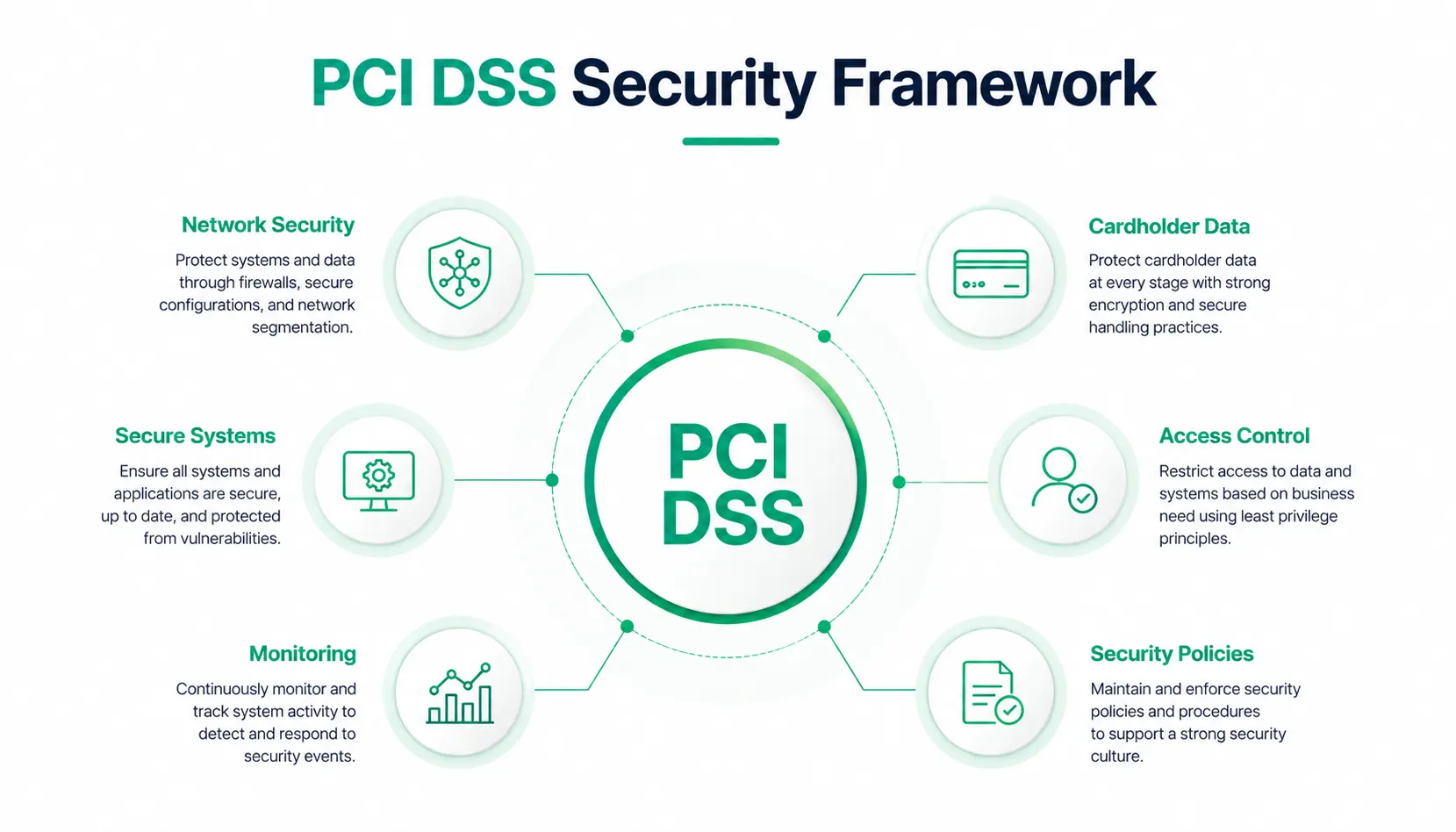
PCI DSS v4.0 outlines 12 essential security requirements designed to protect cardholder data, secure networks, and reduce payment fraud risks. Organizations must implement these controls to maintain compliance and strengthen their overall cybersecurity posture.
| Requirement | Description | Risk Level |
|---|---|---|
| 1–2 | Install and configure network security controls; apply secure configurations | Critical |
| 3–4 | Secure stored account data and protect cardholder data during transmission | Critical |
| 5–6 | Protect systems against malware; develop and maintain secure systems and software | Critical |
| 7–8 | Restrict access to system components; identify users and authenticate access | High |
| 9 | Restrict physical and logical access to cardholder data | High |
| 10–11 | Log and monitor access to network resources; regularly test security systems and processes | High |
| 12 | Implement organizational policies and programs to support information security | Standard |
Practical Path to PCI DSS Compliance
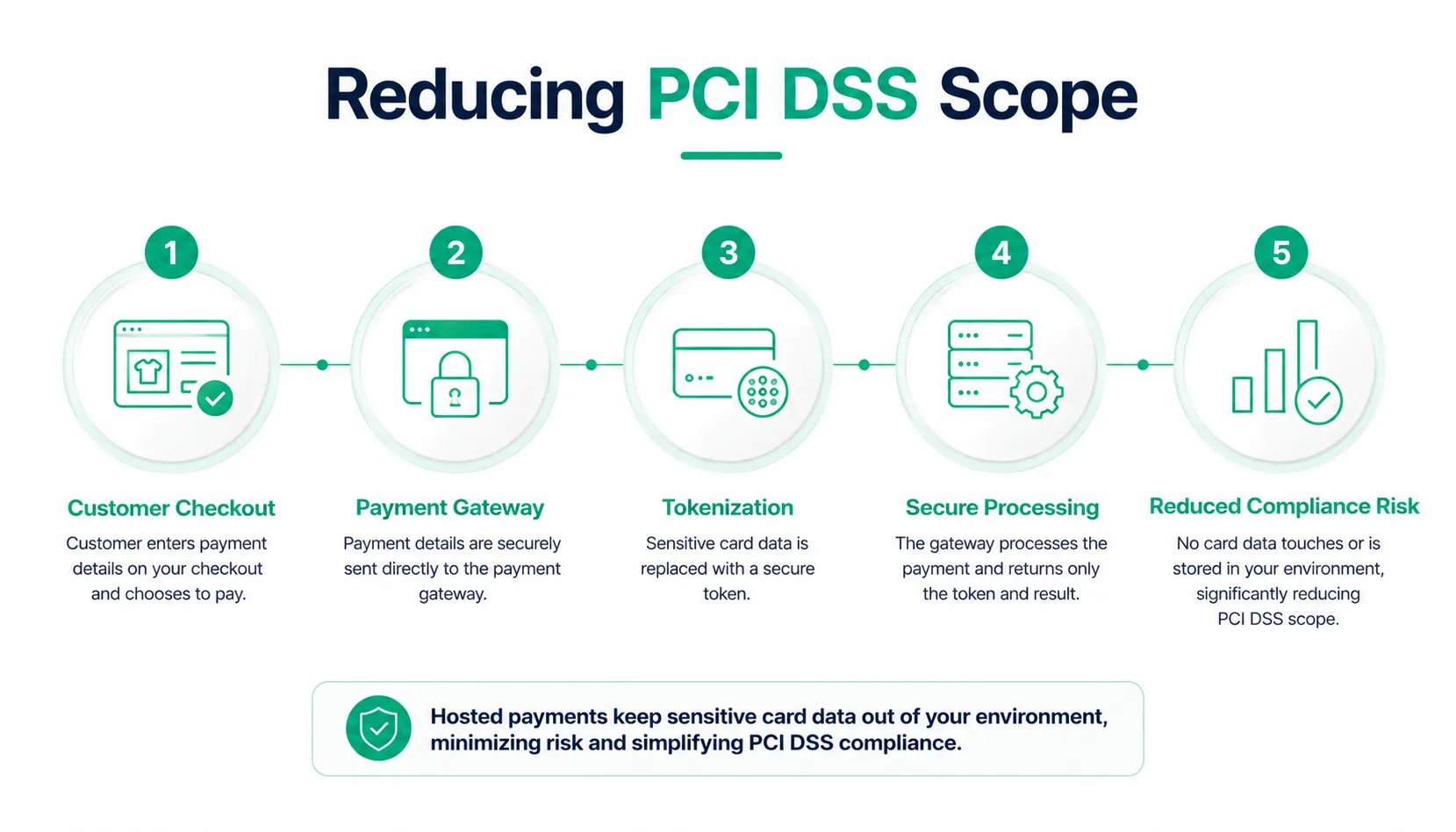
For the majority of ecommerce merchants, the best course of action is to never store raw card data at all and to use a PCI-compliant payment gateway that supports tokenization. This will shorten your PCI scope from the most challenging SAQ D to the less complicated SAQ A, which is limited to checkout page integration.
Best practice: Use the hosted payment page or an iFrame from your payment gateway partner. Card data never enters your servers, making it much easier to be compliant and less vulnerable to breach.
SSL & HTTPS: The Foundation of Online Store Trust
Transport Layer Security (TLS), formerly known as SSL, encrypts data exchanged between a customer’s browser and your web server. Without encryption, form submissions, login credentials, and payment details travel in plain text, making them vulnerable to interception.
SSL Certificate Types Compared
SSL certificates vary in validation levels: Domain Validation (DV), Organization Validation (OV), and Extended Validation (EV), offering different degrees of identity verification and trust. Choosing the right certificate depends on your website’s security needs, business credibility requirements, and user trust goals.
| SSL Certificate Type | Validation Level | Best For | Browser Trust Indicator |
|---|---|---|---|
| Domain Validated (DV) | Domain ownership only | Blogs, content sites | Padlock icon |
| Organization Validated (OV) | Business identity verified | Mid-size ecommerce websites | Padlock + organization details |
| Extended Validation (EV) | Complete legal entity verification | High-volume stores, enterprise websites | Padlock + company name* |
| Wildcard SSL | Depends on DV/OV/EV level; covers all subdomains under a domain | Multi-subdomain storefronts and websites | Padlock icon |
It is highly recommended that OV or EV certificates be used for any payments made in stores. Moreover, SSL is a ranking factor for Google, making it an important security and SEO consideration for ecommerce.
GDPR eCommerce Compliance: Protecting Customer Privacy
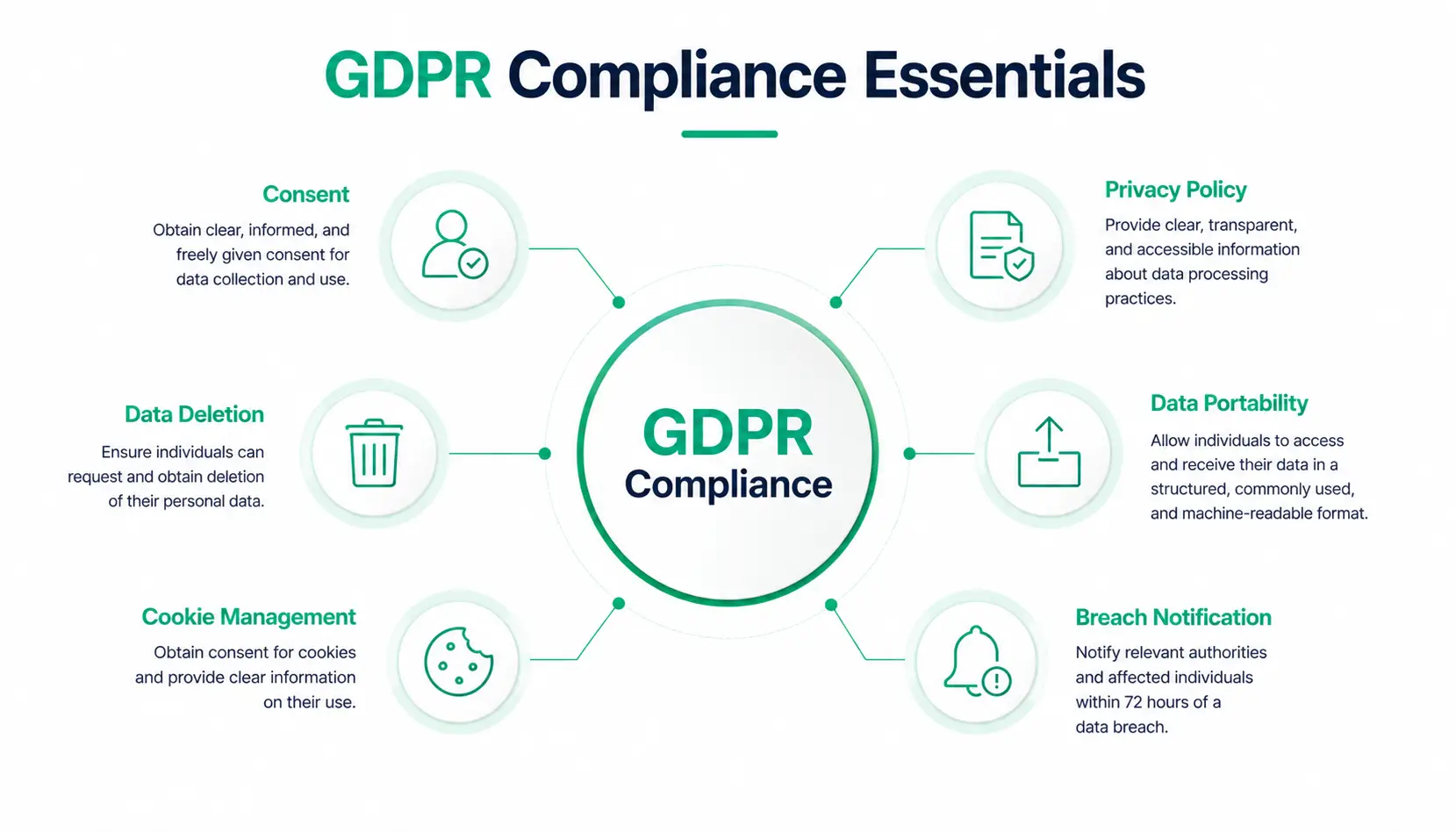
The General Data Protection Regulation (GDPR) applies to you if your store is in the EU or if you have any customers in the EU. GDPR compliance is both an ethical and financial responsibility, with penalties reaching 4% of global annual turnover or €20 million, whichever is higher.
Any eCommerce store must comply with these essential requirements under the GDPR.
- Lawful basis for processing: Get clear and informed consent before gathering marketing data
- Privacy Policy: Make it obvious what types of data you are collecting, why, for how long, and who you share it with.
- Right to erasure: Give customers the option to have their personal information erased.
- Data portability: Enable customers to download their information in a machine-readable format.
- Breach notification: In case of a breach, notify your supervisory body within 72 hours.
- Cookie consent: Use a compliant cookie banner with granular opt-in options
- Data Processing Agreements (DPAs): Execute DPAs with all third-party vendors who process customer data
The GDPR principles align perfectly with the current way B2C ecommerce platforms are designed. Privacy-by-default is not only compliant, but it’s also a conversion rate booster, as customers believe that transparent stores are more trustworthy.
Fraud Prevention Strategies for eCommerce
Fraud creates costs beyond lost products and chargeback fees. It consumes staff time, strains payment processor relationships, and increases processing costs. A proactive ecommerce fraud prevention strategy is designed to prevent fraud from turning into an incident.
The most common fraud types that target online stores are:
- Card-not-present (CNP): Fraud occurs when card information is stolen and used online.
- Account Takeover (ATO): Credential Stuffing Attacks on Saved Payment Methods
- Friendly fraud/chargeback fraud: Customers disputing legitimate charges
- Refund abuse: Exploiting the returns policies to obtain goods for free
- Bot attacks: They use automated scripts to conduct activities such as scalping, inventory hoarding, and credential stuffing.
Proven Fraud Prevention Techniques
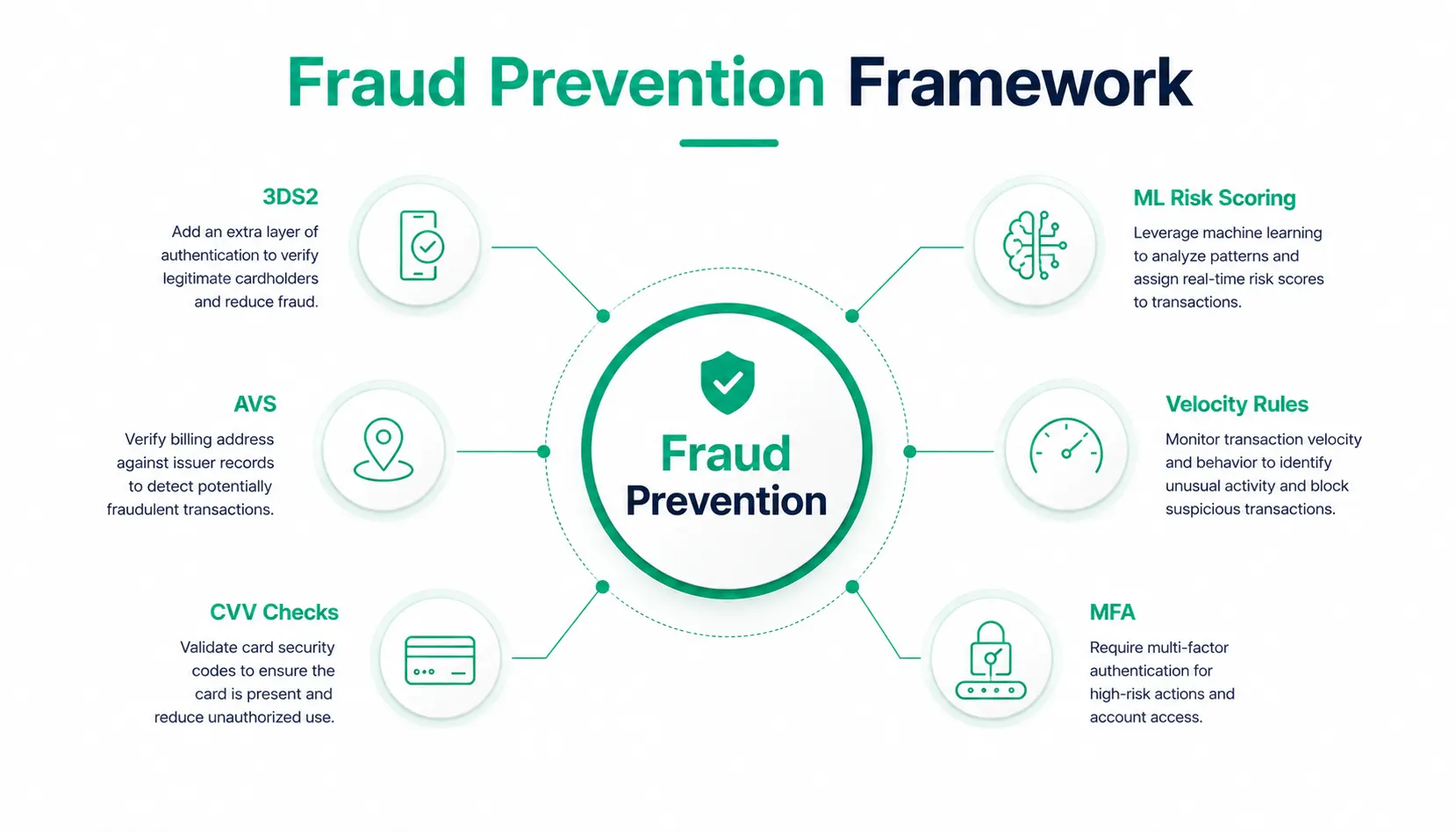
Implement layered security measures, such as real-time monitoring, identity verification, and AI-driven risk detection, to detect suspicious activity early. Regular audits, employee training, and strong access controls further reduce fraud risks and strengthen organizational resilience.
1. Enable 3D Secure 2.0 (3DS2)
3DS2 introduces an authentication layer for card transactions and implements risk-based logic to minimize friction for low-risk purchases. It also shifts certain fraud-related liability from the merchant to the card issuer.
2. Implement Address Verification Service (AVS) & CVV checks
AVS matches the billing address the customer provided with the information stored by the card issuer. Mismatches are a good indicator of fraud and should be auto-declined or picked up for further validation.
3. Deploy machine learning fraud scoring
For instance, Stripe Radar, Signifyd, or Kount provide real-time risk scores for transactions using hundreds of signals, including device fingerprinting, IP geolocation, order velocity, and behavioral biometrics.
4. Set velocity rules and order limits
Flag or hold orders based on a purchase frequency exceeding a threshold, billing/shipping address mismatch pattern, or when the IP address is in a known high-risk IP range.
5. Multi-factor authentication (MFA) for customer accounts
Implement MFA for actions such as refunds, shipping addresses, payment method changes, at login, particularly. This one step is enough to thwart most account takeovers.
6. Monitor chargeback ratios
Keep chargebacks at less than 1% of transactions (Visa’s limit is .9%). High ratios exceeding this may lead to a card network monitoring program or loss of processing capability.
Fraud risk is compounded by several vendors, and buyer accounts for marketplace operators. A strong multi-vendor marketplace software solution should include vendor vetting methods, transaction-tracking dashboards, and a system that automates dispute administration within the platform.
7. eCommerce Security Best Practices by Layer
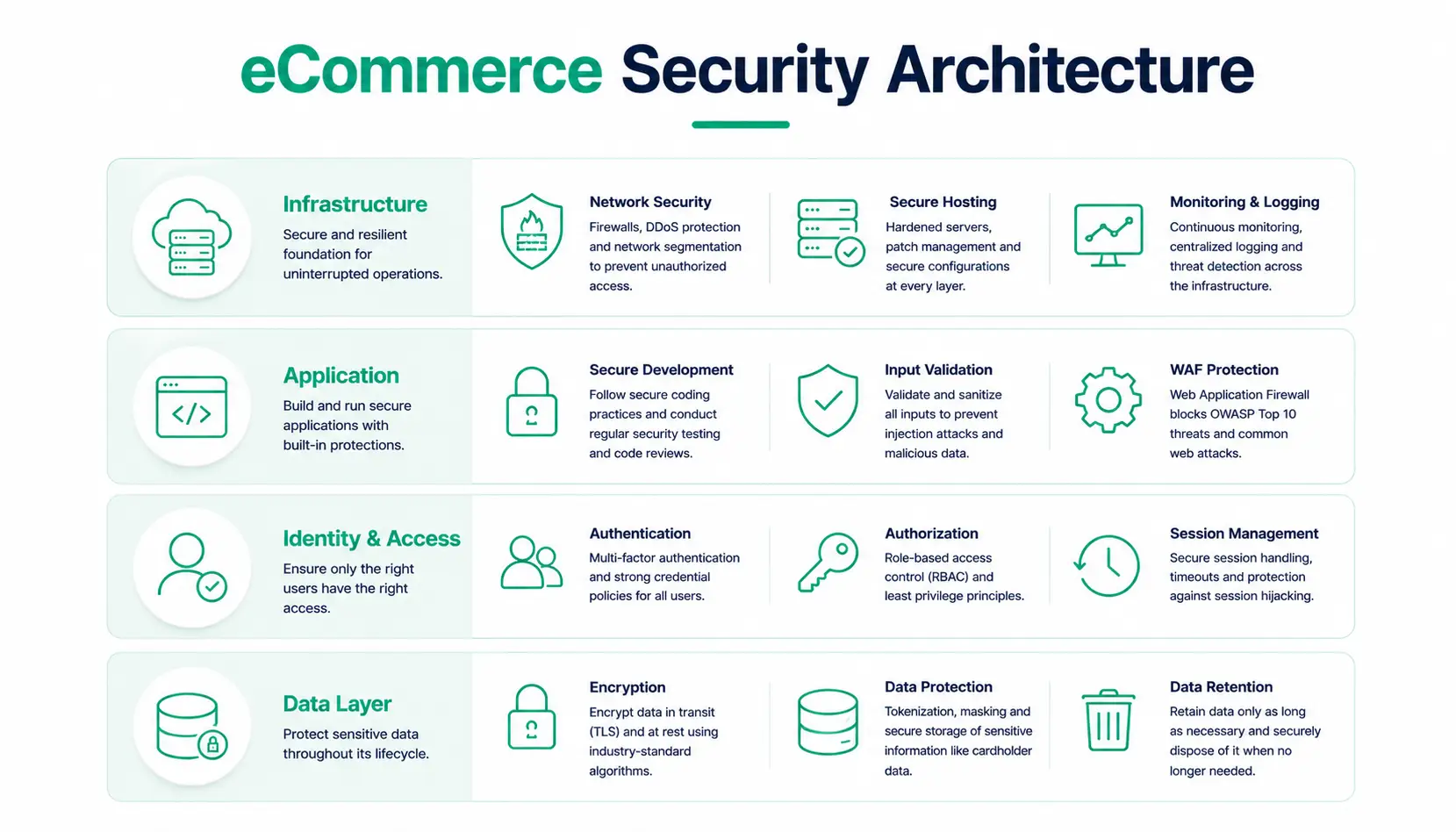
Think of your security architecture as a series of concentric protective layers. The outer layers of protection guard the inner ones, and if each ring is hardened correctly, then a break in the outermost ring has no impact on the inner ones.
Infrastructure Layer
- Run on AWS, Google Cloud, and Azure with ISO 27001 certification.
- Allow Web Application Firewall (WAF) to block malicious traffic from reaching your application.
- Set up DDoS protection (Cloudflare, AWS Shield) to keep the site up and running during volumetric attacks.
- Segment your network so payment processing servers remain separate from your CMS environment.
Application Layer
- Run automated dependency scanning (Snyk, Dependabot) and patch for vulnerable third-party libraries.
- Have quarterly remote penetration testing by a CREST-accredited security company.
- Use Content Security Policy (CSP) headers to stop Cross-Site Scripting (XSS) and Magecart skimmers.
- Always validate and sanitize inputs on both the client and server sides.
Access & Identity Layer
- Implement the principle of “least privilege” as staff should only have access to the data they need for their job function.
- Apply MFA to all admin panel logins.
- Change API keys and access tokens frequently; cancel access tokens when employees leave.
- Implement Single Sign-On (SSO) with audit logging in enterprise team environments
Data Layer
- Store sensitive data in encrypted format (AES-256) and encrypt all data in transit (TLS 1.3);
- Store tokenized payment references instead of raw card numbers.
- Establish and enforce data retention policies, and automatically delete data after the retention period.
- Ensure daily backups to an off-site location in an encrypted format, and test them quarterly.
These practices are a natural fit for a good ecommerce tech stack. Security is not an additional concern but rather an architectural property inherent in all the technologies you select.
How to Ensure Your eCommerce Platform is Secure?
Some platforms have more robust security bases than others. These factors will make security a boon or a bane for both a single-store solution and a complex multi-vendor marketplace.
| Criteria | What to Look For | Why It Matters |
|---|---|---|
| PCI DSS Scope Reduction | Integrated payment pages or certified payment systems | Reduces your compliance obligations and liability in the event of a data breach. |
| SSL Management | Automated SSL certificate issuance, renewal, and HTTPS enforcement | Eliminates certificate expiration issues and ensures secure communications. |
| Access Controls | Role-based permissions, multi-factor authentication (MFA), and audit logs | Helps prevent insider threats and unauthorized access to sensitive systems and data. |
| GDPR Tooling | Built-in consent management, data export, and data deletion workflows | Reduces the need for custom development while minimizing regulatory and privacy risks. |
| Security Patching | SLA-backed patch deployment and continuous CVE monitoring | Enables rapid response to zero-day vulnerabilities and emerging security threats. |
| Fraud Tools | Native fraud scoring capabilities or certified third-party fraud prevention integrations | Reduces chargebacks, fraud losses, and the effort required for manual transaction reviews. |
| Compliance Certifications | SOC 2 Type II, ISO 27001, PCI DSS Level 1 certifications | Provides independent assurance that security controls and compliance requirements are being effectively managed. |
In B2B operations, there are additional security needs, including buyer and seller verification, contract-based access, and audit tracking for procurement processes. These are all managed natively by a purpose-built B2B ecommerce platform, without the need for costly customization of a consumer-centric platform. But grasping the difference is an important aspect of B2B ecommerce platform selection.
Likewise, B2C ecommerce platforms need to focus on frictionless, GDPR-compliant consent management and fraud detection at checkout without compromising conversion rates. If security creates unnecessary friction, merchants often disable it, increasing risk. The best platforms are designed to be invisible to the end user when it comes to security.
Why Choose SpxCommerce for Secure Marketplace Development?
A marketplace adds security elements to your business that a traditional ecommerce solution does not. You aren’t just handling your own transaction data, and you’re handling the personal and financial data of several vendor accounts, their customers, and various interparty payments all at once.
Our platform is a specially designed marketplace software where security is built into the infrastructure and not an afterthought. All marketplaces come with PCI DSS payment integrations, automated SSL management, GDPR compliance tools, role-based access controls, audit logs, and built-in fraud monitoring. It also includes KYC-based vendor onboarding workflows that help verify sellers and minimize fraud from the very beginning.
If you’re starting a new marketplace or moving your current one to a new platform, you need to know how to create a secure ecommerce website. We offer the architecture, security controls, and continuous patching to keep it secure.
Conclusion
Data security for eCommerce is not a project that is completed, and it’s a discipline that spans compliance frameworks, technical architecture, operational processes, and vendor relationships. It’s clear that businesses that treat security as a growth driver rather than a cost center outperform those that view it as a checkbox. Businesses that treat security as a growth enabler rather than a cost center consistently outperform those that do not.
Begin with the basics: establish SSL, ensure PCI DSS compliance with a certified payment gateway, establish baseline fraud controls, and document your GDPR requirements. Next, add an external wall: Application security testing, access controls, automated monitoring, and incident response plans.
If you are interested in creating or expanding an eCommerce marketplace with multiple vendors, look for a platform that has already addressed these architectural challenges. The marketplace software you choose today will determine how much security debt you carry in the years ahead.