Suppose you’ve been working for weeks to upload thousands of products to your ecommerce website, but half of them are missing descriptions, have broken images, or misaligned prices on other channels. Sound familiar? For most growing ecommerce businesses, product catalog management is either an afterthought or an outright bottleneck.
It reduces revenue as customers leave due to incomplete product information, while inaccurate specifications increase return rates. It also creates operational friction, making it difficult for teams to share consistent sales data due to duplicate manual efforts. Multi-vendor marketplace environments accentuate these issues even more, with hundreds of sellers pushing inconsistent product information.
With a well-designed product catalog management strategy and the right software, businesses can reduce these challenges, shorten time-to-market, and deliver a better shopping experience. Here’s a guide to help you with all the basics and software options.
What is Product Catalog Management?
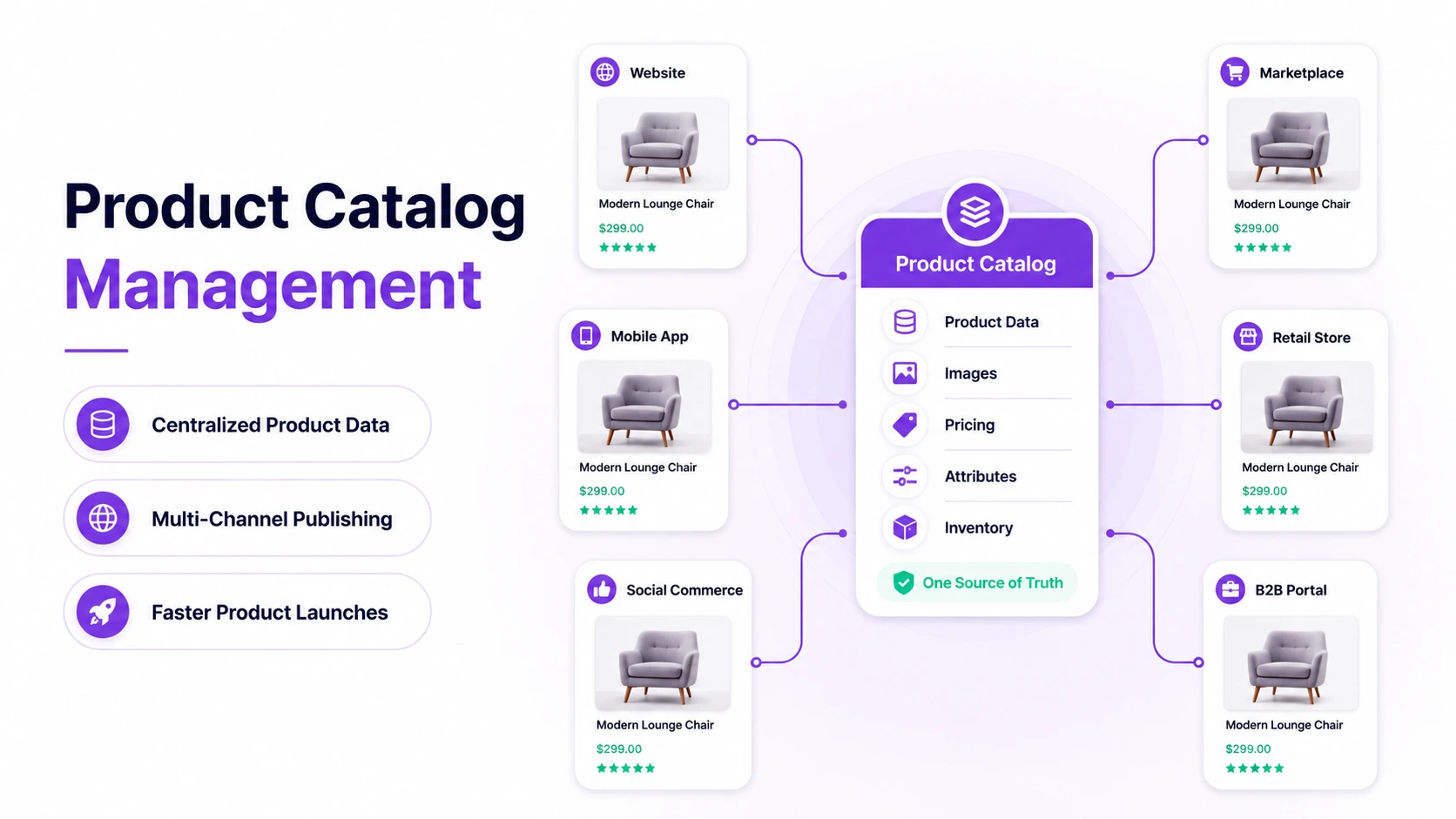
Product catalog management refers to the creation, organization, maintenance, and distribution of structured product data throughout all your sales channels. Imagine your product catalog as a living database that contains all your product information, including names, descriptions, SKUs, images, pricing, variants, availability, and attributes.
This data is organized in a structured way, making it easy to search, display, manage, and syndicate across multiple sales channels.
A product catalog contains the information customers need to discover, evaluate, and purchase products. Effective digital catalog management goes beyond listing products. It ensures product data remains accurate, complete, consistent, and optimized for every sales channel.
Every recipe (product) is printed on a card with precise ingredient amounts, instructions, and presentation guidelines. Each restaurant (channel) serves the correct version of that recipe, tailored to its community, without anyone having to rewrite it from scratch in the kitchens (platforms).
What are the Key Components of a Product Catalog?
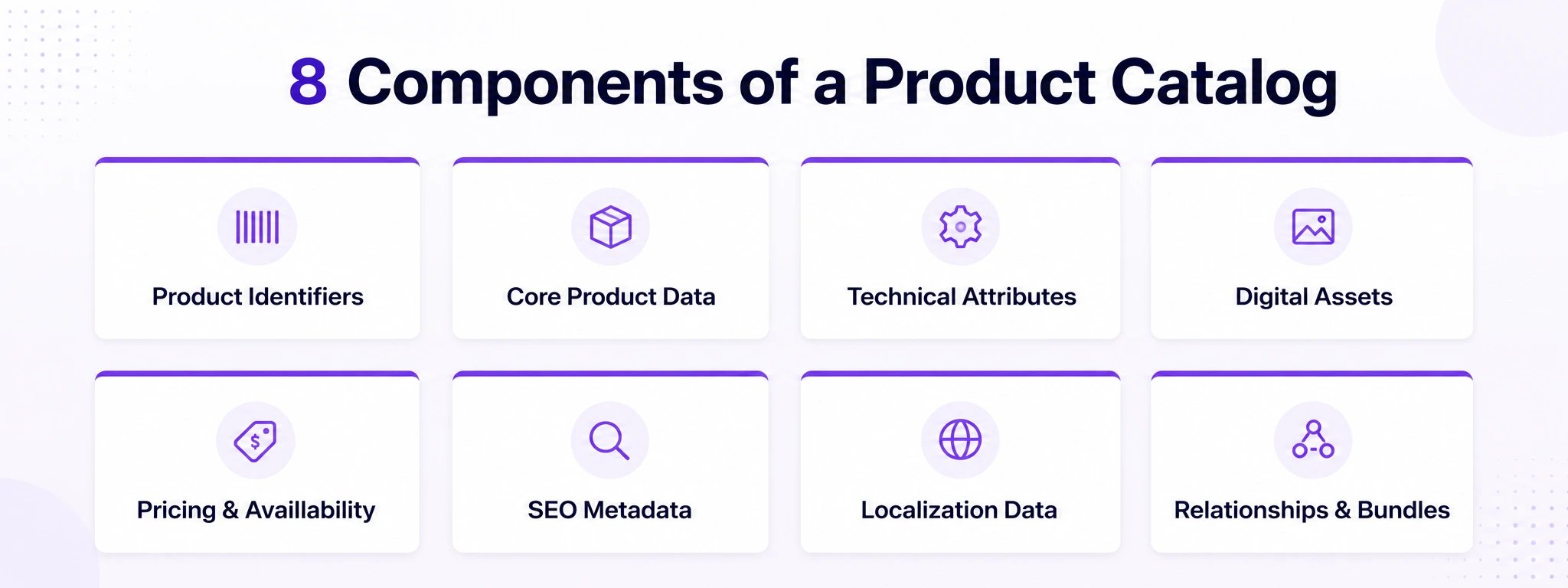
An effective product catalog is developed into multiple layers that play specific roles to support the customer experience and the business:
- Product Identifiers: SKU numbers, UPCs, EANs, and ISBNs that identify each product in a unique system.
- Core Product Data: Names, descriptions, categories, and subcategories the baseline information every product must have.
- Technical Attributes: These include dimensions, weight, material, color, size, compatibility, etc., which are vital for search filtering and fulfillment.
- Digital Assets: Product images, videos, 360° views, and PDFs controlled by your Digital Asset Management (DAM) layer.
- Pricing & Availability: Base prices, discounts, inventory levels, lead times, and region-specific pricing rules.
- SEO Metadata: This includes title tags, meta descriptions, alt text, and structured data markup for improving search engine visibility.
- Localization Data: Translated content, region-specific compliance information and currency formatting for the global market.
- Relationships & Bundles: Cross-sell suggestions, upsell variants and product bundles to boost the average order value.
What are the Common Challenges in Product Catalog Management?
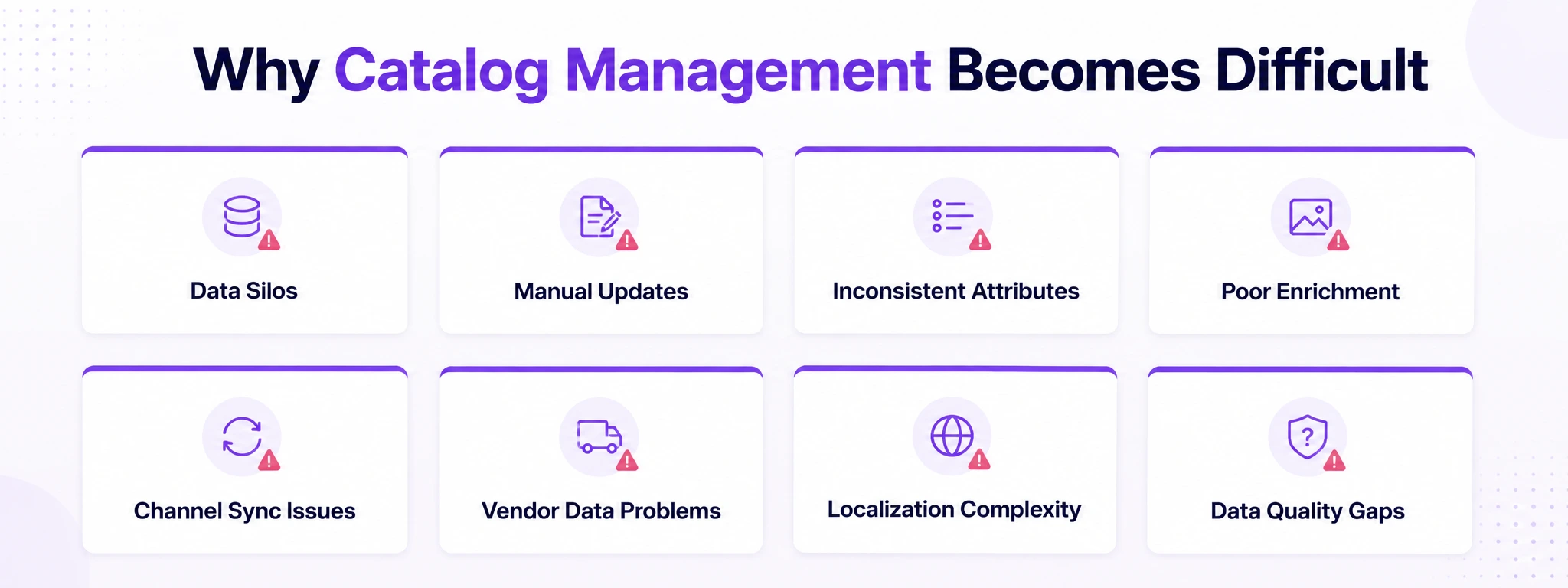
In order to create a scalable catalog strategy, it’s important to understand the real issues that can trip up most ecommerce teams:
- Data Silos: Product data stored in multiple systems, such as spreadsheets, legacy systems, supplier portals, and ERPs, leads to data inconsistencies and inaccuracies.
- Manual Data Entry: Manually entering product data across multiple formats and channels is not scalable.
- Inconsistent Attributes: If the same attribute (e.g., “color”) is given multiple definitions in different systems, filtering and search fail.
- Poor Catalog Enrichment: Thin product descriptions, no product images, and missing specs directly impact conversion and returns.
- Multi-Channel Synchronization: It’s a logistical nightmare to keep your product data in real-time sync across your website, marketplaces, and retail partners without automation.
- Vendor Data Quality: Marketplace vendors submit product data in different formats and quality levels, requiring normalization at scale.
- Localization Complexity: As catalog content must be adapted to various languages, regulations, and cultural expectations, a structured workflow is required. Read our ecommerce localization guide for more information.
PIM vs. Product Catalog Management: What’s the Difference?
One of the most prevalent misunderstandings in product data management is distinguishing between a PIM system and a product catalog. Although these terms are often used interchangeably, they serve different purposes.
| Dimension | Product Catalog | PIM System |
|---|---|---|
| Primary Purpose | Manages product information and presents it to customers | Centralizes and enriches internal product data |
| Audience | Customers, buyers, and channel partners | Marketing, ecommerce, and IT teams |
| Data Scope | Customer-facing attributes only | Full product lifecycle data, including sourcing and compliance |
| Workflow | Primarily for displaying product information | Create, enrich, validate, approve, and publish data |
| Channel Syndication | Limited | Built-in multi-channel distribution |
| Catalog Enrichment Tools | Basic | Advanced |
| Master Data Management | Not included | Core feature |
To sum up: Your product catalogs are what your customers see. A PIM ensures customers see accurate, complete, and consistent product information. Read our in-depth product information management guide or see how a product information management software solution in action for more context.
What are the Best Practices for Product Catalog Management?
It’s important to remember that creating a great catalog isn’t an overnight process, and it’s a continuous practice. These best practices illustrate some of the things that the best ecommerce companies and marketplace operators do consistently well.
1. Establish a Single Source of Truth
Product data should come only from a single authoritative system, whether it’s a PIM, ERP, or dedicated catalog management system. If multiple sources are used to gather data, of course, there are bound to be discrepancies. A product data management strategy that centralizes your data eliminates duplication and helps you establish a solid base for all your channels.
2. Standardize Your Attribute Taxonomy
Establish a naming and data model for all product attributes before you begin adding products to your catalog. For instance, choose one of the words, “Colour” or “Color”, and stick to it throughout the system. Standardized taxonomies are the foundation of all downstream automated processes in the retail master data management environment.
3. Invest in Catalog Enrichment
Limited product information can lead to lower conversion rates. Catalog enrichment involves adding long-form descriptions, comparison tables, use-case content, high-resolution images, and video demos to each product listing. Detailed product information improves both conversion rates and organic search visibility. To maximize visibility and profit per product, integrate your enrichment strategy into your overall ecommerce merchandising plan.
4. Automate Data Validation Workflows
Implement automated quality-assurance processes to identify missing data, data-format issues, or out-of-range values prior to product publication. This is particularly important for ecommerce product catalog management when hundreds of SKUs can be released every day. Automated validation saves your team hours and ensures your customers aren’t inundated with bad data.
5. Implement Lifecycle-Based Catalog Governance
Products are not merely produced, but they are also updated, promoted, discontinued, and archived. Create a governance model that is driven by the product’s lifecycle stage and activates workflows accordingly. Seasonal pricing changes, new image uploads, or changes to regulatory labels should be driven through well-controlled, auditable processes.
6. Optimize for Channel-Specific Requirements
Amazon has its own set of attributes that differ from your Shopify store. Google Shopping has different image specifications than your print catalog. The product catalog management system should also be able to handle channel-specific data templates, so the same base product data can be output in the exact format each channel requires, without manual reformatting. This is directly related to an effective product feed management strategy.
7. Enable Localization at Scale
In the event you sell across regions, your catalog must be multilingual-ready, include culturally appropriate illustrations, regional price lists, regulatory data, etc. Include localization in your catalog design from the outset it is costly and risky to add it in afterward.
8. Use Visual Merchandising to Drive Discovery
The presentation (and grouping) of products is as important as the data itself. Use category banners, featured product slots, and curated collections to direct customers to high-margin/popular products. Learn the fundamentals of visual merchandising and how the structure of a catalog binds to the buyer’s psychology in our guide.
Which are the Top Product Catalog Management Software & Tools?
The best catalog management tools for your business will depend on your catalog and channel strategies, as well as your business’s size and complexity. Let’s take a closer look at the top platforms available in each category:
| Tool / Platform | Best For | Key Strength | PIM Capability |
|---|---|---|---|
| Akeneo | Mid-market to enterprise brands | Enriched PIM with strong workflows | Full PIM |
| Salsify | Consumer goods brands | Retailer syndication network | Full PIM |
| Pimcore | Businesses with complex data models | Open-source flexibility + MDM | Full PIM + MDM |
| Shopify / WooCommerce | SMB ecommerce stores | Built-in catalog and app ecosystem | Basic |
| Adobe Commerce (Magento) | Large B2B/B2C retailers | Advanced catalog rules and segmentation | Moderate |
| SpxCommerce | Multi-vendor marketplace operators | Seller catalog management and data normalization | Marketplace-native |
Don’t forget to consider integration depth (how deeply it integrates with your ERP, OMS, and marketing systems), scalability, and workflow automation features that save your team a ton of manual work.
Ecommerce Product Catalog Management in a Multi-Vendor Context
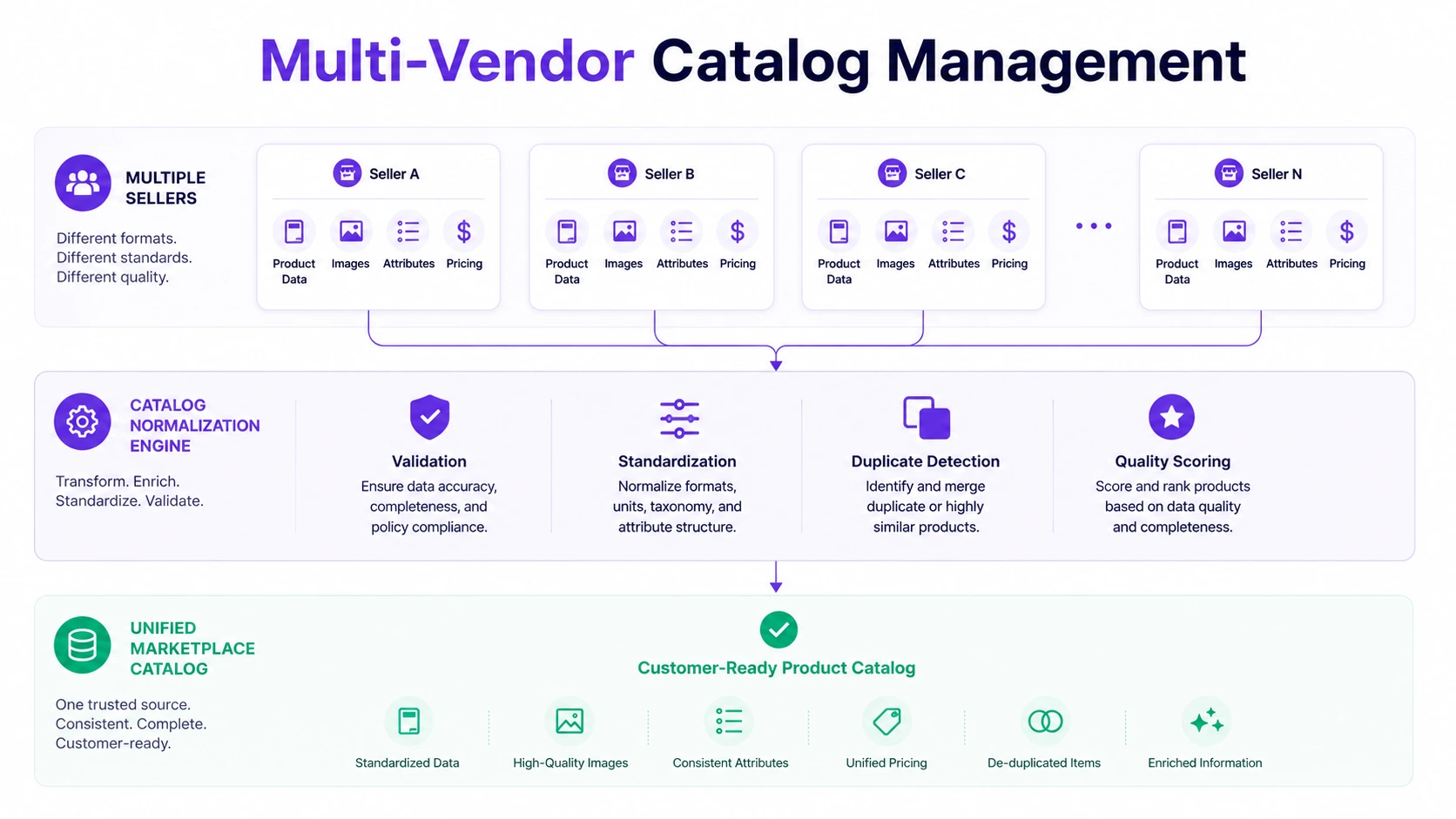
Product catalog management presents an entirely different challenge for businesses with a multi-vendor marketplace platform. You don’t only have to control your products, you have to control the data provided by dozens, hundreds, or thousands of third-party merchants.
This creates several unique requirements that standard catalog tools don’t address:
Seller Onboarding Workflows: Sellers must be provided with seller-specific templates and validation rules for submitting product data in your format and not in their own.
Data Normalization at Ingestion: Product feeds from various sellers come from different sources, with varying attribute names, units, and category structures. This should be normalized automatically in your platform.
Duplicate Detection: If multiple sellers are offering the same product, it will be detected. Your system should automatically identify and merge duplicate listings to avoid cluttering your buyers with your competitive seller data.
Catalog Governance Rules: Identify attributes that can be customized by sellers (e.g., price, stock) and those that are platform-defined (e.g., catalog category taxonomy, content standards).
Quality Scoring: Automated catalog completeness scores to encourage sellers to enhance their catalogs before they go live.
This complexity is too much to handle manually. Hence, the need for marketplace platforms such as SpxCommerce to include seller-side catalog management natively into the platform, along with a seller management system that maintains data quality throughout your entire network of suppliers.
How to Choose the Right Product Catalog Management System?
There are a number of product catalog management systems, and the decision on which one to choose depends on a clear-eyed evaluation of your business needs. Consider these decision criteria before assessing a vendor:
1. Catalog Size & Complexity
How many SKUs do you manage today, and how many will you manage in three years? Have complex configurable variants, bundles, or tiered pricing for B2B products? Choose a platform that supports both your current requirements and future growth.
2. Channel Requirements
Write the list of all channels you currently sell or intend to sell through. For each of these channels, your catalog system needs to be able to natively or via APIs include data models, image specs, and export formats.
3. Integration Ecosystem
Evaluate your current technology ecosystem: ERP, OMS, WMS, ecommerce platform, marketing tools. These need to be easily accessible via robust APIs or pre-engineered connectors in your catalog system, without having to develop a dedicated connector for each touchpoint.
4. Team Structure & Workflow Needs
Who is responsible for the creation, approval, and publication of product data? Need role-based access, approval process, or multi-team collaboration? Search for workflow automation that reflects the way your organization works.
5. Vendor / Seller Management
You will need seller-facing portals, submission workflows, and automated validation in your system if you want to use third-party sellers to add product data. This is where a dedicated Product Management System for marketplace contexts comes into play.
6. Localization & Compliance Support
If you’re running a global business, make sure your platform can handle multilingual workflows, region-specific attribute requirements, and regulatory requirements.
Conclusion
Product catalog management has evolved from an operational function into a strategic competitive advantage. With accurate, complete, consistently formatted, and product-Channel-enriched product data, you will see real results: increased conversion rates, reduced return rates, quicker time to market, and a customer shopping experience you can trust.
Whether you manage a D2C brand with 500 SKUs or a marketplace with 500,000 products, the same catalog management principles apply. These are the rules to follow: centralize data, standardize your taxonomy, aggressively enrich, automate your product validation, and publish confidently across every channel that matters.
The goal is not just to implement a catalog management system, but to choose one that supports growth without creating operational complexity. For marketplace operators, that means infrastructure begins with selecting a platform designed for multi-seller data at scale.