
Traditional ecommerce journeys often rely on multiple search, browsing, and checkout steps, creating friction that contributes to cart abandonment and lower conversion rates.
Instead of typing, a shopper simply asks their smart speaker or phone to find and order the preferred items. This whole process is known as voice commerce. For the retailer, though, it means rethinking product data, search indexing, and checkout logic so a voice assistant can actually complete the job.
The US voice commerce market is estimated at $22.4 billion in 2026 and is driven by advances in natural language processing and payment authentication, as per Ringly.io. It’s becoming a genuine transaction channel, and brands that treat it as an alternative risk losing visibility in a search experience that no longer starts with a screen.
Before diving deep, understand the voice commerce definition. After that, you will learn about its advantages, including faster micro-conversions for repeat purchases, a new discovery channel for local and long-tail queries, and much more.
What Is Voice Commerce?
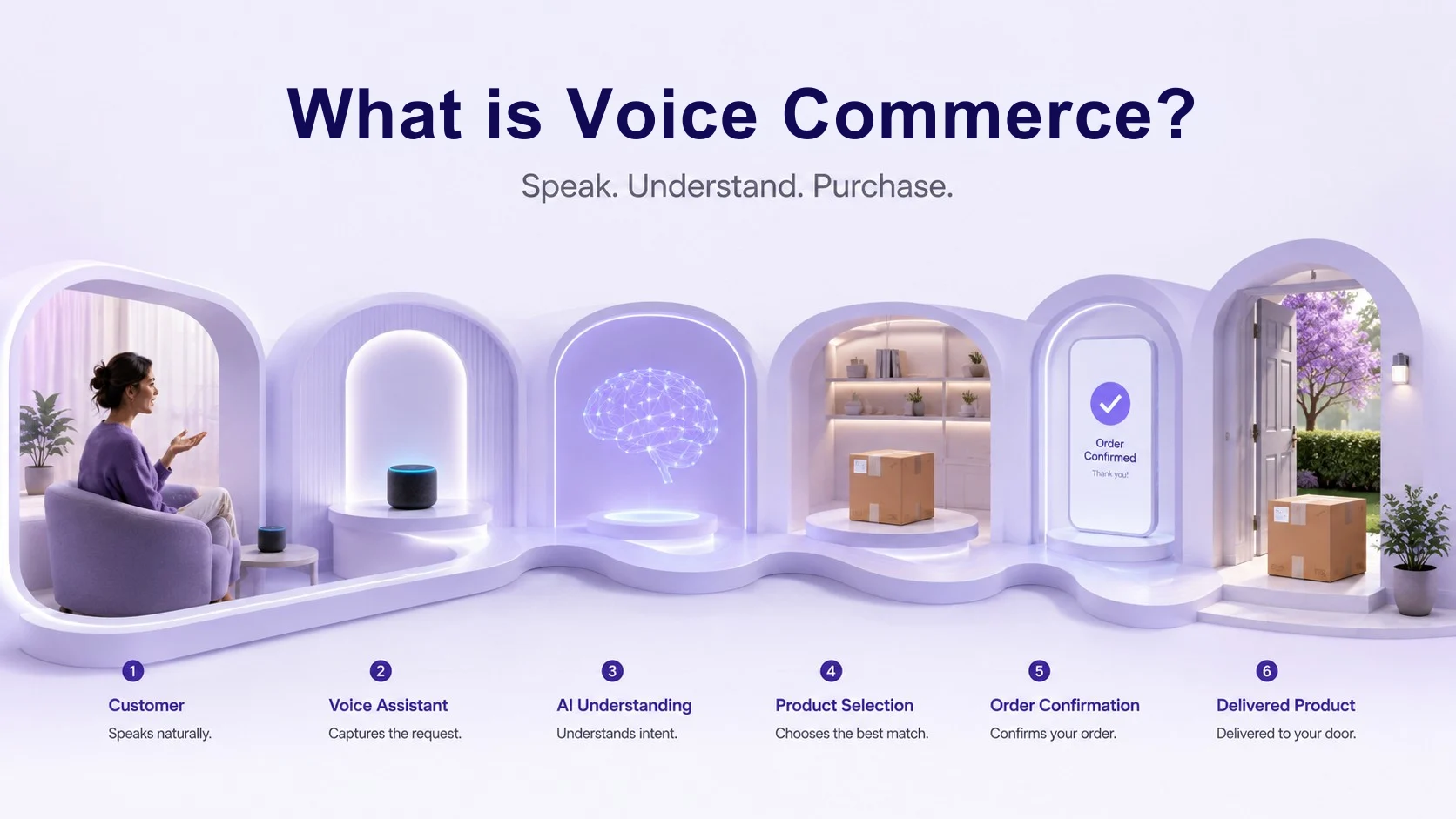
The use of virtual assistants, such as Google Assistant, Amazon Alexa, or even Siri, to analyze, search for, and purchase products without manual intervention. It is known as Voice Commerce. Plus, throughout the process, natural language removes clicks as the primary input method.
Voice commerce should be distinguished from voice search for e-commerce. However, it is the broader practice of optimizing product content so it surfaces correctly when someone asks a voice assistant a question.
Voice search is about discovery. On the other hand, voice commerce includes discovery but goes further, into the actual purchase. Every voice commerce transaction relies on voice search working well first. If the assistant can’t find the right product, it can’t sell it either.
How Voice Commerce Works: Key Components?
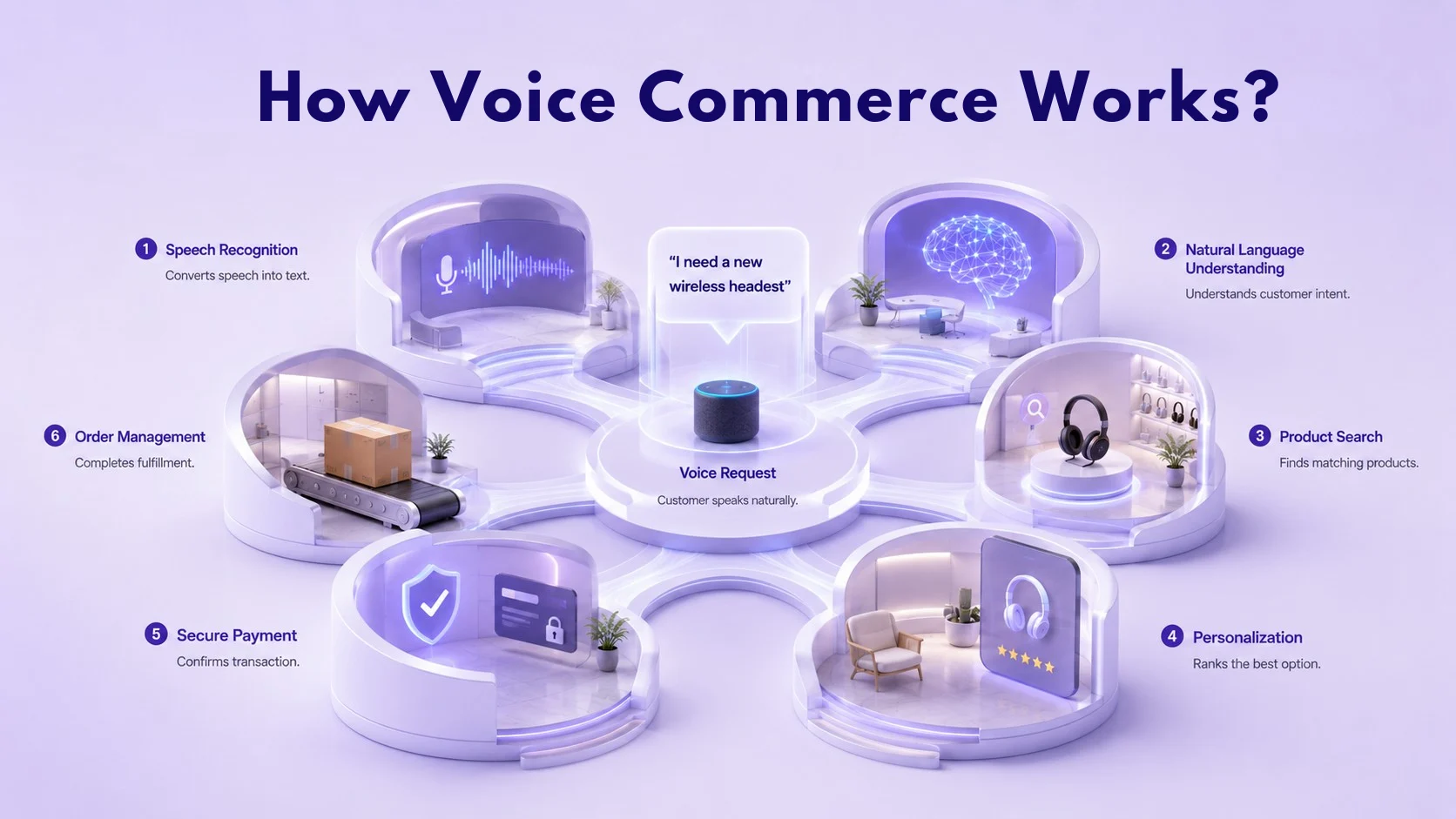
Voice shopping might feel effortless to the end user, but below the surface, several technical layers work together in sequence.
1. Automatic Speech Recognition (ASR)
This layer converts spoken audio into text. It has to account for accents, background noise, and interrupted speech. That is why ASR accuracy has been one of the biggest barriers to the adoption of voice commerce until recent years.
2. Natural Language Understanding (NLU)
Once speech becomes text, NLU determines intent. “Find me a red dress for a wedding under $100” isn’t a keyword string. It’s a bundle of intent, category, attribute, and budget constraint that has to be parsed correctly.
3. Product Data and Search Indexing
This layer depends on the commerce platform to manage structured product data, search indexing, and API-driven product discovery. Product titles, attributes, and structured data (schema markup) need to be clean and conversational-query-friendly, not just SEO-keyword-friendly.
A rigid, centralized catalog structure makes this hard to maintain at scale. However, it is one reason more merchants are shifting toward a headless commerce architecture that separates the product data layer from the front end and exposes it cleanly through APIs.
4. Personalization and Recommendation Engines
Voice assistants don’t have space to show twenty product options. They typically present only one to three product recommendations. That means the underlying recommendation logic has to be sharp. Merchants relying on AI product recommendations already have a favorable start. The same behavioral and purchase-history models that power on-site recommendations can also inform which product a voice assistant offers first.
5. Payment and Authentication
Voice biometrics, linked payment accounts, and confirmation prompts such as “Should I complete this $34.99 order?” help ensure the transaction is handled securely. This is also the layer where trust gets built or broken. An incorrect charge or a missed order quickly impacts repeat usage.
6. Fulfillment and Order Management
Once the order is placed, it flows into the same order management and fulfillment systems as any other channel.
Voice Commerce vs. Voice Search for Ecommerce
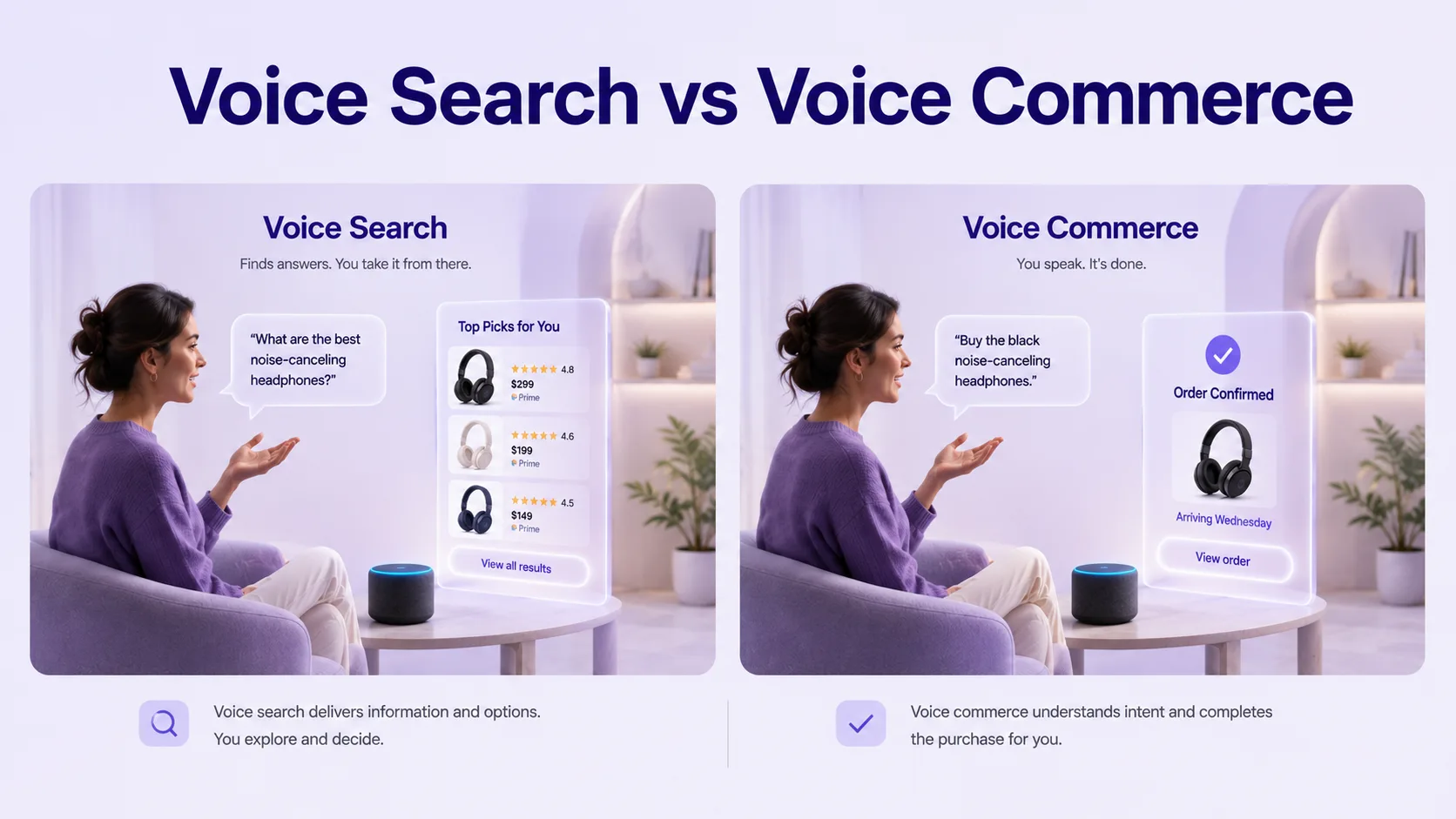
Both terms are completely distinct. Voice search helps users discover products through voice queries, while voice commerce enables the complete purchase process through voice interactions. So, the differences between the two terms are clearly outlined below:
| Aspect | Voice Search for Ecommerce | Voice Commerce |
|---|---|---|
| Typical query | “What’s the best running shoe for flat feet?” | “Order my usual running shoes.” |
| Outcome | Website visit and further research. | Purchase, reorder, or cart addition. |
| Optimization focus | Content, schema markup, and FAQ structure. | Catalog data, payment flow, and personalization. |
Both aspects are relevant. Voice search brings shoppers into consideration. Meanwhile, voice commerce closes the loop. Ignoring either one leaves a gap in how your brand shows up across a growing share of consumer interactions.
Main Types of Voice-Activated Shopping
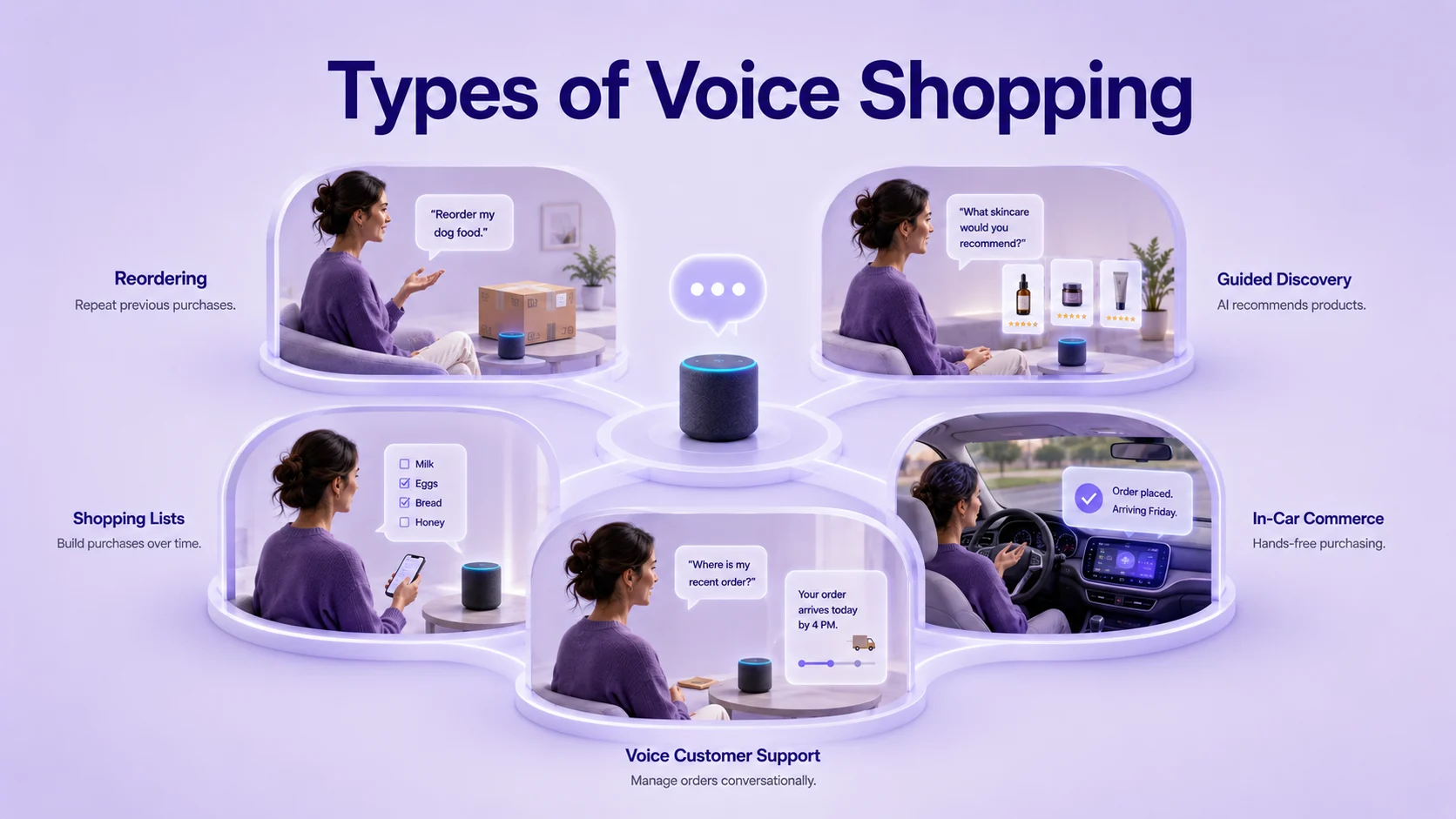
Voice-activated shopping breaks down into a few recognizable patterns. These are as highlighted below.
- Reorders and replenishment: Groceries, household goods, and subscription items control this category because shoppers already know exactly what they want.
- Guided discovery: The assistant asks clarifying questions (“What’s your budget?” and “Any brand preference?”) to reduce the number of unfamiliar categories, such as electronics or apparel.
- List-building: Shoppers add items to a cart or wish list by voice, then complete the purchase later on a screen. This is actually the most common voice-to-purchase pattern today.
- In-car and ambient commerce: Voice purchases initiated from a vehicle dashboard or wearable device, often for fuel, parking, or food orders.
- Customer service via voice: Order tracking, return initiation, and account questions are handled in a conversational manner, blurring the line between commerce and support.
Benefits of Voice Commerce
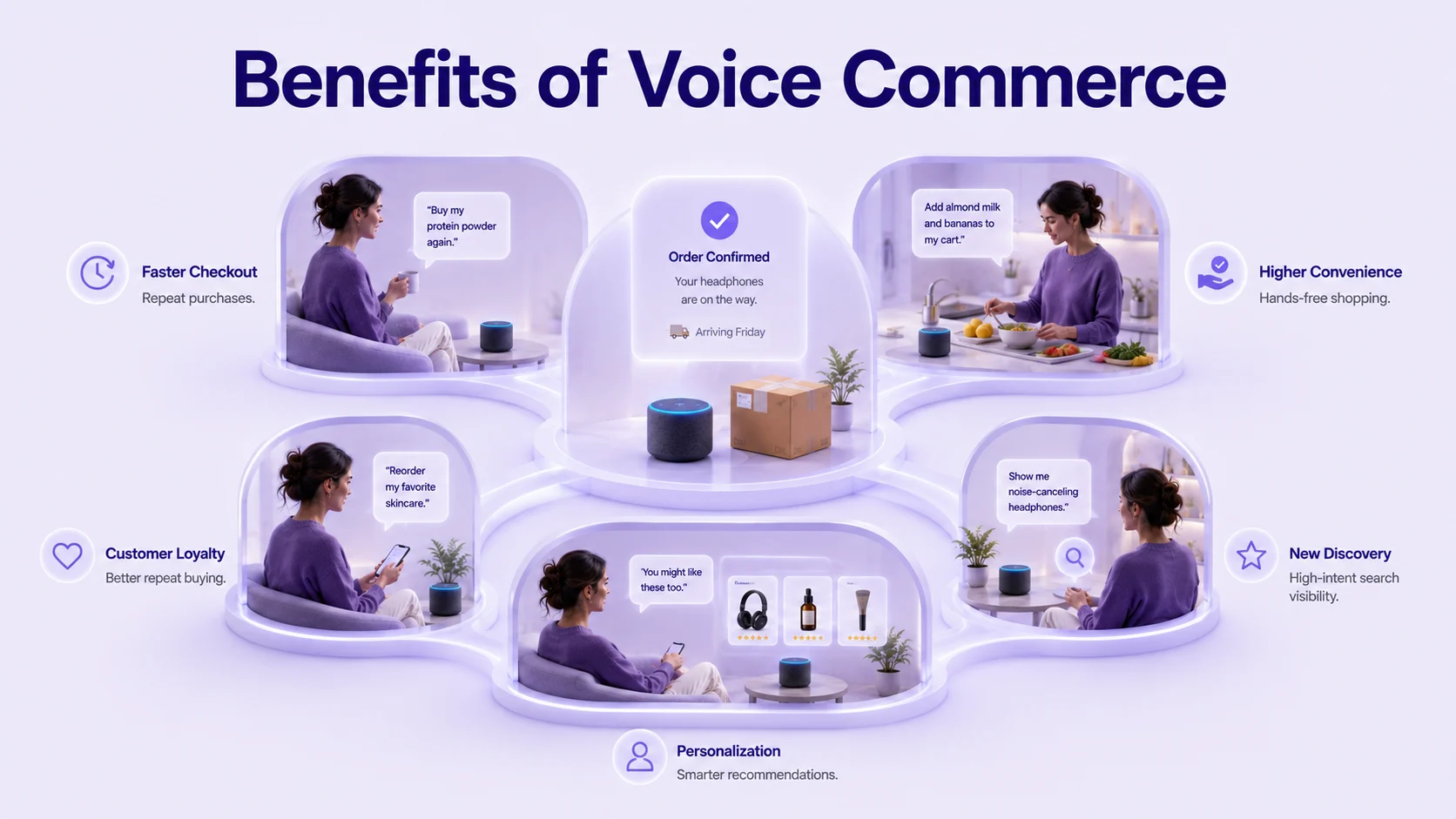
For enterprise brands evaluating strategic plans, voice commerce improves customer experience while increasing conversion rates, repeat purchases, and operational efficiency.
1. Faster Repeat Transactions
Reorders and replenishment purchases move through voice in seconds, reducing the hassle that causes returning customers to abandon their carts during a slow mobile checkout.
2. Access to a Highly Engaged Audience
Voice commerce bridges the utility gap during multi-tasking scenarios, capturing transactions at the exact moment of intent when manual entry is difficult.
3. A High-Signal Discovery Environment
Voice search results display far fewer competing listings than a typed query, which means well-optimized product data can win visibility. This gives well-optimized brands a greater opportunity to appear in high-intent voice search results.
4. Stronger Customer Retention
Reorder-friendly experiences build habit loops. Once a shopper trusts a voice for one purchase, they tend to route more of their recurring spend through it.
5. A Natural Fit With Personalization
Since a voice can only surface one or two results at a time, brands with strong personalization data have an outsized advantage over competitors relying on generic catalog listings.
Challenges of Voice Commerce
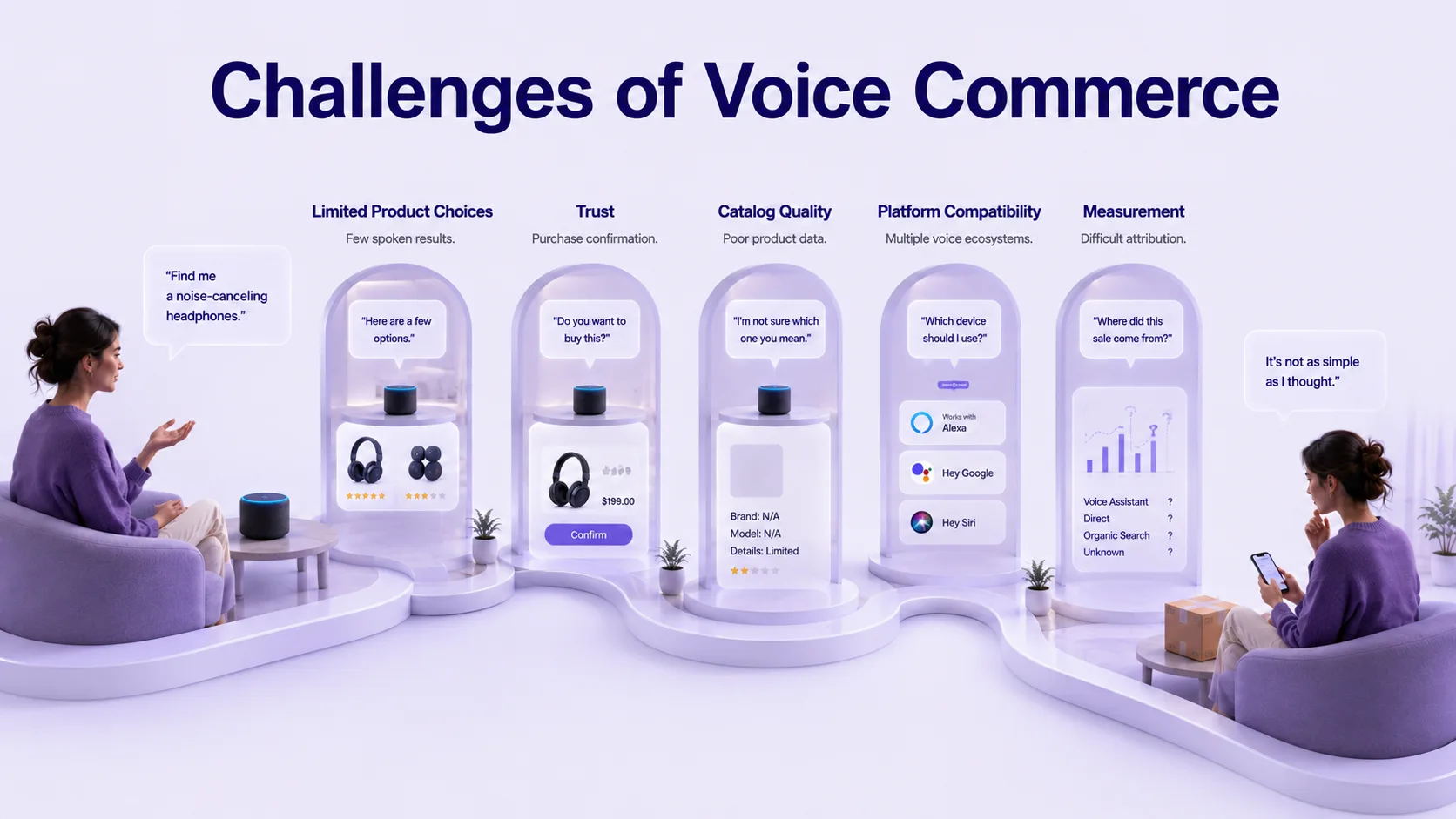
None of this comes without difficulties, and it’s worth being direct about where voice commerce still faces challenges.
- Limited product visibility: A voice assistant can’t display twenty options side by side, so brands lose the ability to let shoppers visually compare before buying.
- Trust and accuracy concerns: Misheard orders, unclear pricing confirmations, and hesitation around voice-based payment authorization remain real barriers to adoption.
- Data and catalog readiness: Inconsistent product titles, missing attributes, or unstructured content make it difficult for assistants to interpret a catalog correctly. However, this is more of a technical debt problem than a voice problem.
- Fragmented ecosystems: Alexa, Google Assistant, and Siri each handle commerce integrations differently, so building for one doesn’t guarantee compatibility with another.
- Measurement gaps: Attributing a sale to a voice-initiated session is harder than tracking a typical web session, complicating ROI reporting for marketing teams.
These challenges require careful planning and the right technology foundation rather than discouraging adoption. There are reasons to treat it as an extension of your existing data and personalization strategy rather than a bolt-on feature.
Real-World Examples of Voice Commerce
The following examples demonstrate how enterprise retailers are adopting voice commerce. The following core patterns are currently driving volume across enterprise retail:
1. Grocery and Household Reorders
Pantry items and cleaning supplies remain among the most common voice-purchase categories. Voice assistants retrieve previous purchase history, enabling customers to reorder products without repeating detailed product information.
2. Guided Beauty and Personal Care Shopping
Some beauty retailers use voice-guided assistants to walk shoppers through product recommendations tailored to their skin type or preferences. They narrow a large catalog down to a short, personalized shortlist.
3. Food Ordering Through Smart Speakers
Quick-service restaurant chains have integrated voice ordering into smart speakers and connected car systems, letting customers repeat a previous order without opening an app.
4. In-store Voice Assistance
Large retailers use voice-enabled devices or mobile assistants to help shoppers locate items or check stock without needing a staff member.
5. Smart Display and Visual Voice Commerce
Devices that pair a screen with a microphone let shoppers speak a query and then tap or scroll to refine it. This approach combines conversational search with visual product comparison, creating a more complete shopping experience.
Popular Voice Commerce Tools and Technologies
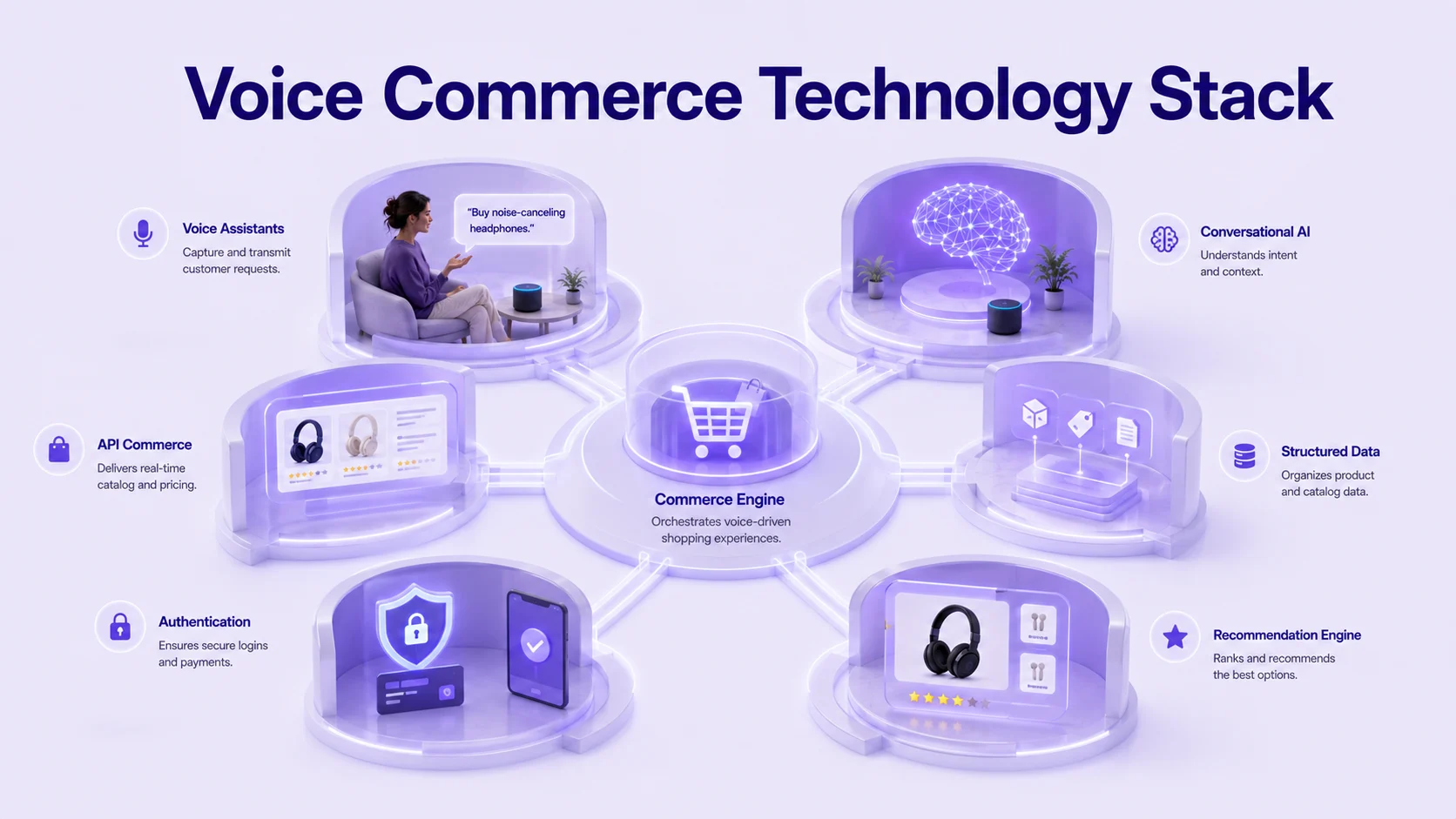
Retailers building a voice commerce strategy typically work with a mix of the following:
- Voice assistant platforms, such as Amazon Alexa Shopping, Google Assistant, and Apple Siri Shortcuts, serve as direct routes to high-intent consumers. They capture transactional volume at the exact point of demand validation.
- Conversational AI and NLU engines are tools that interpret intent beyond a platform’s native capabilities and are often built on top of a commerce API.
- Structured data and schema markup, such as Product, Offer, and FAQPage schema, make catalog data legible to voice search crawlers.
- Headless and API-first commerce platforms are the backbone that lets product, pricing, and inventory data flow to voice interfaces without being locked to a single storefront template.
- Voice biometric authentication systems are used to confirm identity and securely authorize payments.
- Recommendation and personalization engines are the same systems that power on-site upsells, adapted to return the single best match rather than a scrollable list.
Voice Commerce Trends to Watch in 2026
Several emerging trends are shaping the future of voice commerce.
- Agentic shopping assistants: Newer platforms are moving beyond simple command-response and toward AI agents that can compare products, apply filters, and negotiate price ranges across multiple retailers on a shopper’s behalf.
- Voice-to-screen hybrid journeys: Most voice sessions still end with the shopper confirming or completing the purchase on a screen. It means voice and mobile experiences need to be designed together, not separately.
- Trust and privacy as adoption barriers: A meaningful share of consumers remain hesitant to complete payment by voice, citing concerns about misheard orders or data privacy, which is pushing platforms to invest more in confirmation flows and biometric security.
- Multilingual and regional expansion: Voice commerce is no longer an English-first channel, with support expanding across multiple languages and regional dialects.
Best Practices for Implementing Voice Commerce
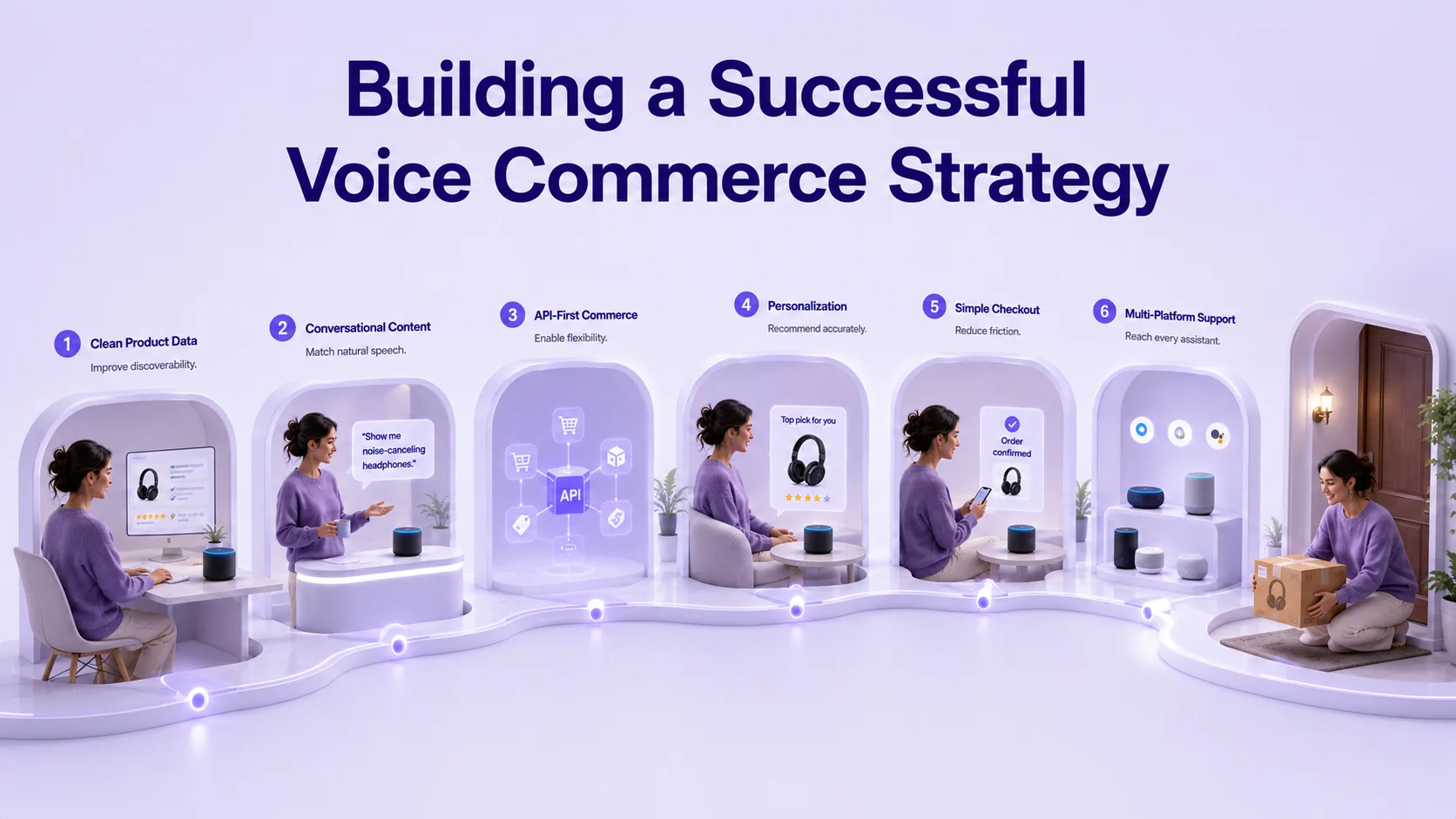
Successful voice commerce adoption requires a scalable commerce architecture rather than isolated feature additions. It’s about making sure the underlying commerce foundation can support it.
- Clean up structured product data first: Voice assistants rely on schema markup and consistent attributes. Inconsistent titles or missing metadata will cause a product to be skipped over entirely.
- Write for conversational queries, not just keywords: Optimizing FAQ content and product descriptions around natural questions, like “Does this fit narrow feet?” performs differently from a keyword-stuffed title.
- Prioritize a mobile-first foundation: Because voice discovery frequently hands off to a screen for final confirmation, your voice and mobile commerce strategies need to work in combination, not in isolation.
- Personalize aggressively but carefully: With only one or two product slots available in a voice response, eCommerce personalization becomes the deciding factor in surfacing the right product.
- Simplify checkout and reorder logic: The fewer steps between intent and confirmation, the higher the completion rate.
- Build for multiple assistants: Locking into a single voice ecosystem limits reach. An API-first setup makes it easier to extend to new platforms as they develop.
- Test for accuracy relentlessly: Misheard orders damage trust fast. Confirmation prompts and clear pricing recaps reduce costly errors.
How to Choose the Right Voice Commerce Approach?
Not every brand needs the same starting point. The right approach usually depends on product complexity, current tech stack, and customer behavior.
- If your product is:
- Small and repeat-purchase-driven (subscriptions, consumables): Start with reorder-focused voice flows through existing assistant integrations.
- Large and attribute-heavy (fashion, electronics): Invest first in structured data and a recommendation engine before building a full voice checkout.
- If you sell across multiple channels or run a marketplace, a flexible, API-first foundation matters more than picking a single voice assistant integration. This is where a B2C eCommerce solution built for omnichannel data flow pays off, since it lets product and pricing information sync consistently across web, mobile, and voice channels without duplicated effort.
- If your platform cannot expose structured product data through APIs, voice commerce capabilities will remain limited regardless of optimization efforts.
Conclusion
Voice commerce complements traditional ecommerce by introducing an additional channel for customer engagement and transactions. It’s adding another entry point that is built around convenience, speed, and hands-free moments. Brands that ensure their product data, personalization logic, and checkout flow are flexible enough to work wherever the shopper happens to be, including spoken queries.
That flexibility is exactly what SPXCommerce is built around. As a marketplace development platform, SPXCommerce helps brands architect commerce experiences from product catalogs to checkout on infrastructure designed for multiple channels.
SPXCommerce enables businesses to integrate voice commerce capabilities into existing marketplace ecosystems through scalable, API-first architecture. Partnering with a specialist who understands both enterprise marketplace architecture and emerging voice channels ensures a seamless transition.
If you’re evaluating how voice commerce fits into your broader strategy, the SPXCommerce marketplace platform is a practical place to start that conversation.