Getting a product in front of the right buyer at the appropriate time through the correct channel is where most companies actually lose money. A pricing model can be flawless, and a product can be genuinely useful, yet sales still lag. It can occur because the connection between the warehouse and the customer’s cart is slow or wrong for that market.
Multichannel e-commerce sales are projected to reach $25.35 billion by 2032, growing at 14% annually, according to Envive.AI’s research. Organizations with well-planned delivery tactics are quickly surpassing competitors who ignore them. This strategic difference is the primary reason some businesses make huge profits while others lose money.
The fix isn’t complicated. Companies just need to build a distribution architecture that matches how their specific customers actually want to buy. Along with that, they should support it with systems that don’t collapse while adding a new channel.
An effective distribution strategy reduces fulfillment costs, shortens delivery timelines, and improves operational efficiency. Plus, a business can expand into new markets or platforms without rebuilding its operations from scratch.
That’s exactly what this guide walks through. We’ll define distribution channels, their major type with real examples, and give you a practical framework for choosing the right mix for your business.
What Is a Distribution Channel?
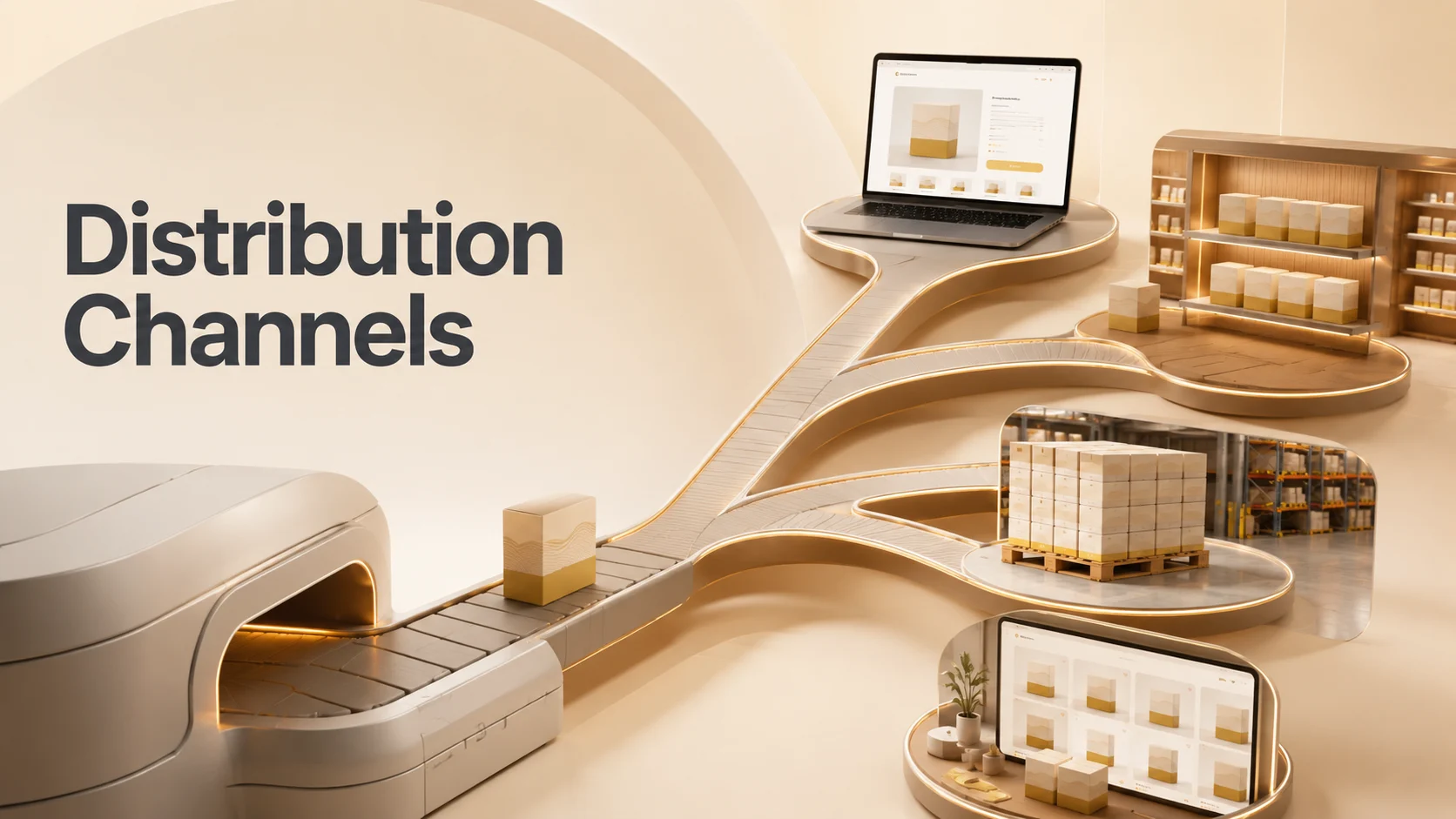
A distribution channel is the path a product takes from the manufacturer to the end customer through the businesses, platforms, or intermediaries involved in fulfillment. Moreover, a product’s journey can involve wholesalers, retailers, an online marketplace, agents, or none of these at all, depending on whether the manufacturer sells directly.
- The factory is the starting point.
- The customer’s doorstep is the destination.
- And the channel of distribution is everything that happens in between: warehousing, transportation, order handling, and the final handoff.
Some routes are short and direct. Others pass through several stops before the product reaches its buyer.
Distribution channel is often used interchangeably with sales channels. There’s a subtle difference worth knowing. Sales channels refer specifically to where a transaction occurs, whether on a website, a marketplace, or a physical store. On the other hand, a distribution channel is the broader system that gets the product to that point of sale in the first place.
Although businesses often use these terms interchangeably, understanding the distinction supports better operational planning. However, what matters is understanding the mechanics behind them.
Distribution Channel vs. Supply Chain: Key Differences
These two terms are often confused, and that lack of clarity leads to real strategic mistakes.
Supply chain distribution covers the entire lifecycle of a product. It involves everything, such as raw material sourcing, manufacturing, quality control, inventory management, and logistics. It’s an internal, end-to-end operational process.
A distribution channel is a subset of the supply chain. It specifically deals with how the finished product moves outward, from the point of production to the final buyer. In other words, the supply chain builds the product and prepares it. Meanwhile, the distribution channel determines how the finished product moves through intermediaries before reaching the customer.
| Aspect | Supply Chain | Distribution Channel |
|---|---|---|
| Scope | End-to-end (sourcing to delivery) | Outbound movement only |
| Focus | Production, procurement, logistics | Sales, market reach, intermediaries |
| Ownership | Usually internal, cross-functional | Can involve external partners |
| Goal | Operational efficiency | Market access and customer reach |
Understanding this distinction matters because fixing a failed distribution channel won’t solve a supply chain bottleneck, and vice versa. They need to be identified and managed separately, even though they’re deeply connected.
Key Components of a Distribution Channel
Every distribution channel, regardless of industry, is built from a handful of recurring components. Knowing these helps when mapping or redesigning your own channel of distribution.
- Producer/Manufacturer: The product’s point of origin.
- Intermediaries: wholesalers, distributors, agents, or retailers who move the product forward.
- Inbound channels: The systems and partners responsible for moving products or inventory into the business before customer fulfillment.
- Logistics and transportation: the physical or digital means of movement.
- Point of sale: The platform or location where a transaction is completed (e.g., a marketplace, storefront, or app).
- End customer: The final recipient of the product.
Types of Distribution Channels
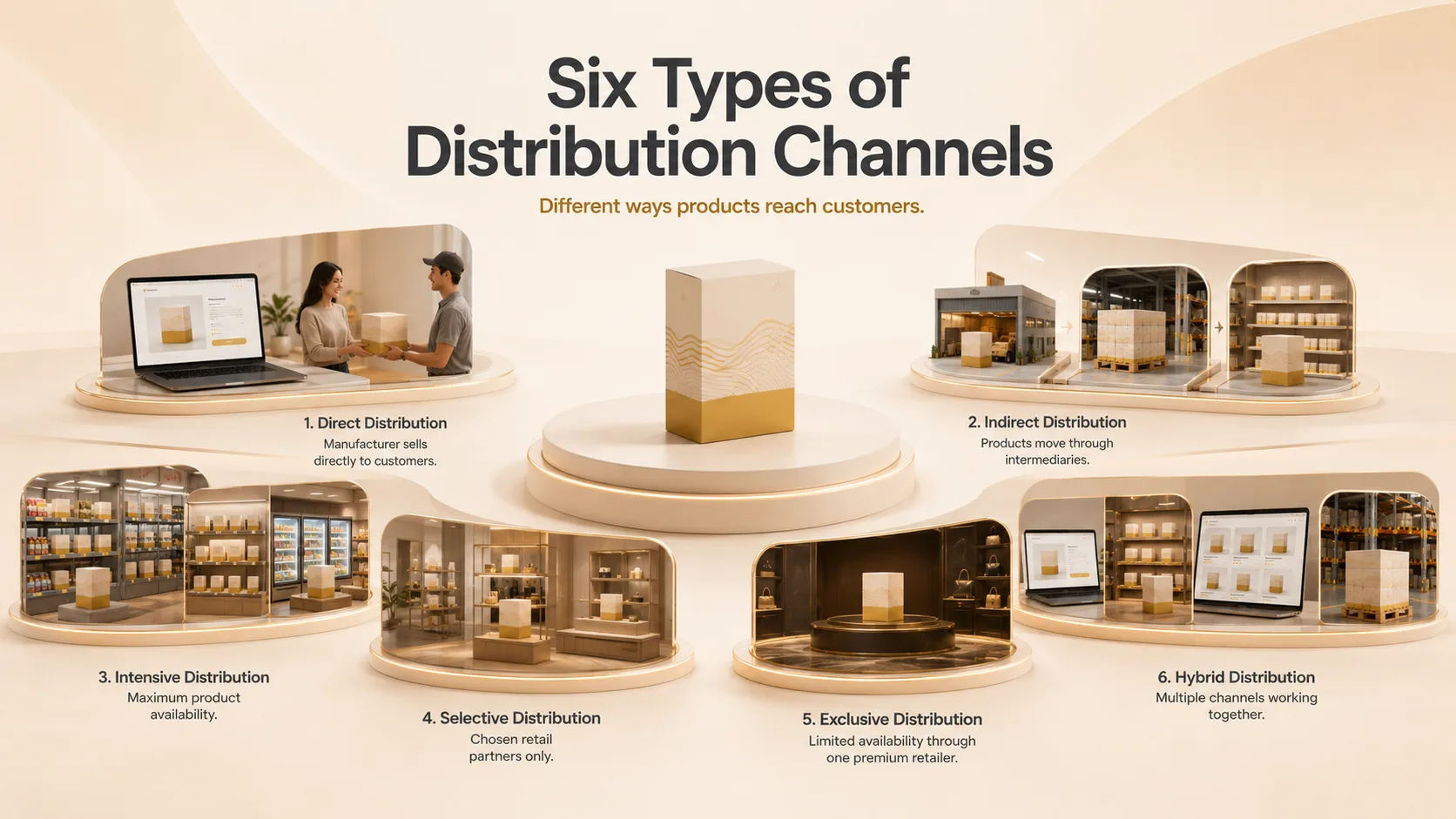
There are several recognized types of distribution channels, and most real businesses use a blend rather than sticking to just one.
1. Direct Distribution
The manufacturer sells directly to the customer, with no intermediaries involved. This includes company-owned websites, direct-to-consumer (D2C) marketplaces, and factory outlet stores.
Let’s see direct distribution examples. A coffee roaster selling exclusively through its own website and subscription app, or a furniture brand shipping straight from its factory to the buyer’s home.
2. Indirect Distribution
This covers channels of distribution that involve the use of intermediaries, such as wholesalers, retailers, agents, or brokers, standing between the producer and the end customer. A packaged foods company selling through supermarkets is a textbook example of indirect distribution.
3. Intensive Distribution
The product is placed in as many outlets as possible. Snacks, soft drinks, and basic household items typically use this model because the goal is maximum shelf presence.
4. Selective Distribution
The product is sold through a limited number of carefully chosen outlets. Mid-range electronics and specialty appliances often follow this pattern to maintain brand positioning without going fully exclusive.
5. Exclusive Distribution
Only one or a small number of retailers are authorized to sell the product in a given territory. Luxury goods and high-end automobiles commonly rely on this model to protect brand value.
6. Dual or Hybrid Distribution
The company sells both directly and through intermediaries simultaneously. Many modern brands run their own D2C storefronts alongside listings on Amazon, Walmart Marketplace, or regional platforms. Hybrid distribution enables businesses to balance customer reach with greater control over pricing and customer experience.
Here’s a quick side-by-side reference:
| Distribution Type | Intermediaries Involved | Best Suited For |
|---|---|---|
| Direct | None | Brands wanting full control over pricing and CX |
| Indirect | Wholesalers/retailers | Businesses needing a wide market reach quickly |
| Intensive | Many, unrestricted | High-volume, low-consideration goods |
| Selective | Few, chosen carefully | Mid-tier, brand-conscious products |
| Exclusive | One or very few | Luxury or premium-positioned goods |
| Hybrid | Mixed | Growth-stage and enterprise brands scaling across channels |
Levels of Distribution Channels Explained
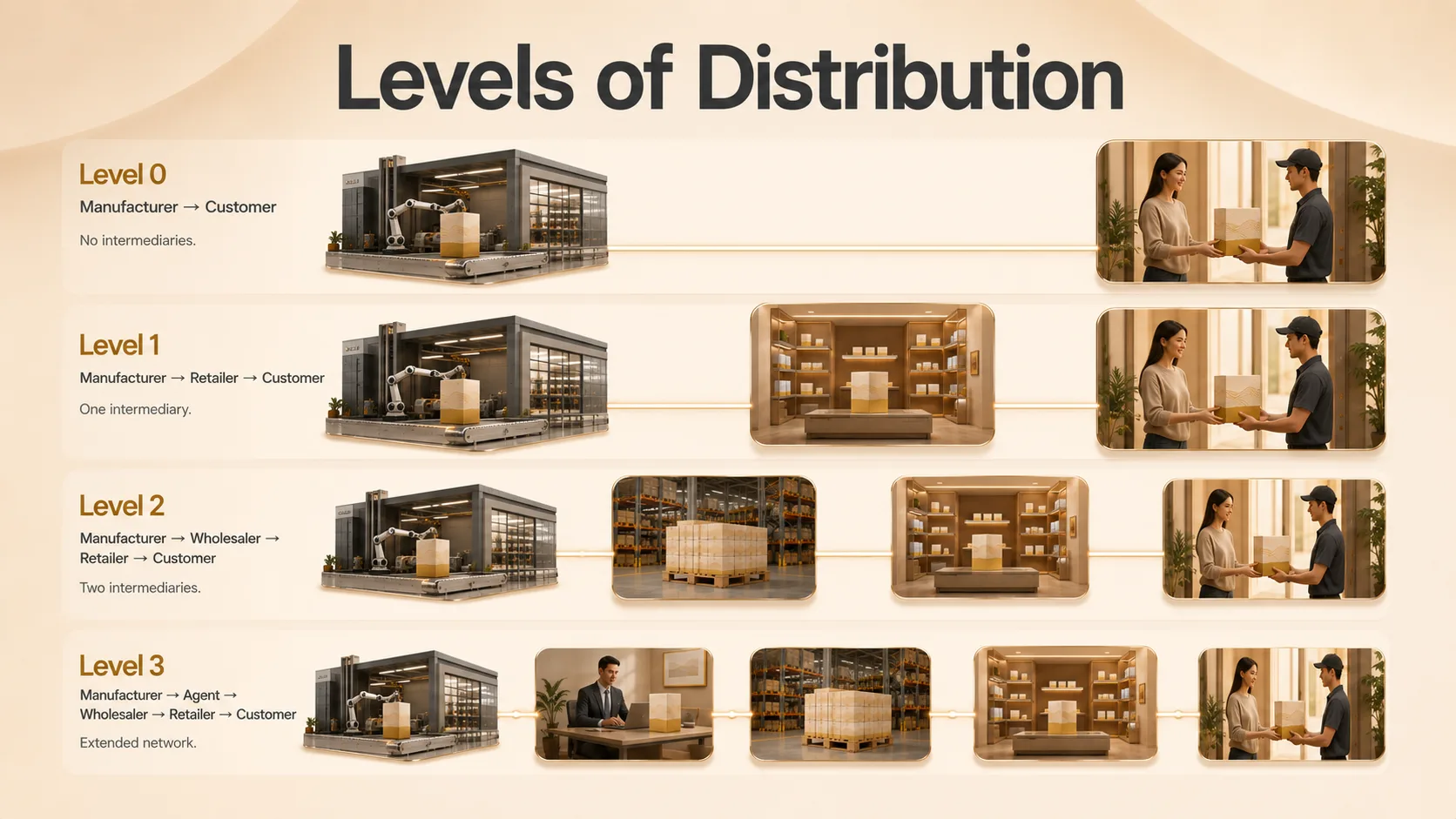
Distribution is also commonly classified by levels, which count how many intermediaries sit between the producer and the customer.
- Zero-level (direct): Producer → Customer. No middlemen at all.
- One-level: Producer → Retailer → Customer.
- Two-level: Producer → Wholesaler → Retailer → Customer.
- Three-level: Producer → Agent/Broker → Wholesaler → Retailer → Customer.
Each added level increases market reach but also adds cost, reduces the producer’s control over pricing and customer experience, and stretches the time it takes for feedback to travel back from the customer. Many businesses reduce unnecessary intermediaries to improve margins, accelerate delivery, and strengthen customer relationships.
Direct vs. Indirect Distribution: A Comparison
The following comparison highlights the differences between direct and indirect distribution models.
| Factor | Direct Distribution | Indirect Distribution |
|---|---|---|
| Control over pricing | Full control | Shared or limited |
| Customer data ownership | Complete | Partial or none |
| Market reach | Slower to scale | Faster, leveraging existing networks |
| Setup cost | Higher upfront (own storefront/logistics) | Lower upfront, ongoing margin share |
| Customer relationship | Direct and continuous | Indirect, mediated by the retailer |
| Speed to new markets | Slower | Generally faster |
Neither model is universally better.
- A DTC skincare brand might flourish on direct distribution because customer data and brand experience are core to its value proposition.
- A packaged food producer, on the other hand, may have no realistic path to scale without retail and wholesale partners.
The right answer depends on the product, the margin structure, and the level of operational complexity the business can absorb.
Real-World Examples of Distribution Channels
The following examples illustrate how different businesses apply distribution strategies in practice.
- Apple runs a hybrid model, its own retail stores and website for direct sales, alongside carriers and authorized resellers for indirect reach. This dual approach lets Apple protect its brand experience while still achieving massive market penetration through partners.
- A regional apparel brand sells through its own D2C website while also listing on a large online marketplace. Plus, it is running direct and indirect channels simultaneously, which is a common channel distribution for growth-stage retailers.
- A B2B industrial parts manufacturer selling through distributors, who in turn sell to repair shops, illustrates a two-level indirect channel, with intermediaries adding regional reach that the manufacturer couldn’t efficiently build on its own.
- A specialty coffee brand that sells exclusively through its own subscription platform is a clear example of zero-level, direct distribution.
What connects all of these examples is a deliberate choice. Each business picked a structure that matched its margin needs, brand goals, and customer expectations.
Popular Tools & Technologies for Channel Management
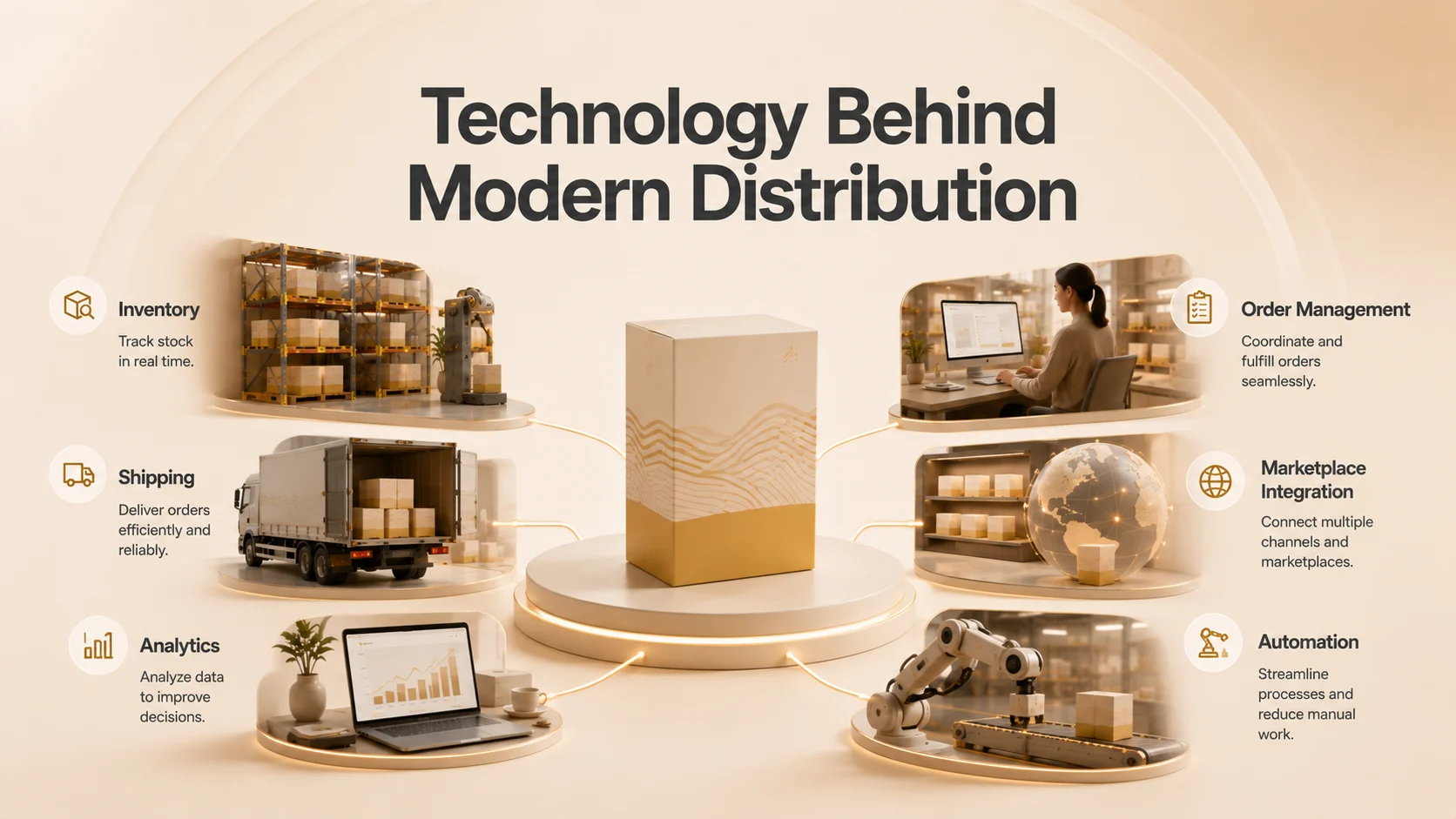
Modern distribution relies on integrated technologies that improve inventory visibility, order management, and operational efficiency. A layer of technology now sits beneath almost every channel strategy, and choosing the right stack matters as much as choosing the right channel type.
Marketplace integration platforms: They connect a single product catalog and inventory feed to multiple online marketplaces at once, avoiding manual listing work across each one.
Order management systems (OMS): These systems centralize orders from every channel into a single dashboard, so fulfillment doesn’t fragment across disconnected tools.
Inventory management software: It keeps stock levels in real time across warehouses, stores, and online channels, preventing overselling.
EDI (Electronic Data Interchange) systems: They automate data exchange with large retail partners that require structured order and invoice formats.
Fulfillment and shipping automation tools: This software routes orders to the nearest or most cost-efficient warehouse and generates shipping labels without manual intervention.
SPXCommerce, for instance, is built specifically for marketplace developers, helping brands build and manage their own marketplace infrastructure rather than stitching together disconnected tools.
Best Practices for Building a Distribution Strategy
These are the most effective practices to develop a distribution strategy.
- Map the customer journey before choosing channels. Understand where your buyers actually search, compare, and purchase before committing budget to a channel.
- Avoid channel conflict. If direct and indirect channels compete on price for the same customer, both suffer. Set clear pricing and territory rules upfront.
- Centralize inventory visibility. Disconnected stock data across channels is one of the most common causes of overselling and canceled orders.
- Validate the performance of each distribution channel before expanding into additional markets or platforms. Prove a channel works before adding five more at once. Spreading resources too thin early on is a common, avoidable mistake.
- Treat data as a strategic asset. Every channel generates customer and sales data, which feeds back into forecasting and product decisions rather than being left unused.
- Plan for returns and reverse logistics. A distribution channel isn’t complete at delivery; how easily a customer can return a product shapes repeat-purchase behavior.
- Build for omnichannel from the start where possible. Retrofitting a single-channel setup into a multichannel one later is far more expensive than designing for it early. A clear omnichannel commerce strategy ties these channels together so the customer experience feels consistent no matter where the purchase happens.
How to Choose the Right Distribution Channel?
There’s no universal formula, but a few practical questions consistently narrow the decision:
- Who is the customer, and where do they already shop? Selling where your buyer already spends time significantly reduces acquisition friction.
- How much margin can the product absorb? Low-margin products often can’t support multiple intermediary cuts; high-margin products have more flexibility.
- How much control does the brand need over pricing and experience? Premium and DTC-first brands usually lean direct; commodity products often lean indirect for reach.
- What’s the operational capacity right now? A lean team may be better served starting with one or two channels done well, rather than five done poorly.
- Is the business planning to sell internationally? Cross-border logistics, tax rules, and local marketplace preferences add complexity that should shape channel choice early. A cross-border eCommerce expansion plan needs to account for this before entering a new market, not after.
- Can fulfillment keep pace as channels multiply? Adding channels without a solid multichannel fulfillment strategy behind them tends to create delivery delays and inventory mismatches that undo any gains from wider reach.
The mix tends to evolve as the business grows, and that’s expected. Distribution strategy isn’t a one-time decision; it’s revisited as products, markets, and customer behavior shift.
Why Choose SPXCommerce?
Designing and running a multi-channel distribution setup, especially one that includes online marketplaces, takes more than a good product. It requires infrastructure capable of handling catalog syncing, order routing, and inventory accuracy across every channel a business operates in. SPXCommerce is designed to manage marketplace operations, inventory synchronization, and order routing through a unified platform.
SPXCommerce provides the technology businesses need to build, launch, and scale their own marketplace platforms. Whether a business is setting up a B2B marketplace to serve wholesale buyers or a D2C platform to sell directly to end consumers, its platform is built to support both models within a single architecture.
For brands already dealing with several channels, this kind of unified platform is often the difference between a distribution strategy that scales cleanly and one that quietly breaks under its own growth.
Conclusion
A distribution channel is a direct extension of business strategy. The type of channel a company chooses shapes its margins, its control over the customer relationship, and how fast it can grow into new markets.
There’s no single correct channel of distribution for every business. The right structure depends on the product, the customer, and the operational maturity of the company running it. Plus, the businesses that treat distribution as a deliberate, data-informed decision consistently outperform those that let it happen by default.
If managing multiple distribution channels becomes increasingly complex, it often indicates limitations in the underlying operational infrastructure.