A customer is shopping for a product, adding it to their shopping cart, entering the credit card info, and then waiting. The problem isn’t that their card isn’t valid, but that the single payment service provider (PSP) you’re using isn’t good at processing authorizations in other countries as in yours. The sale is lost, the customer is upset, and you may never be told why. Take this example and multiply it by dozens of markets, currencies, and payment methods. From this, you’ll have a good idea of what payment fragmentation is and why it’s the single biggest operational headache in modern digital commerce.
These are the same issues that plague businesses trying to sell globally: Transactions that fail for no real reason, unpredictable processing fees, costly integrations with each new PSP, poor visibility of payment failure reasons, and increasing compliance requirements as businesses expand into different markets. A single payment gateway may be fine for a small, local business, but once you grow, it becomes a liability.
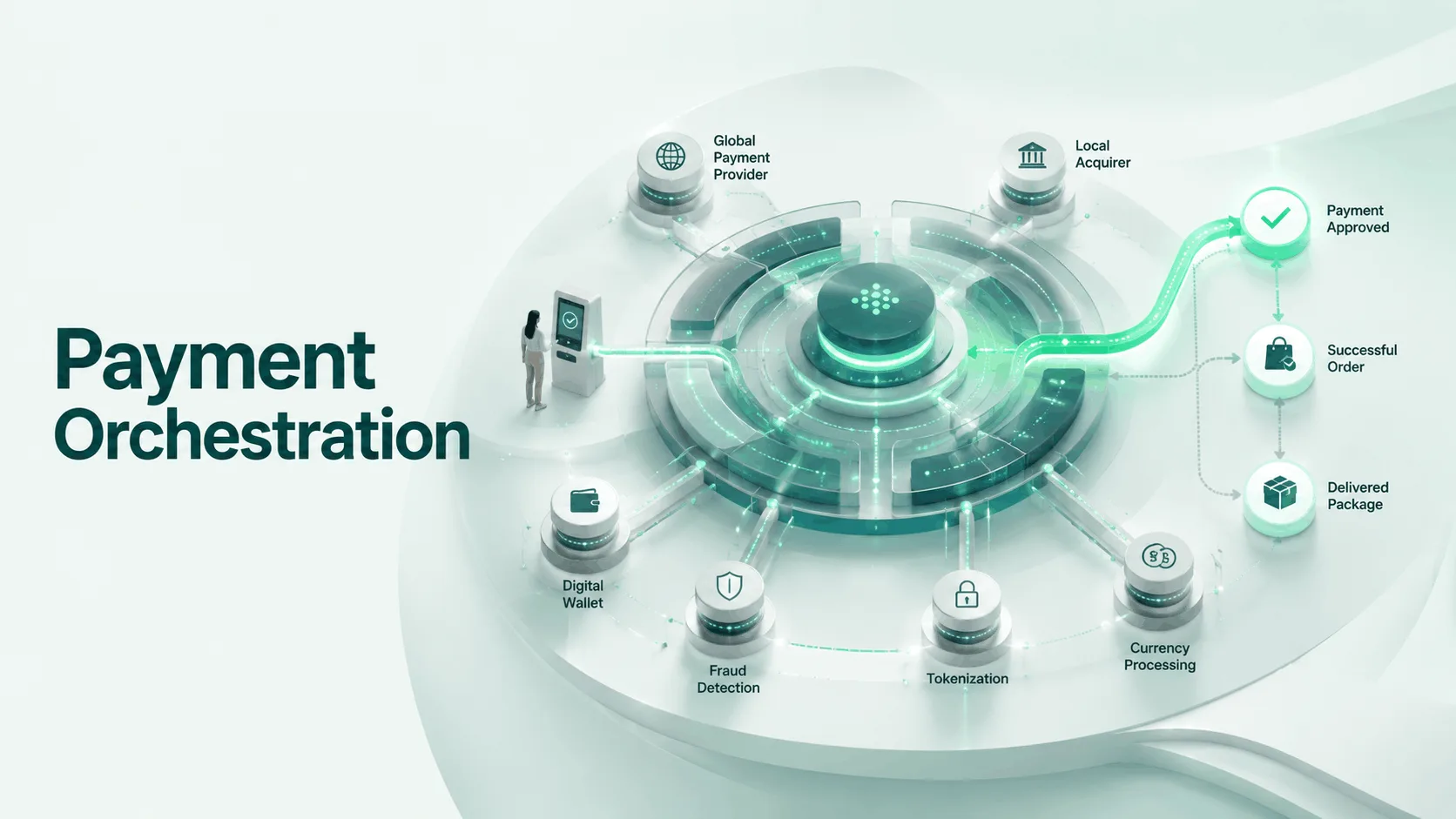
This is exactly what payment orchestration is designed to handle. A payment orchestration platform sits atop multiple PSPs, acquirers, and payment methods, and intelligently routes each transaction to the most likely successful provider, rather than relying on guesswork. The outcome: more authorizations, reduced processing costs, faster expansion into new markets, and centralized payment management.
In this guide, you will learn what payment orchestration truly is, how it operates under the hood, the various routing patterns businesses implement, the tools that are available today, and what payment orchestration approach is right for your business.
What Is Payment Orchestration?
Payment orchestration is the process of integrating various payment service providers, acquirers, gateways, and alternative payment methods (APMs) into a unified system to simplify payment processing. Businesses integrate once with the orchestration layer and gain access to its network of integrated providers, rather than integrating each one individually, which could require weeks of engineering time per provider.
It’s similar to an air traffic control tower, only in this case it is on a computer. Individual airlines (PSPs) have their own planes (transactions), and the control tower does not replace them, but it only controls traffic, decides which runway to use, reroutes traffic due to bad weather, and keeps the whole operation running smoothly and safely. Just as with payments, a payment orchestration platform doesn’t take the place of your PSPs, it just coordinates them.
Payment orchestration differs from the following related payment technologies:
| Concept | What It Does | Limitation |
|---|---|---|
| Payment Gateway | Provides one central place for processing transactions with a single payment processor. | No routing logic and no multi-PSP failover. |
| Payment Optimization | Enhances the outcome of a single transaction (e.g., retry logic, smart retries). | Operates on a transaction-by-transaction basis rather than optimizing the overall payment system. |
| Payment Orchestration | Manages the entire payment ecosystem across multiple PSPs, payment methods, and regions. | Requires upfront architecture planning and careful implementation to be effective. |
So, what does payment orchestration look like in the real world? It’s the layer of control that determines for each transaction what provider it should go to, what should happen if it fails, and how the resulting data is reconciled, without human intervention, in milliseconds.
Key Components of a Payment Orchestration Platform
A payment orchestration platform consists of multiple interlocking layers. Learning about them will help you to understand why orchestration is not “just another integration”.
1. Unified API Layer
The only integration point to which developers bind this. The orchestration platform adjusts all the APIs into a unified interface, rather than writing separate code for each PSP’s API.
2. Routing Engine
The routing engine serves as the decision-making core of the payment orchestration platform. It compares each transaction against a set of rules (or, in more sophisticated platforms, machine learning models) and determines which PSP to route it to in real time.
3. Failover & Retry Logic
If the payment is rejected by one processor, the system can repeat the transaction with another processor without delay, before the customer realizes it. This one characteristic can effectively decrease cart abandonment rates.
4. Tokenization & Security Layer
Card data is tokenized once, securely stored, and then used across multiple PSPs without re-entering sensitive card details, thereby minimizing PCI DSS scope and enhancing data protection.
5. Reporting & Reconciliation Dashboard
A unified reporting dashboard consolidates transaction data across all connected PSPs into a single source of truth. This provides the finance and operations teams with a single source of truth regarding authorization rates, fees, chargebacks, and settlement periods.
6. Fraud & Risk Management
Screens transactions before they are routed through built-in or integrated fraud detection tools, minimizing fraud exposure across all connected providers.
How does the Payment Orchestration Work?
Next, it’s best to review the series of steps involved in a typical transaction to see how it works. Visualize the flow in a diagram that has five phases from left to right:
- Checkout presentation: Lists the payment options most relevant to the customer, based on their location, device, and currency.
- Transaction initiation: The routing engine checks real-time costs, historical success rates, transaction volume, currencies, and regional compliance needs upon customer payment.
- Smart routing: The engine chooses the PSP most likely to approve the transaction at the lowest price.
- Processing: It is safely transmitted to the selected PSP for approval.
- Failover (if declined): If the first PSP rejects the transaction, the orchestration platform automatically attempts it with another PSP (usually without customers even realizing there was a delay).
- Reconciliation: When transaction information is settled, it is in a consistent format and reported on a single dashboard, regardless of the PSP that settled it.
This entire sequence is usually completed in less than a second, which is why orchestration is so invisible to the end customer yet transformative for the business behind the scenes.
Main Types of Transaction Routing Patterns
Not all routing strategies are created equal. A payments orchestration system can be based on one or multiple of the following patterns, depending on business needs:
1. Rule-Based Routing
The transactions are directed towards the appropriate provider based on the specific business rules, such as “all transactions in the EU under €50 are routed to Provider A” or “high-risk transactions are sent to Provider B for extra fraud checking.
2. Cost-Based Routing
The routing engine processes costs of interconnected PSPs and redirects transactions to the cheapest PSP, taking into account PSP-specific pricing tiers, currency conversion costs, and interchange fees.
3. Performance-Based (Smart) Routing
This is the most advanced pattern. It constantly checks the approval percentage on a per-PSP, per-region, and per-card-network basis and redirects traffic to the most successful provider, even changing traffic direction within the same day if a PSP has an outage or its approval percentage drops.
4. Geographic / Regional Routing
The transactions are forwarded to local acquirers in the customer’s country, thereby increasing the likelihood of approval, as local banks are more familiar with local acquirers than foreign ones.
5. Cascading / Waterfall Routing
If the first PSP responds with “no” to the transaction, the primary PSP passes it along to a list of preconfigured backup PSPs to check until it finds a “yes” response or the list runs out.
| Routing Pattern | Best For | Primary Benefit |
|---|---|---|
| Rule-Based | Predictable, policy-driven businesses | Simplicity and control |
| Cost-Based | High-volume, margin-sensitive businesses | Lower processing costs |
| Performance-Based | Businesses operating globally with varying PSP performance | Higher authorization rates |
| Geographic | Multi-region marketplaces | Localized trust and regulatory compliance |
| Cascading / Waterfall | Businesses focused on transaction recovery | Fewer abandoned carts and improved payment success rates |
Payment Orchestration Across Different Marketplace Models
Different marketplace business models have different payment challenges.
Multi-Vendor Marketplace
Multiple independent sellers require automated commission calculations, split payments, vendor onboarding, and payouts. Payment orchestration simplifies these workflows while improving transaction success.
B2C Marketplace
Consumer marketplaces process high transaction volumes across multiple payment methods. Smart routing helps improve authorization rates and reduce checkout abandonment.
B2B Marketplace
Enterprise marketplaces often involve invoices, credit terms, approval workflows, and cross-border payments. Payment orchestration supports complex payment scenarios while maintaining compliance.
D2C Marketplace
Direct-to-consumer marketplace ecosystems focus on delivering fast checkout experiences, subscription payments, and personalized customer journeys. Payment orchestration helps optimize payment performance while supporting customer loyalty.
Popular Payment Orchestration Providers & Technologies
Payment orchestration has come a long way, and companies can find standalone providers or platforms that offer payment orchestration as part of their commerce services.
- Standalone orchestration platforms: These are solo orchestrators that specialize in routing, failover, and reconciliation logic, enabling businesses to have more control over provider relationships. In general, they will need businesses to have their own merchant agreement with each PSP.
- PSP-native orchestration: Some major processors offer orchestration capabilities as part of their platforms and are likely better suited to companies that need simplicity rather than the flexibility of multiple PSPs.
- Merchant-of-record solutions that include built-in orchestration: These solutions include tax compliance, chargeback management, and entity handling for global entities, which alleviate operational burden but provide less granular control.
- Direct integration of orchestration into commerce platforms: Increasingly, orchestration is being built into eCommerce and marketplace platforms, so businesses don’t necessarily need to deal with a separate payments layer.
This final one is significant for businesses creating multi-vendor marketplaces where the payment splitting, vendor payouts, and multi-currency settlement must operate as seamlessly as the routing logic, not as an afterthought.
Best Practices for Implementing Payment Orchestration
Payment orchestration is most effective when it is implemented with clear objectives, resilient infrastructure, and continuous performance optimization. The following best practices can help you improve payment success rates, strengthen reliability, simplify operations, and deliver a more secure and scalable payment experience.
Get clear about your routing goals. Determine whether you need to focus on cost reduction, improving authorization rates, or compliance by region, as this will influence your routing rules.
Have at least two PSPs per critical market. Failover is based on redundancy, and if there is a single point of failure, it is not a failover.
Keep track of authorization rates on an ongoing basis. PSP performance varies over time, and routing rules effective in one quarter may need to be modified in the next.
Centralize reconciliation early. Avoid manually reconciling reports from five different PSP dashboards and create the integrated reporting layer from the outset.
Prioritize tokenization. Limit the PCI DSS scope and enhance security by tokenizing card data at the orchestration level.
Simulate failover situations regularly. Test the outages in the PSP simulation to ensure the cascading and retry logic work as desired under stress.
Target the payment system by area. The payment methods a routing engine supports are as many as the card routing options it supports.
How to Choose the Right Payment Orchestration Platform
When choosing one of the various payment orchestration providers in the market today, there are a few key elements to consider:
Network breadth of providers: Are there already providers on the platform who are strong in your target markets, or will you need to onboard new ones?
Routing intelligence: Does the routing mechanism have intelligence, is it rule-based, or does it dynamically adapt based on real-time performance data?
Integration effort: How many engineering man-hours would be needed for getting live, and is it in your current tech stack?
Compliance support: Does the platform support PCI DSS, regional data residency and tax requirements, or are they your responsibility?
Multi-vendor features: Does the platform include native split-payment, vendor payouts, and multi-party settlement?
Reporting depth: Is your finance team able to access the depth of information they need without exporting it into spreadsheets?
Payment orchestration is not a standalone product or solution to be assessed in isolation, and it must be used alongside the underlying commerce architecture. That’s where the choice of payment routing logic is just as significant as the choice of marketplace infrastructure.
Conclusion
Payment orchestration is a problem every growing enterprise faces, like inefficiency, risk, and revenue loss resulting from reliance on a single payment provider. In this way, businesses can enjoy higher authorization rates, lower processing costs, enhanced fraud protection, and the ability to enter new markets without rebuilding their payment stack from the ground up.
We know at SpxCommerce that payment is not just about the backend, but it’s about the whole customer experience, and it directly influences conversion. We are a marketplace developer built to help businesses start and grow multi-vendor marketplaces efficiently. Our platform unifies payment routing, vendor payouts, and reconciliation within a single architecture instead of relying on disconnected third-party systems.
Whether you are building a marketplace from the ground up or enhancing an existing ecommerce platform, our team delivers scalable payment infrastructure designed for long-term growth. We also make it our mission to power an AI-driven customer experience, whether that means creating a custom checkout process or building a system that gives customers the most relevant next recommendation for their transaction.
If your payments are underperforming due to failed transactions, broken PSP relationships, or a low conversion rate in the market, it might be time to reconsider payments as a layer of your commerce architecture rather than an afterthought.