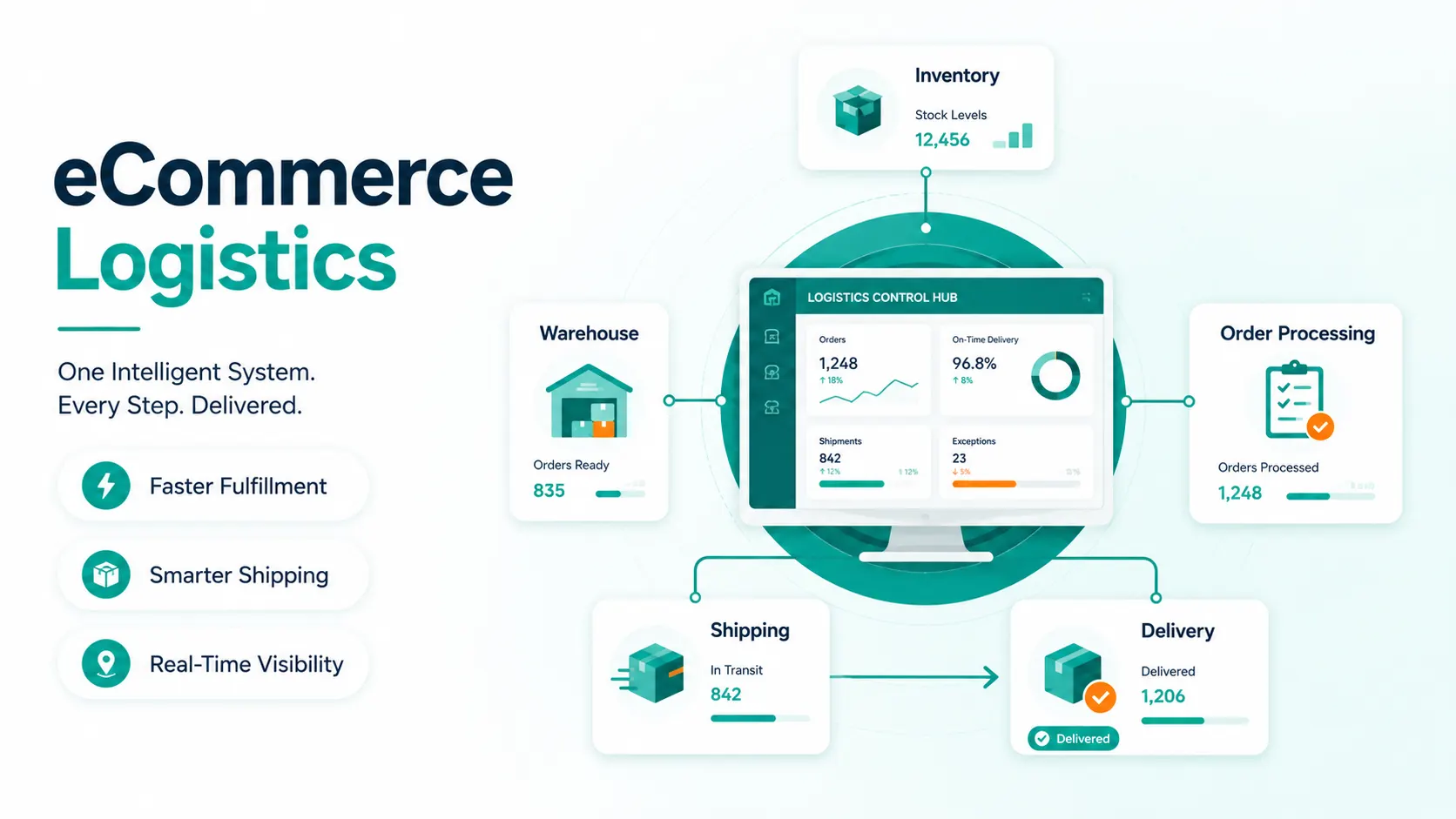
You’ve put a good product up for sale online. Orders began to come in. But all that changed when reality set in: warehouse delays, lost shipments, overloaded customer service desks, and a never-ending queue. If you’ve ever been in the same situation, you’re not the only one. For most online sellers, eCommerce logistics is the biggest gap between customer expectations and delivery fulfillment.
Today’s customers demand timely, transparent, and frictionless delivery. Same-day and next-day delivery have become the standard rather than a premium service. To overcome that expectation gap, a strong ecommerce logistics architecture is needed that integrates inventory management, order orchestration, carrier networks, and last-mile delivery operations. If it goes well, your brand gets loyalty. When it cracks, you lose customers forever.
This guide takes you step-by-step through each stage of ecommerce logistics, from the moment the product arrives in the warehouse to the moment it arrives in a customer’s hands, and again when it is returned. From scaling your marketplace to assessing 3PLs and even developing your ecommerce shipping strategy, this is the all-in-one reference.
What is eCommerce Logistics?
eCommerce logistics refers to the overall process of handling orders from the manufacturer or warehouse to the end consumer, and, of course, processing returns. It covers stock management, order management, packaging, carrier selection, order tracking, and ecommerce reverse logistics.
It’s like the backbone of your online shop. Your website and product listings, as well as your marketing, generate demand, while ecommerce logistics and order fulfillment meet that demand. Retail logistics is a bulk supply chain from the manufacturer to the store, while ecommerce logistics operates at the order level. Thousands of different packages, each of which needs to be sent to the right destination and monitored in real time.
What are the Key Components of eCommerce Logistics?
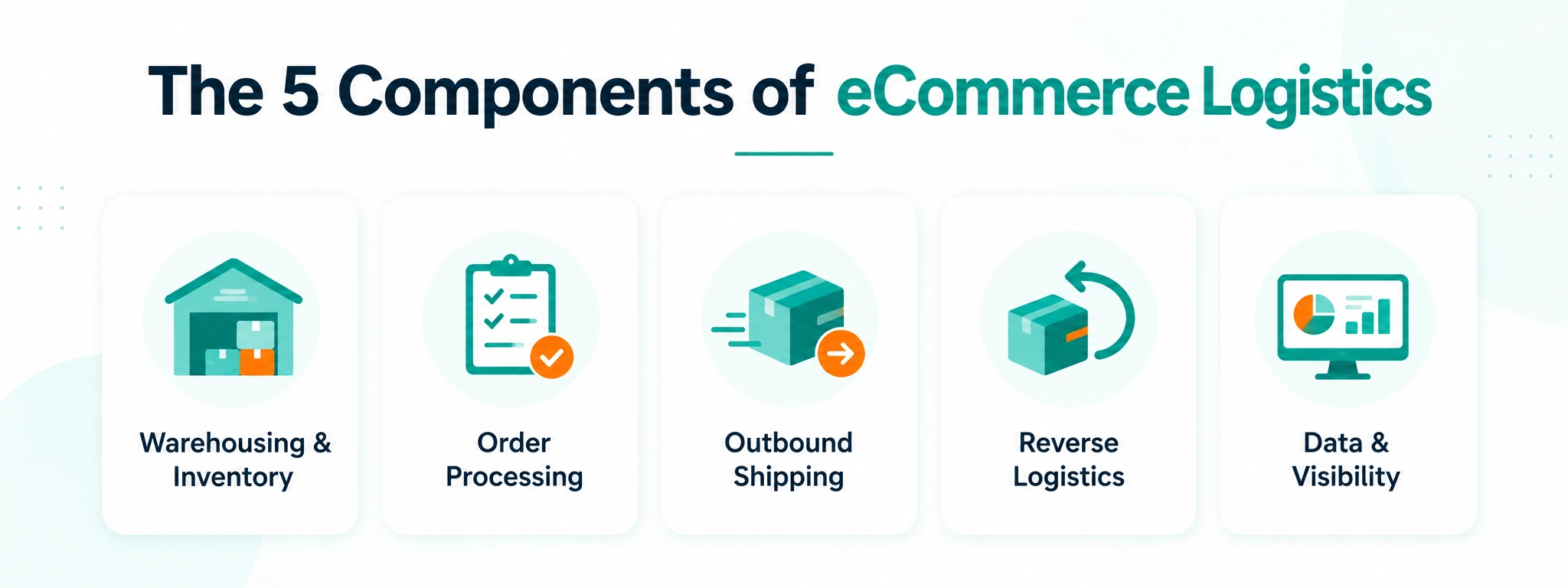
The key elements of successful ecommerce logistics management are interdependent and must be in harmony:
1. Warehousing & Inventory
Receiving, storing, and monitoring stock levels across multiple fulfillment centers. Managed through a Warehouse Management System (WMS) that serves as the control center for inventory operations
2. Order Processing
Capturing, validating, and routing orders from all sales channels. Supported by an Order Management System (OMS) to ensure accurate and efficient order fulfillment.
3. Outbound Shipping
Managing carrier selection, shipping label generation, package handoff, and real-time shipment tracking from the warehouse to the customer.
4. Reverse Logistics
Managing product returns from the customer back to the warehouse or designated facility, including return initiation, pickup coordination, inspection, restocking or disposal, refund processing, and reverse shipment tracking.
5. Data & Visibility
Providing real-time dashboards, carrier integrations, performance monitoring, and analytics to identify operational bottlenecks before they impact customers.
All these elements are linked to each other. Delays in warehousing result in downstream shipping delays. Weak returns management drives up costs and slashes margins. eCommerce logistics management requires optimizing all five components rather than focusing on a single operational area.
How to Build Your eCommerce Shipping Strategy?
An ecommerce shipping strategy is your approach to delivering profitably to your customers while fulfilling their expectations. There is no one-size-fits-all solution, but an effective strategy takes into account four factors: speed, cost, reliability, and reach.
| Shipping Model | Best For | Key Trade-off |
|---|---|---|
| In-house Fulfillment | Brands in the early stages that require strict control over inventory, operations, and customer experience. | High capital investment and limited scalability. |
| 3PL Outsourcing | Growing brands with variable demand and those needing scalable fulfillment capacity. | Reduced operational control compared to managing fulfillment internally. |
| Dropshipping | Lean businesses test product-market fit without holding inventory. | Lower profit margins and increased dependency on suppliers. |
| Hybrid Model | Omnichannel sellers are managing multiple SKUs across different sales channels. | Complex system integrations and operational coordination. |
| Marketplace Fulfillment (FBA/FBM) | Sellers focused primarily on marketplaces such as Amazon. | Limited brand experience and dependency on marketplace fees and policies. |
Sellers on Amazon, with their own D2C storefront, and in social commerce need a multichannel fulfillment strategy that integrates inventory visibility and order routing to prevent overselling. This strategy should also ensure that the right carrier is selected to optimize order handling across all sales channels.
The Role of 3PL Providers in Modern eCommerce Logistics
3PL providers (third-party logistics) handle warehousing and fulfilment services and sometimes even negotiate with carriers on behalf of ecommerce brands. They enable businesses to expand without the need for a physical infrastructure.
What to Evaluate in a 3PL Partner?
- Geographic footprint: Do they have fulfillment centers in close proximity to their customer bases? Last-mile delivery costs are drastically lowered with proximity.
- Technology integrations: Can their WMS synchronize with your ecommerce environment, OMS, and ERP system?
- SLA commitments: What are the guaranteed pick-pack-ship times, and what happens during peak season?
- Returns handling: Do they handle ecommerce returns logistics, or is it on you?
- Scalability: Do they have the capacity to scale for a flash sale without breaking fulfillment SLAs?
If you are an operator of a marketplace with multiple vendors/sellers, you need to ensure you are selecting the right 3PL that fits in with your vendor management system. This includes the ability to maintain automatic inventory segregation, apply each seller’s specific fulfillment rules, and track and monitor each seller’s SLA.
Last-Mile Delivery in eCommerce: The Final (and Costliest) Mile
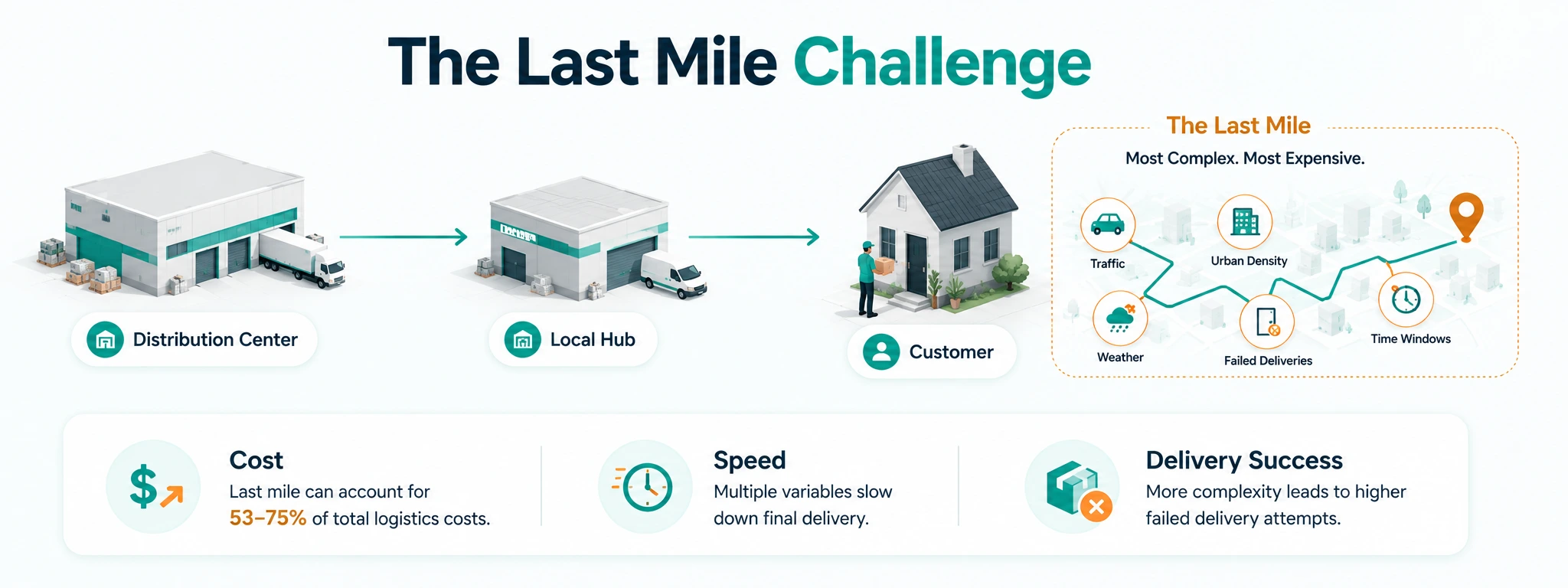
Last-mile delivery ecommerce is the last step in the delivery process, from a local distribution center or fulfilment center to the customer. It represents up to 53% of all shipping costs and is where most delivery failures occur. It’s also where the customer experience is created or destroyed.
Why Last-Mile Delivery is So Challenging?
- Traffic and access difficulties in urban areas, and distance in rural areas.
- Failed delivery attempts are expensive, and rescheduling costs 1.5–2× the original delivery cost
- Demand for real-time tracking and exact delivery windows continues to grow at a large pace.
- Environmental pressure is driving brands toward sustainable last-mile solutions.
Emerging Last-Mile Innovations
As customer expectations for faster and more flexible deliveries continue to rise, last-mile logistics is evolving through technology-driven innovations. Emerging solutions are helping businesses improve delivery speed, reduce costs, enhance visibility, and create a more seamless customer experience.
| Solution | Description | Key Benefit |
|---|---|---|
| Route Optimization Software | AI-driven routing reduces fuel costs and improves delivery density. | Lower transportation costs and improved delivery efficiency. |
| Micro-Fulfillment Centers | Dark stores positioned inside cities reduce the distance to customers. | Faster deliveries and lower last-mile costs. |
| Crowdsourced Delivery | Platforms leverage gig-economy drivers for flexible same-day coverage. | Scalable delivery capacity and wider service coverage. |
| Smart Lockers & PUDO Points | Parcel lockers and Pick-Up/Drop-Off (PUDO) points reduce failed delivery attempts in dense urban areas. | Higher delivery success rates and lower redelivery costs. |
What Makes Reverse Logistics a Competitive Advantage in eCommerce?
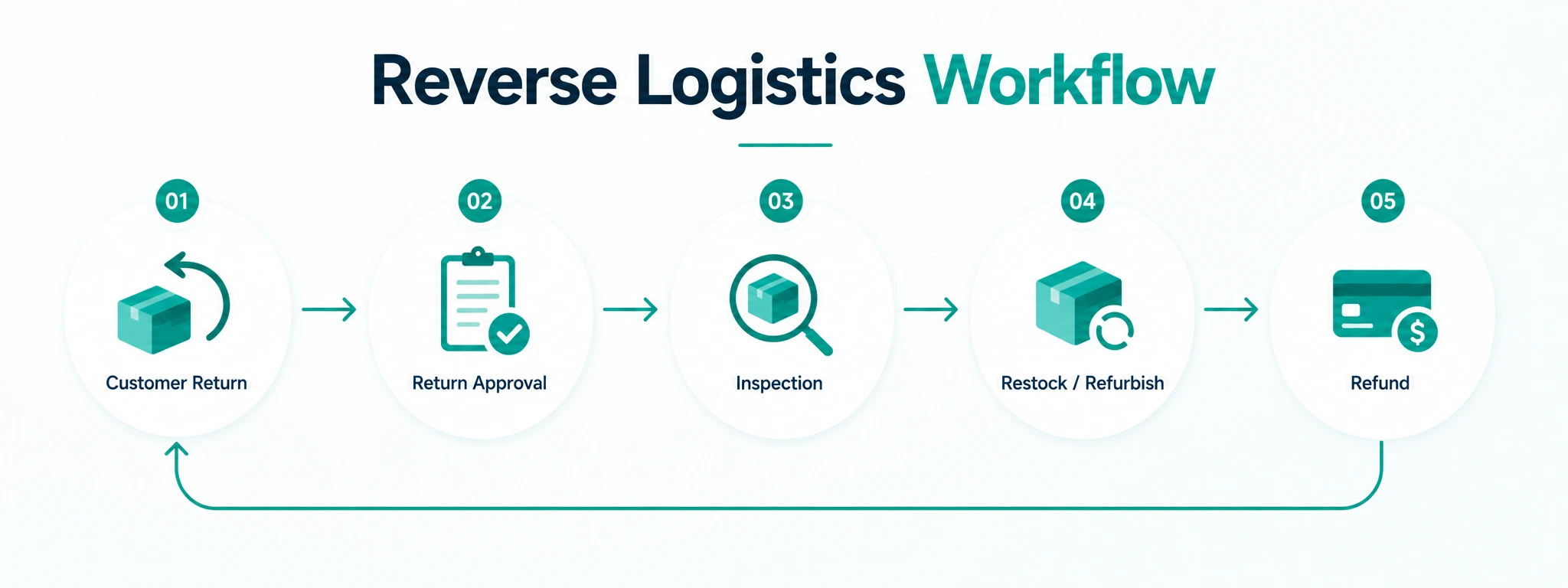
Reverse logistics refers to the movement of products from customers back to the seller, warehouse, or fulfillment center for returns, exchanges, repairs, or disposal. Ecommerce reverse logistics is not something you can think about after the sale. In ecommerce, return rates can reach 30-40% in certain categories such as fashion or electronics, so it is a competitive differentiator.
The True Cost of Poor Returns Handling
- When shoppers are shopping online, 65% read a brand’s return policy before buying.
- Customers are less likely to purchase again when returns and refunds take too long to process. Delayed refunds, negative reviews, and churn are all consequences of poor ecommerce returns logistics.
- The direct margin loss from unsalvaged returns.
Building a Strong Returns Logistics Process
- Reduce support load and initiate returns automatically with a self-service returns portal.
- Pre-printed return labels and low-friction return processes drive faster item recovery.
- Establish clear rules and conditions for restocking, refurbishing, and liquidation.
- Analyze and understand return reasons by SKU to prevent quality or product issues from accumulating.
In the past, returns were seen as a cost center, but with a mature Ecommerce returns management policy, they become a touchpoint that builds loyalty. Easier returns increase customers’ likelihood of repeat purchases by 3 times.
What is included in eCommerce Logistics Software: Know Technology Stack
Good ecommerce logistics software integrates all fulfillment nodes, from purchase order to final delivery, into a single data-driven workflow. Let’s take a look at a modern logistics tech stack:
| Layer | System | Core Function |
|---|---|---|
| Order Intelligence | Order Management System (OMS) | Manages routes, prioritizes, and tracks orders across multiple channels |
| Inventory Control | Warehouse Management System (WMS) | Manages stock levels, storage locations, and pick-pack workflows |
| Carrier Management | Shipping & Transportation Management Software (TMS) | Tracks carrier rates, performs rate shopping, and generates shipping labels |
| Seller/Vendor Operations | Vendor Management System (VMS) | Controls supplier performance, SLA compliance, and dropship operations |
| Automation Layer | eCommerce Automation Software | Triggers workflows for fraud checks, order routing, and customer notifications |
| Returns Engine | Returns Management System (RMS) | Automates return approvals, restocking processes, and refund workflows |
Leading ecommerce businesses use an omnichannel ecommerce platform as a central coordination layer to unify inventory, orders, and customer data. This platform brings all sales channels together and provides a single view of stock, orders, and customer interactions across the business.
What are the Best Practices for eCommerce logistics management?
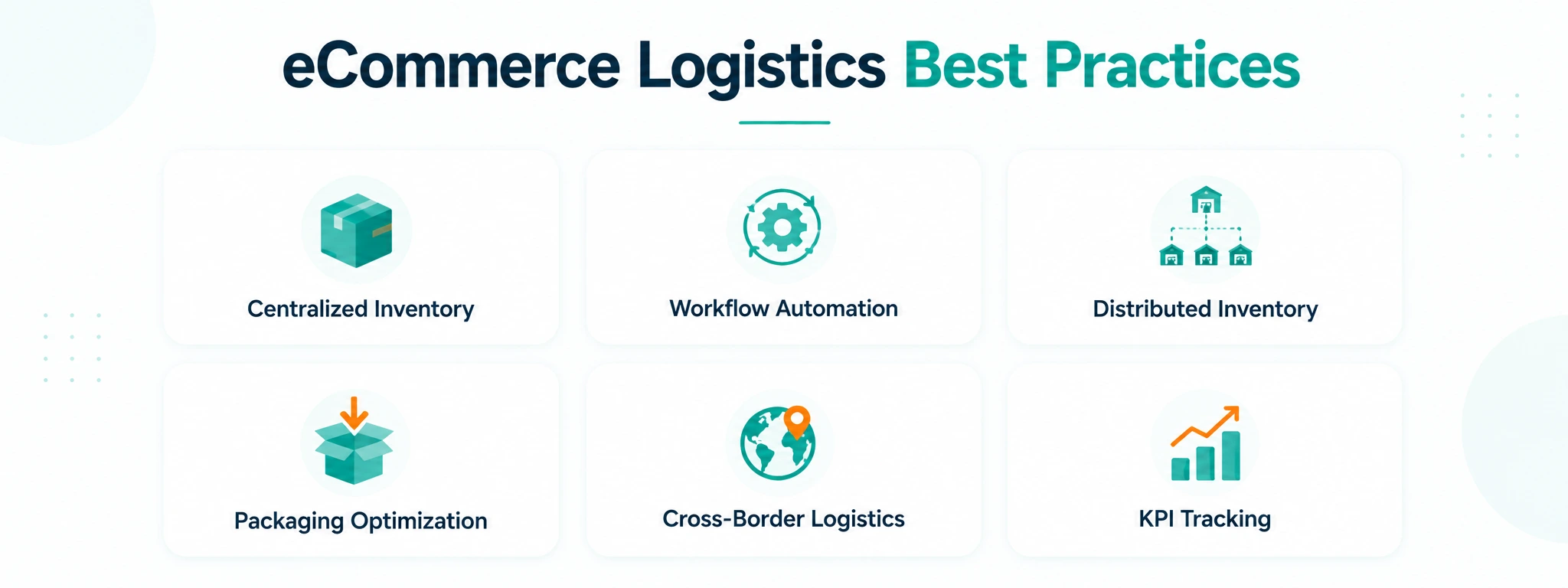
Effective eCommerce logistics management is the foundation of faster deliveries, lower operational costs, and a better customer experience. By implementing the right strategies and technology, businesses can streamline fulfillment, improve efficiency, and scale operations with confidence.
1. Centralize Inventory Visibility
Overselling, stockouts, and fulfillment delays are all problems that stem from fragmented inventory information. Adopt a single source of truth with a warehouse management system connected to all stores and fulfillment partners.
2. Automate Repetitive Logistics Workflows
Reduce repetitive tasks with eCommerce Automation Software: routing orders, selecting carriers, notifying when stock is low, and approving returns. Your team can focus on the exceptions, not the routine.
3. Distribute Inventory Strategically
Keep inventory near the “last-mile” delivery points to lower last-mile delivery expenses and transit times. Understand your customers’ geographic reach and match fulfillment center locations.
4. Optimize Packaging for Dimensional Weight
Carriers will charge for dimensional weight, not actual weight. Without compromising service quality, right-sizing packaging can save 15-25% on shipping costs at scale.
5. Build Cross-Border Logistics Capability
Managing cross-border ecommerce logistics requires handling customs paperwork, landed costs, and international returns flows, all of which require specialized integrations and carrier partnerships for brands expanding cross-border.
6. Track Logistics KPIs Relentlessly
What you can’t measure, you can’t improve. Some of the important logistics KPIs that every ecommerce team should be monitoring are:
- Order accuracy rate (target: >99.5%)
- On-time delivery rate (target: >95%)
- Return rate by SKU/category
- Cost per shipment by carrier and zone
- Warehouse throughput (orders processed per hour)
Why Choose SpxCommerce for eCommerce Logistics & Marketplace Operations?
SpxCommerce is a specialized marketplace development platform that enables businesses to create, run, and scale multi-vendor marketplaces, complete with robust ecommerce logistics features out of the box.
Our platform is designed to be more robust than a generic eCommerce platform. It is built to handle the complexities of marketplace operations, where multiple sellers, diverse product types, and fragmented fulfillment networks must work together seamlessly.
We offer intelligent order fulfillment software that sends orders to 3PLs, dropshippers, and in-house fulfillment.
Our built-in vendor management system helps you manage seller logistics with SLA tracking, shipping rules, and performance scorecards. The platform automates returns through configurable policies, approval workflows, and restock triggers.
It also enables omnichannel ecommerce integration, linking all key sales channels and eliminating data silos.
Real-time analytics dashboards provide visibility at the SKU and seller levels into fulfillment performance, carrier efficiency, and return trends. Marketplaces can easily scale without having to manage multiple disconnected systems.
Conclusion
eCommerce logistics is more than a business process. It directly influences customer satisfaction, brand reputation, and profitability. Whether it’s the moment inventory is received at a warehouse or the moment a package is delivered to a customer’s door, each and every second counts on a well-thought-out system, intelligent automation, and the right technology stack.
The most successful ecommerce companies are not always those with the best products. They have the most effective, efficient, and transparent logistics processes. By investing in the right ecommerce logistics software, creating a solid ecommerce shipping strategy, and employing capable 3PL providers, you can build a strong and scalable fulfillment foundation. By managing last-mile delivery with precision, this fulfillment setup becomes a competitive moat rather than a chronic cost center.