Your eCommerce platform should be driving growth, not slowing it down. Yet many businesses still struggle with rigid, traditional architectures that make simple updates time-consuming, limit mobile experiences, and hinder expansion into new channels like social commerce, IoT, and voice.
This is why the choice between headless and traditional commerce has become a critical business decision. By separating the front-end experience from the back-end commerce engine, headless commerce gives businesses the flexibility to deliver faster, personalized, and omnichannel experiences. The result is quicker time-to-market, greater scalability, and a technology stack that can evolve with changing customer expectations.
In this guide, we’ll explain the architecture, trade-offs, real-world scenarios, and considerations to help you make a confident decision.
What Is Traditional eCommerce?
Traditional eCommerce, also known as monolithic commerce, combines the frontend and backend into a single, all-encompassing application. Sites such as older Magento, WooCommerce, or OpenCart are of this type.
It’s like a furnished apartment that you can move into right away. However, if you would like to knock down a wall or install a floor, the structure will resist change because one part relies on the other.
- There is a strong coupling between frontend templates and backend logic.
- Changes to one layer may cause problems in another layer
- Scaling must apply to the system, even to components that do not require scaling.
- It may be customized, but this is costly and may break easily.
What Is Headless Commerce?
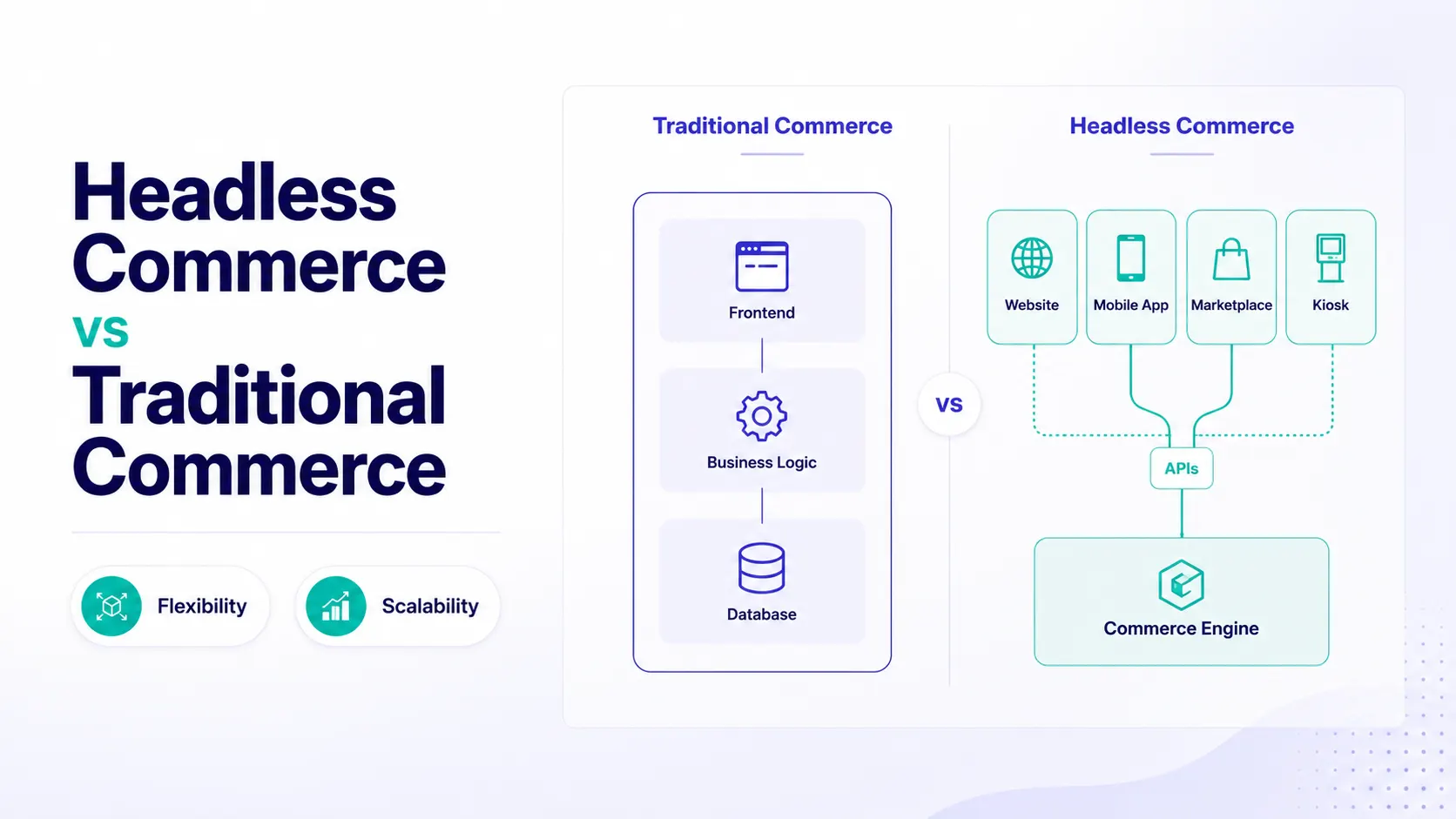
Headless commerce architecture is a system that decouples the frontend presentation layer (head) from the commerce backend. The two layers connect through APIs, typically REST or GraphQL, allowing your front end to be anything: a React app, mobile app, PWA, a voice app, a smart display, or all of them at once.
To make it easy, let’s use an apartment analogy: headless commerce provides you with the plumbing, the electricity, and the structure, and you can design every room as you please, without fear of one room falling apart because of the other.
Learn more about how this works in our headless commerce deep-dive. If you want some background about the ecommerce architecture, you can check out our ecommerce architecture overview.
Whats the difference in the Architecture of Traditional Commerce and Headless Commerce?
Traditional (Monolithic) Architecture
In a Monolithic stack, the rendering engine, business logic, and data layer are all in a single stack. A user clicks a link to a server, which then executes the request and returns an HTML page rendered on the server. It’s simple, but rigid.
Headless Commerce Architecture
A headless commerce architecture is one where the front-end is completely separated. The storefront is built with a modern JavaScript framework (Next.js, Nuxt, or Gatsby) and serves data dynamically from commerce APIs. The back-end is concerned only with business logic and data.
This API-driven approach is also at the root of composable commerce, which contrasts with a single all-in-one platform by using best-of-breed services. Before going either route, it’s important to grasp your ecommerce tech stack options.
Side-by-Side Comparison of Headless Commerce vs Traditional Commerce
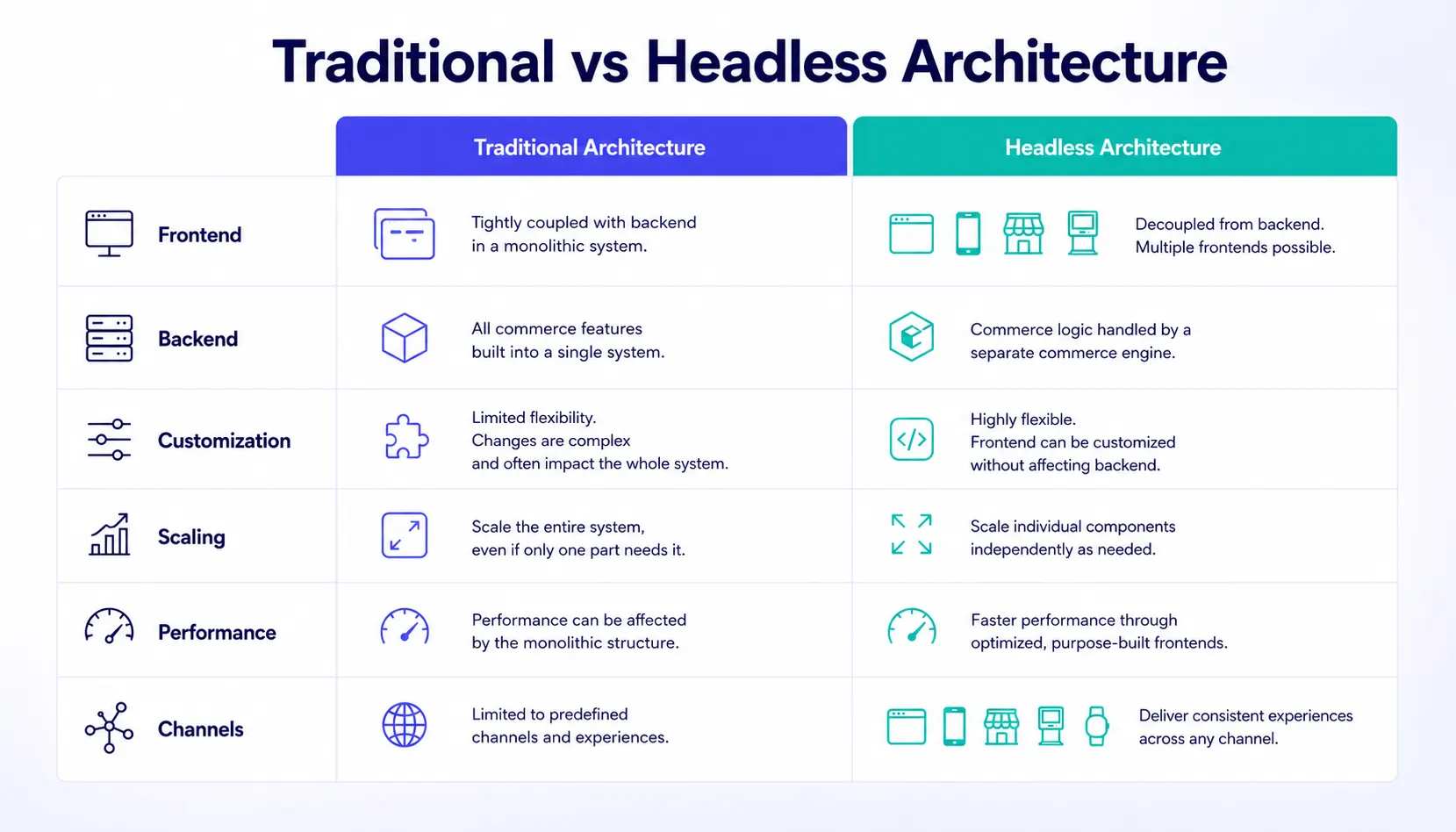
The table below provides a side-by-side comparison of headless commerce and traditional commerce across key factors such as flexibility, scalability, development complexity, performance, and cost, helping you understand which approach may better suit your business needs.
| Factor | Traditional (Monolithic) Commerce | Headless Commerce |
|---|---|---|
| Architecture | Tightly coupled frontend and backend system | Frontend and backend are decoupled and connected via APIs |
| Frontend Flexibility | Limited, template-based customization | Unlimited flexibility using any framework, device, or channel |
| Time-to-Market | Faster initial setup | Longer initial setup, but faster iterations and updates over time |
| Developer Experience | Easier for non-technical users and smaller teams | Preferred by modern development teams for flexibility and control |
| Scalability | The entire system must scale together | Individual services can scale independently |
| Omnichannel Support | Challenging due to a single frontend | Native support for multiple channels through shared APIs |
| Performance (Core Web Vitals) | Good with proper caching | Optimized for SSG, SSR, and edge rendering, enabling superior performance |
| Customization Cost | Lower upfront cost, higher long-term costs | Higher initial investment, lower long-term customization costs |
| Integration Ecosystem | Plugin-dependent and can be prone to compatibility issues | API-first integrations that are more stable and flexible |
| Total Cost of Ownership (TCO) | Lower initially, increases as the business grows | Higher initial investment, but better ROI and lower costs at scale |
| Best For | Businesses with simple requirements and limited customization needs | Growing enterprise, B2B, and multi-channel businesses requiring flexibility and scalability |
What are the Key Benefits of Headless Commerce?
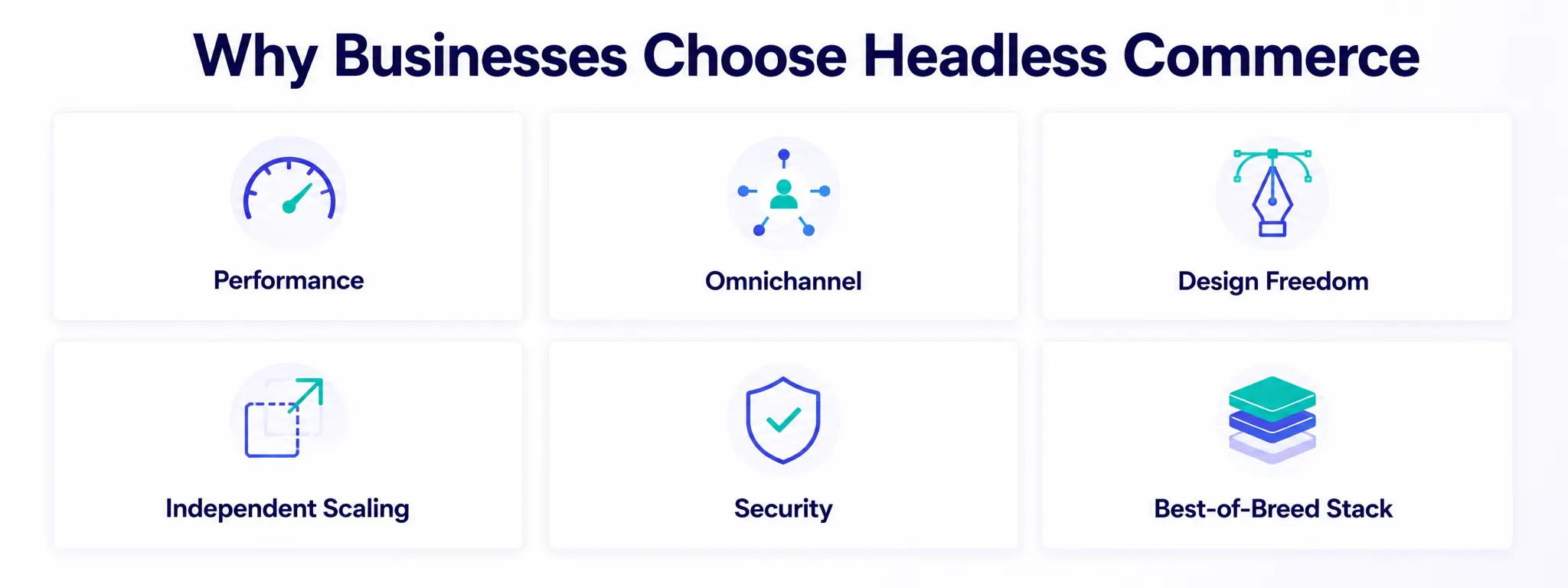
The advantages of headless commerce are evident in scalability, and even mid-market players are embracing it to remain competitive. So what you really get:
1. Superior Performance
Improve page load speeds with static site generation, edge delivery, and modern caching strategies. This enhances the user experience, streamlines the Core Web Vitals, and can positively affect search engine rankings and conversion rates.
2. True Omnichannel
Connect all your customer touchpoints to one commerce back-end. Consistencies across the different platforms and channels where customers browse, purchase, and learn about your products and services remain intact.
This applies whether they use your website, mobile app, kiosk, marketplace, voice assistant, or future digital channels. At the same time, you can support all these channels without duplicating your business logic.
3. Design Freedom
Support front-end teams with the use of the frameworks & technologies they choose. This separation of the frontend and backend allows teams to develop new features at a much faster pace, launch them more often, and build highly individualized customer journeys.
4. Independent Scalability
Scale services by demand, not by the platform. High-traffic areas such as search, checkout, product catalog, and recommendation engines can be optimized and scaled separately to achieve maximum efficiency and cost control.
5. Better Security
Cut down on risk and less attack surface. Static rendering or edges are less vulnerable, and critical business logic, customer information, and transactions are handled safely via secure backend APIs.
6. Best-of-Breed Stack
Minimize risks by reducing the attack surface. This allows for more limited exposure of vulnerabilities on frontends (static or edge-rendered) and more robust protection of business logic, customer data, and transactional processes on backend APIs.
These benefits are directly related to a broader ecommerce replatforming initiative, particularly when transitioning from a legacy centralized system to a modern, API driven approach.
When Is Traditional Commerce the Better Choice?
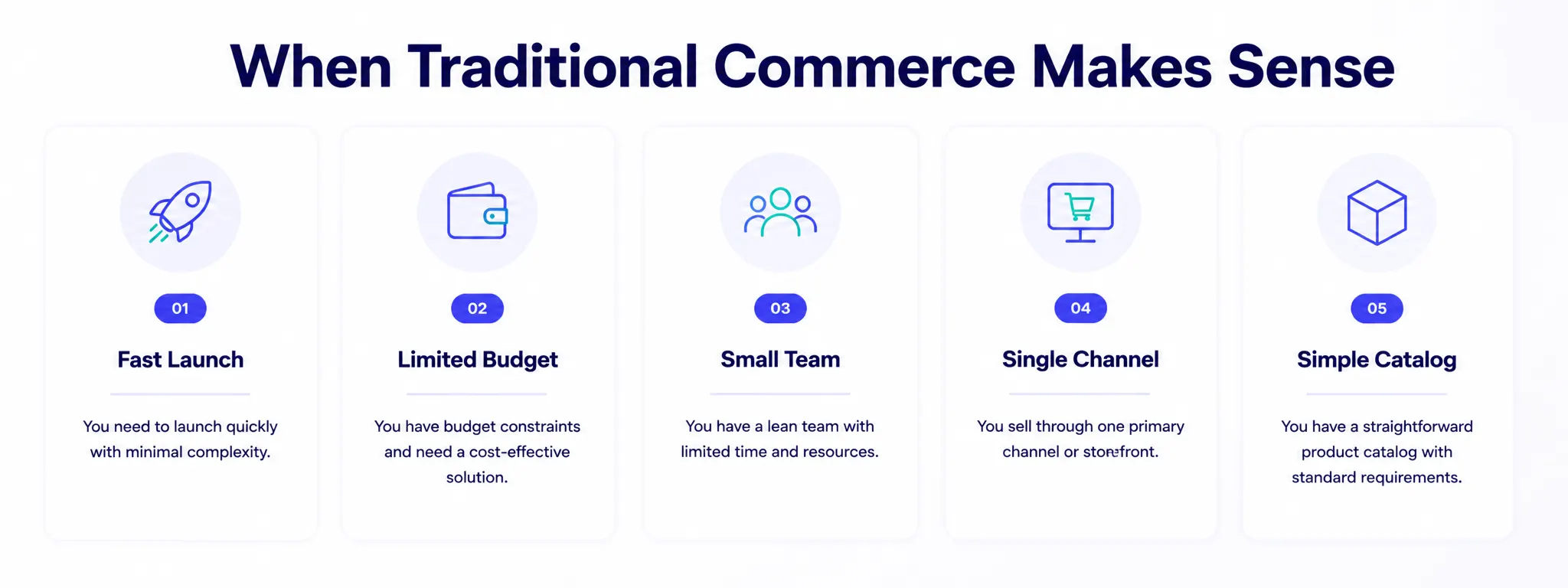
Headless is not for every business. Traditional commerce platforms are a good option when:
- You have a simple product catalog, are in the early stage, and need to launch in weeks, not months.
- Your team is not strong in front-end engineering, so you need to deal with a decoupled stack.
- You are a single-channel strategy (web only) and have no plans for mobile apps or other touchpoints for now.
- The budget is limited, and the benefits of headless flexibility haven’t yet been proven.
- Your traffic is not at a high level, and you are not ready to consider infrastructure-level optimization.
The truthful response is: There is no quality comparison to make between monolithic versus headless commerce, and it’s a maturity and complexity comparison. It’s a time and cost waste to make the wrong selection either way.
What are the Real-World Use Cases of Headless Commerce and Traditional Commerce?
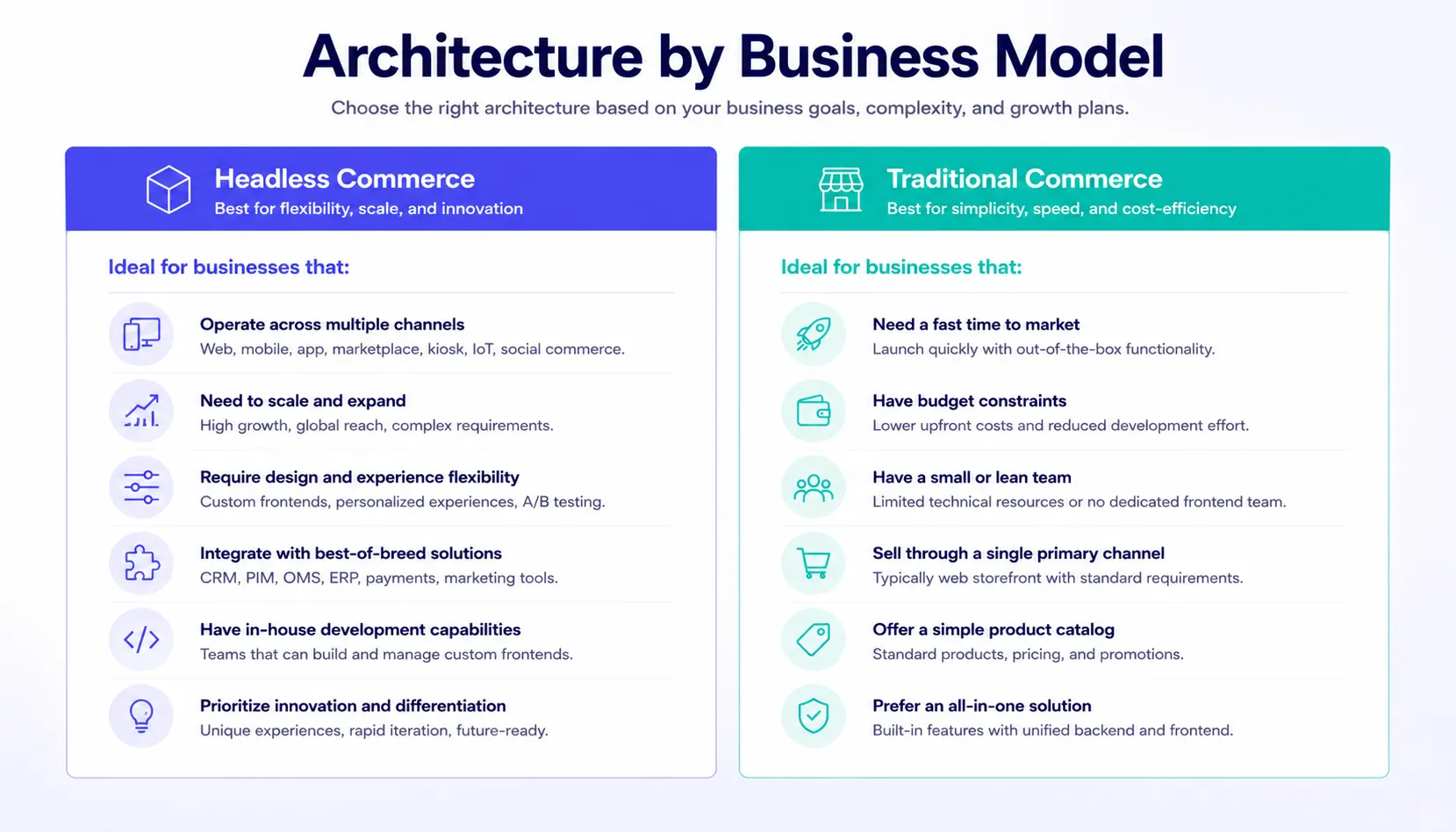
Various ecommerce models necessitate different requirements, and a suitable architecture might be a blend of business complexities, growth objectives, and customer encounter goals. Knowing which platform works best for each approach can help organizations select a platform that meets their current needs and accommodates future growth.
When to choose Headless Commerce:
- Fashion & lifestyle brands with editorial-rich storefront pages, with a combination of content from the CMS and the product pages.
- B2B commerce platforms that provide personalized pricing and catalogs for each account and enable multiple buyers in a single workflow.
- Expansive multi-brand companies with multiple stores that use different design languages for their stores.
- D2C brands are launching mobile apps, in-store kiosks, and social commerce simultaneously through a B2C commerce solution.
- Marketplace operators who require a flexible product data model and multiple-vendor logic, which a “one-size-fits-all” template system can’t support
When to Choose Traditional Commerce:
- A local retailer launching their first online store in 2–3 weeks
- A professional services firm adding a simple merchandise shop
- A startup validating product-market fit before committing to custom infrastructure
How to Choose the Right Architecture for eCommerce?
Before you make your decision, be honest in answering the following six questions:
- What is the number of channels you are serving today and in 18 months? There are several channels that strongly prefer headless.
- Do you have (or plan to hire) frontend engineers? Headless requires skilled JavaScript developers.
- How often do you change the content or design? Decoupled frontends are a tremendous asset to high-velocity creative teams.
- How much money do you make in a year? Headless infrastructure is often shown to deliver tangible ROI for businesses with annual revenue between $2M and $5M.
- Do you intend to set up a marketplace? Multi-vendor/multi-seller logic is a solid indication to go headless from the start.
- What does your integration roadmap look like? For those who require best-of-breed search, loyalty, and personalization tools, then API first.
The rule of thumb: If you responded “yes” to three or more of the above, headless commerce will reward you in 12-18 months. If you responded ‘no’ to most, a well-set-up traditional platform might be suitable for the short term.
If you haven’t already, be sure to check out our ecommerce replatforming guide and overview of composable commerce before making your architecture decision.
Why Choose SpxCommerce for Your Headless Marketplace?
SpxCommerce is tailored for businesses that require more than a storefront for just one seller. We are a marketplace development platform that provides a fully headless, API-first commerce engine out of the box to power multi-vendor architectures, seller onboarding, omnichannel distribution, and more.
From a B2B procurement marketplace to a direct-to-consumer (D2C) multi-brand storefront to a multi-sided marketplace, SpxCommerce offers the technology backbone to scale and innovate with confidence.
It features a robust headless ecommerce architecture, pre-designed APIs for catalog management, shopping carts, checkout, and order processing, and enables quicker implementation and reduced development time.
With built-in features such as account management, tiered pricing, quote requests, bulk ordering, and more, we support both B2B and B2C business models and provide the flexibility to create highly customized, high-performance storefront experiences.
Our platforms are built on a composable architecture, enabling businesses to easily adopt best-of-breed technology for search, personalization, payment, and analytics, while providing a technology stack that adapts to their business needs. With a focus on growth, customer experience, and business strategy, SpxCommerce supports teams with dedicated implementation and support services to help them avoid the complexity of infrastructure management.
Conclusion
The headless commerce vs. traditional commerce question pretty much hinges on where your business is now and where it’s going. Traditional commerce means speed and simplicity at launch. Headless commerce offers the flexibility, performance, and scalability that businesses need to win and excel at every channel and touchpoint as they grow.
The smartest thing to do isn’t choosing a trend, it’s honestly evaluating your complexity, your team, and your roadmap. When your platform is becoming more of a drag than it is a help, you’re almost certainly in the right place with headless. Plus, launching the marketplace headless from the start provides a strategic edge.