Do you have a slow eCommerce platform? Can’t roll out new features without hitting a dozen interdependent systems? Maybe you’ve come across the terms composable commerce and headless commerce, and you are still not sure which of these two architectures is really solving your problem?
You’re not alone. The dilemma for many digital leaders is deciding the right type of ecommerce architecture to deliver speed, flexibility, and scalability without starting from scratch. In this guide, we’ll explain the concept of composable vs headless commerce in simple terms, explore the distinction, and provide guidance on choosing between the two for your business.
What Is Headless Commerce?
Headless commerce is an architecture in which the frontend is completely separated from the backend. The two layers are connected with APIs.
Compare it to a restaurant where the food is prepared in the kitchen (backend) and the dining room’s decor and layout (frontend). The dining room can be completely redesigned without disturbing the kitchen.
In classic monolithic commerce, the frontend and backend are tightly coupled if you change the design of the product page, for example, you may need to make changes to the backend code. Headless takes away that requirement.
Core Features of Headless Commerce:
- API-first design: Commerce features (catalog, cart, checkout) are all made available via APIs (usually REST or GraphQL).
- Frontend Freedom: Developers can use any frontend framework, such as React, Next.js, Vue, or even a mobile application.
- Omnichannel readiness: Your website, mobile app, kiosk, and voice assistant are all backed by the same backend.
- CMS integration: Pair with a headless CMS for delivering personalized, content-rich experiences.
Learn about our complete headless commerce solution and how it functions in production environments.
What Is Composable Commerce?
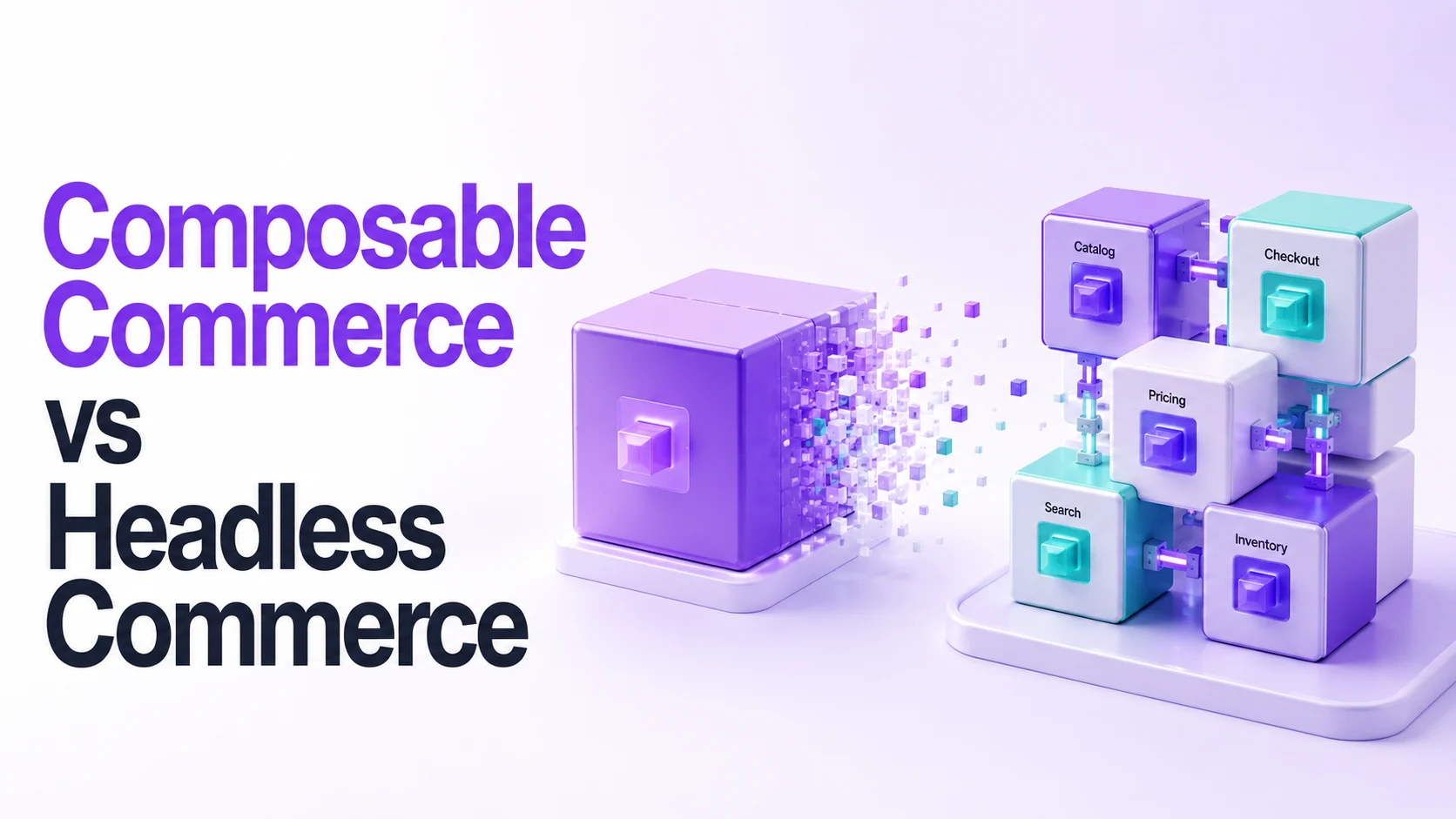
Composable commerce extends the concept of headless commerce. Composable commerce is not only separating the frontend from the backend, but now the entire system, from the frontend to backend, is broken down into modular, interchangeable parts called Packaged Business Capabilities (PBCs).
A PBC is responsible for a specific business function and could be a search, checkout, price, loyalty, inventory, or review PBC. These building blocks you create, like LEGO bricks, with best-of-breed vendors for each capability, all linked via APIs.
The MACH Alliance (Microservices, API-first, Cloud-native, Headless) formally defines this paradigm. Composable commerce is the next generation of the ecommerce tech stack.
The Four Pillars: MACH Architecture

Microservices
Commerce functions are completely services-based, e.g., search, checkout, and pricing, are independent, deployable, and scalable independently.
API-First
All services communicate only via APIs, so they can seamlessly integrate with any tool or channel.
Cloud-Native
Services designed to run on cloud platforms can scale and stretch to be resilient and globally reachable.
Headless
The front-end is completely decoupled from the back-end services, providing full freedom in UI/UX across all touchpoints.
Detailed Composable Commerce vs Headless Commerce Comparison
Often, the concepts of headless and composable commerce are used interchangeably, but they represent different levels of architectural shifts. Let’s get to that truth report:
| Criteria | Headless Commerce | Composable Commerce |
|---|---|---|
| Core Concept | Decouples the frontend from a unified backend. | Decouples both frontend and backend into modular Packaged Business Capabilities (PBCs). |
| Architecture Scope | Focuses primarily on the frontend layer. | Covers the entire eCHeadless eCommerce Platformommerce stack. |
| Backend | Typically uses a single platform-based or monolithic backend. | Uses multiple best-of-breed microservices. |
| Flexibility | Very high frontend flexibility. | Maximum flexibility, with each layer being independently replaceable and swappable. |
| Vendor Lock-in | Backend vendor lock-in still exists. | Minimal vendor lock-in; services can be replaced individually. |
| Implementation Complexity | Moderate. | High; requires comprehensive engineering resources and expertise. |
| Time to Value | Faster initial deployment. | Longer setup time, but enables faster iteration and innovation after launch. |
| Best For | Brands that need frontend freedom and rapid deployment. | Organizations that require end-to-end modularity and scalability. |
| Cost | Moderate implementation and maintenance costs. | Higher upfront investment, but potentially lower long-term costs due to flexibility and scalability. |
| Omnichannel Support | Yes, through API-enabled frontends. | Yes, with native and more tightly integrated omnichannel capabilities. |
Key Insight
Headless commerce is all about composability, but not all headless commerce is composable. Headless is a frontend decoupling approach. Composable is a full-stack, best-of-breed assembly philosophy.
Composable Commerce Benefits: Why Enterprises Are Making the Shift
A MACH Alliance survey found that 54% of enterprise technology leaders adopt composable architectures to improve customer experience, while 53% do so to accelerate innovation. Additionally, 49% of respondents said they have adopted composable architectures to gain a competitive advantage. The numbers say it all, but what are the real-world benefits:
1. Best-of-Breed Freedom
With composable commerce, you choose the best tool for each job. All powered by Algolia for search, Stripe for payment, and Contentful for content, all seamlessly. No one is ever obligated to use an average “native” feature just because it’s packaged on your platform.
2. Eliminate Vendor Lock-in
Traditional platforms take a monolithic approach, integrating your search, catalog, checkout, and promotions into a single system. Composable architecture allows you to replace one component at a time, for example, replace your loyalty platform, without having to rebuild everything around it.
3. Faster Innovation Cycles
Since each microservice is deployed separately, you can deploy improvements to your checkout without waiting for a platform release. Test and improve quicker, grow quicker.
4. Infinite Scalability
Scale services individually based on load. When it comes time for sales, scale your search, checkout microservices independently, and don’t over-provision your entire stack.
5. True Omnichannel Commerce
Drive your website, mobile app, marketplace listings, in-store kiosks, and voice commerce from one modular backend. Try out our omnichannel commerce platform to understand how it works at an enterprise scale.
Understands the Composable Commerce Architecture
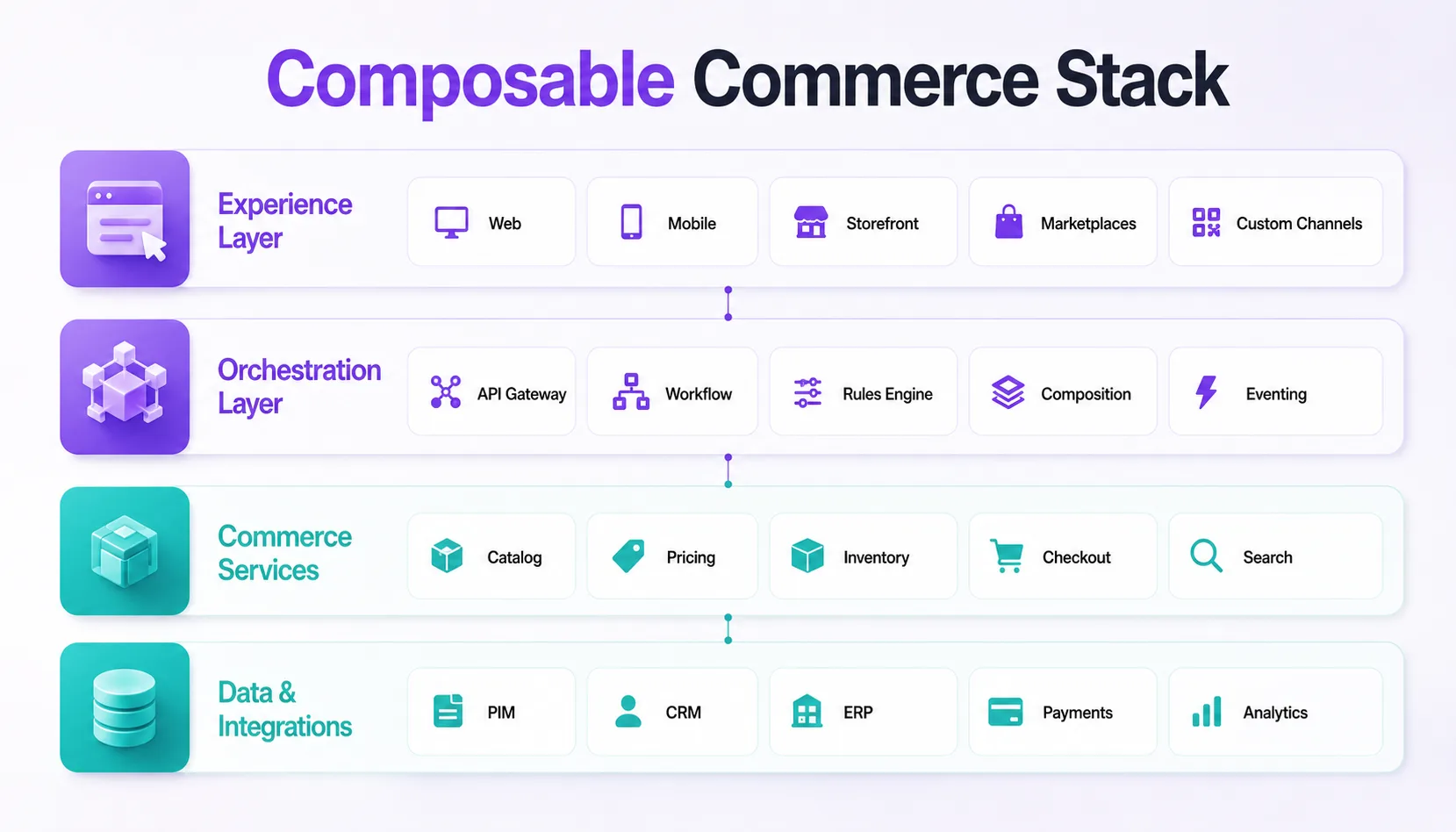
Composable commerce architecture is built in a layered structure, with each layer having its own specific purpose:
Layer 1: Experience Layer (Frontend)
That’s the thing customers will engage with: your website, mobile app, or progressive web app (PWA). It’s developed using a framework such as Next.js, Nuxt, or React, and it consumes APIs from all backend services, rendering the experience. The layer will be headless.
Layer 2: Orchestration / Middleware Layer
This is the “middleware” or connective tissue, also known as the “ecommerce middleware layer”. Combines and returns a single response from various microservices (search, product, cart). If you think of an orchestra, the “conductor” is like that.
Layer 3: Commerce Services (PBCs)
These are the Packaged Business Capabilities, each of which is a microservice: search, catalog, pricing, promotions, checkout, inventory, reviews, and loyalty. All are developed, deployed, and scaled independently.
Layer 4: Data & Integration Layer
This layer is used to communicate data between services, third-party integrations, and external systems such as ERP and CRM without issues. An important condition here is a robust ecommerce integration platform that guarantees information consistency across services.
Know When to Choose Headless Commerce?
Headless commerce is the right starting point when your organization has:
- Good frontal development skills and poor support of backend infrastructure.
- The need for a quick transformation of the customer experience without impacting backend systems.
- An established and stable backend (such as Shopify, Magento, or Salesforce Commerce Cloud) that you’re looking to maintain
- Increased plans for new channels (mobile apps, kiosks, social commerce) soon
- Moderate complexity and moderate product/order volume, which is a mid-market business.
Headless commerce is the first, and likely the right, step towards full composability. This is a good starting point for many enterprise brands as they transition to a full-fledged composable commerce architecture.
Know When to Choose Composable Commerce?
Composable commerce is a good architecture when your enterprise requires:
- Highest possible flexibility and no vendor lock-in from the tech stack.
- The integration capability of multiple brands, regions, or business models in one platform.
- High amount of transactions, need for independent scaling of services.
- Fast speed of adopting new technology, such as AI-powered search, headless checkout, and AR try-on without platform limitations.
- A long-term plan for digital transformation with robust in-house engineering or a trusted engineering partner.
- Requirements that are complex and span the marketplace or involve multiple vendors, where a single platform is not sufficient to address all requirements.
Composable commerce is becoming the architecture of choice, especially for marketplace builders, whose logic is not easily accommodated by any monolithic platform.
How SpxCommerce Enables Composable & Headless Commerce for Marketplace Builders?
Creating a marketplace (B2B, B2C, or multi-vendor) demands more than the typical eCommerce website. Designed specifically for marketplaces, SpxCommerce combines headless and composable commerce principles, enabling even more complex business models to be handled smoothly.
Our API-first design ensures easy integration with key marketplace capabilities such as vendor management, product catalogs, commission management, and order routing. This enables shorter development cycles, seamless integrations, and greater flexibility for frontend teams and tech partners.
Our modular and composable structure allows businesses to connect their preferred payment gateways, search solutions, logistics providers, and CRM systems, all without being limited by a singular platform.
Moreover, we offer full headless storefront capabilities, enabling brands to create quick, engaging marketplace experiences with modern platforms such as Next.js and React. One backend supports web, mobile, and in-app channels, delivering one channel experience.
Whether you’re about to launch a niche marketplace or scale up an enterprise-level multi-vendor platform, SpxCommerce offers you the functionality, performance, and enterprise-class scalability to ensure you grow and flourish.
Conclusion
Let’s get rid of the composable-or-headless commerce dichotomy because it’s actually a continuum of architectural maturity. Headless commerce offers you front-end freedom and quick time-to-market. You can enjoy long-term agility and full-stack modularity with composable commerce.
The best digital commerce teams don’t ask about headless or composable. They ask: What level of architectural flexibility does our business require today, and where will it go in 3 years?
Begin by identifying the problems you’re facing, the internal engineering capabilities you have, and your growth objectives. For marketplace builders and scalers, composable commerce is not a choice, and it’s a necessity to meet any ambitions you have.