
You may list a product, set a competitive price, and then draft a solid description, yet your rivals can still beat you by a huge margin. They have listed their products on Walmart, Amazon, Etsy, or Airbnb, which works perfectly.
In addition, a number of buyers are totally dependent on the first page, as they prefer those products that are ranked higher. Plus, being placed is all about product listing optimization, the planned process of improving every element of your page so the platform’s algorithm recognizes it and the buyer starts purchasing.
Over 2.71 billion people purchased products online in 2026, according to MarketBiz. The marketplace software market, valued at US$14.72326 billion in 2026, is projected to grow to US$62,439.64 billion by 2035, as stated in Business Research Insights.
Meanwhile, listings without seven or more high-resolution images convert at rates up to 35% lower than those that include them, per SellerSprite’s 2026 benchmark data.
This guide explains the complete optimization framework in detail. You will learn how marketplace algorithms actually decide rankings, what each listing element contributes, how the major platforms differ, and how to build an optimization system that compounds results over time.
What Do Marketplace Algorithms Actually Want From Your Product Listing Optimization?
Every major multi-vendor marketplace platform operates with a custom ranking algorithm. The objective is similar across Amazon and Etsy: to showcase the listing in the most likely way to result in a completed, profitable transaction.
To identify that outcome, algorithms consider two types of signals at the same time.
- Relevance signals determine whether your listing matches what a buyer typed. These come from your title, bullet points, description, and backend search terms.
- Performance signals determine whether buyers actually purchase when they land on your page. These come from click-through rate, conversion rate, return rate, review velocity, and fulfillment reliability.
The distinction has important business implications.
You cannot rank on performance signals until you first win on relevance, and you cannot sustain relevance rankings without the conversion data that only comes from sales. The two categories create a self-reinforcing cycle. Product listing optimization initiates and strengthens this performance cycle.
Many sellers consider listing quality as a temporary setup activity instead of a long-term optimization discipline. The financial implications will be invisible on standard reporting dashboards until they build up long enough to become unavoidable.
If your listing has low-quality images, incomplete product information, or the wrong keywords, shoppers are less likely to buy it. Over time, the marketplace sees this as a sign that the listing isn’t relevant to buyers and pushes it lower in search results. To recover that lost visibility, businesses often need to increase their advertising budget.
Which Elements Separate a High-Ranking Listing From One That Gets Ignored?
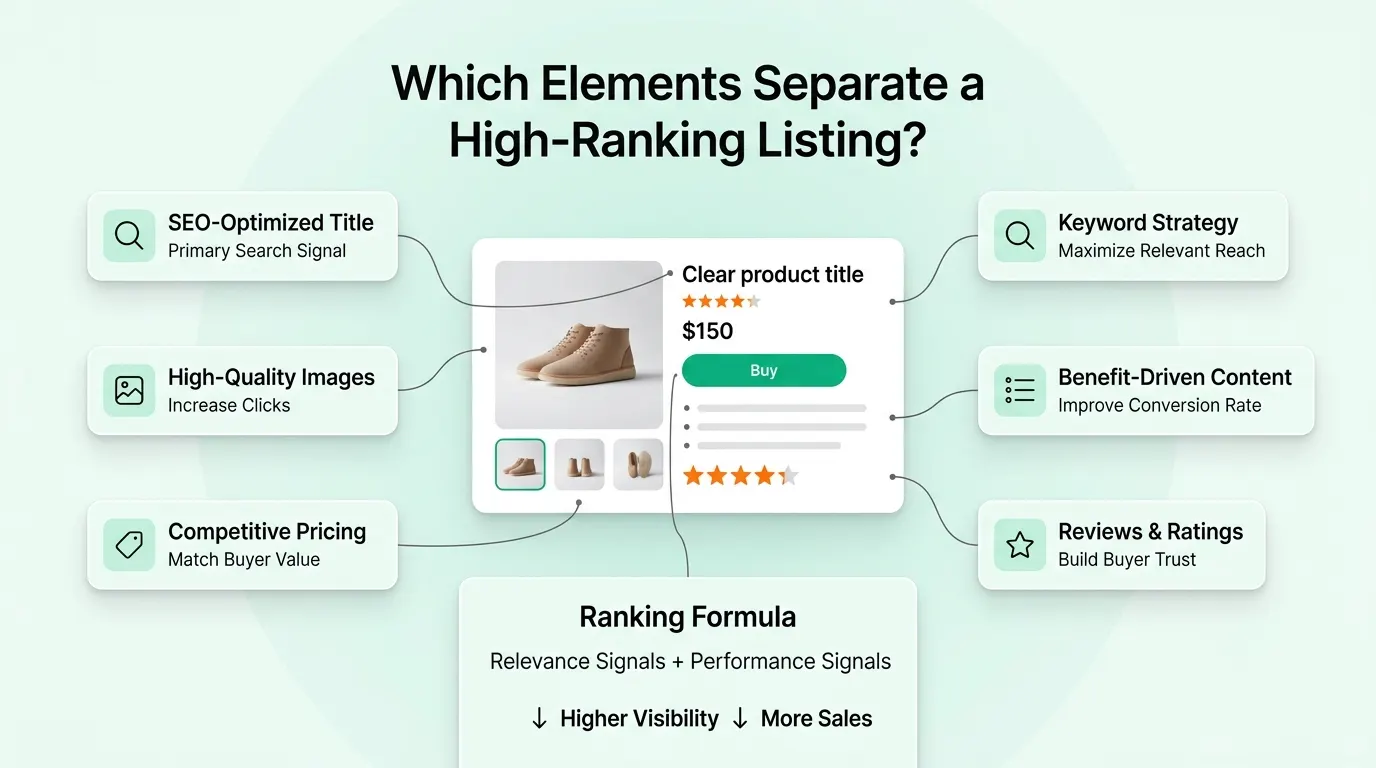
An effective list just needs to integrate all six elements at once so that sellers can easily rank their product lists higher.
1. Title
You should prepare an eye-catching title, as the algorithm prioritizes it. It is the primary category the platform ranks for in search and the one buyers browse first when choosing what to click.
A well-built title follows a clear architecture:
Brand Name + Product Type + Key Differentiator + Core Specifications + Use Case
Consider two titles for the same insulated water bottle:
- Weak: “Blue Water Bottle”
- Strong: “HydroEdge 40oz Insulated Water Bottle, Triple-Wall Stainless Steel, Leak-Proof Lid, Keeps Cold 48 Hours, Ideal for Hiking and Gym”
The second title incorporates high-intent keywords naturally, communicates specific attributes that reduce buyer uncertainty, and answers pre-purchase questions before the buyer even clicks. The title remains natural because each element serves a specific purpose.
For Walmart listing optimization, Walmart’s algorithm weights the presence of exact-match keywords in the title more heavily than Amazon’s. Precise keyword matching often delivers stronger search visibility than creative phrasing.
For Etsy listing optimization tips, the dynamic shifts toward buyer-intent phrases and niche descriptors. Etsy buyers search with emotional specificity: “personalized gift for nurse graduation” outperforms “custom mug” as a targeting frame.
2. Keyword Strategy
Prioritizing only high-volume keywords often limits visibility because these terms typically face intense competition. Top-volume terms carry the most competition. A listing without a strong conversion history cannot outrank established players for those terms, regardless of how well the title reads.
A more effective approach uses a tiered architecture:
- Tier 1 (Primary): Moderate-competition keywords with clear buyer intent. These go in the title and the first bullet point.
- Tier 2 (Secondary): Specific use-case and attribute keywords. These go in the remaining bullets and the description.
- Tier 3 (Long-tail and variation): Niche phrases, spelling variants, and semantic synonyms. These go into backend search-term fields, which are invisible to buyers and indexed by the algorithm.
Amazon listing optimization tools like Helium 10, DataHawk, and Jungle Scout are really helpful. They do not just show how many people are searching for something. They also show how things were ranked in the past, which keywords other sellers are not using, and even whether people are searching for something less than they used to. This helps teams find keywords that other sellers have not used yet.
For Airbnb listing optimization, the keyword strategy works differently. The Airbnb search engine surfaces properties based on location, property type, and guest-need phrases. Descriptions that include terms like “fully equipped kitchen”, “mountain views with fast WiFi,” or “pet-friendly with fenced yard” serve as both conversion drivers and search signals.
3. Images:
Across every major marketplace, visual merchandising drives click-through rate more than any other single element. Listings with weak imagery often lose clicks to competitors whose visuals immediately convey quality and trust.
Use this structure as a starting point:
| Image Slot | Purpose | Key Requirement |
|---|---|---|
| Main Image | Primary visual on a white background | Platform-compliant, the product fills 85%+ of the frame |
| Image 2 | Product in use/lifestyle shot | Target customer in context |
| Image 3 | Feature callout infographic | Top 2-3 benefits, scannable text |
| Image 4 | Scale reference | Next to a common object or shown in hand |
| Image 5 | All components/accessories | Builds perceived value |
| Image 6 | Competitor comparison infographic | Shows differentiation clearly |
| Image 7-9 | Social proof, certifications, or brand story | Trust-building visuals |
Amazon allows up to nine images per listing. Most underperforming listings use three or four. Listings with seven or more high-resolution images see conversion rates up to 35% higher, per SellerSprite 2026 benchmarks.
4. Bullet Points and Description
Search visibility drives traffic, while persuasive bullet points and descriptions influence conversion.
Most product teams write bullets that describe features. Buyers purchase outcomes. The gap between those two approaches often determines conversion performance.
A high-converting bullet structure:
- Opens with the primary benefit in plain language.
- Supports it with the specific feature or specification that delivers it.
- Closes with a use-case scenario that helps the buyer imagine ownership.
“6mm thick foam padding” is a feature. “Your knees feel cushioned even during 90-minute sessions on hard studio floors” is an outcome. Write five bullets using the outcome-first pattern; address the five most common objections in your category. This approach builds trust before the buyer reaches the reviews.
For Amazon product listing optimization, Brand Registry members can add A+ Content, which can easily be enhanced with imagery, comparison charts, and module-based storytelling just below the bullets. Sellers who use the Comparison Chart module within A+ Content see 4 to 12% conversion rate improvements on average, according to Sellerview.AI’s 2026 analysis.
5. Pricing and Competitive Signals
Marketplace algorithms look at how much something costs compared to things in the same category. Being the cheapest is not always the best. If something is too expensive and there is no reason for it, people are less likely to click on it or buy it.
The best thing to do is to show people why a product is special and worth the money. If a product has pictures, many positive reviews, and a clear description of what sets it apart, people are more willing to pay a little extra. If the price needs to be changed, adding a coupon can be an idea. This can make people more likely to click on the product without much of a price reduction. The coupon badge is also easy to see in search results.
6. Reviews and Ratings
Review count and average star rating influence both buyer decisions and algorithm rankings on every major platform.
The data is clear: Products with 4.5+ stars and 50 or more reviews convert at nearly twice the rate of eCommerce merchandise with lower ratings.
Big companies cannot make people leave reviews. They can make it easier for people to leave them. Amazon has a program called Vine that can help. There is also a button in Seller Central that says “Request a Review.” Sending emails after someone buys something can also help. All of these things can be done within Amazon’s rules. Responding to reviews professionally can also help. It shows that the company cares about what people think.
The same principle applies to Airbnb listing optimization. Hosts who respond to all guest reviews, maintain response rates above 90%, and earn Superhost status receive measurable algorithmic preference in Airbnb search results. The platform rewards accountability because accountability correlates with guest satisfaction.
How Do You Apply SEO In Product Listings?
Understanding the six optimization elements is only the first step.. Applying SEO correctly across all of them, without keyword stuffing or sacrificing readability, is what actually moves rank. Here is the practical sequence to follow on any listing.
- Start with search intent, not your own product description. Before writing a single word, research what buyers actually type when they want what you sell. Tools like Helium 10 or Jungle Scout reveal the exact phrases driving search volume in your category. Build your title and bullets around those phrases rather than internal product terminology.
- Place primary keywords properly. Title and first bullet point carry the heaviest indexing weight on most platforms. Secondary keywords belong in the remaining bullets and description. Long-tail variations belong in backend search fields, where they are indexed but invisible to shoppers.
- Write for humans first. A title packed with keywords but unreadable to a buyer will hurt the conversion rate, and a low conversion rate suppresses rank regardless of keyword match. The strongest product listing optimization always balances relevance with clarity.
- Refresh keywords quarterly. Search behavior shifts with seasons, trends, and platform algorithm updates. A keyword set that ranked well six months ago may now be missing newer high-intent phrases.
- Track keyword-level performance. Use platform analytics or third-party rank trackers to see which keywords are actually driving impressions and clicks. This tells you where to double down and where your current approach is not working.
Applied consistently, this framework transforms SEO into a repeatable system that delivers compounding gains across listings.
Does Every Marketplace Rank Listings the Same Way?
Core product listing optimization principles remain consistent across marketplaces. But each marketplace has its own weighting, requirements, and nuances that determine what actually moves the needle.
| Platform | Primary Algorithm Focus | Top Optimization Lever | Key Pitfall |
|---|---|---|---|
| Amazon | Sales velocity + keyword relevance | A+ Content + backend keywords | Ignoring conversion rate vs. category average |
| Walmart | Listing completeness + 2-day fulfillment | Attribute completeness + WFS enrollment | Leaving required attributes blank |
| Etsy | Buyer-intent keywords + shop performance | Long-tail title phrases + response rate | Generic titles that miss niche intent |
| Airbnb | Guest experience signals + listing completeness | Response time + all-6-subcategory reviews | Low acceptance rate suppressing rank |
Amazon
Amazon listing optimization operates within one of the most sophisticated ranking environments available. The A9/A10 algorithm considers hundreds of signals, but five carry the most weight for sellers:
- Keyword relevance in title and backend,
- Conversion rate relative to category average,
- Unit session percentage,
- Fulfillment method (FBA consistently outperforms FBM in rankings),
- Return rate.
Brand Registry members should prioritize A+ Content and the Manage Your Experiments tool to validate optimization decisions through data. A/B testing titles, main images, and A+ modules against live traffic is the fastest way to generate proprietary data on what drives conversions in your specific category without relying on industry averages that may not apply to your niche.
Walmart
Walmart listing optimization rewards two things above nearly everything else: listing comprehensiveness and fulfillment speed.
Walmart’s algorithm explicitly scores listings on how many required and recommended product attributes are filled in. Listings with incomplete attribute data get suppressed in rankings regardless of keyword quality. Sellers who complete every available field, like materials, dimensions, color specifications, and compatibility notes, rank meaningfully higher than those who leave fields empty.
Walmart also prioritizes two-day and next-day fulfillment. Sellers using Walmart Fulfillment Services or maintaining their own two-day delivery capabilities hold a clear ranking advantage.
Etsy
Etsy listing optimization methods need to be adjusted to a degree that differs from that of mass-market platforms. Their customers are not only looking for objects but also searching with a kind of emotional precision and making purchases that revolve around times, tastes, and craftspeople’s stories.
Items that mention the origin of the materials, the possibility of custom changes, and even the specific times of the use of the product do better than simple product descriptions all the time. However, Etsy’s algorithm does not only look at the health of the individual listing but also the whole shop in a holistic way.
Factors such as how fast a message is responded to, the metrics of timely delivery, and review scores are all elements that affect how listings rank individually. Without maintaining the shop-level operational discipline, optimizing the listing alone will only bring limited results.
Airbnb
An Airbnb listing optimization guide for professional operators starts with a shift in perspective: your operational systems are your ranking signals. Factors such as acceptance rate, cancellation rate, response time, and review scores across all six subcategories are fed directly into the algorithm.
For someone managing multiple properties, automated guest communication, consistent housekeeping standards, and streamlined check-in processes are the SEO investments the platform is making. The algorithm favors listings that consistently meet the highest delivery standards for guest experiences.
How Do You Build a Product Listing Optimization Program?
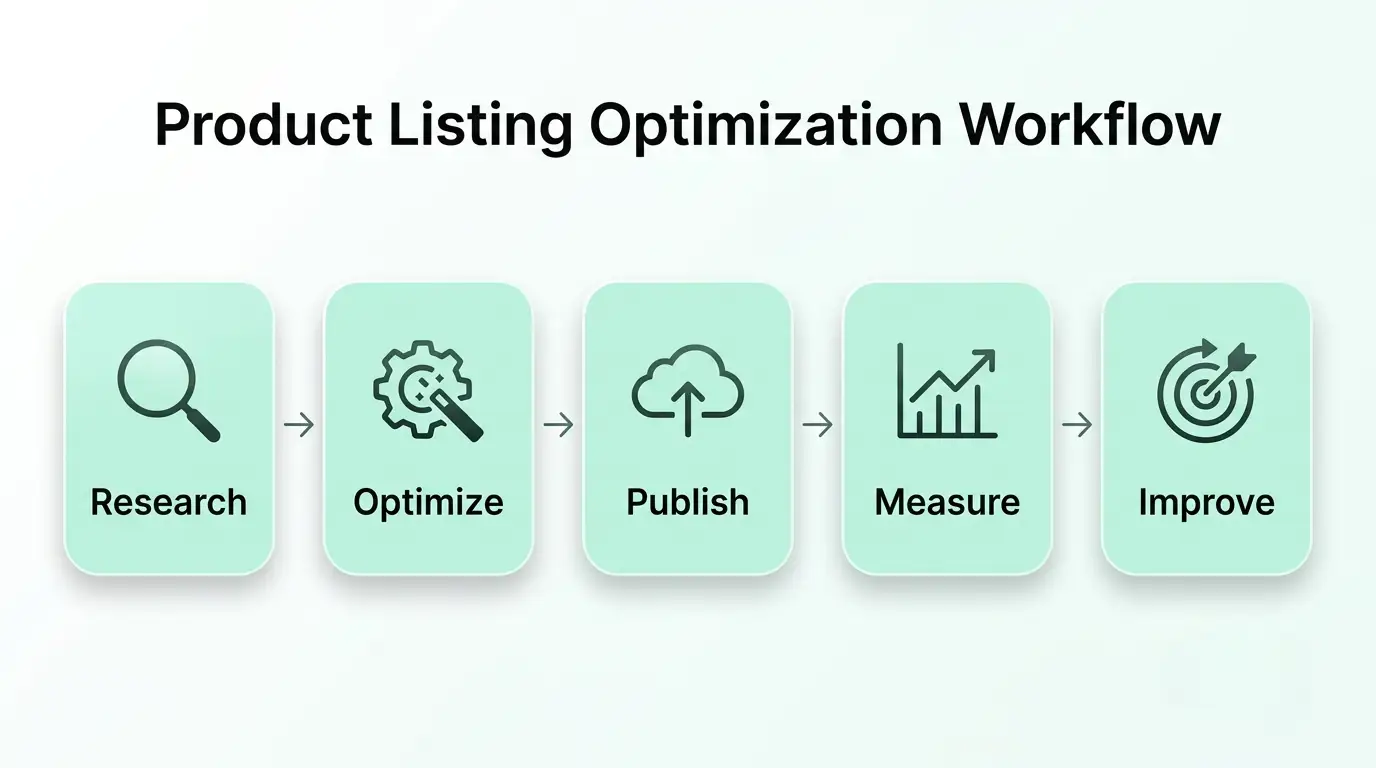
If done systematically, optimizing product listings creates a competitive edge that keeps increasing and eventually becomes difficult for rivals to imitate.
Start with a Competitive Audit
The first thing to do before modifying anything is to know your position. An audit is structured when you look at your best listings and, at the same time, the ones ranking above you in the search results for your main keywords. You can check the structure of titles, the number and quality of images, the depth of bullet points, the price level, the number of reviews, and the completeness of attributes.
You will almost certainly find some quick wins during this process: fields left empty for attributes, keywords put in the back-end and not used, and image placeholders left unfilled. Most of the time, these gaps can be closed in a matter of days, not weeks.
Test One Variable at a Time
The most effective Amazon listing optimization programs run continuous A/B tests. Amazon’s Manage Your Experiments tool lets Brand Registry members test alternative titles, images, and A+ Content modules with live traffic and measure the impact on conversions directly.
A disciplined cadence of one variable per listing per 30-day cycle generates compounding improvements. Sellers who test consistently see 15 to 25% improvements in annual conversion rates through accumulated small wins, according to Envive.AI’s 2026 analysis.
Measure What Connects to Revenue
Optimization programs stall when teams measure activity rather than outcomes. The metrics that matter are:
- Conversion rate at the listing level (unit session percentage on Amazon)
- Organic keyword rank for primary and secondary terms
- Click-through rate from search results
- Return rate and its impact on net revenue
- Ratio of organic to paid revenue, which is the clearest indicator of listing self-sufficiency
Track these weekly at the SKU level. Roll them up monthly to category and portfolio views. This visibility enables leadership teams to allocate resources effectively and accurately measure optimization ROI.
Conclusion
Product listing optimization is the foundational basis on which the efficiency of conversion rate, organic visibility, and scalable revenue growth is developed. Companies must regularly make investments in their businesses to stay ahead of competitive pressures and algorithm updates.
Those businesses that are consistently top performers on Walmart, Amazon, Etsy, and Airbnb have a common thought: They test continuously, meet all operations with ranking signals, and monitor metrics. Through this approach, their main motive is to stand out in this competitive market.
The tiered keyword strategy, the image sequence, the benefit-led bullet structure, and the platform-specific priorities drive rankings and conversions in real categories for real sellers, generating real revenue.
Start with your highest-revenue SKUs. Fix the obvious gaps first. Build a testing habit. And measure everything against the metrics that matter.
Why Do Growing Brands Trust SPXCommerce With Their Listing Performance?
Successfully scaling marketplace optimization requires specialized expertise, proven processes, and continuous performance analysis.
SPXCommerce helps brands and sellers build high-performing listings across Amazon, Walmart, Etsy, and beyond, combining deep marketplace expertise with data-driven content strategy. From keyword research and title architecture to A+ content development and competitive auditing,
It builds optimization programs that generate measurable improvements in organic rankings, conversion rates, and revenue per listing
If your current listings are not working as hard as they should, the gap between where you are and where you need to be is closer than you think.
Ready to see what optimized listings can do for your revenue? Connect with the SPXCommerce team today.