The pitch for this is probably something you’ve heard a hundred times: “It’s like Airbnb… but for X.” Two-sided marketplaces have become one of the most widely replicated business models of the past decade. However, most founders who try them hit the same brick wall after building the platform: no one visits it. The party on the supply side is waiting for the buyers.
The marketplace struggles to generate the activity required for sustainable growth.
That issue is what is known as the chicken-and-egg problem, and it’s among several structural issues that plague marketplace businesses each year. Factor in platform leakage, the need for high quality at scale, and winner-take-all market dynamics, and it is easy to see why many marketplace startups go under quietly.
These challenges can be overcome. Service providers such as Airbnb, Etsy, Uber, and many other niche companies have figured it out. Today, purpose-built marketplace platforms can reduce the development time and investment required to launch a full-featured two-sided marketplace.
This guide will explain what a two-sided marketplace is, help you understand the fundamental business models, explore examples you can learn from, and even provide a step-by-step model you can use to create a successful two-sided marketplace.
What Is a Two-Sided Marketplace?
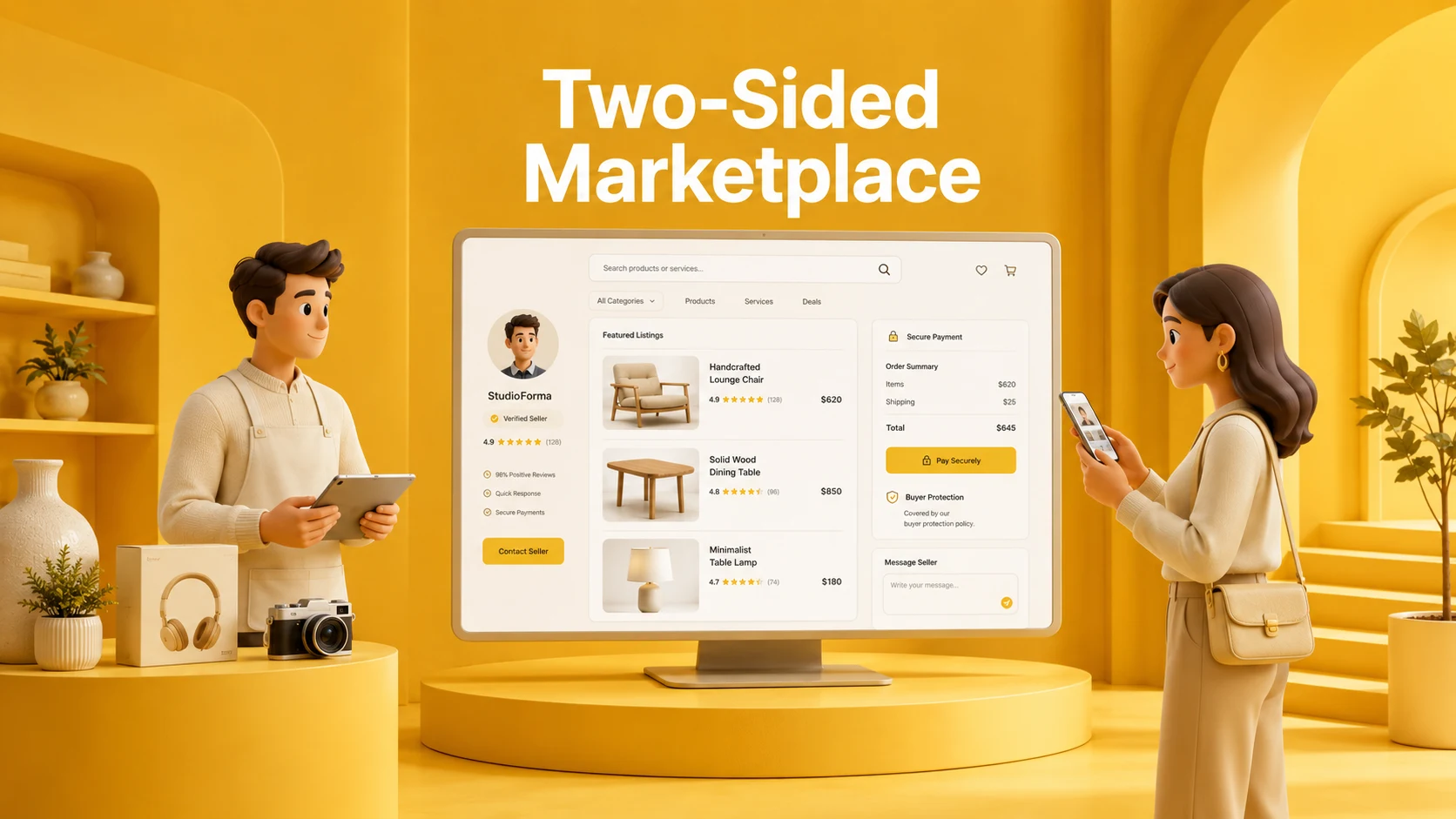
A two-sided marketplace is a website that allows transactions to occur between two different groups of users, such as consumers and producers, or buyers and sellers, that are not held by the company that manages the site. The marketplace makes money from interactions, typically by charging a commission on each interaction, a listing fee, or a subscription fee.
A two-sided marketplace acts as a digital intermediary between two user groups. Airbnb is a matchmaking service for the accommodation sector. Uber is the platform that matches riders with drivers. Etsy is a platform for connecting independent creators with shoppers. In both instances, it’s the platform that provides the infrastructure, while the two parties provide the rest.
The difference between a two-sided marketplace and a traditional online store is that it is not the owner or manufacturer of what it sells. Amazon was a store in its early beginnings. Amazon Marketplace, a platform for third-party sellers to sell their own products, is a two-sided marketplace. The difference is crucial, as it alters everything from the cost structure and scalability to the risk profile and competitive dynamics the business will encounter.
In 2024, the worldwide value of the sharing economy powered by two-sided marketplaces reached $366.2 billion and is projected to exceed $1.4 trillion by 2030. It is not a trend but a change in how business is done.
How Does a Two-Sided Marketplace Work?
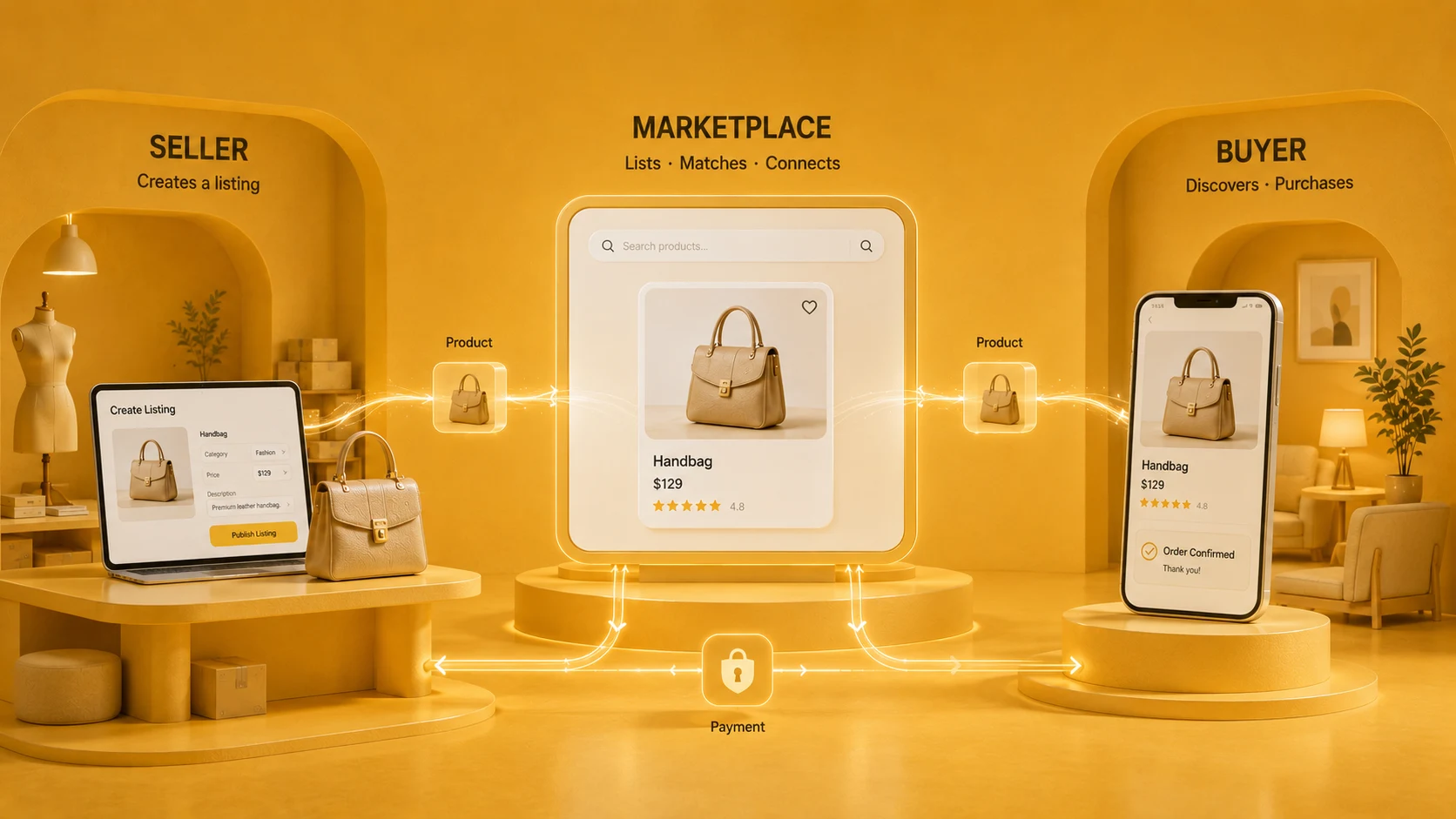
The basic mechanics are straightforward, but marketplace dynamics are more complex. Let’s see the essence of the flow:
Sellers / Providers
List goods/services or rentals. They provide the content that makes the platform worth visiting.
Buyers / Customers
Shop, find, and pay. Their demand makes them worthy of sellers’ attention.
The Platform
Offers the infrastructure: search, payments, trust signals, dispute resolution, and communication tools.
Network Effects
Once both parties realize they’re getting a good deal, the network effect takes over and growth becomes organic. This positive feedback cycle is the backbone of the marketplace’s growth.
The platform’s job is to improve the circumstances for both sides compared to what they would be without it. Buyers receive selection, price transparency, and trust. Sellers get distribution, payment processing, and a stream of customers they couldn’t reach on their own. Once both parties realize they’re getting a good deal, the network effect takes over and growth becomes organic.
These businesses are also defensible because of the two-sided marketplace dynamics. “When both sides consistently receive value, stronger network effects can improve retention, liquidity, and organic growth metrics. For a new player to ‘disrupt’ an existing market, they would have to win over both sides. That’s the same chicken-and-egg conundrum that makes them difficult to get off to a good start.
What Are the Main Two-Sided Marketplace Business Models?
Many product and strategic decisions made by a marketplace are influenced by its monetization model. These are the two most prevalent marketplace business models and when they apply:
| Model | How It Works | Best For | Example |
|---|---|---|---|
| Commission / Take Rate | Platform takes a % of each transaction | High-volume, recurring transactions | Airbnb (3–14%), Upwork (10%) |
| Listing Fees | Sellers pay to list products or services | Marketplaces with high-intent sellers | Etsy ($0.20/listing) |
| Subscription | Recurring fee for platform access or premium features | B2B or professional service platforms | UpCounsel (attorney monthly plan) |
| Lead Fees | Sellers pay per qualified lead or connection | High-value, low-frequency services | Thumbtack, Bark.com |
| Featured Listings | Sellers pay for premium placement or visibility | Any marketplace with organic search volume | Amazon Sponsored Products |
| Freemium | Free base tier; charge for advanced tools or lower fees | Volume-first marketplaces building supply | TeachersPayTeachers (40% free vs. 15% paid) |
Most mature platforms have two or three of the above. Airbnb charges a service fee for hosts, promoted listings, and products, and hosts must pay an insurance premium. The commission model is the most popular to begin with because it ties the platform’s success to its users’: if your users are successful, then so are you.
Real-World Two-Sided Marketplace Examples Worth Studying
Specifics clarify theory. These are the five real 2-sided marketplace examples that demonstrate the different possibilities and what makes each tick:
1. Airbnb: The Trust-First Rental Marketplace
Airbnb wasn’t just the first to invent short-term rentals. It was establishing a trust infrastructure, verifying IDs, enabling two-sided reviews, and providing host protection insurance, making people feel comfortable visiting each other’s houses. Airbnb is a rental marketplace that now offers more than 7 million properties worldwide and makes money through a split fee applied to both hosts and guests.
2. Etsy: Niche-First, Community-Forward
Etsy originally focused on a niche like handmade and vintage products. That specificity helped attract early supply and buyers seeking products that broader marketplaces did not emphasize. The platform prioritized seller loyalty before its growth accelerated, an approach many founders overlook.
3. Rover: Trust in a Regulated-Adjacent Space
Rover matches dog owners with dog walkers and sitters. The service fee it collects from care providers is 15-25%, and the fee it collects from pet owners is 11%. Its in-between layer includes vetting, a background check, detailed provider profiles, and an in-person meet-and-greet before each initial booking, all of which make Rover work.
4. Google Classroom: The Course Management System
TeachersPayTeachers, founded by a classroom teacher in 2006, allows teachers to sell lessons and resources they have already created. The insight was that supply was available in each school in the country. All that the platform had to do was compile it. Indeed, some top sellers make six figures a year from materials they created for their own classes.
5. BlaBlaCar: Geographic Focus Beats Broad Launch
Instead of competing on a global scale from the start, BlaBlaCar developed a strong liquidity base in France and later expanded country by country, using a playbook tailored to each market. It is used by 27 million people in 21 countries to this day. The example shows why establishing liquidity in a focused market can create a stronger foundation for expansion.
What Are the Biggest Two-Sided Marketplace Challenges?
It is as important to know the reasons why markets fail as to understand the reasons for their success. The following 4 challenges keep recurring:
1. The Chicken-and-Egg Problem
No one’s going to sign up for a site where they can’t purchase anything. If there are no buyers, then sellers will not list. This is where all marketplaces begin. In many successful marketplaces, an early focus on building sufficient supply helps create the liquidity needed to attract buyers. For the first 20-50 sellers, recruit them manually through direct outreach, fee exemptions, or existing communities. Build a compelling supply base before investing heavily in customer acquisition.
2. Platform Leakage
Once a relationship is established with motivated users, they will attempt to do business off-platform if your platform has a 15% commission. The only way to make your platform truly more beneficial than going around it is to provide payment protection, dispute resolution, booking options, and marketing reach. Technical restrictions alone cannot fully prevent off-platform transactions.
3. Quality Control at Scale
If you have a very small marketplace, you can check out all the listings. It is not possible when it’s big. Algorithmic trust signals such as reviews, verification badges, and response rate scores do some of the work. However, clear community guidelines and real enforcement are a requirement. A major trust scandal can undo years of trust-building.
4. Winner-Take-All Dynamics
The majority of markets have one dominant marketplace and one or two challengers. When a platform reaches sufficient liquidity and brand, it just cannot be easily displaced. A vertical focus is the counterattack for new players, and it’s owning a particular segment of the market so thoroughly that the incumbent has no reason to bother.
How to Build a Two-Sided Marketplace: Step-by-Step
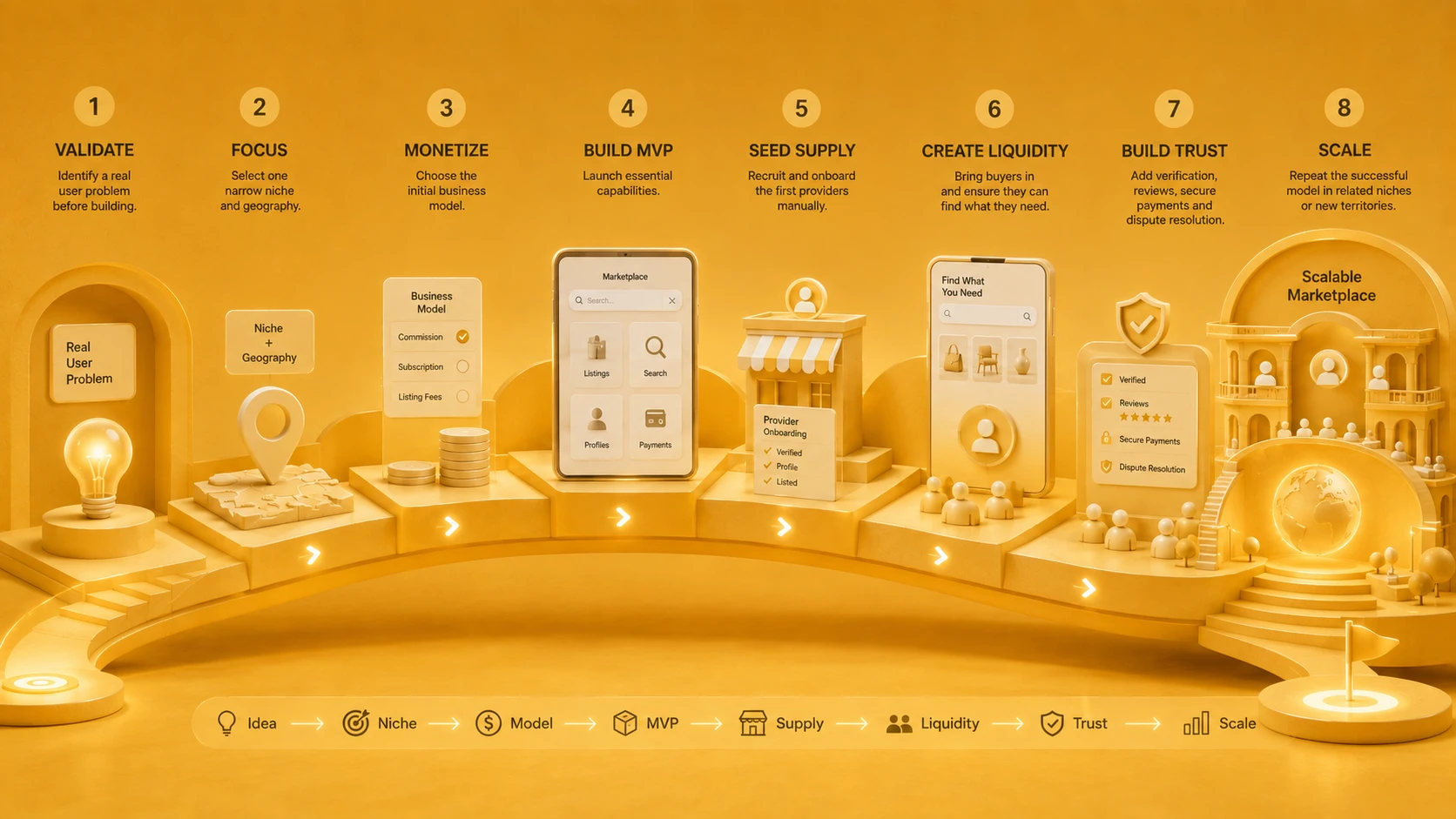
The following is a practical model to build on what works, not theory:
1. Validate the problem, not the idea
Talk about potential users’ frustrations, not your concept. If people can’t clearly state a pain point that your marketplace will address, then STOP building anything!
2. Pick a narrow niche and geography
Most businesses fail because of the desire to please all their potential customers. Start with one type of transaction in one location. Develop liquidity there before expansion.
3. Choose your business model
Commission is the usual basis for most marketplaces, as it has a natural progression. Choose one model first, and refine as you get real transaction data.
4. Build a minimum viable platform fast
Prioritize essential capabilities such as listings, search, profiles, and payments before adding non-critical features. Significantly reduce the cost and time of building by utilizing two-sided marketplace software. Custom development from scratch can be $50,000+ and take 6 months or more.
5. Seed supply manually
Be on board with your first sellers. Assist them in writing listings. Offer a fee discount to those who sign up early. You’re creating the shop before you bring customers to it.
6. Launch to buyers and obsess over liquidity
Check if buyers are finding what they are looking for and if sellers are selling. Total users alone do not measure marketplace health. Liquidity provides a more meaningful indicator of whether buyers and sellers can transact successfully.
7. Build trust infrastructure
Include reviews, verification, secure payments, and a dispute process that is clear. Trust is not a single feature that can be added to a system. It develops through mechanisms such as verification, secure payments, reviews, and dispute resolution.
8. Iterate, expand, repeat
Having reached the liquidity stage in your niche, copy the playbook in related niches and/or new territories. If you don’t have a repeatable model, don’t scale.
What Two-Sided Marketplace Software Should You Use?
How you build your product determines your time-to-market, cost, and flexibility. Here’s how the options compare:
| Approach | Time to Launch | Cost (est.) | Flexibility | Best For |
|---|---|---|---|---|
| Custom build from scratch | 6–18 months | $50,000–$500,000+ | Maximum | Funded teams with unique technical requirements |
| Open-source (self-hosted) | 2–4 months | $5,000–$30,000 | High | Technically capable teams wanting ownership |
| No-code SaaS tools | Days to weeks | $100–$500/month | Low–Medium | Idea validation and early MVPs |
| Purpose-built marketplace platforms | 1–4 weeks | Custom pricing | High | Founders who want speed and scalability |
For the majority of founders, a marketplace platform that’s built specifically for them is just right: quick enough to test their hypothesis with actual users, scalable enough to expand upon, and much less expensive to acquire than to build from scratch.
Why SPXCommerce for Your Two-Sided Marketplace Platform?
Creating a two-sided marketplace is not only more complicated than connecting buyers and sellers, but it’s also fundamentally different. All the features must work together to provide a smooth user experience, from real-time listing management to secure payments, user verification, reviews, chatting, and admin controls.
Creating these attributes in the first place can be costly, time-consuming, and technically difficult. In addition, custom development can lead to longer launch times and higher maintenance costs for many businesses.
SPXCommerce has been designed to make the whole process easy. It offers all the necessary features to get your marketplace up and running quickly, without having to build from scratch or use several third-party tools.
From B2B marketplace, B2C, service or rental to niche marketplaces, SPXCommerce provides the flexibility to customize your platform as your business grows. A shorter time to market, reduced development costs, and a robust marketplace architecture allow you to focus on acquiring users and transactions, and expanding your business with confidence.
Conclusion
Creating a successful two-sided marketplace isn’t just about creating a website or app. It involves generating value for both the buyer and the seller and developing trust to maintain engagement.
Platform leakage, the chicken-and-egg problem, and quality control are a few of the challenges that arise in this scenario, but can be resolved with the right strategy. Having a niche, a sustainable business model, and growing only when the marketplace is liquid are crucial for success.
The great news is that there’s no need to start with a large budget or months of custom development. There are platforms such as SPXCommerce that can help you kickstart faster, test your concept, and grow your marketplace as it expands.
Start with a focused market, listen to users, and continually improve the platform. Sustainable marketplace growth depends on consistent execution and continuous iteration.