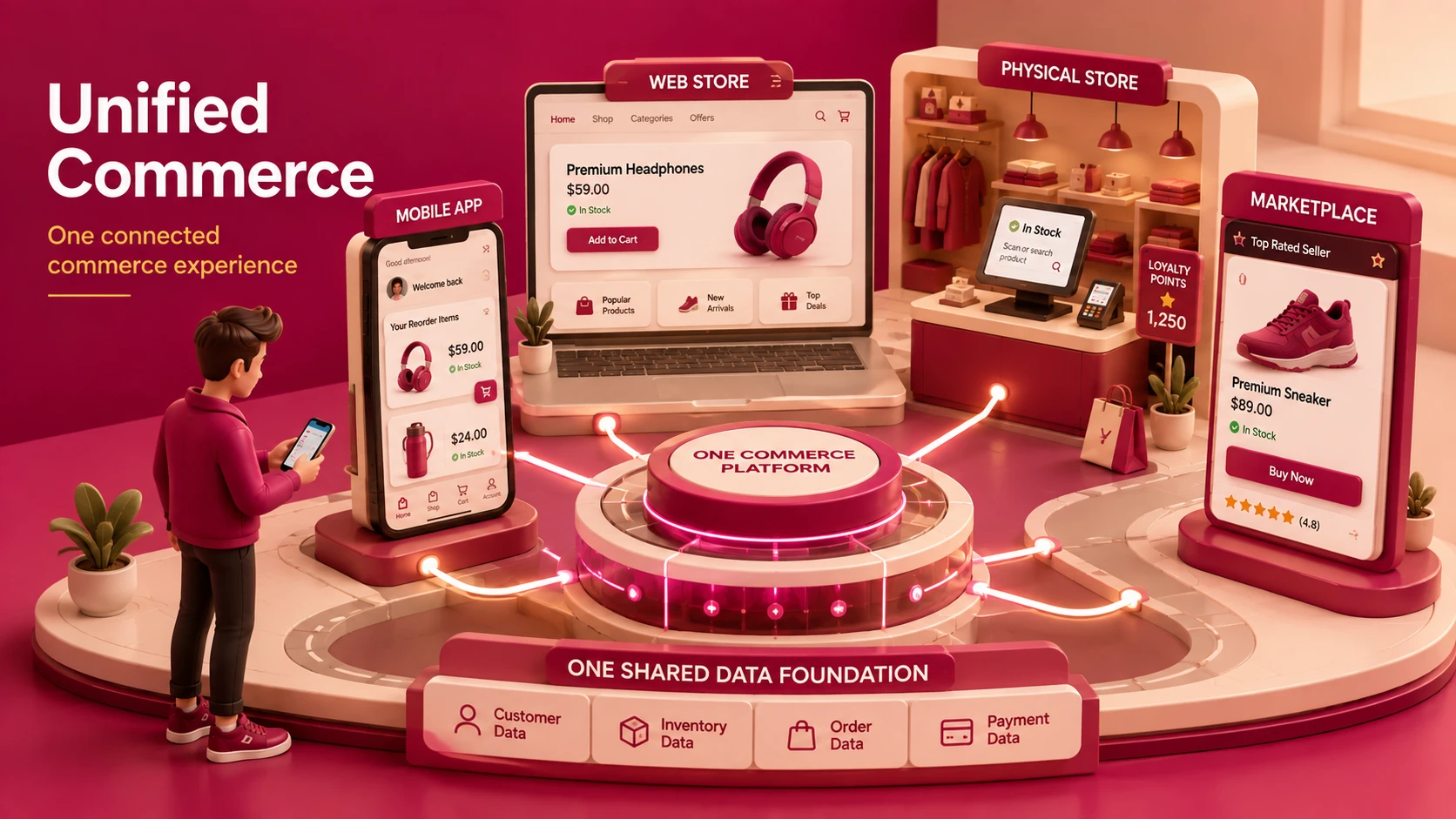
Your customer adds a product to their cart while eating lunch in your mobile app. That night, they go into your shop and ask one of your employees about it. The associate is clueless as to what the customer is talking about. Your products are listed as “in stock,” but you don’t have them on hand. No loyalty points carry over between channels, and a refund that began online remains in limbo in-store.
This is the working life of thousands of retailers operating on isolated platforms made up of disjointed solutions for inventory, point-of-sale, order management, and ecommerce, with insufficient communication between them. The cost is real as it results in lost sales, lost customer confidence, and more time spent reconciling data than growing the business.
A good unified commerce solution resolves this issue from the start. It integrates all of your systems inventory, payments, orders, customer data, and more into one operational backbone, as opposed to bolt-on channels installed later. The result is a uniform shopping experience for customers and an operational layer that truly scales.
In this guide to unified commerce, you will learn what it is, how it is different from omnichannel, its architecture, best platforms, and how to select the right platform for your business.
What Is Unified Commerce?
Unified commerce is a business strategy and technology approach to having all sales channels, customer touchpoints, and backend systems, from ecommerce through to point of sale, order management, inventory and payments, all working on a single real-time platform.
Data is the same for all channels. No “sync delay. If the product is sold on the floor, the online count will be automatically reduced. A customer can log in to their account and see all purchases, regardless of the channel.
So, to summarise, omnichannel is an addition to the channels you already have. Unified commerce eliminates the plumbing-based silos and replaces them with a single system designed from the ground up to integrate all channels. The customer’s shopping cart in the app, loyalty points, and purchase history in the store are all stored in the same real-time, accessible database across all touchpoints.
There is a huge disparity between expectation and achievement. TCS OmniStore research with RIS News reveals that 77% of retailers agree that unified commerce is about a seamless experience and consistent data, but only 3% deliver a “truly unified experience” across channels.
This discovery reveals one of the fundamental problems that unified commerce aims to resolve: While retailers increasingly recognize the importance of connected customer experiences, many still use disjointed systems and data.
What is the Difference between Unified Commerce vs. Omnichannel Commerce?
The terms are related but refer to fundamentally different approaches to connecting commerce channels and systems.
| Dimension | Omnichannel Commerce | Unified Commerce |
|---|---|---|
| Architecture | There are several systems connected through APIs and middleware. | Single platform or “tightly native-integrated” core |
| Data Sync | Near real-time (may have a lag) via integrations | Real-time is defined as having one shared database. |
| Customer View | Put together from several data sources | A 360° profile that is consistent throughout all channels. |
| Inventory Accuracy | Accuracy varies based on synchronization frequency | Exact up-to-the-minute updates |
| Implementation Complexity | Moderate because integrations can increase technical complexity and maintenance overhead | When the base platform is established, reduce. |
| Scalability | Individual channels and integrations can become scalability bottlenecks as the business grows. | In the terrace at platform level, there are scales. |
For businesses that rely on a variety of legacy tools, an omnichannel approach may provide a practical transition path toward unified commerce. When you realize that all your integration pain is making you tired and when you want your customer experience to be consistently great, without having to do heroic engineering each time you want to integrate a new channel, you end up on unified commerce.
What Does Unified Commerce Architecture Look Like?
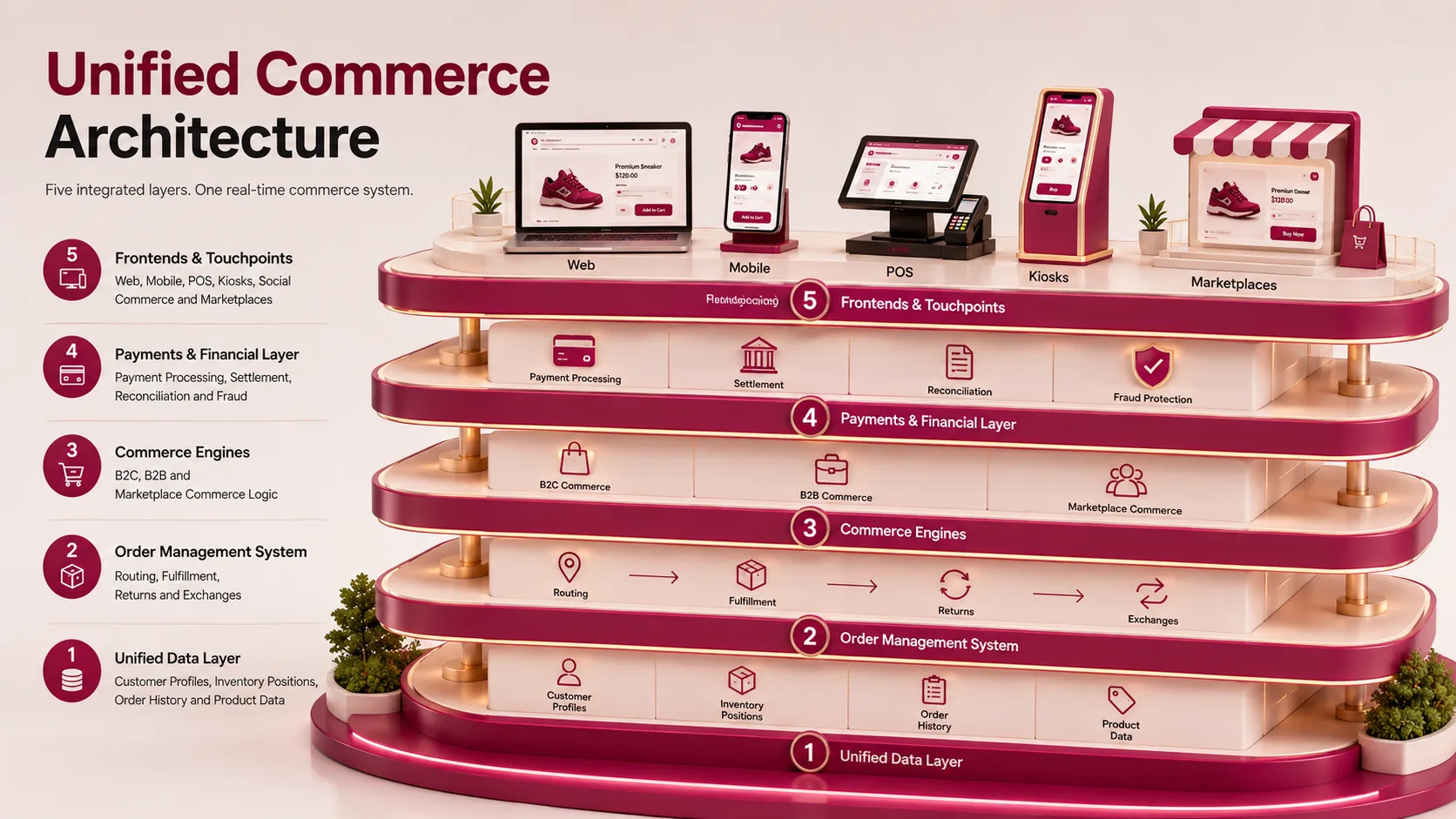
A unified commerce architecture can be organized into five core layers. Each performs a specific task and shares the same data layer below. Let’s take a look at the diagram:
Layer 1 – Unified Data Layer
The data layer establishes a single source of truth. All customer profiles, Inventory positions, Order history, and Product data reside here. This layer feeds each channel in and out simultaneously with no batch syncing, no reconciliation jobs.
Layer 2 – Order Management System (OMS)
Manages routing, fulfillment, returns, and exchanges across all channels. If a customer purchases online and returns to the store, a single order record is generated, not two separate records in two separate systems.
Layer 3 – Commerce Engines (B2C, B2B, Marketplace)
The logic for selling per channel type, including pricing, promotions, catalog, and checkout logic. On a well-designed marketplace platform, these engines access the same product and pricing data rather than maintaining their own product and pricing catalogs.
Layer 4 – Payments & Financial Layer
Unified commerce payments bring all payment channels (card, digital wallets, BNPL, in-store cash) under a single processing layer and unified settlement, reconciliation, and fraud management.
Layer 5 – Frontends / Touchpoints
Customer-facing technologies like web storefronts, mobile Apps, POS terminals, Kiosks, social commerce, and Marketplace integrations. These are separate from the commerce logic, in a headless architecture, and can be updated without affecting the back end.
The above architecture isn’t a theory, but it’s the design pattern that keeps platforms running at scale rather than those that crumble at the slightest demand for orders or the quickest need for a new channel.
What Are the Key Components of a Unified Commerce Platform?
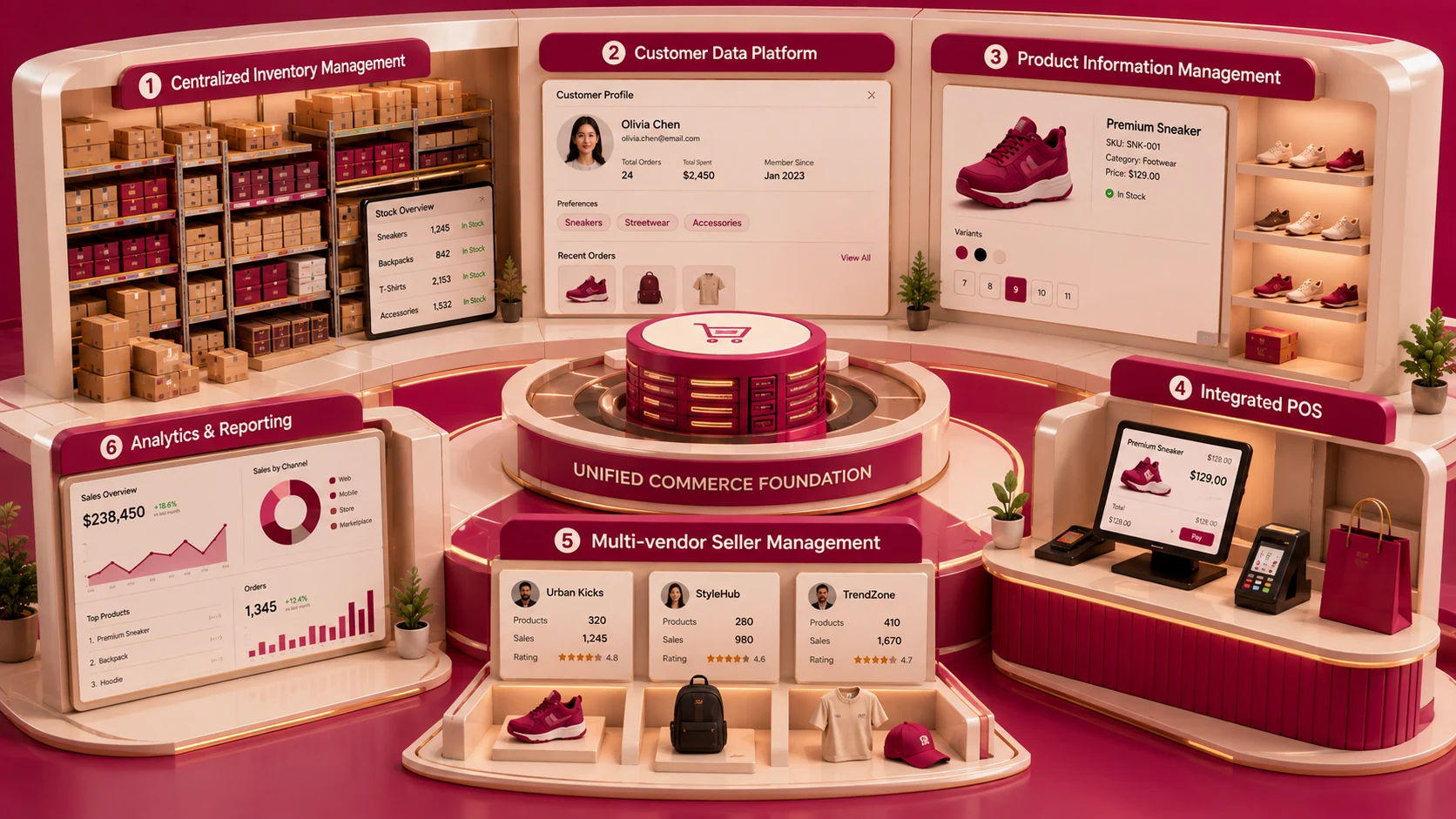
These are the elements of unified commerce software that do matter when you are considering it or creating your own stack:
1. Centralized Inventory Management:
See stock in real time across all warehouses, stores, and fulfillment centers. Accurate inventory visibility helps reduce overselling and supports BOPIS and ship-from-store fulfillment.
2. Customer Data Platform (CDP):
A singular customer profile that collects all customer behavior, transactional, and loyalty data across all channels. Personalization’s base.
3. Product Information Management (PIM):
All product information, including descriptions, images, variants, pricing, etc., in one place, which is synced automatically to all channels.
4. Integrated POS:
In-store system that reads and writes into the same platform as the ecommerce engine. At the register, associates can view the customer’s online shopping cart, purchase history, and loyalty balance.
5. Multi-vendor Seller Management:
In marketplace models, seller onboarding, commission management, and payment splitting in one system.
6. Analytics & Reporting:
Cross-channel dashboards that allow merchandisers, marketers, and ops teams to view the big picture of the business without having to export data between tools.
How Do Unified Commerce Payments Work?
Unified commerce payment merges all payments and channels into a single payment processing layer. No need to use a different payment gateway for your website, a different processor for your POS, and a third one for your marketplace. Unified commerce brings it all into one system.
Practically, this means:
- The saved card in the app is used in the physical checkout.
- Whenever the item is returned, it will be sent to the original payment method.
- Split payouts are automatically performed when the marketplace vendors settle.
- If a card is flagged online, it will be flagged in-store.
- Reconciliation is a single report, not a multi-system puzzle.
Services such as Stripe have been developed expressly for this model, providing a single payments platform that hides the complexity of multi-channel, multi-currency, and multi-entity payments. Marketplace builders know that split payments and vendor payouts are the difference between a marketplace and a storefront.
Which Are the Best Unified Commerce Platforms for Developers?
The unified commerce platform market has become much more established. For instance, here’s how the major options compare, and where each would be appropriate.
| Platform | Best For | Key Strength | Limitation |
|---|---|---|---|
| SpxCommerce | Multi-vendor marketplaces, B2B/B2C/D2C | Built-in marketplace architecture + AI-powered commerce engine | Newer entrant best evaluated for mid-market to enterprise |
| Salesforce Commerce Cloud | Large enterprise retail | Deep CRM integration, strong AI personalization | High TCO, long implementation cycles |
| BigCommerce | Mid-market brands | Open API, strong headless support | Marketplace features require third-party apps |
| SAP Commerce Cloud | Enterprise, complex B2B | ERP integration, global scalability | Steep complexity, significant IT investment |
| OroCommerce | B2B-focused businesses | B2B workflows, pricing rules, account management | Limited B2C native features |
The truth is that the very best unified commerce platform depends on your model, and there is no single right or wrong solution. A fashion brand with 50 retail stores requires a solution more than a B2B distributor operating a supplier marketplace. There is no consensus on architecture requirements, and business model clarity should drive platform selection, not the other way around.
What Are the Best Practices for Unified Commerce Implementation?
The key to successful unified commerce implementation is to join together data, systems, and customer experiences, not just increase the number of sales channels. The idea is to establish a common, live platform that enables all channels to function in harmony.
1. Create the data architecture
Make a data flow map before choosing a platform. Know where customer, inventory, and order information live today, and what should be combined into the unified layer.
2. Prioritize Real-Time Inventory
The quickest way to lose consumer trust is to oversell or surprise them with an out-of-stock situation. Optimize for inventory accuracy first.
3. Phase Your Rollout
Don’t attempt to migrate all channels. Start with your busiest channel pair (online + POS), test the unified model, then add additional surfaces.
4. Start with headless from the beginning
Separating the front ends from the commerce logic lets you introduce new channels without re-engineering the back end, such as a mobile app, a kiosk, or a social shop.
5. Treat Payments as Infrastructure
Don’t pick payment processors per channel. Choose a consistent payment layer to manage every channel, currency, and split with every vendor, from the beginning.
6. Measure Cross-Channel, Not Per-Channel
A KPI for each channel creates perverse incentives. Track customer lifetime value, fulfillment accuracy, and return rates throughout the entire customer experience.
How Do You Choose the Right Unified Commerce Platform?
The bulk of platform appraisals stall at the feature level. A better mindset to have: What fails first as your business grows? The questions that find out the limits of platforms sooner than any demo can:
1. What is the native support for multiple business models?
Do you currently have B2C but need to enable B2B accounts or a marketplace? Can the platform support that without a re-implementation?
2. What are the technical workings of inventory sync?
Find out how long it takes the vendor to get the inventory update to the ecommerce storefront after a POS transaction. The term “real-time” can have different meanings for different vendors.
3. What’s the integration footprint?
Each 3rd party integration adds to the burden of maintenance and the risk of failure. A more self-sufficient platform (PIM, OMS, seller management) is easier to run than a marketplace of extensions.
4. How can multi-vendor be supported?
If you have external sellers, even if only a handful, you require built-in split payments, commission logic, and seller-specific dashboards, not bolted-on ones.
5. What jobs can be filled by the AI layer?
Every vendor’s slide mentions AI-powered. Ask a specific question, such as whether AI improves product discovery, pricing recommendations, demand forecasting, or search relevance. The specifics matter.
Why use SpxCommerce for Your Unified Commerce Strategy?
The primary purpose of SpxCommerce is to offer companies a connected commerce ecosystem instead of a list of disconnected tools. It is an integrated platform that integrates inventory, orders, payments, seller management, and customer experience into a single architecture.
It keeps business data cohesive and simplifies managing multiple systems and integrations.
From scalability to multi-channel integration, SpxCommerce offers infrastructure solutions that let you scale your business as you see fit, whether you’re operating a B2B marketplace, a B2C ecommerce platform, or both.
Centralized order and Seller management, integrated into the platform, enables teams to streamline daily workflows, enhance visibility, and provide a uniform customer and seller experience.
Conclusion
Unified commerce isn’t just about linking sales channels; it is about building a unified operational platform that integrates customer data, inventory, orders, payments, and commerce experiences in real time. Unlike traditional omnichannel methods that require numerous integrations, unified commerce breaks down silos and gives businesses greater control and visibility across the entire customer journey.
The key is a solid data architecture, accurate inventory, a single payments system, scalable APIs, and a gradual implementation plan. It’s also important to pick a platform that supports your existing business model and enables additional channels and growth.
SpxCommerce offers a single platform for managing B2B, B2C, and multi-vendor eCommerce, helping businesses simplify complex commerce operations with a connected solution. By leveraging the right technology and strategy, companies can streamline operations, enhance customer journeys, and create a scalable commerce environment.