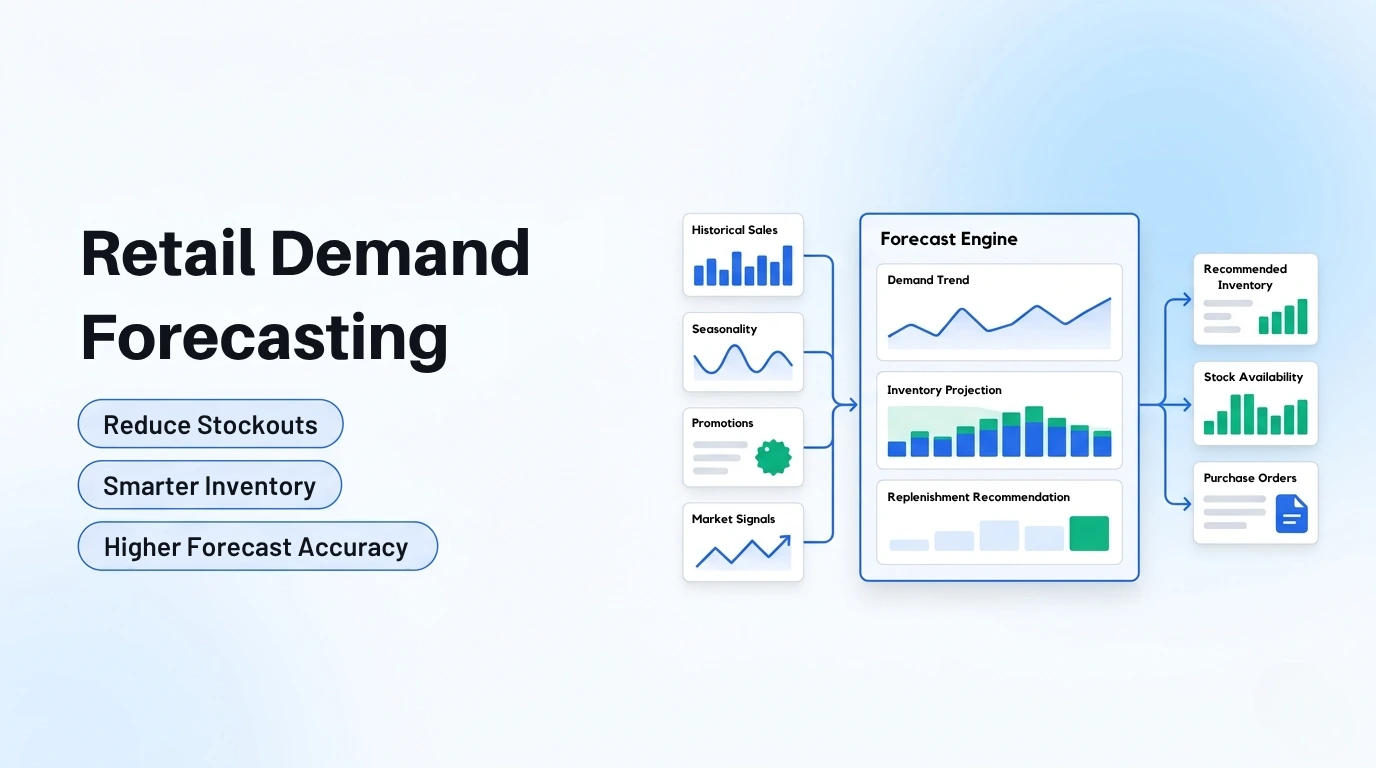
You overorder one week and end up sitting on dead stock. You place an order for the next one and miss out on sales to a competitor who has it in stock. Sound familiar? Retail demand forecasting is at the core of this constant juggling act for most retail and marketplace businesses, and the cost of failure is high.
Industry studies estimate that global retailers lose more than $1.75 trillion per year due to overstocking, out-of-stock products, and misaligned supply chains, with misaligned demand forecasts being the root cause of most of these losses. The issue is not only data; models, tools, and processes are also not in place to turn data into confident decisions.
Today’s retail demand forecasting has come a long way. AI-powered engines, granular historical data, and intelligent demand planning software now help retailers better understand customer demand. Whether you’re a small retailer or a multi-channel marketplace, these tools can predict how much demand there will be and when it is likely to occur. The outcome is lower stock, higher stock levels, reduced holding costs, and satisfied customers.
Whether you’re using basic models, advanced software, or best practices, this guide covers all the essentials of demand forecasting for retail and how to implement them effectively so your business doesn’t fall short of its goals.
What is Retail demand forecasting?
Retail demand forecasting involves predicting customer demand for products over a given time period using historical sales data, market signals, and analytical models. It is the foundation for stock forecasting, buying, pricing, and work scheduling.
Just like a weather forecast, demand forecasting isn’t 100% accurate. However, it helps ensure the right amount of inventory is available in the right place at the right time. This prevents capital from being tied up in excess stock that doesn’t sell and reduces the risk of customers facing out-of-stock situations when they want to make a purchase.
There are multiple aspects of demand forecasting in retail: First is SKU-level forecasting, then store-level aggregation, then channel-specific demand, and finally, there’s promotional lift estimation. They all contribute to a unified demand planning process that connects supply chain, procurement, and retail inventory management functions.
Why It Matters know the Key Benefits of Retail Demand Forecasting?
Retail demand forecasting helps businesses predict customer demand and make informed decisions. It improves inventory planning, reduces costs, prevents stockouts, and supports better overall business performance. The table below highlights the key benefits of retail demand forecasting and how it contributes to operational efficiency and business growth.
| Percentage | Impact |
|---|---|
| 30% Reduction | Inventory carrying costs with accurate forecasting |
| 15–25% Improvement | Order fill rate using demand planning software |
| 50% Fewer | Stockouts with AI-driven inventory demand forecasting |
| 20%+ Uplift | Revenue from better promotion and markdown planning |
In addition to the figures, here are some of the reasons behind investing in strong demand forecasting for retailers:
- Optimized inventory levels: Don’t overstock slow-moving items and understock fast-moving items.
- Improved cash flow: Capital is not locked in unsellable inventory.
- More effective supplier negotiations: Accurate forecasts enable firmer purchase orders and volume commitments.
- Smarter promotions: Know exactly what your sales/campaign will increase by and have enough stock.
- Higher customer satisfaction: Consistently being in stock fosters loyalty and avoids lost sales.
What are the Various Retail Demand Forecasting Methods?
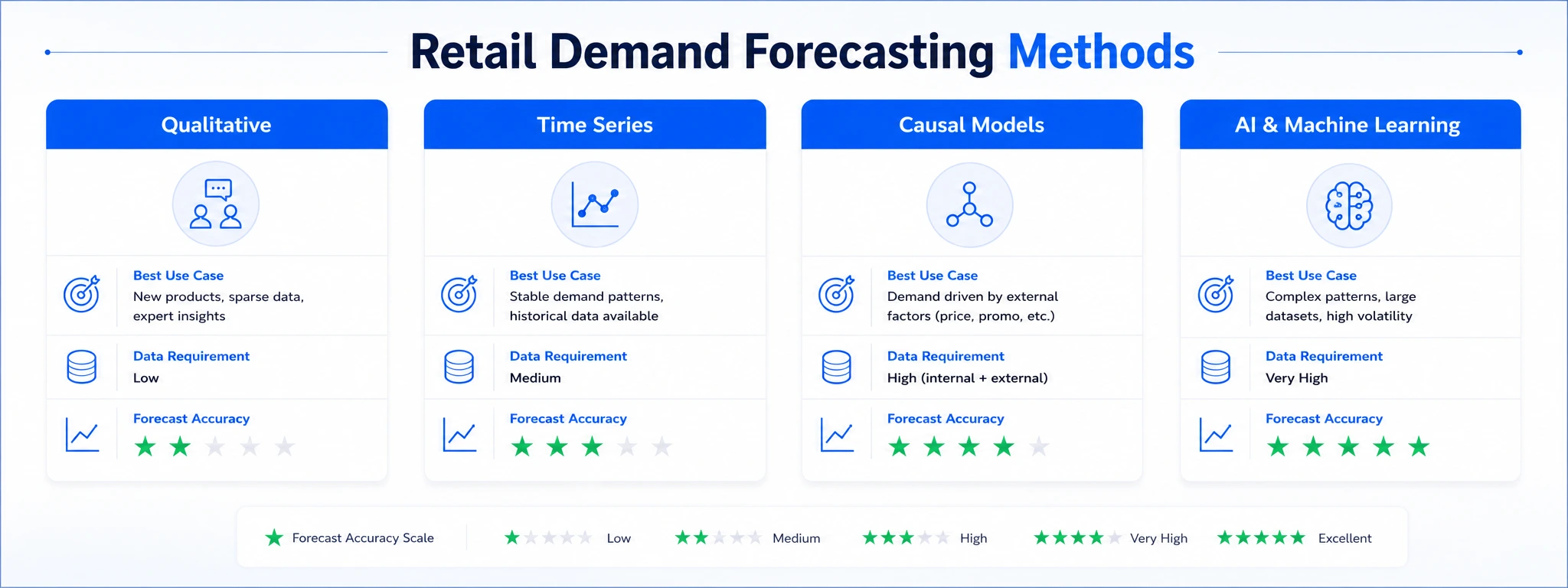
The best retail demand forecasting techniques vary based on the maturity of your data, the complexity of your products, and the scale of your business. Below you can find a structured overview:
1. Qualitative Methods
Qualitative techniques will be used when historical data is not available, or when a new product is being developed, and are based on expert opinion, market research, and consumer surveys. They’re most useful when launching new products or entering new markets.
2. Time-Series Methods
These statistical methods involve analyzing the characteristics of historical sales data (trend, seasonality, and cyclicality) to predict future sales. Common time-series techniques are:
- Moving Average: This is a simple smoothing over a window of past periods.
- Exponential Smoothing (ETS): Assigns more importance to the latest data and is more responsive to fluctuations.
- ARIMA (Auto-Regressive Integrated Moving Average): Describes and models both trend and autocorrelation for stationary time series.
- Seasonal Decomposition: Decomposition of the data into trend, seasonality, and residual components for granular analysis.
3. Causal / Econometric Methods
Causal models include external factors as well as sales history. These include regression-based models and distributed lag models, which are excellent tools for comprehending the underlying dynamics of demand fluctuation, rather than merely the fact of it.
4. Machine Learning & AI Methods
Today, retail businesses are turning to ML models that can automatically identify complex non-linear patterns from hundreds of variables and more. Leading approaches include:
- Gradient Boosting (XGBoost, LightGBM): Excellent performance on tabular retail data.
- LSTM Neural Networks: Model long-term, sequential patterns of demand.
- Prophet (Meta): It has out-of-the-box capabilities to handle missing data and holiday effects.
- Ensemble Models: Use several models to reduce forecast errors (RMSE/MAPE).
| Method | Best For | Data Requirement | Accuracy Level |
|---|---|---|---|
| Moving Average | Stable, low-volatility SKUs | Low | Moderate |
| Exponential Smoothing | Short-term forecasting | Low–Medium | Good |
| ARIMA | Seasonal patterns | Medium | Good |
| Regression / Causal | Promotions, pricing impact | Medium–High | Very Good |
| Machine Learning / Artificial Intelligence (LSTM, XGBoost) | Multi-variable, large catalogs | High | Excellent |
What are the Benefits of AI in Retail Demand Forecasting?
AI can do more than just speed up the calculation process in retail demand forecasting. In short, AI is revolutionizing the way retailers sense and respond to demand signals in real time and at scale.
- Automated pattern recognition: AI can detect patterns that human analysts may miss, such as niche demand surges or halo effects across product categories.
- Real-time data ingestion: Models are continually updated as new sales, traffic, and social signals are received, allowing for dynamic replenishment triggers.
- Promotional lift modeling: AI calculates the impact of promotions, discounts, and marketing strategies on sales to avoid overselling and missed sales during sales events.
- Anomaly detection: When there are sudden jumps or drops in the demand, it is flagged and isolated; it will not affect the baseline forecasts.
- Granularity at scale: A traditional planner can handle 500 SKUs. An AI model can predict hundreds of thousands of SKU locations at once.
Retailers can see a dramatic improvement in forecast accuracy by using AI-based ecommerce solutions, with mean absolute percentage error (MAPE) often 30-50% lower than spreadsheet-based solutions. Read more about the impact of AI on the broader pricing and merchandising landscape in our AI-driven pricing optimization guide.
Retail Demand Forecasting Dataset: What You Need?
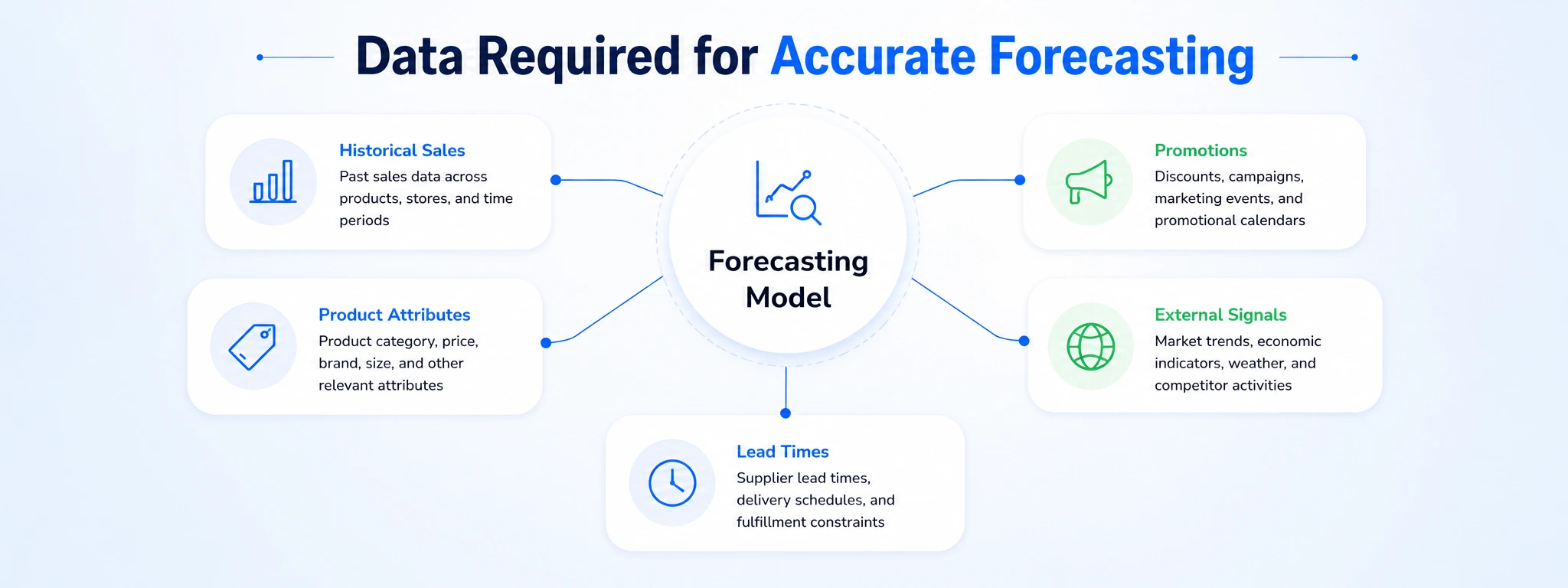
The key to any good model is a top-notch retail demand forecasting dataset. Bad data equals bad forecasts. This is the essential data that should be gathered in all retail forecasting programs:
1. Historical Sales Data
SKU-level, store/channel-level, and date-level transactional data, with up to 2-3 years of history, to help identify seasonality and cyclical trends. It is the primary data source for any forecasting model of inventory demand.
2. Product Attributes
Category, sub-category, brand, price tier, weight, dimensions, and product lifecycle stage. Clean, centralized product information is ensured by a well-structured product information management (PIM) system.
3. Promotional & Event Calendar
Past and planned promotions, markdowns, flash sales, holidays, and major events that impact purchasing behavior are crucial for causal modeling.
4. External Signals
Fine-grain weather data, economic indicators, competitors prices, social media sentiment, and search trend data (Google Trends, etc.) as input to causal and ML models.
5. Supply Chain & Lead Time Data
Supplier lead times, order minimums, and warehouse management system (WMS) data, to match demand forecasts with realistic supply replenishment windows.
Top Retail Demand Forecasting Software
Retail demand forecasting software comes in many forms, ranging from enterprise solutions to lean SaaS solutions. Here are some of the top categories and solutions:
| Software / Platform | Type | Key Strength | Best For |
|---|---|---|---|
| Blue Yonder (JDA) | Enterprise | AI technology for end-to-end supply chain | Large enterprise retailers |
| RELEX Solutions | Enterprise / Mid-market | Planning, fresh food, and promotions are unified | Grocery, fashion, hardlines |
| SAP IBP | Enterprise ERP-integrated | Enhanced integration with the SAP ecosystem | SAP-centric organizations |
| Anaplan | Connected planning | Cross-functional collaborative planning | Multi-BU retail groups |
| Inventory Planner | SMB SaaS | Easy setup, native to Shopify/WooCommerce | eCommerce SMBs |
| SpxCommerce Platform | Marketplace-native | Customer demand signals combined with seller and order integration using AI | Multi-seller marketplace operators |
Don’t consider demand planning software from the perspective of a feature checklist. Real-world accuracy will be determined more by how deeply it integrates with your existing order management system, seller management system, and PIM layer.
What are the Best Practices to follow for Demand Forecasting in Retail?
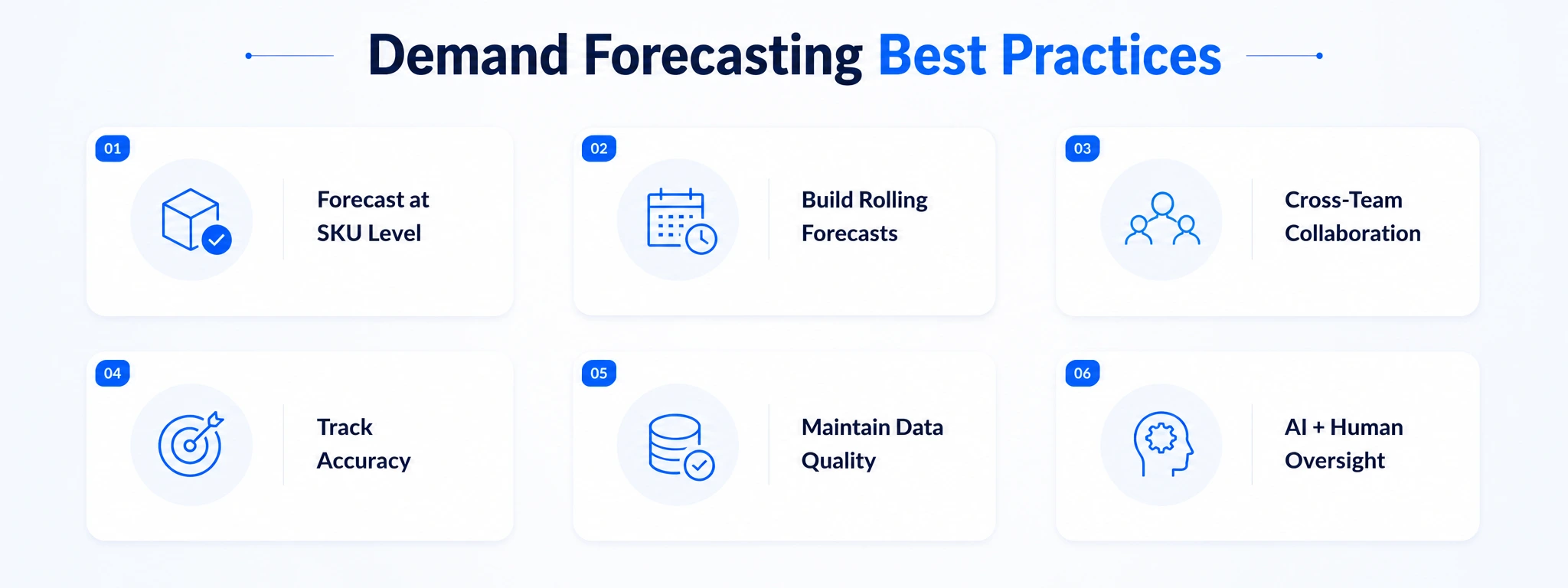
The optimal algorithm is useless without good operational practices. Let’s take a look at the most effective practices in demand forecasting in retail:
1. Forecast at the Right Granularity
Where feasible, predict at the SKU-store-week level. Poor local-level forecasting due to aggregation can lead to misallocation of effort and resources across channels.
2. Build Rolling Forecasts
Consider rolling 13-week or 26-week forecasts rather than one-year forecasts, so they can be continually adjusted as new information arrives.
3. Collaborate Across Teams
Demand signals are carried by sales, marketing, and supply chain teams, all of which are not modeled. There are demand signals carried by the sales, marketing, and supply chain teams, but models do not pick them up. Structured Sales & Operations Planning (S&OP) processes are the approach to institutionalizing this collaboration.
4. Track Forecast Accuracy KPIs
Track and evaluate MAPE (Mean Absolute Percentage Error), bias, and Forecast Value Added (FVA) to continuously push the model and question the underlying assumptions.
5. Maintain Data Quality Pipelines
Automate outlier detection, handle stockout periods appropriately (true vs. constrained demand), and mark promotional periods in the training data.
6. Combine AI with Human Judgment
Take advantage of AI capabilities for high-volume and systematic forecasting. Use human overrides for strategic products, new products, and macro disruptions that AI models have not encountered.
For marketplace operators, your product management system and seller catalog data are the most important inputs to demand models, particularly for new or seasonal SKUs, which may have limited historical data. Integrating seller-level lead times and fulfillment performance into your forecasting model can greatly enhance replenishment accuracy.
How to Choose the Right Retail Demand Forecasting Solution?
There are many tools available in the market, and here is a useful assessment guide to find the right retail demand forecasting software for your business:
1. Check the Maturity of your Data First
The turnaround time for advanced ML models is 18-24 months of clean transactional data. For a “fresh” start, the statistical models (ETS or ARIMA) will perform better than “under-trained” deep learning models.
2. Draw a Picture of your Integration Environment
Is there a native integration between the forecasting tool and your OMS, WMS, and PIM? Killing forecast frequency and accuracy is a manual data export to spreadsheets.
3. Assess Scalability on a Catalog Size Basis
The solution that works well for 10,000 SKUs won’t work well for 500,000 SKUs. Test vendors with your entire catalog during the evaluation process.
4. Check for Promotions & Event Handling
Many tools predict base sales pretty well, but have a poor ability to predict how many sales would occur if you increased the promotion.
5. Expect Clarity in Models
The dangers of black-box AI for retail planning. Explainability is necessary to understand why a model recommends a 200% stock build for a mid-tier SKU just before peak season.
6. Total cost of ownership (TCO)
Don’t just cover the license fees, as it covers implementation, training, integration, and continued maintenance. The typical TCO benefits of cloud-native SaaS platforms are lower than those of on-premises enterprise suites.
Why SpxCommerce is the best option for Retail Demand Forecasting?
A marketplace development platform specifically designed for operators who require intelligence at every touchpoint and stage of marketplace operation, from seller registration to demand-driven replenishment. Our platform natively connects demand signals to your order management system, seller management system, and product information management layer, so forecasting insights are reflected in procurement actions without the need to export manually or use disconnected tools.
With our AI-based ecommerce solution, you’ll gain real-time demand visibility across sellers, categories, and channels, making every marketplace data a competitive forecasting asset. From hundreds to hundreds of thousands of SKUs, SpxCommerce offers the architecture, integrations, and intelligence to forecast with confidence and to run profitably.
Conclusion
Today, retail demand forecasting is a vital function and a must-have capability to optimize inventory, minimize operations costs, and deliver customer expectations. By combining historical data, forecasting models, and AI tools, retailers can make better decisions, reduce stockouts and overstocking, and boost profits.
From a growing eCommerce brand to a multi-store retailer to a marketplace operator, you can reach a better equilibrium between inventory and actual orders and improve planning in procurement, supply chain, and sales operations by implementing effective demand forecasting. The important component is bringing technology together with good data practices and ongoing performance monitoring.
In an era of rapidly changing retail markets and shifting consumer preferences, companies that embrace cutting-edge demand forecasting tools will be better positioned to adapt, scale efficiently, and secure a sustainable competitive edge.