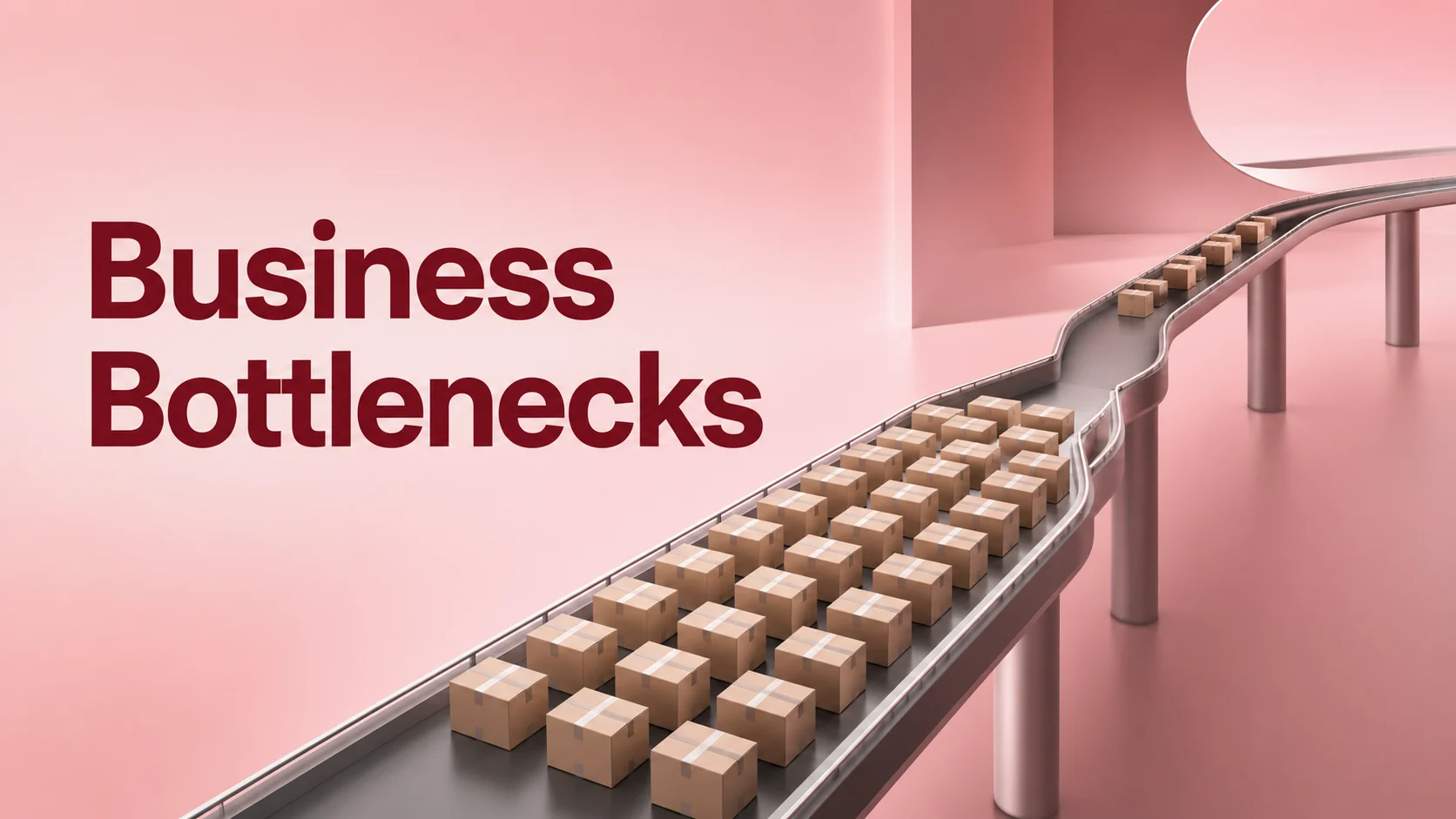
Orders have started piling up. Deliveries are running behind schedule. One department finishes its work early and then waits, doing nothing, because the next team hasn’t caught up yet. This whole scenario is a bottleneck that disrupts operational efficiency and slows overall performance.
A bottleneck in business is any point in the operational process where the flow of work slows down because that stage cannot keep pace with the stages around it. There are various consequences, such as rising costs, late deliveries, degradation in customer experience, and underused capacity in the chain.
With real-time operational visibility, organizations can identify constraints early, resolve them faster, and maintain consistent business performance. Plus, they can stop the rest of the business from paying for the cost of one team’s delay. Organizations that eliminate bottlenecks systematically improve operational efficiency, accelerate fulfillment, and increase customer satisfaction. The results include shorter order cycles, tighter inventory accuracy, lower fulfillment costs, and a customer base that receives what it ordered on schedule.
This guide explains the meaning of business bottlenecks, their types, common causes, real-world examples, proven identification techniques, and practical strategies to eliminate them.
What Is a Bottleneck in Business?
A bottleneck is a stage in a workflow, production line, or supply chain that limits the overall speed and output of the entire system. Every process operates at the speed of its slowest step, making bottlenecks a direct constraint on productivity, scalability, and profitability.
The bottleneck meaning in business can occur across multiple operational functions, including
- Customer service queues
- Hiring processes
- Software release cycles
- Project timelines
- And eCommerce order processing
Bottleneck vs. Constraint vs. Capacity Issue
Although these terms are often used interchangeably, they represent different operational concepts. That is why the distinction matters when you’re trying to fix the right problem.
| Term | What It Means | Example |
|---|---|---|
| Bottleneck | A specific point in a process that limits throughput because it’s slower than the surrounding steps. | A single quality checkpoint that every product must pass through. |
| Constraint | A broader term (used in the Theory of Constraints) for anything limiting a system’s performance, not always a physical step. | A policy, a budget cap, or a market limitation. |
| Capacity Issue | A lack of overall resources, which may or may not create a single identifiable bottleneck. | Not enough warehouse space during peak season. |
Why Bottlenecks Matter?
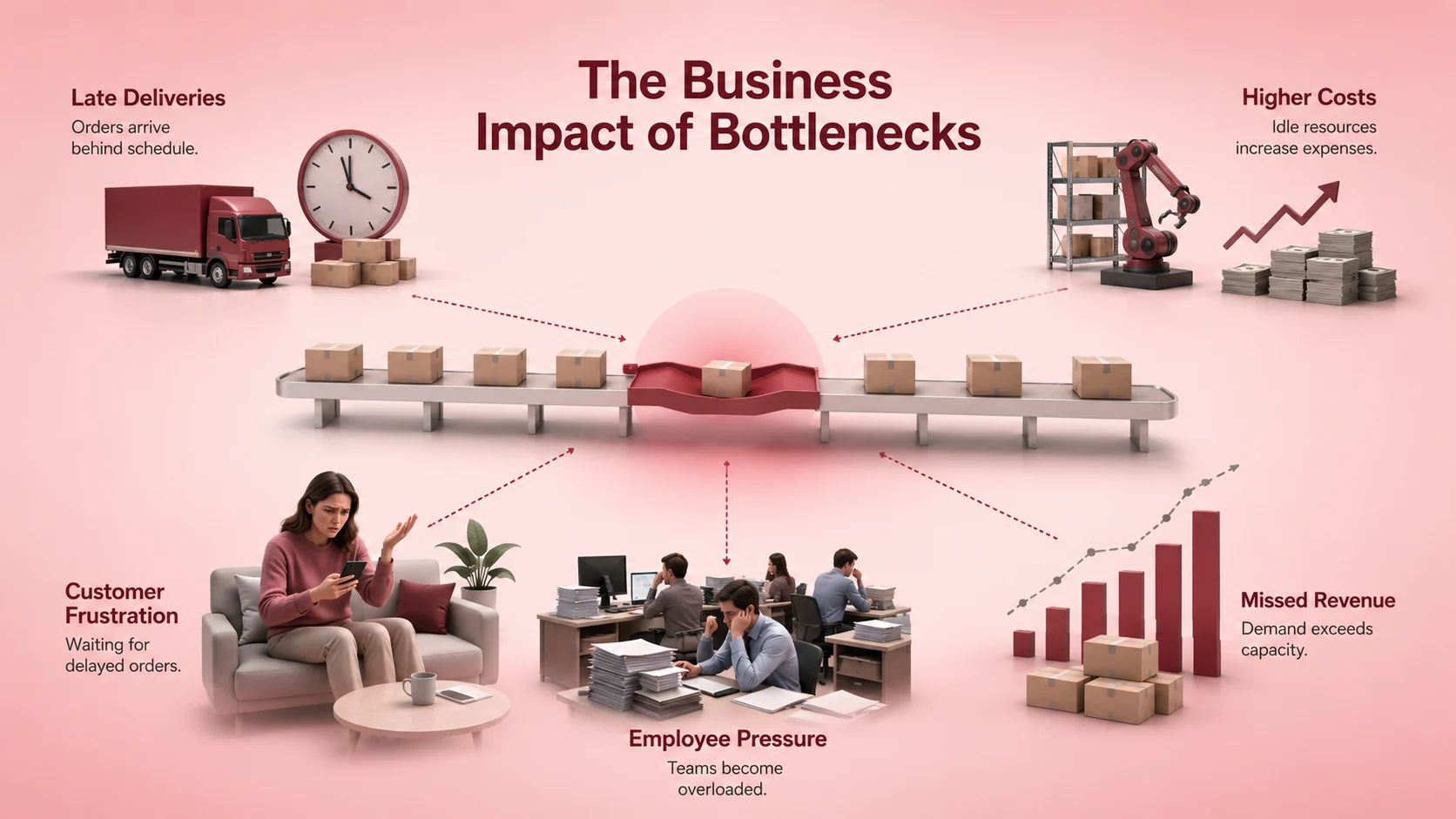
Leaving a bottleneck unsolved does not make it disappear. It simply raises the cost of ignoring it. If it remains unresolved, a bottleneck in business tends to produce:
- Delayed delivery timelines: It negatively impact customer trust and repeat purchases over time.
- Higher operating costs: Since unused labor and excess inventory continue to cost money even when nothing is moving.
- Missed revenue opportunities: It is particularly during periods of high demand that the business cannot scale output to meet customer demand.
- Employee Pressure: Teams often work overtime to compensate for delays created elsewhere in the workflow, reducing productivity and increasing operational costs.
- Misidentified problems: Leadership often focuses on the visible symptoms, such as a busy team, rather than the deeper, system-level causes.
Signs You Have a Bottleneck
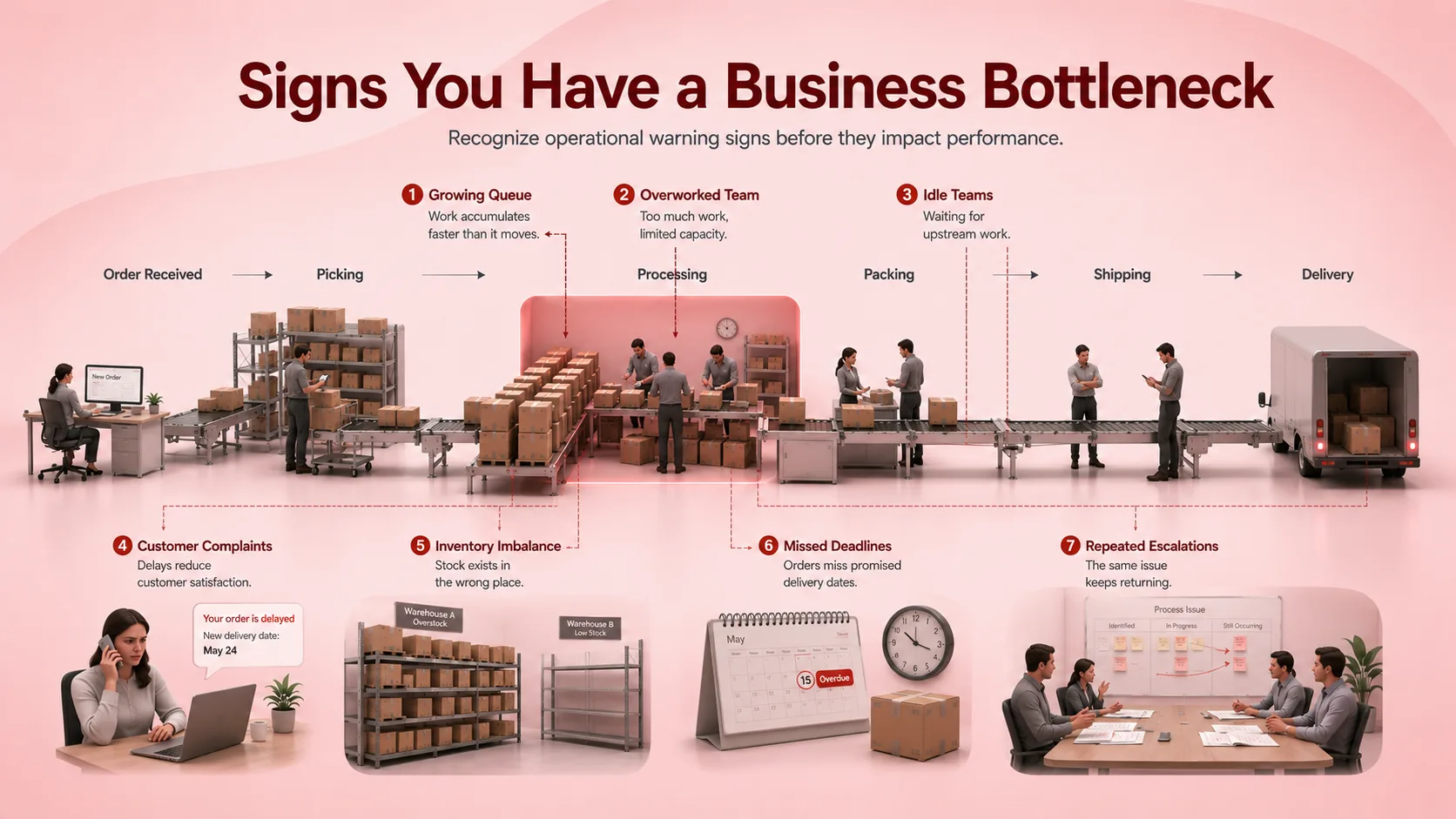
A bottleneck in business shows up as a pattern of small frustrations that, taken together, point to one underlying cause. Watch for:
- The workload is piling up at a specific stage, while the steps after it remain idle.
- One of the team is consistently working overtime while the others complete their tasks on schedule.
- Recurring customer complaints about the same part of the process, like late shipping, slow approvals, and delayed responses.
- Growing delays or backlogs that don’t reduce even after adding more staff elsewhere.
- Inventory remains unsold while another item runs out of stock, pointing to a forecasting or allocation bottleneck.
- Missed schedules are traced again to the same delivery point every time.
- Managers focus on the same problem multiple times instead of solving it once.
If two or more of these patterns show up regularly, there’s a strong chance a single stage in the process is the actual problem.
Key Components That Create a Bottleneck
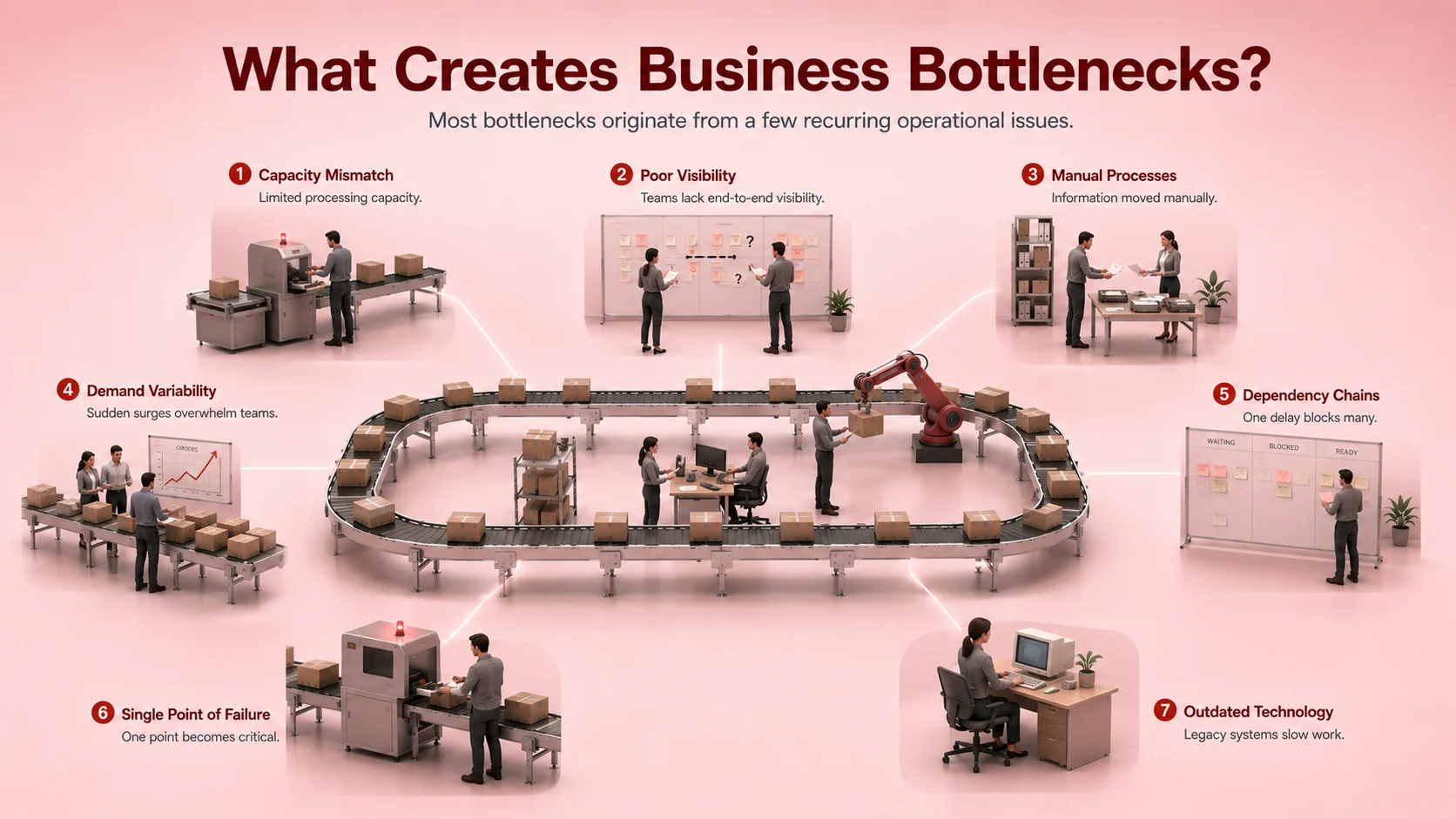
Before dealing with a bottleneck in business, it helps to figure out what actually causes it. Most barriers form around a combination of these factors:
1. Capacity Mismatch
One stage of a process simply has less capacity, like fewer people, machines, or processing power, rather than the number of stages it has.
2. Poor Visibility
Teams can’t see what’s happening at the top or downstream, so issues remain hidden until they’ve already caused interruptions.
3. Manual, Disconnected Processes
When data must be re-entered across spreadsheets, emails, and disconnected systems, every handoff introduces a possible delay. This is precisely the gap that AI-powered business automation is designed to address. It removes all repetitive manual steps and allows information to move between systems without manual interruption.
4. Demand Variability
Sudden increases in demand can overwhelm processes designed for average workloads rather than peak capacity.
5. Dependency Chains
Some tasks simply can’t start until a previous one finishes, and if that earlier task stops, everything that depends on it stalls too.
6. Single Points of Failure
A process that depends on a single person, machine, or approver has no safety net if that single point is unavailable or overloaded.
7. Outdated Technology
Legacy systems that can’t scale, integrate, or automate force teams to compensate manually, which slows everything down.
Main Types of Bottlenecks
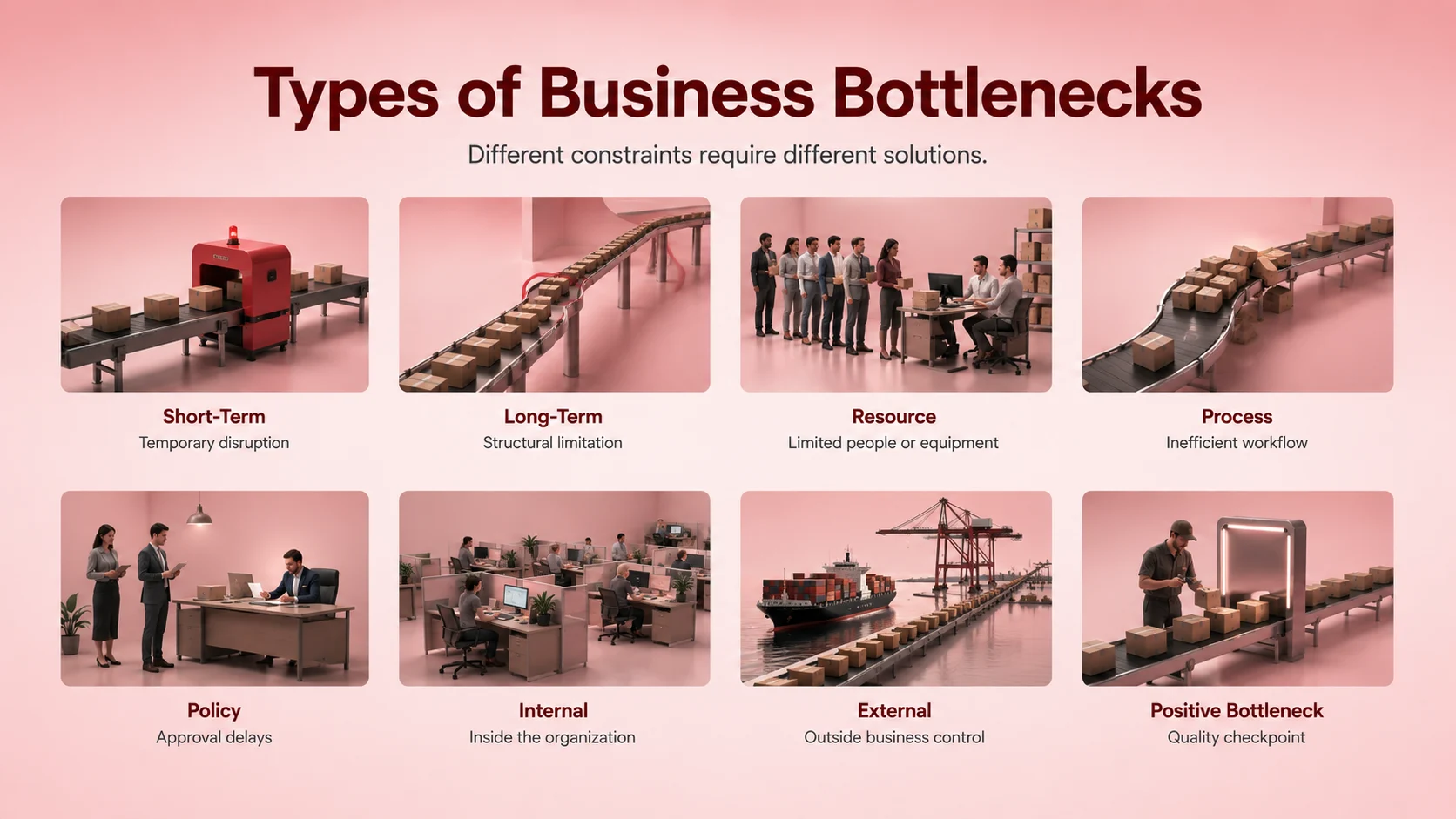
Not all constraints act the same way. Broadly, a bottleneck in business is classified into a few recognizable categories.
| Type | Description | Common Trigger |
|---|---|---|
| Short-Term Bottleneck | A temporary slowdown caused by an unusual spike in demand or a single-time interruption. | Seasonal sales, a single machine failure. |
| Long-Term Bottleneck | A structural limitation baked into the process itself. | Outdated equipment, understaffed teams, and legacy software. |
| Resource Bottleneck | Limited people, equipment, or budget restricts throughput. | Hiring freezes and outdated machinery. |
| Process Bottleneck | The workflow design itself is inefficient, regardless of resources. | Redundant approval steps and manual data entry. |
| Policy Bottleneck | Internal rules or approval requirements slow work down unnecessarily. | Rigid sign-off chains, outdated compliance checks. |
| Internal Bottleneck | It can be caused by something within the organization’s direct control. | Understaffed teams, different departments. |
| External Bottleneck | This can be caused by factors outside the organization. | Supplier delays, regulatory changes, and shipping carrier disruptions. |
There’s also a useful distinction between a negative bottleneck, which genuinely limits growth and needs fixing. On the other hand, a positive bottleneck is a deliberately controlled checkpoint, such as a strict quality-control gate, that trades off some speed for consistency and lower defect rates.
Understanding which type you’re dealing with matters because the fix is different for each.
How to Analyze and Measure a Bottleneck?
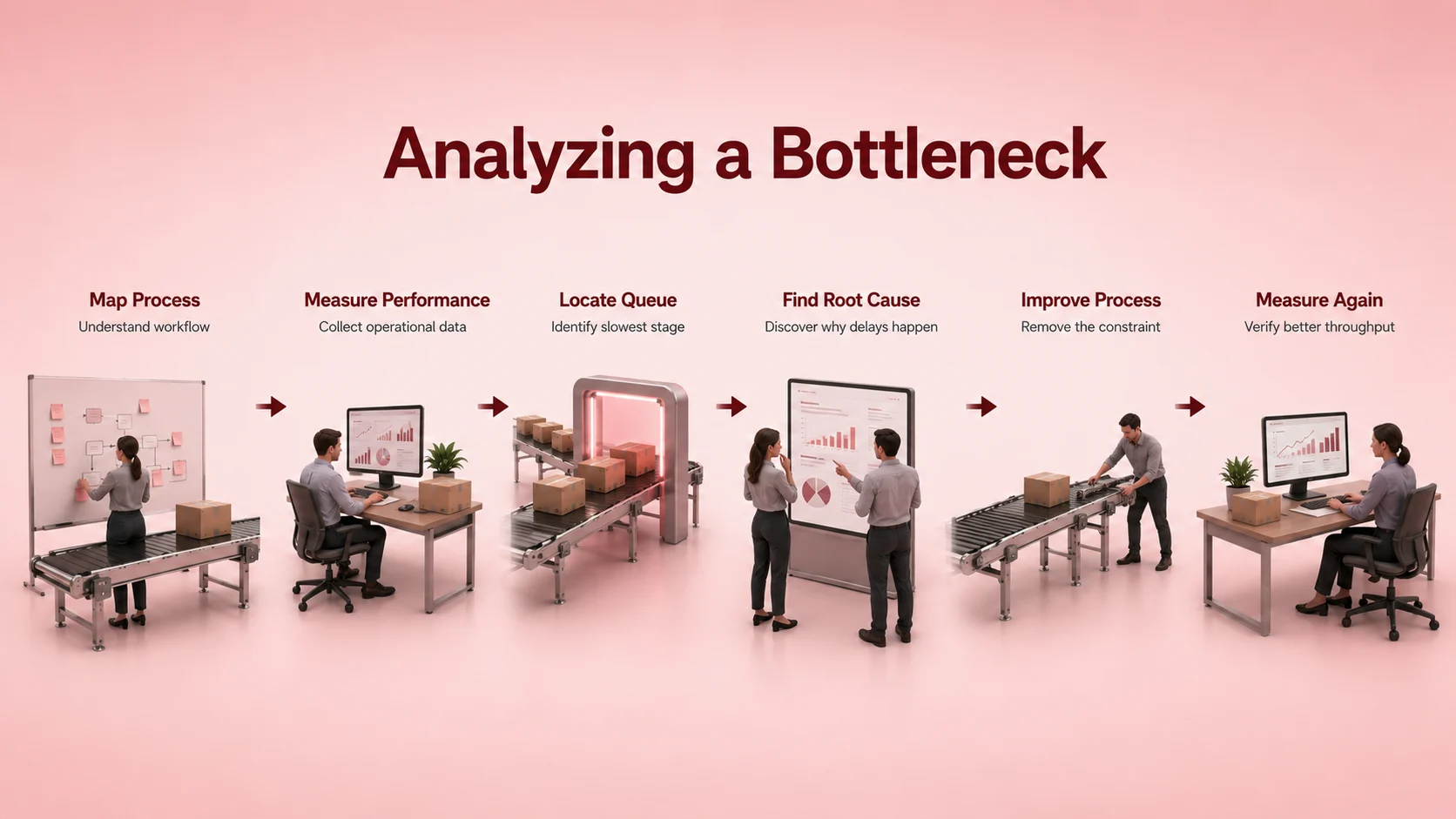
Spotting a bottleneck in operations management by instinct is a start, but measuring it properly makes the fix far more precise. A few established methods:
Value Stream Mapping
This visually sets out every step in a process, along with the time each step takes and the wait time between steps. The stage with the longest wait time or the largest queue in front of it is usually the bottleneck.
Little’s Law
A formula from queuing theory:
Average Time in System = Average Number in Queue ÷ Average Processing Rate
Applied to business processes, it helps quantify exactly how much a bottleneck slows the overall cycle time, rather than relying on guesswork.
Critical Path Method (CPM)
CPM is used heavily in project management. It identifies the longest sequence of dependent tasks in a project. Any delay on this path delays the entire project, making it the project-level equivalent of a bottleneck.
Throughput Analysis
Measuring the number of units processed per hour (or per day) at each stage reveals which stage has the lowest throughput. This stage sets the ceiling for the whole system.
Root Cause Analysis
Once a bottleneck is located, the symptom is traced back to its actual root cause, rather than stopping at the first explanation.
Combining a couple of these methods to identify the bottleneck with the 5 Whys to understand its cause tends to yield a far more reliable fix than addressing whichever stage looks the busiest.
Bottleneck Examples Across Industries
Here are practical examples across different business functions and industries:
Manufacturing
A single machine on the production line runs slower than the rest. Thus, finished goods accumulate behind it while later stations remain unused.
eCommerce Fulfillment
Orders arrive faster than a warehouse can pick, pack, and ship them, creating a backlog during peak sales periods. This particular barrier compounds quickly, since last-mile delivery alone now represents 53% of total shipping costs, according to 2026 Ringly data.
Retail Inventory
A store cannot restock quickly enough because demand forecasting is inaccurate, leading to stockouts even when inventory is available elsewhere in the network.
Customer Support
A support team receives more tickets than agents can resolve, so response times extend, and satisfaction scores decline. It is often because the root delay actually originated upstream in fulfillment or approvals.
B2B Order Processing
A distributor manually re-enters purchase orders from email into an ERP system, and that single manual step slows every order behind it. Top-performing organizations generate a purchase order in about five hours. On the other hand, the weakest performers take up to 48 hours, according to a 2026 APQC benchmark cited by ProcureKey. A properly connected order management system typically removes this exact point of failure by capturing order data once and routing it automatically.
Each example demonstrates the same underlying issue: one stage cannot process work as quickly as the stages feeding into it.
How to Identify and Fix a Bottleneck?
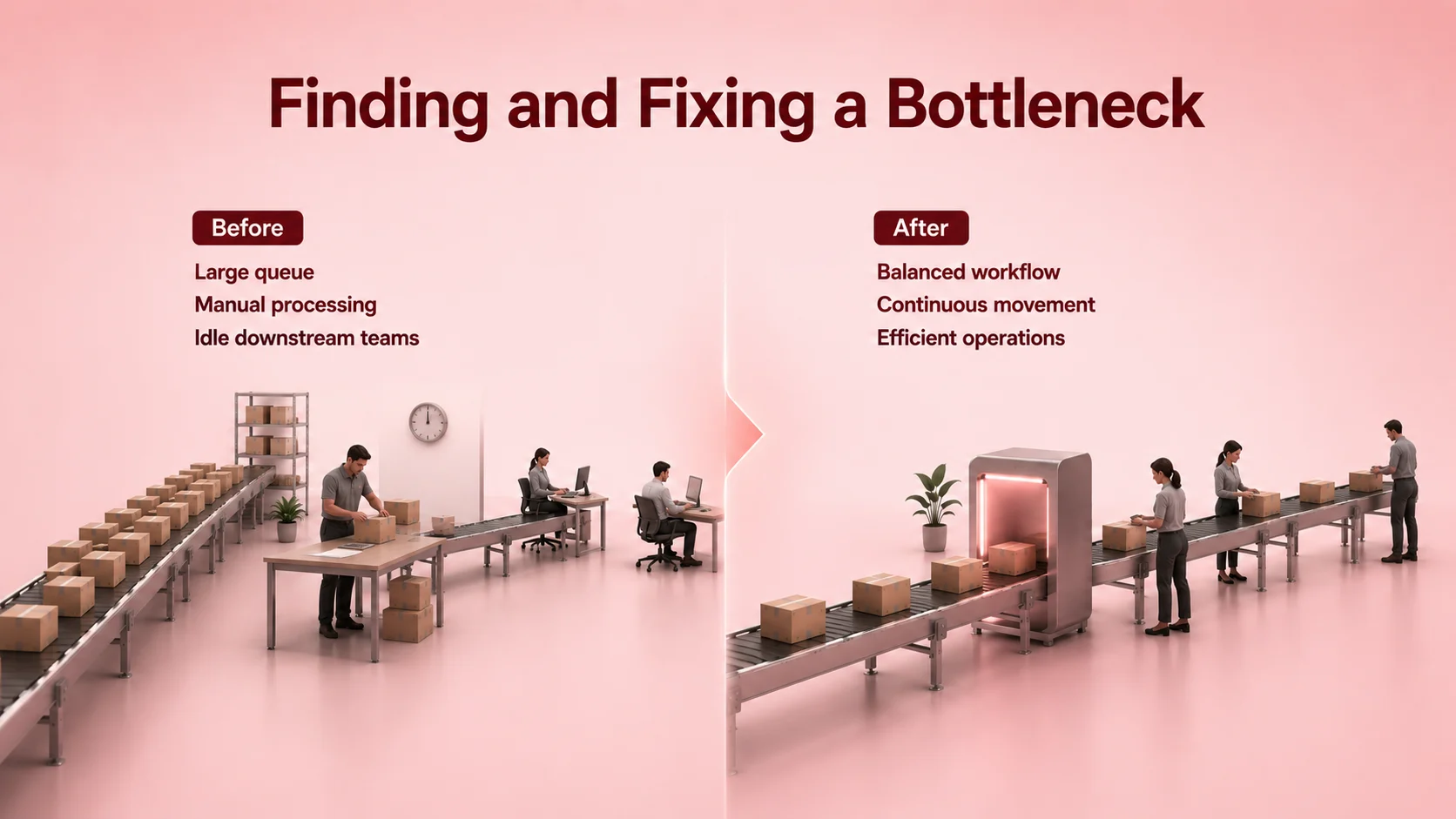
These are some ways to determine and resolve bottleneck operations.
- Map the full process end-to-end: Write out every step, including handoffs between departments or systems, before assuming you already know where the problem sits.
- Collect data at each stage: Measure cycle time, wait time, and volume processed at every step, rather than relying on impressions.
- Locate the queue: The stage with the largest backlog building up in front of it is almost always the bottleneck. Work piles up before it and thins out after it.
- Confirm the root cause: Use root cause analysis to check whether the issue is capacity, process design, technology, or policy, since the fix differs for each.
- Address the constraint directly: Add capacity, automate the manual step, redesign the workflow, or adjust the policy, whichever matches the actual cause identified in step four.
- Subordinate other steps to the fix: Make sure upstream stages don’t simply overproduce, creating a new backlog in front of the newly improved step.
- Re-measure: Once the fix is in place, re-check the data. If throughput improved but a new stage now has the longest queue, that stage is the next constraint to tackle.
This loop repeats indefinitely in a healthy operation. The goal is an ongoing discipline of identifying and elevating the constraint currently limiting the system.
Popular Tools & Technologies to Fix Bottlenecks
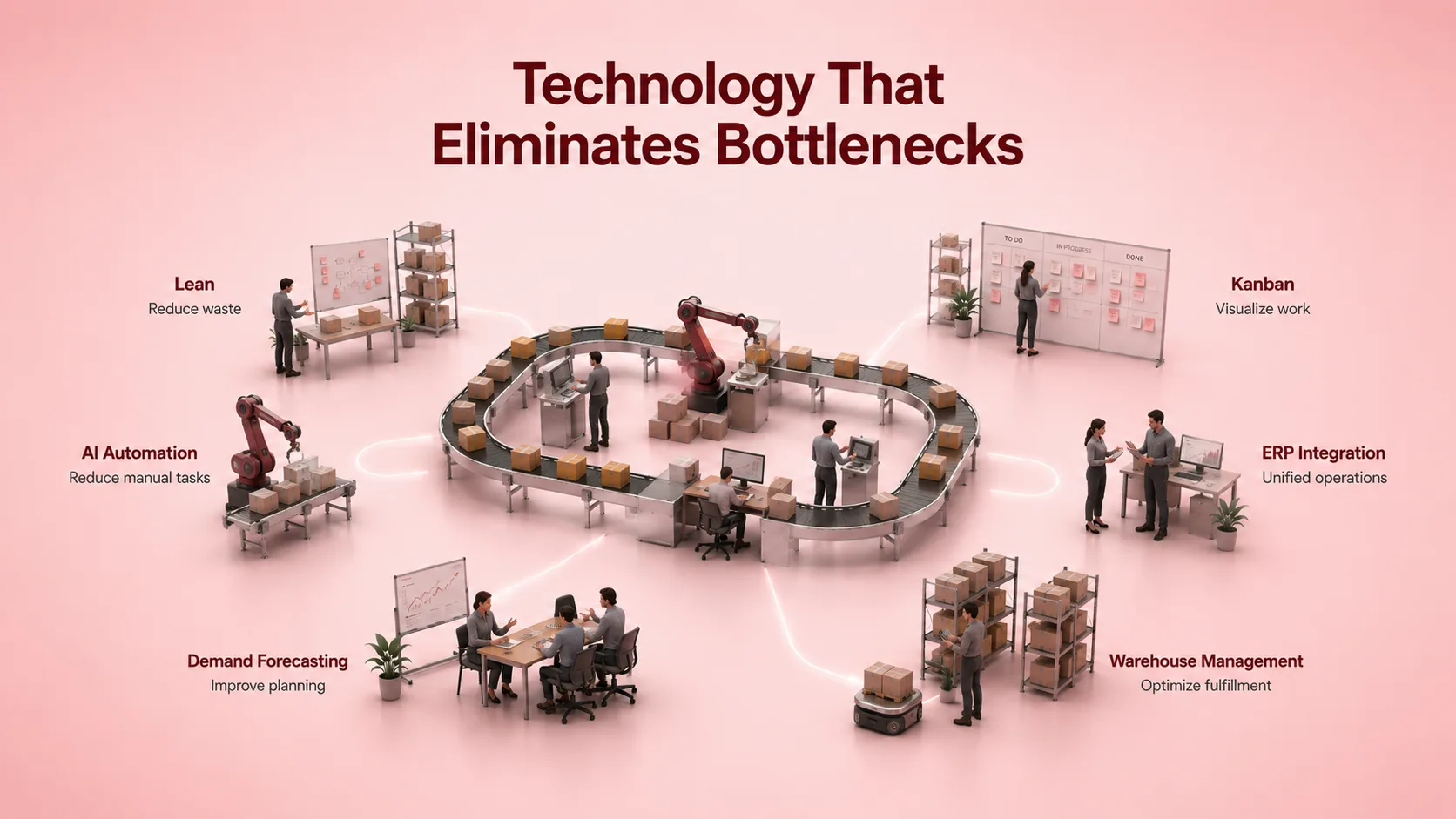
Modern businesses rarely solve bottlenecks with spreadsheets and guesswork anymore. Instead, they lean on connected systems and established methodologies that surface constraints before they cause real damage. Some of the most effective approaches include:
- Lean and Six Sigma frameworks for structured process improvement and waste reduction
- Kanban boards to visualize work in progress and identify where tasks are accumulating
- Retail demand forecasting tools that anticipate inventory needs before stockouts or overstocking become an issue
- AI-powered supply chain optimization that dynamically reallocates resources when one part of the chain becomes overloaded
- B2B eCommerce solutions that automate procurement and order workflows between businesses, eliminating manual approval delays
- ERP and warehouse management integrations that keep order, inventory, and fulfillment data synchronized in real time
Selecting the right combination depends entirely on where the specific constraint sits within an organization, whether that is production, fulfillment, forecasting, or customer-facing operations.
Best Practices to Prevent Bottlenecks
Preventing bottlenecks in business is far cheaper than fixing the damage they cause. A few practices consistently help:
- Map the entire workflow before assuming you know where the constraint sits. Bottlenecks are often not where they appear to be at first glance.
- Use real-time dashboards instead of end-of-month reports, since delays compound quickly and need immediate attention.
- Train multiple staff so capacity can shift temporarily to whichever stage is under the most pressure.
- Automate repetitive manual steps, particularly data entry and order routing, which are common hidden constraints.
- Review capacity regularly, especially before seasonal demand spikes, rather than reacting after backlogs form.
- Set clear ownership for each stage of the process, so accountability doesn’t get lost between departments.
- Build in buffers at critical communication points, so a small delay in one step doesn’t immediately cascade into every step after it.
- Revisit the process after every fix, since removing one constraint typically shifts the bottleneck somewhere else in the chain.
Most successful bottleneck prevention initiatives begin with real-time operational visibility and data-driven performance measurement.
Why Choose SPXCommerce?
Bottlenecks in eCommerce and omnichannel business operations frequently trace back to disconnected systems. A warehouse platform does not communicate with the storefront, a forecasting tool does not sync with inventory, or an order pipeline is still dependent on manual entry. SpxCommerce, a marketplace development platform, is built to close precisely these gaps.
Rather than treating automation, order management, and channel operations as separate initiatives, SpxCommerce brings them together within a single architecture. It gives operations teams the end-to-end visibility described earlier in this guide. Plus, it allows a constraint identified in one part of the business to be resolved without introducing a new one somewhere else.
For organizations evaluating a long-term partner rather than a point solution, SpxCommerce’s marketplace platform is designed to grow alongside the business. Also, it extends to new channels, buyer relationships, and demand patterns as they emerge.
Conclusion
A bottleneck in business is a natural byproduct of growth, complexity, and interdependent processes. What separates resilient businesses from struggling ones is how quickly they identify constraints and act on them. Map your workflow, measure it properly, automate the repetitive steps that slow things down, and revisit the process regularly. Fixing one bottleneck almost always reveals the next.
For businesses running marketplaces, retail operations, or B2B order pipelines, platforms like SpxCommerce make that ongoing work considerably easier. It connects systems that often operate in isolation, creating a unified operational workflow.
FAQs