
Freelancers are having a hard time finding good clients. Clients are not able to verify who they are hiring. Small businesses attempting to start a marketplace for services run into a roadblock: custom builds take 12-18 months to develop, off-the-shelf tools do not work with the workflow of intangible services, and scaling seller onboarding is a pain. There is a better way.
Today, buyers expect to discover, evaluate, hire, and pay service providers through a trusted digital marketplace. Ten years ago, you’d ask around. These days, you launch a service marketplace, check out verified providers, read a few reviews, pay securely, and book in minutes. But that isn’t a coincidence, and it’s because service marketplace platforms are built to solve a problem that had been almost insurmountable: how to make intangible work discoverable, transactable, and trustworthy at scale.
However, for every successful Upwork or Fiverr story, there are a hundred companies that underestimated the complexity. They built too tightly, selected platforms that were incapable of supporting service-specific flows, or failed to consider provider verification, dispute management, and flexible pricing models.
This guide demystifies what it means to be an online service marketplace, how it works behind the scenes, and the types of service marketplaces. Along with this, learn how to select and use a service marketplace platform to launch and grow without building one from scratch.
What Is an Online Service Marketplace?
An online service marketplace is a digital platform that connects service providers with buyers through discovery, communication, booking, and secure payment capabilities. A service marketplace is not the same as a product marketplace where you receive a product, but rather a marketplace for work, things that you can’t see or touch, like design, consulting, tutoring, home repair, legal advice, software development, and literally hundreds of other services that require skill.
Amazon is a place where you do purchase things. Upwork, Fiverr, Thumbtack, and Airbnb are service markets. Do not package or ship items with third-party skills or time value.
With the rise in demand for flexible talent acquisition and the remote-first culture, the freelance platform market is projected to reach $14.17 billion by 2029. Add home services, healthcare, education, legal, and B2B professional services, and a vibrant marketplace for online services emerges.
How Does a Service Marketplace Work?
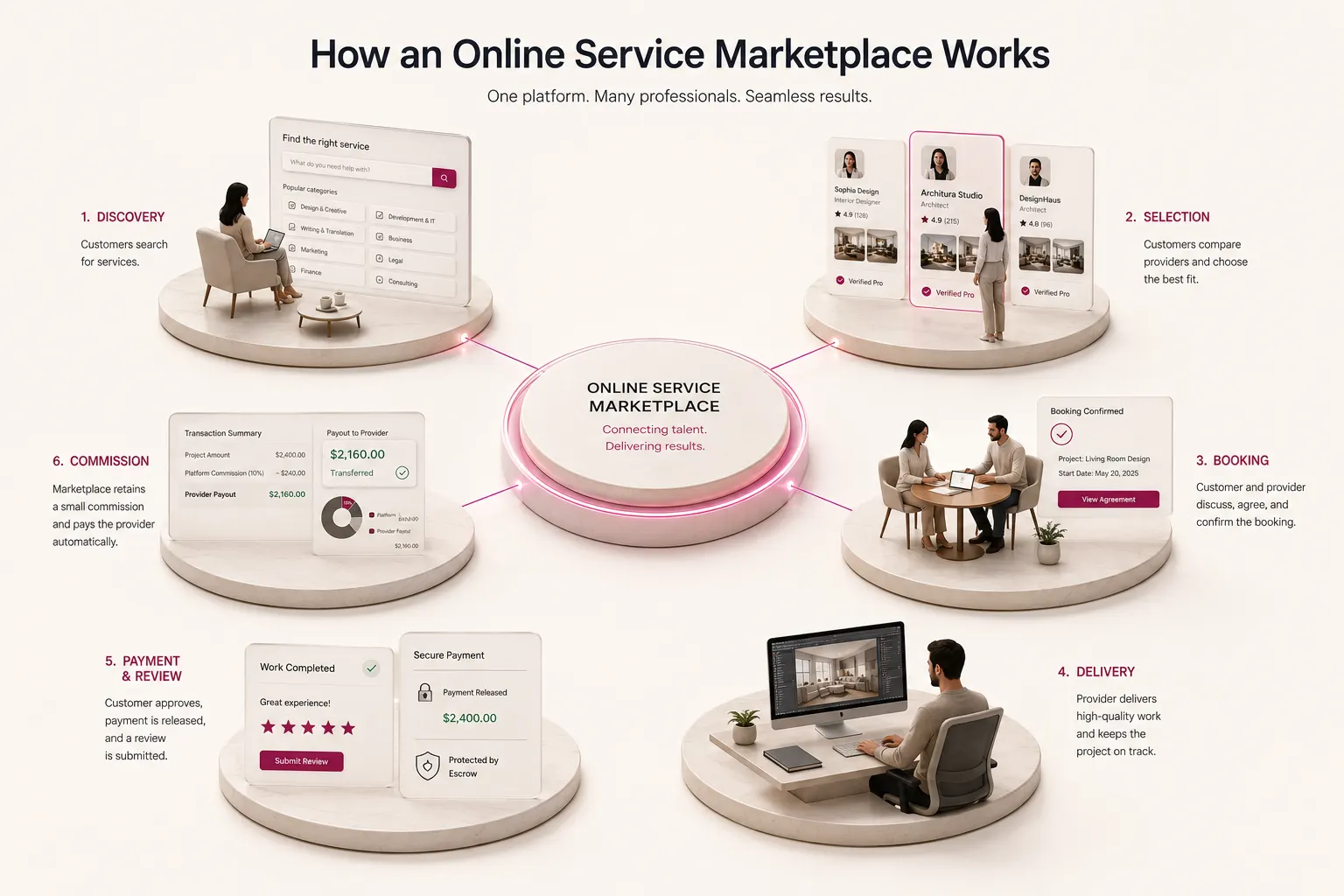
A service marketplace is based on the 3-party model. The platform owner dictates the terms and charges fees or commissions. Service providers sign up for their services and respond to buyers’ requests. They can browse and compare, communicate, and pay on the platform while they are shopping and buying.
Here’s how a typical transaction flows:
1. Discovery
A user enters a request into the search box, such as “service” (logo design, home cleaning in Austin, etc.). The platform offers the best ratings, price, availability, and relevance.
2. Selection
The buyer directly investigates the provider’s portfolio, references, certifications, and pricing, or requests a custom one.
3. Negotiation / Booking
The price is set and can be booked immediately, or there will be a negotiation period (typical of B2B or complicated professional services).
4. Delivery
Services are finalized by the service provider. Depending on the type of service, the marketplace can feature file-sharing tools, milestone tracking, a time log, or scheduling.
5. Payment & Review
After the buyer confirms service completion, the platform releases the payment held in escrow, where applicable. Both parties offer reviews that are used to build the trust layer of the platform.
6. Commission
Before depositing money with the provider, the platform retains its cut, which is typically 5-20%.
On the surface, this flow seems like it’s a very easy one. In practice, it requires an all-encompassing seller management system, safe transaction handling, an arbitration mechanism, and higher volume of AI-powered matching to guarantee that the proper buyer is matched with the proper provider.
What Are the Key Components of a Service Marketplace Platform?
It’s not a directory or a booking widget. It needs to be reliable at scale and have several interdependent layers that meet the three basic parties required.
| Audience | Feature | Description |
|---|---|---|
| Platform Operators | Admin Dashboard | Instant access to transactions, disputes, provider performance, platform revenue, and actionable BI reports. |
| User Management | Handle multiple tier/service providers and buyers onboarding, verification, suspension, and segmentation. | |
| Commission & Settlement | Automate payout reconciliation using percentage, flat-fee, subscription, or hybrid commission rates. | |
| Dispute Resolution | Clear processes for dealing fairly and effectively with service quality complaints, refunds, and policy breaches. | |
| Service Providers | Profile & Portfolio Management | Showcase certifications, work samples, service packages, and dynamic availability calendars on provider profiles. |
| Order Management | Service providers can manage incoming requests, active projects, and completed work through a centralized dashboard. | |
| Flexible Pricing Models | Hourly rates, fixed rates, retainers, milestone billing, and custom quotes are supported. | |
| Scheduling & Calendar | Built-in booking system, time zone support, buffer time settings, and automatic appointment reminders. | |
| Buyers | Search & Filter | Search providers by category and keywords, by price, by availability and ratings, and by skill-based filters. |
| Reviews & Ratings | Positive reviews posted after services, verified, to build provider credibility and foster trust and repeat business. | |
| In-Platform Messaging | Secure messaging between buyers and providers, ability to see who sent or received a message and to dispute if they don’t like the outcome. | |
| Secure Payments | Support for multiple payment gateways, regional currency, fraud protection, and optional escrow payment. |
All of this is made available natively with a multi-vendor marketplace platform, with configurable marketplace commission logic. A pre-installed marketplace seller management system, and a headless marketplace that can be customized to any service vertical.
What Types of Online Service Marketplaces Exist?
Service marketplaces vary based on their business model, audience, and operational requirements. There is a huge difference in the requirements for the business model, audience, and platform when the buyer or seller is different.
| Marketplace Type | Who Sells | Who Buys | Real Examples | Key Complexity |
|---|---|---|---|---|
| C2C (Consumer-to-Consumer) | Individuals | Individuals | TaskRabbit, Rover, Airbnb | Building trust through identity verification, local discovery, and reputation management (the “3 Ts” of trust). |
| C2B (Consumer-to-Business) | Freelancers / Individuals | Businesses | Upwork, Fiverr, Toptal | Talent vetting, contract management, milestone-based billing, and project collaboration. |
| B2C (Business-to-Consumer) | Professional businesses | Consumers | Thumbtack, Chewy Vet Connect | Provider licensing, appointment booking systems, and compliance with regulated service categories. |
| B2B (Business-to-Business) | Professional service firms | Other businesses | Xometry, Clutch, Toptal Enterprise | Custom quotations, enterprise contracts, negotiated pricing, and volume-based pricing models. |
| B2E (Business-to-Employee) | External service vendors | Company employees | Internal talent platforms, HR service hubs | Integration with internal workflows, Single Sign-On (SSO), approvals, and policy enforcement. |
Beyond these, by structure, marketplaces for service offerings can be verticals such as home services, freelance creative, legal and consulting, healthcare and wellness, education, IT and software development. Each service vertical requires specialized workflows, compliance measures, and marketplace capabilities. A marketplace for tutors will need a layer to schedule and integrate videos. A document-handling layer and a layer for licensing providers and verification are necessary for a marketplace for legal services.
SPXCommerce enables organizations to launch and manage service marketplaces across multiple industry verticals through configurable workflows. They provide a dedicated service marketplace solution, tailored specifically for platform providers of professional services, with workflow customization not possible in a generic service marketplace.
What Is Marketplace as a Service (MaaS)?
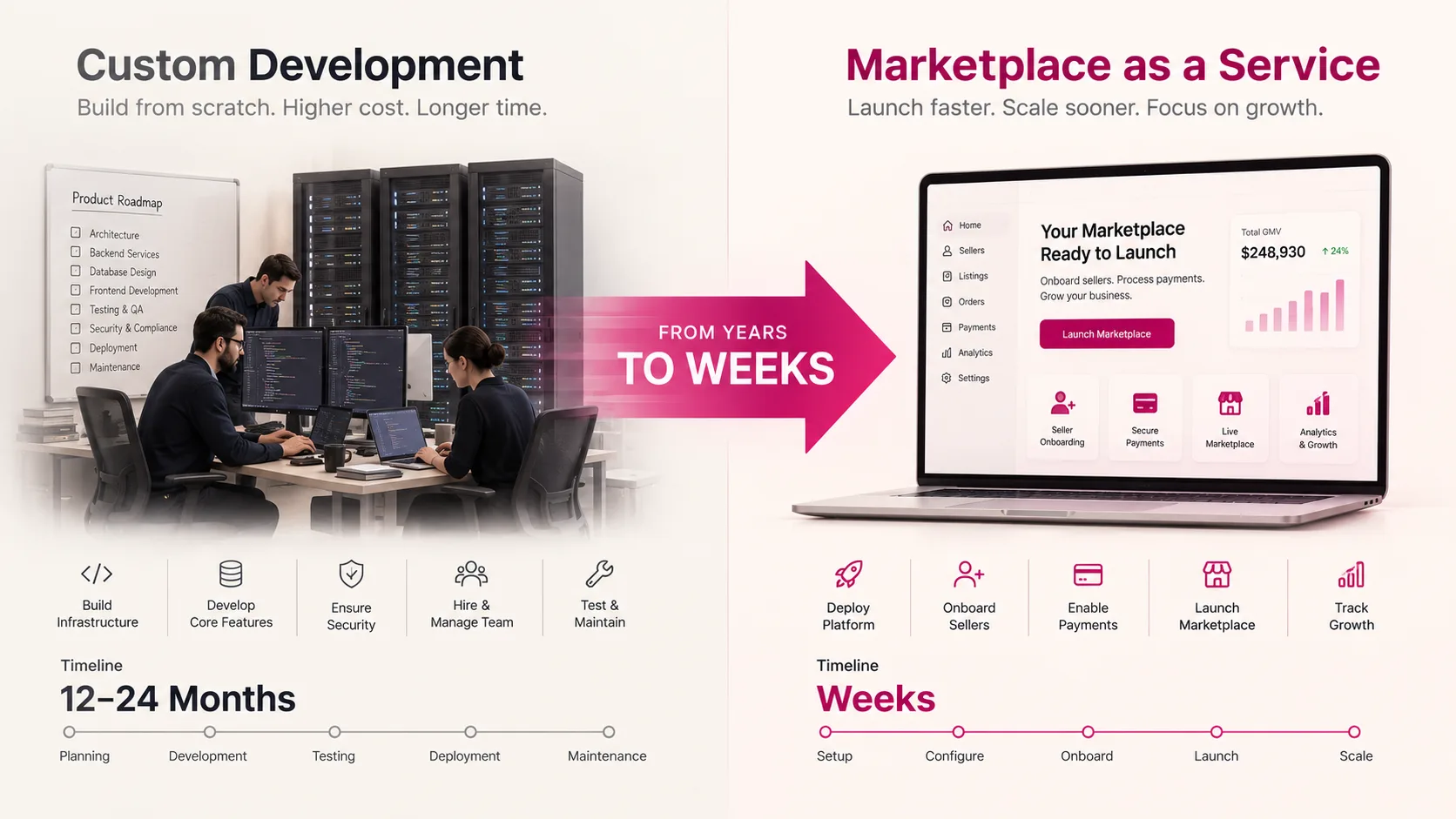
Marketplace as a Service (MaaS) is a software delivery model that allows a vendor to provide the complete platform for running a multi-seller marketplace business as a hosted, configured marketplace, ranging from seller onboarding to catalog management to transaction routing to commission settlement. You use it, you brand it, and your sellers and your buyers use it. You do not have any responsibility for the infrastructure level, but this is the responsibility of your MaaS provider.
Marketplace as a Service significantly reduces development complexity and accelerates deployment. In-house building of marketplace infrastructure typically takes 12 to 24 months and requires expert platform engineers. In weeks or months, MaaS brings such functionalities that do not require building. Organizations can focus on configuring marketplace workflows instead of building core infrastructure from scratch.
For most businesses that are launching a service marketplace, it makes sense to begin with MaaS, especially in the absence of a platform engineering team. Differentiation at a time when you have established the need and developed your sales organization, not when you first start out.
SpxCommerce works in just that area. From vendor onboarding to storefront performance to business intelligence reporting, their marketplace solutions deliver an end-to-end, fully configured and hosted marketplace foundation and AI technologies to operators.
What Are the Best Practices for Building a Service Marketplace?
Most of the service marketplace problems come from the same set of problems that can be avoided. Here’s some of what successful operators do from the get-go.
Niche before you scale
First, the best service marketplaces launch the market in a particular vertical: legal, home repair, creative freelancing, and so on, before they grow. Any wide catalog with thin margins doesn’t work for a mix of supply and demand fit.
Invest in trust infrastructure early
Provider verification, reviews, escrow payments, and dispute resolution should be implemented before scaling the marketplace. These are the ones that make customers come back and keep providers happy. These are what make customers return, and providers remain. Build these before growth, not after.
Design for both sides of the marketplace
Complex seller onboarding discourages provider participation and reduces marketplace supply. Demand is killed by a confusing buyer search. The design needs to be equally dedicated to both those experiences.
Choose a platform that adapts
Your pricing model, services offered, and matching will change. If the platform you use has a rigid structure and is unable to adjust to change, it will be a problem.
Use AI for matching and quality signals
Numerous websites, such as Xometry, already feature AI-driven RFQ systems with real-time pricing. AI improves marketplace operations through intelligent matching, personalized recommendations, and anomaly detection.
Plan for regulation from day one
Healthcare, legal, financial, and licensed trade require verified credentials from providers. Dedicate time and money to integrate credential storage and verification into the platform design—it will be expensive to add it to the system afterward.
How Do You Choose the Right Online Services Marketplace Platform?
There’s a big mistake that marketplace founders make, and that is to choose the platforms that they have at present. There has to be the right attitude. The Internet marketplace is ever-changing. The question is: will this platform be able to sustain itself as my needs change?
Evaluate candidates on these dimensions:
| Evaluation Criteria | What to Look For |
|---|---|
| Service-Specific Workflows | Does the platform offer service-oriented processes like scheduling, milestone-based billing, service requests, appointments, and project workflows beyond a traditional product checkout? |
| Seller Onboarding | Does it support provider registration, provider credential checks, provider approval processes, document management, and configurable tiers of providers/sellers? |
| Pricing Flexibility | Is it able to offer multiple pricing structures, such as hourly pricing, fixed fees, retainers, subscriptions, milestone payments, and custom quoting all in one place? |
| Commission Engine | Can service categories, provider tiers, transaction value, service types, and custom business rules be used to configure commissions? |
| Extensibility | How much effort is needed to create new service types, processes, business rules, and/or custom features? |
| Integration Layer | Does it provide APIs, webhooks, or pre-built connectors for seamless enterprise integrations? |
| Time-to-Launch | How many weeks/month(s) do you estimate it will take to implement? Faster deployment can give a huge competitive edge. |
| AI & Analytics | Does it have AI-powered features like intelligent service-provider matching and recommendations, demand forecasting, pricing optimization, and integrated business intelligence (BI) reporting? |
Think of the long-term total cost of ownership (TCO) beyond licensing fees, engineering hours to set up, maintenance costs, and options for transitioning to a more flexible platform when the organization is limited.
Why SpxCommerce for Your Service Marketplace?
SpxCommerce offers a marketplace development platform for businesses to build and expand digital marketplaces with less time required to develop a custom platform. It is tailored for service marketplaces and can support the distinct workflows of service-based marketplaces without adapting eCommerce solutions.
ProactiveAI, the AI automation feature, automates vendor onboarding with OCR, provides conversational analytics and demand forecasting, reduces manual work, and enhances operational productivity.
The platform also features powerful multi-vendor functionality like Seller onboarding, commission management, permission controls, and order routing. It also provides a full commerce stack of a React-based storefront, native mobile apps, order management, and product information management (PIM), all of which are tightly integrated.
SpxCommerce offers both a B2B and a B2C marketplace. With as little as 24 hours to deploy, businesses can reap enterprise-level security that has been certified to ISO 27001:2022.
Conclusion
The online service marketplace isn’t a platform where individuals post their skills, just a website. It is a trust-based infrastructure, a transaction engine, and a two-sided network that grows richer with the growing number of users. Everything from how the seller is introduced to the platform, how they are paid, how they align with the platform, and how they resolve disputes is what makes a platform that scales from one that stalls.
The type of platform you are constructing will determine your capabilities on a platform level, whether you are developing a brand new platform for a freelance site, a home service marketplace, a professional services B2B site, or a brand new concept. Select one that was created to serve workflows for services, not as an add-on.
SPXCommerce is purpose-built to support the unique operational requirements of modern service marketplaces. Know their marketplace solutions, or connect with the team to determine how quickly you can get to market.