You’ve seen the costs when the car is in the checkout line, the cart times out, the inventory system is slow, and the CMS can’t push updates quickly at the same time when a tightly coupled, monolithic architecture comes into play. Teams step all over one another. Deployments become planned activities. If one part is scaled, then all of them are scaled.
This is what was taken into consideration when designing MACH architecture. The design principle is to decompose your commerce platform into distinct parts you can replace, scale up, and deploy. It results in a system that adapts to change, not fights it.
60% or more of all new B2C and B2B digital commerce solutions that are deployed in the cloud will adopt the principles of the MACH architecture by 2027, according to Gartner. Well, it’s not a prediction of the migration, but it’s an ongoing process. If you’re a business that is marketplace-first, you know the MACH stack is now table stakes.
What Is MACH Architecture?
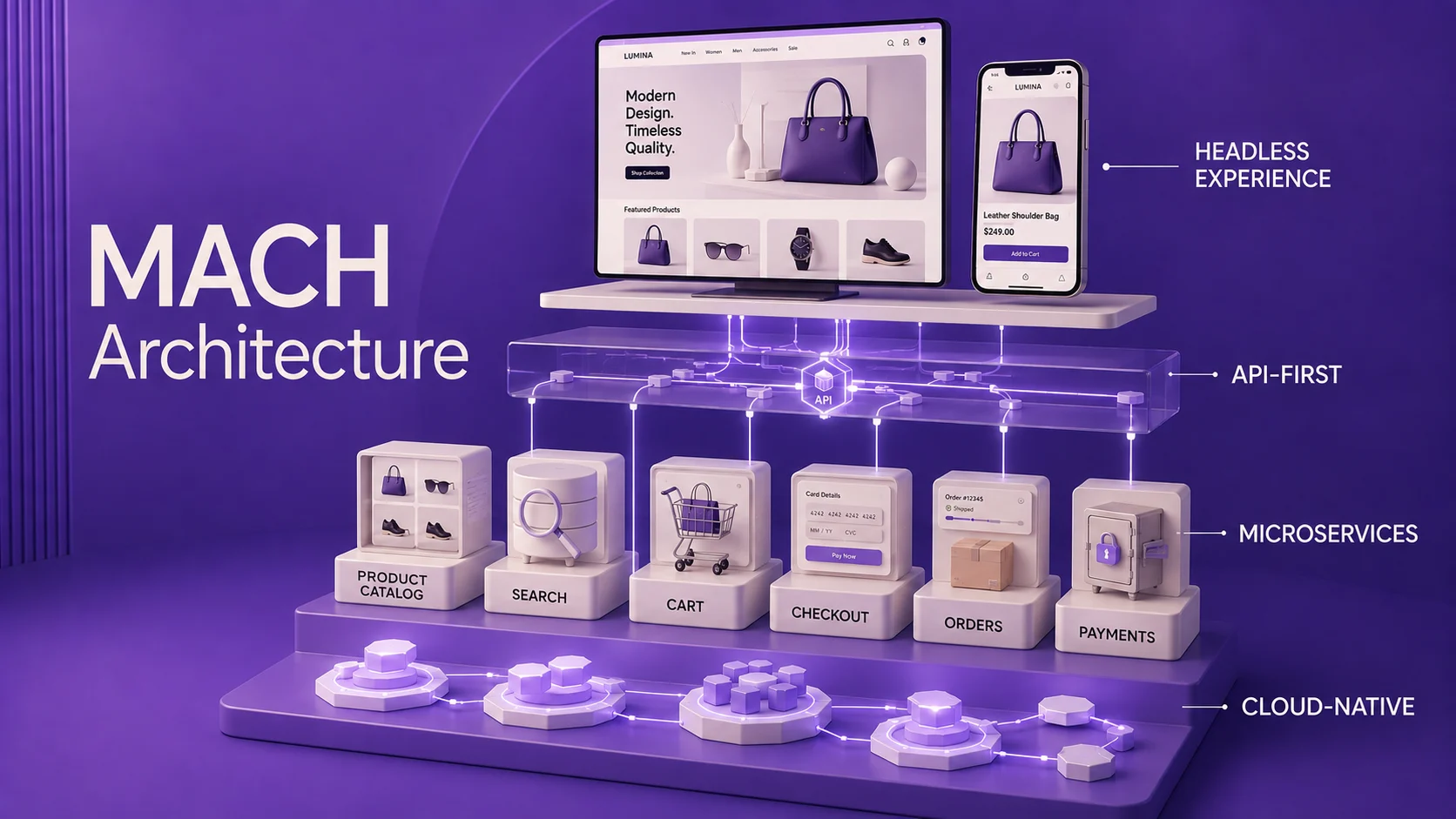
MACH architecture is a modern approach to building enterprise software systems. It is an acronym for four architectural principles that together support a composable technology stack that enables building, scaling, updating, and replacing components. The acronym represents four architectural principles: Microservices, API-first, Cloud-native, and Headless.
The term was coined by the MACH Alliance, which was formed in 2020 as a not-for-profit industry alliance to promote open and best-of-breed enterprise tech. More than 40 vendors are part of the MACH Alliance, including Contentful, Commercetools and Amplience, and are certified against the principles.
The easiest answer: LEGO sets vs actual bricks. One block is the monolithic platform. Each MACH system is separate, so replacement will not require dismantling the structure. For example, you can change the red piece with the blue piece, but don’t remove any other pieces.
|
87% In the last year (MACH Alliance 2024), the number of enterprises that used MACH in their infrastructure also grew. |
75%
The number of technology decision-makers who feel more urgency to innovate has increased to 94% at legacy-heavy orgs. |
49% In the enterprise market, 53% of front- and back-end infrastructure is now MACH-based. |
What Are the 4 MACH Architecture Principles?
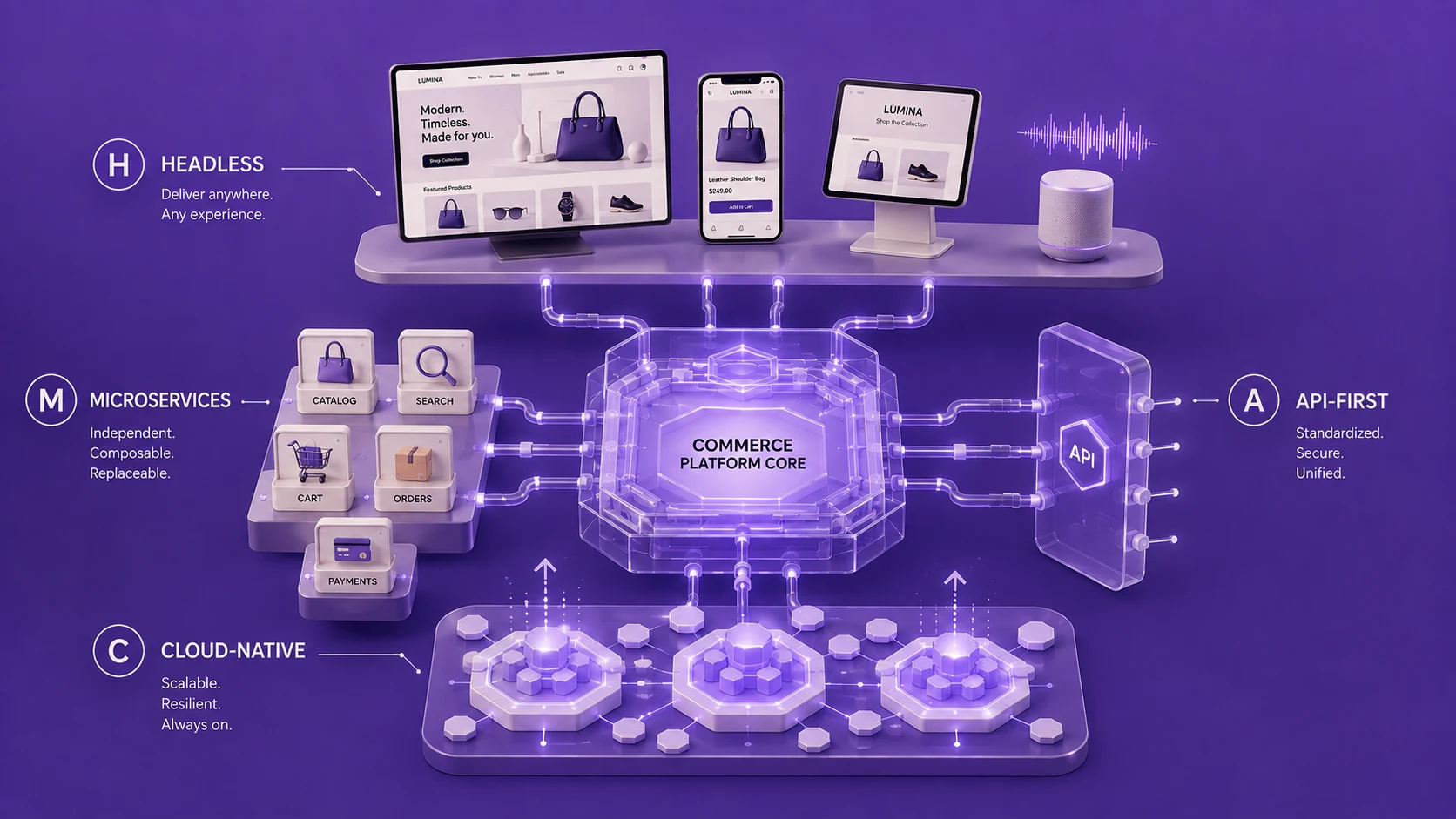
The letters in MACH represent four core architectural principles. They are symbiotic, and removing one reduces the composability of the architecture. Let’s consider what they imply in practice.
M – Microservices
Business functions are broken into services, each with its own database, codebase, and deployment cycle.
A – API-First
APIs provide standardized access to capabilities while reducing unnecessary point-to-point integrations and hidden dependencies.
C – Cloud-Native
Cloud-native systems are designed to run in cloud environments with scalable and automated infrastructure.
H – Headless
Separation of back-end and front-end logic through a decoupled architecture. A backend can support a website, App, kiosk, and voice interface.
Microservices: What Does Microservice-Based Actually Mean?
A microservices architecture is a collection of small, focused services rather than a single application. Every service offers a special business feature like Order Management, User Profiles, Product Catalog, Payment Processing, or Seller Onboarding. They can be deployed, scaled, and updated independently, reducing the potential impact on other services.
Your inventory service scales to handle the flow when a flash sale comes through. The checkout system, search engine, and the Content Management System (CMS) remain unchanged. This illustrates how MACH principles enable microservices to operate independently.
API-First: Why Does “API-First” Differ from “API-Enabled”?
Legacy platforms generally add APIs as an afterthought, serving as the point of contact for REST calls to the core, which was designed for a monolithic interface. The product is API first! The design of each function, data resource, and workflow is API-first, UI-second.
This enables services to integrate through standardized APIs and the creation of new channels, including mobile apps, PWAs, voice commerce, and headless storefronts, without revealing that a back-end rewrite has been performed.
Cloud-Native: Is There a Difference Between Cloud-Native and Cloud-Hosted?
There’s a huge gap. Cloud-hosted means running an application in a cloud environment, whether through migration, rehosting, or another deployment approach. Cloud-native is a design approach that leverages cloud capabilities such as containers, automation, auto-scaling, and resilient deployment patterns.
With MACH, most of the vendors provide SaaS, which includes infrastructure management, security patching, and performance monitoring. Your team can focus primarily on developing the product while the provider manages much of the underlying infrastructure.
Headless: How Does Headless CMS Architecture Work?
With a traditional CMS, the presentation layer is typically integrated closely with the content management system. You might experiment with the content organization, then that could affect the front end. With headless CMS architecture, content is stored in a back-end repository and retrieved by frontends through APIs such as REST or GraphQL.
Everything in your store is communicated between your React store, your native iOS app, and your voice assistant of choice. Changes in one do not “ripple down to the others”.
MACH vs. Monolithic Architecture: How Do They Compare?
These differences are not subtle, and they impact every facet of your team’s activities, how your system operates under stress, and how rapidly you can respond to market shifts.
| Dimension | Monolithic Architecture | MACH Architecture |
|---|---|---|
| Scalability | Scales the entire application together, even if only one service is experiencing high demand. | Scales individual services independently, enabling efficient resource utilization and cost optimization. |
| Deployments | Major version releases often require sweeping changes, downtime, and extensive regression testing. | Supports continuous, rolling updates across services with minimal or no downtime. |
| Technology Choice | Limited to the vendor’s technology stack and built-in capabilities. | Allows a best-of-breed approach, enabling organizations to choose and replace services as better technologies emerge. |
| Risk of Change | Changes in one component can have cascading effects across the entire system. | Changes are isolated to individual services, minimizing impact on the rest of the system. |
| Data Structure | Uses a centralized database shared by all application functions. | Each microservice maintains its own independent data store. |
| Team Velocity | Shared codebase creates dependencies and bottlenecks, causing teams to wait on one another. | Teams can independently build, test, and deploy services, accelerating development. |
| Multi-channel Delivery | Frontend is tightly coupled with the backend, making support for new channels costly and complex. | Headless architecture enables a single backend to power multiple channels and devices through APIs. |
What Does a Real MACH Stack Look Like?
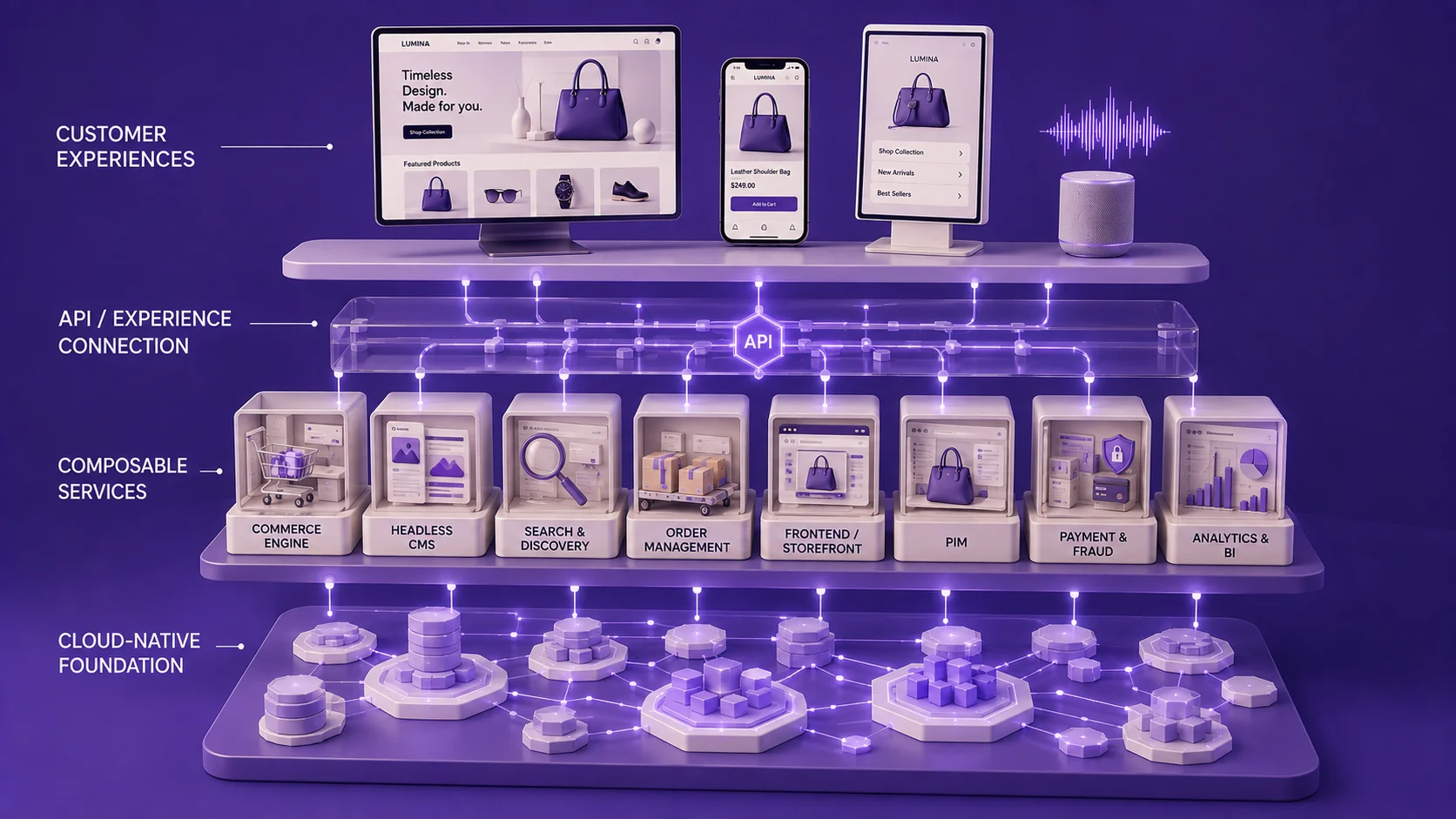
The MACH stack is not a single product, but it’s a collection of best-of-breed services with specific capabilities that communicate with each other via APIs. The typical commerce stack for a MACH application:
1. Commerce Engine
The library of processes is the content of catalog, pricing, promotions, and cart logic. It can be done in a number of different ways, such as with Commercetools, Elastic Path, or API-native and decoupled from any particular storefront, such as SpxCommerce’s headless eCommerce platform.
2. Headless CMS
Cross-channel content management & delivery. Typically, these are used: Contentful, Hygraph, or Contentstack. You can access the content via any frontend (CMS’ GraphQL or REST API).
3. Search & Discovery
Real-time product search, filtering, and personalized ranking, independent of the commerce engine, powered by Algolia, Elasticsearch, or any other search service.
4. Order Management System (OMS)
It brings order routing, order fulfillment, and order tracking to one place, regardless of where orders come from. Standalone service applications that run on top of the MACH stack are known as platforms, like the Order Management System (OMS) offered by SpxCommerce.
5. Frontend / Storefront
A storefront built with React or Next.js, which calls the APIs from the commerce engine, CMS, and search service. Fully detached interchange without affecting the back end.
6. PIM (Product Information Management)
Gathers product information, product attributes, and media. Structured product data is transmitted to any downstream service through the API as part of services, such as SpxCommerce’s PIM feed.
7. Payment & Fraud
Stripe or Adyen as separate services that can be replaced or plugged in, including when using a regional payment gateway.
8. Analytics & BI
A specific layer for business intelligence that is typically linked via event streams rather than direct database queries. Real-time data, without dependency on the operational layer.
What Are Real-World MACH Architecture Examples?
Many of the world’s biggest brands have switched to MACH architecture to be more scalable, faster to innovate, and achieve a seamless digital experience on a variety of channels. The following are real-world examples of how a composable, API-first approach can help businesses get to market faster in response to customer and market needs.
1. Sennheiser (MACH eCommerce in 11 Weeks)
The headless D2C brand Sennheiser launched its standalone website in 11 weeks with Hygraph, Algolia, and Shopify. This led to a 136% higher conversion rate and 200M monthly API calls across more than 25 markets.
2. Dr. Oetker (100 Stakeholders, 45 Brands, 40+ Countries)
At a basic level, the food giant is using a MACH stack with Hygraph as its content layer and Algolia as its search provider, allowing 100+ editors to handle experiences across 40 countries, all at once.
3. Nike (Independent Services at Scale)
Nike’s digital store sends updates to the microservices that manage inventory, personalization, checkout, and content, so that teams can release a new feature for one component without impacting the others.
4. Zalando (Modular Retail Infrastructure)
The European fashion company manages inventory, orders, and customer data for several markets by using microservices and delivers a localized user experience over a shared infrastructure backbone. The European fashion company manages inventory, orders, and customer data across multiple markets by using microservices and runs localized experiences on a shared infrastructure backbone.
How Does MACH Architecture Apply to Commerce & Marketplaces?
MACH commerce is specifically about using the principles of MACH in marketplaces and eCommerce. It’s where the approach brings the most benefit to the platforms in the marketplace, which are complex entities with several sellers, buyer paths, regions, and integration points with payment, shipping, and content systems.
All of this complexity in a traditional marketplace platform resides in a single codebase. A seller onboarding bug may impact the checkout. The product listing page could be broken by a CMS update. As much time as engineers spend on building features, they spend on managing dependencies.
A MACH approach makes those concerns easily separable. The seller management system is an independent service. The multi-vendor marketplace engine is another. Both are separated from the storefront. They can be modified, expanded, or replaced independently of each other.
For teams building marketplace platforms for B2B, B2C, or D2C the MACH framework enables:
- Independent scaling of sellers and buyers surfaces when traffic spikes.
- Importing new types of sellers or models without a rewrite.
- Storefronts from multiple brands on a single storefront, under an operating foundation.
- Logistics, payments, and analytics through standardized APIs with plug-in integration.
What Are the Key Business Benefits of the MACH Approach?
Beyond flexibility, MACH architecture can deliver tangible business value through faster performance, greater scalability, and improved efficiency. The composable design allows companies to be more innovative and adaptable to changing customer preferences without significant disruption.
1. Best-of-Breed Technology at Every Layer
A monolithic platform can limit flexibility when search, content management, payments, and analytics are tightly integrated into the same platform. MACH allows you to select the optimal service per function. A better searching software comes out, you replace it. Your platform changes with the market, not with the next big release from your monolith vendor.
2. Faster Time to Market
Independent services can be deployed in parallel, reducing shared deployment dependencies and limiting the scope of regression testing. Sennheiser went from a completely non-existent website to a live MACH-based eCommerce site in just 11 weeks, with 90% of hosting handled out of the box by the chosen vendors.
3. Lower Risk on Every Change
With a tightly coupled monolith, changes to the checkout flow can have broader effects across the system. A change in MACH means a change in the microservice that checks out the game. The catalog, the CMS, and the search layer none of them are aware of or care about the checkout update.
4. Elastic Scalability
Cloud-native MACH services grow on-demand per-service. When your order management service is under load, you are not charged for using an idle search service. Services can automatically scale with traffic when appropriate autoscaling policies are configured.
5. Future-Proof Composability
From personalization to demand forecasting to automating the seller onboarding process, the use of AI is seeping into every facet of commerce. The AI capabilities are then delivered as microservices or via API in a MACH architecture. You don’t create intelligence to be added to your platform, as you plug it in.
What Are the Challenges of Implementing MACH?
For many businesses, MACH can provide significant architectural benefits, but teams should evaluate its trade-offs before adoption.
1. Increased Integration Complexity
The more services, the more integration points. API contracts must be carefully designed, properly versioned, and monitored in production. The capital cost for organizations without API governance tooling is often underestimated. The answer is to build an API Gateway early on and use a limited set of integration patterns across all services.
2. Operational Overhead
A large number of microservices can increase the number of deployment pipelines, health checks, dependencies, and potential failure points. This comes with overhead costs, which may be lost if you aren’t using a container orchestration platform (Kubernetes is the current one).
In the early stages of a MACH implementation, it may be beneficial to use a managed MACH platform, such as SpxCommerce, that handles orchestration rather than building it from the ground up.
3. Requires Strong API Design Discipline
Well-designed APIs are the key to the flexibility MACH offers. Poorly designed APIs become a technical debt that permeates the stack. Adopt the API-first design and documentation from the start, not when the system is created.
4. Not the Right Fit for Every Team
For small teams that have basic commerce needs, the surface area of an entire MACH stack might be more than they need. The right place to begin is usually a managed platform, such as SpxCommerce’s composable eCommerce solutions that leverage MACH principles at the infrastructure level, which provides flexibility without the heavy burden of DevOps from the get-go.
Is MACH Architecture Right for Your Business?
Here’s a helpful rule of thumb: if you’re constantly pushing the limits of your current platform’s flexibility, or if you’re operating more than 2 channels (web, mobile, marketplace, kiosk, voice), it’s time to take a serious look at MACH.
In particular, MACH architecture is a good choice when:
- You need to scale your multi-vendor marketplace and require systems to scale on both the seller’s and the buyer’s side.
- Shared codebase deployments and cross-functional relationships continually block your development team.
- You must provide uniform commerce experiences on web, mobile, and third-party surfaces at the same time
- There are unpredictable peaks in traffic, such as promotions or seasonal changes, and/or geographically dispersed demand.
- You don’t want to rebuild your platform to include AI features (personalization, seller scoring, demand forecasting)
In some instances, a small team with one channel store and a basic catalog might be better suited to a managed SaaS solution. The complexity of MACH is a function of its value.
Why Choose SpxCommerce for MACH-Based Commerce?
SpxCommerce is a marketplace development platform built on MACH architecture principles, enabling scalable, flexible, and future-proof marketplace solutions. It simplifies composable commerce with a pre-integrated MACH stack and managed infrastructure.
Businesses can develop and launch multiple microservices and still expand without compromising the advantages of headless storefronts, API-first integrations, cloud-native deployments, and independent scaling.
It has a headless eCommerce solution built on React that enables enhancements to front-end experiences without affecting back-end capabilities. It offers multi-vendor marketplace capabilities to manage sellers, provide catalog services, and commission engines.
It also comes with a built-in Product Information Management (PIM) system, an analytics and demand forecasting tool named ProactiveAI, and omnichannel commerce support. These capabilities all enable a unified, omnichannel experience for companies, from a single API-first foundation.
Conclusion
MACH architecture is not just a modern technology perspective, and it’s a building block for agile, scalable, and future-proof commerce platforms. For businesses, a microservices-based approach, API-first development, cloud-native infrastructure, and headless experiences provide the flexibility to innovate without relying on legacy systems.
The implementation of MACH is not without its challenges, and careful planning, API governance, and implementation are key, but the benefits can be significant in the long term. Independent service, rapid deployment, and smooth scalability enable companies to meet evolving customer expectations and market demands in a timely manner.
In an era of rapidly transforming and evolving digital commerce, composable architectures will be a key enabler of growth, an omnichannel user experience, and AI-inspired innovation. Those businesses that adopt MACH now will be prepared for years to come to meet challenges, to compete, and to provide the customer experience they deserve.