Starting an online store doesn’t always mean buying inventory, renting storage, or handling fulfillment yourself. That’s where ghost commerce comes in.
Ghost commerce generally refers to online business models that generate revenue without requiring the business to maintain traditional inventory or fulfillment infrastructure. Depending on the model, a third-party supplier may manufacture, store, package, and ship products while the business owner focuses on branding, marketing, sales, and customer relationships.
But ghost commerce isn’t a single business model. It can refer to approaches such as dropshipping, print-on-demand, affiliate marketing, and certain white-label arrangements. Each has different costs, margins, risks, and levels of control.
In this guide, we’ll explain what ghost commerce means, how it works, how it compares with dropshipping and affiliate marketing, and whether it’s worth considering in 2026.
What is Ghost Commerce?
Ghost commerce refers to an online operation without a store or its own warehouse. You have a website, marketplace, or social media page where you sell products, and a third-party supplier holds, packs, and ships them.
For example, suppose you need to sell a water bottle online. You list the price on your website as $30, but you have no bottles at home. Your supplier sends the bottle directly to your customer when she orders it. If the customer pays $30 and the supplier charges $18, the $12 difference is gross profit before other costs, not necessarily “gross margin.
According to research, the U.S. dropshipping market size was $135,201.4M in 2025 and is set to expand at a compound annual growth rate of 18.9% through 2033.
Ghost commerce is not one vendor. It is a broader model that can include dropshipping, print-on-demand, affiliate marketing, and some white-label options.
How does Ghost commerce work?
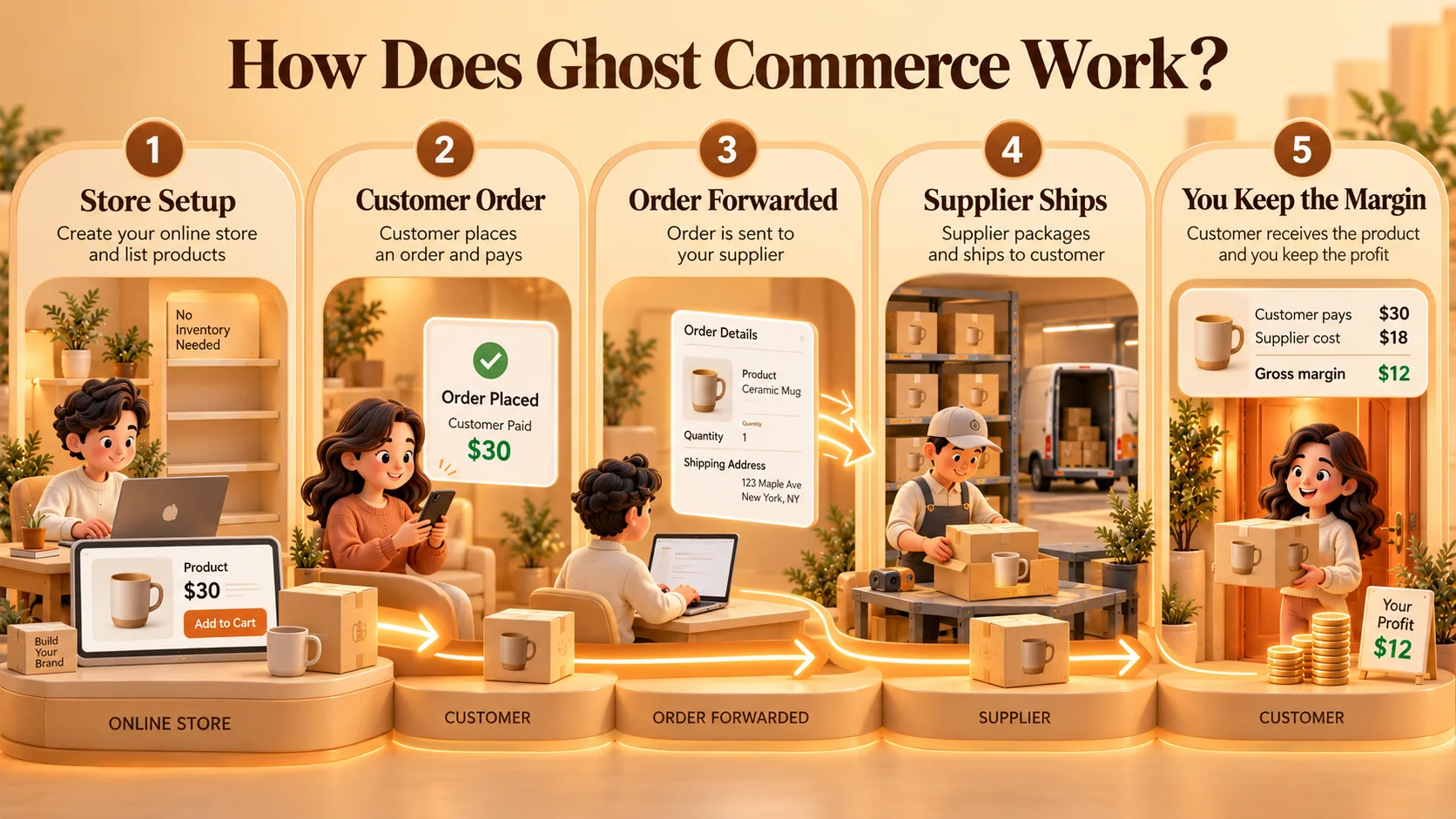
The workflow is straightforward:
- You set up an online store or presence where a customer can find and purchase your product, whether that’s your website, marketplace store, or a social channel.
- A customer places an order, pays you at full retail value, and the transaction goes to your account.
- You (or an automated system) forward the order to your supplier.
- The supplier ships the product directly to the customer, either under your brand or, depending on the arrangement, under the supplier’s brand.
- You keep the margin. Your profit equals the customer payment minus supplier, platform, marketing, payment processing, and other operating costs.
The key to this chain is your supplier relationship. Although customers can’t see them, supplier reliability, product quality, and shipping speed directly affect your brand reputation. Choosing suppliers carefully is no longer optional in ghost commerce, as it’s integral to the operation.
What Are the Main Types of Ghost Commerce Models?
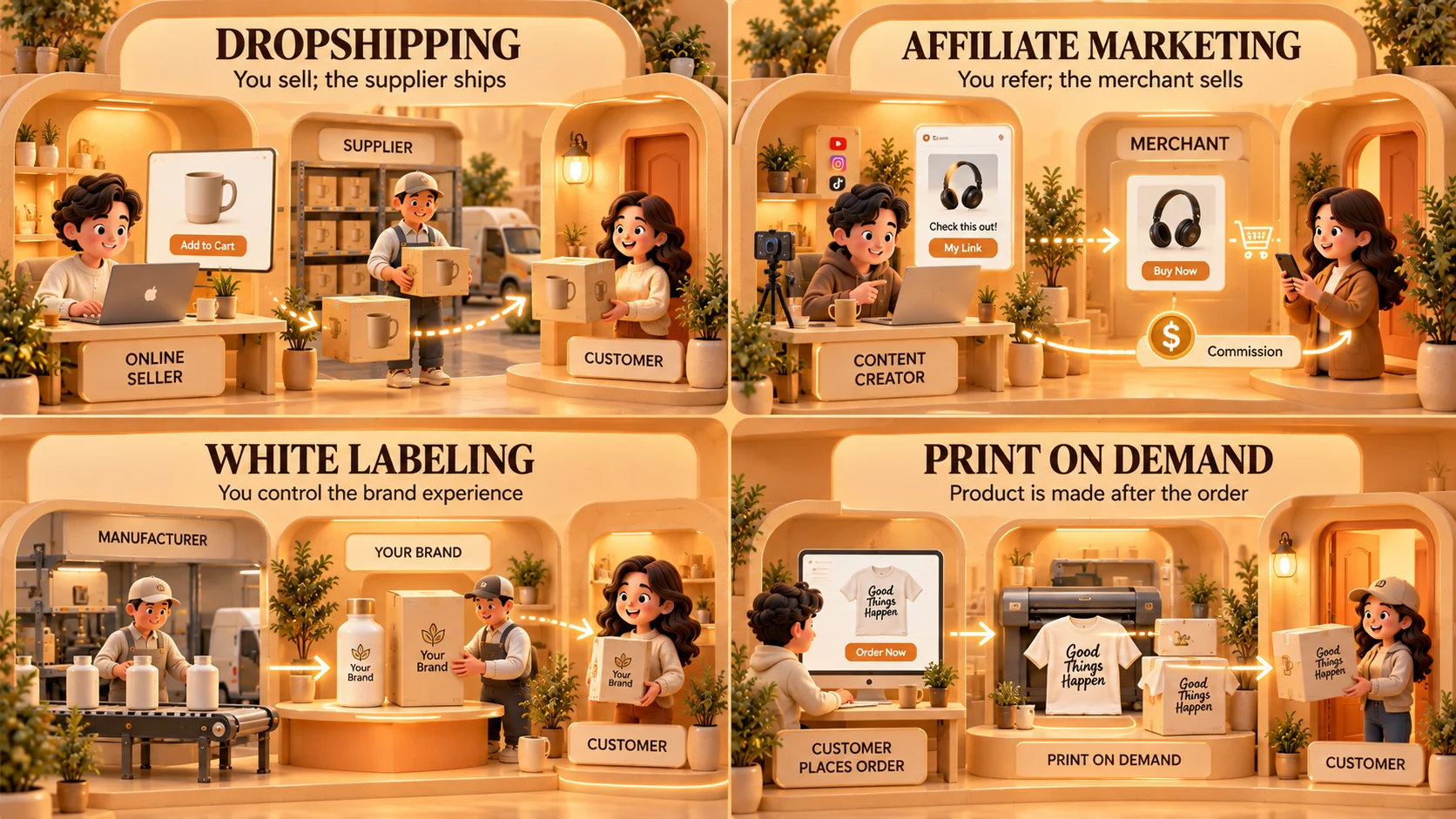
Ghost commerce isn’t one thing. These are the four models and how they are different:
1. Dropshipping
You operate the storefront and manage the customer-facing side of the business. When you receive an order, you pass it to a supplier, who then delivers it to the customer. You can choose prices and the brand experience on your storefront, but not the price or how the product is made. This is the most popular way to do ghost commerce, partly because platforms such as AliExpress, Spocket, and SaleHoo offer easy ways to find suppliers.
2. Affiliate Marketing
You don’t sell any products directly. You promote other businesses’ products through unique tracking links or codes and earn a commission when referred customers make qualifying purchases. If someone clicks your link and purchases a product, you receive a commission ranging from 5 to 30%, depending on the item category. No store to run, no orders to send out. Everything you do is content, SEO, and audience building.
3. White Labeling
A manufacturer makes a product and gives you the opportunity to add your own brand name to it. You have control over the packaging, the brand narrative, and the price positioning. This model reduces the manufacturing burden, but suppliers may require closer collaboration and minimum order quantities.
4. Print on Demand (POD)
You upload designs, and the supplier prints them on whatever you want (apparel, mugs, posters, etc.) only when you place an order. You only produce products after customers place orders, which reduces inventory risk. The leaders in this area are Printful and Printify. POD is especially beneficial for creators, like an artist, YouTuber, or writer, who already have an audience and are looking to sell them their products.
Ghost Commerce vs. Dropshipping: What’s Actually Different?
Dropshipping isn’t ghost commerce, and it’s a part of ghost commerce. Knowing the difference will help you avoid treating them as equal when making business decisions.
| Factor | Ghost Commerce (Umbrella) | Dropshipping (Specific Model) |
|---|---|---|
| Scope | Integrates drop-shipping, white label, affiliate, and POD | One of the particular methods of fulfilment |
| Inventory ownership | Typically low or none, depending on the model | None, as the suppliers deliver directly to the customer. |
| Brand control | Varies by model | You are the one who manages the storefront, not production |
| Revenue model | Commissions and margins or a combination of both | The retail margin for each transaction. |
| Entry cost | $0–$1,000 depending on model | $500–$1,000 typically |
| Typical margin | 10–30%+ depending on model | 10–20% on most categories |
When people say they have a ghost commerce business, they may mean dropshipping, affiliate marketing, or white labeling. The word is used in a general sense. They all share one thing: no physical burden of inventory and a digital-first operating model.
Ghost Commerce vs. Affiliate Marketing: Where Does Revenue Come From?
The key difference is transactional control. With dropshipping or certain white-label ghost commerce models, you typically run the storefront and serve as the merchant of record; the customer purchases from you, while a third party handles fulfillment. In affiliate marketing, you act as a referral source in which the customer purchases directly from the brand or merchant, and you earn a commission for generating the sale.
That matters for a few reasons. Affiliates aren’t responsible for customer support, returns, payment methods, or the checkout process, and they aren’t in charge of pricing or the checkout process either. Outside of affiliate, Ghost Commerce merchants have the customer relationship (more control and more responsibility).
Content creators and publishers do well with affiliate marketing. Dropshipping and white labeling work well for those who want to build a brand and own the entire customer journey.
Ghost Commerce vs. Traditional eCommerce: The Real Trade-Off
While ghost commerce is a more streamlined alternative to eCommerce, it has pros and cons in functionality and use compared with an eCommerce store.
| Factor | Ghost Commerce | Traditional eCommerce |
|---|---|---|
| Startup cost | $500–$2,000 | $5,000–$50,000+ |
| Inventory risk | None | High as unsold stock is lost capital |
| Profit margins | 10–30% | 30–60%+ on own products |
| Product differentiation | You don’t sell anything that is not for sale by suppliers | Completely depends on you |
| Scalability speed | Fast, add SKUs without any physical burden. | Slower, as inventory needs to scale too |
| Quality control | Depends on supplier | You are not part of the production process. |
| Brand depth | Brand is on generic products | High, as product and brand are one and the same |
There is no right or wrong model to choose. Ghost commerce can validate the market and start generating revenue. Building a more secure eCommerce business takes time and requires more capital and conviction at the outset.
How Much Does Ghost Commerce Cost?
The cost of ghost commerce varies significantly based on the model you use. Beyond website or platform fees, your expenses can include product samples, branding, software, payment processing, customer acquisition, and more.
The following areas are a typical starting budget:
| Expense | Typical Cost | What It Covers |
|---|---|---|
| Website & Domain | $20–$100+ | You can choose from a domain, hosting, or an eCommerce platform. |
| Product Samples | $50–$200+ | Assessing the quality and reliability of products. |
| Branding | $0–$300+ | Images of products, designs, and logo/brand assets. |
| Software & Apps | $0–$200+/month | Automation, email, analytics, customer support |
| Marketing | $100–$500+ | Ads, content, influencers, or paid promotion |
| Payment & Misc. Fees | Variable | Transaction fees and other payment costs. |
A lean business can start small, but it’s crucial to keep some money in the bank for product testing and marketing. Rather than a specific amount of up-front capital, use an initial budget as a validation budget: invest enough to see if there’s money to be made from your product, niche, and marketing strategies before you invest more.
What Are the Real Benefits of Ghost Commerce?
Businesses selling online with minimal overhead can benefit from ghost commerce in many ways, from lower costs to increased flexibility.
1. Low barrier to entry
Even “low startup cost” business models have a hidden cost. Dropshipping or affiliate marketing is real ghost commerce, and it can start for less than $1,000. The main costs are your store platform subscription, a domain name, and your initial marketing budget.
2. Flexibility to test and pivot fast
Since you have no stock to switch between product categories, the costs of changing are minimal aside from the time you spend updating your store. A traditional retailer can’t quickly switch direction if they are carrying a large inventory of a slow-moving item. A ghost commerce operator can create a new category and drop a failing one in the same afternoon.
3. Location independence
Much of the day-to-day operation can be managed online, while suppliers handle physical fulfillment. Suppliers do the physical work. This means the business can run from anywhere with good internet connectivity, which is often appealing to many.
4. Automation opportunity
You can enable automatic order forwarding, email sequences, inventory syncing, and customer notifications. Once the systems are established, automation can reduce repetitive operational work and free up more time for growth activities.
What Are the Drawbacks of Ghost Commerce?
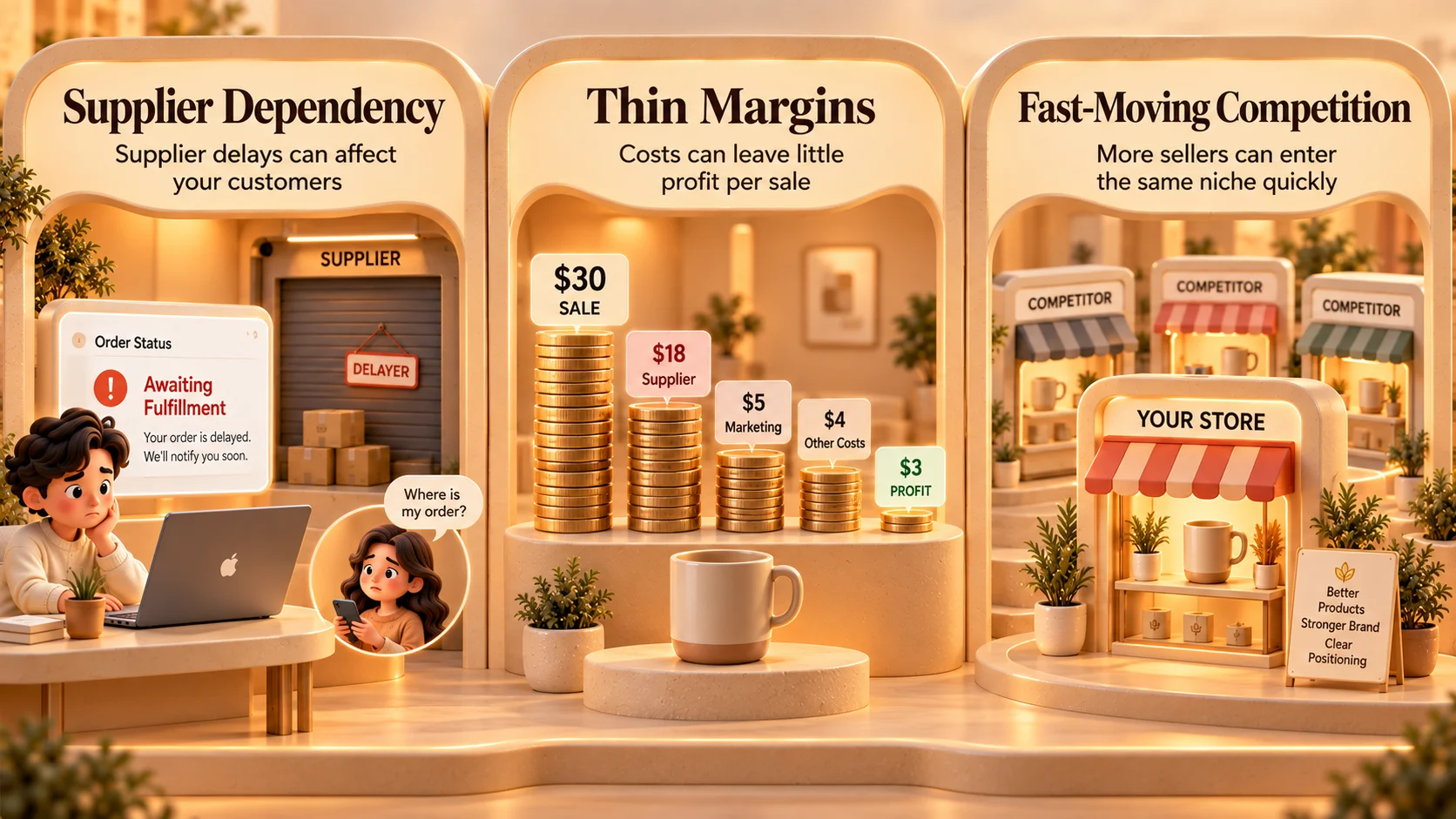
All models have failure modes. If you’re considering ghost commerce, keep the three ghosts in mind.
1. Supplier dependency is a real business risk
According to reports, many online shoppers give up on a purchase because of long delivery times, and with ghost commerce, you have no control over delivery time. One bad apple can spoil the bunch, resulting in months of negative reviews. It’s not an option to review suppliers before going live – it’s a requirement.
2. Margins are thin, and volume math is demanding
Dropshipping margins are usually 10-20%. At a 10% to 20% gross margin, a $30 sale generates $3 to $6 in gross profit before marketing and other operating costs. If the business isn’t generating much traffic and it doesn’t cost you much to acquire it, it can feel like a treadmill. White labeling slightly increases margins, but also introduces minimum ordering.
3. Competition is concentrated and fast-moving
The same low cost to get started is available to everyone else. Niches are popular, and they are saturated quickly. A race to zero is playing on price alone. Those businesses that remain in ghost commerce develop a clear brand identity, a community, or a content strategy that makes them the obvious first choice in a certain niche and not just another business selling the same products.
Is Ghost Commerce Worth It in 2026?
In 2026, ghost commerce is still a potential business model, but it takes a certain mindset to succeed. A low barrier to entry also comes with the downside of high competition, and launching a generic store alone is unlikely to be enough.
Some of the most important considerations:
- Specialization is the key: Target a specific audience or problem rather than sell something that’s trending.
- You need to differentiate: Perhaps it’s strong branding, great content, product selection, or customer experience.
- Customer acquisition is critical: You need a consistent approach to bringing customers to your business through social media, creators, communities, paid ads, or SEO.
- Supplier quality matters: When products aren’t delivered on time and quality isn’t consistent, customer satisfaction suffers.
- Automation brings efficiency: AI and eCommerce tools can streamline product research, marketing, customer support, and order management.
- Marketplaces have scaling potential: If you have several suppliers and increasing demand, a multi-vendor marketplace can build a more scalable business model.
Overall, ghost commerce can remain viable in 2026, but success requires focused positioning, reliable suppliers, consistent customer acquisition, and strong execution.
How Do You Start a Ghost Commerce Business?
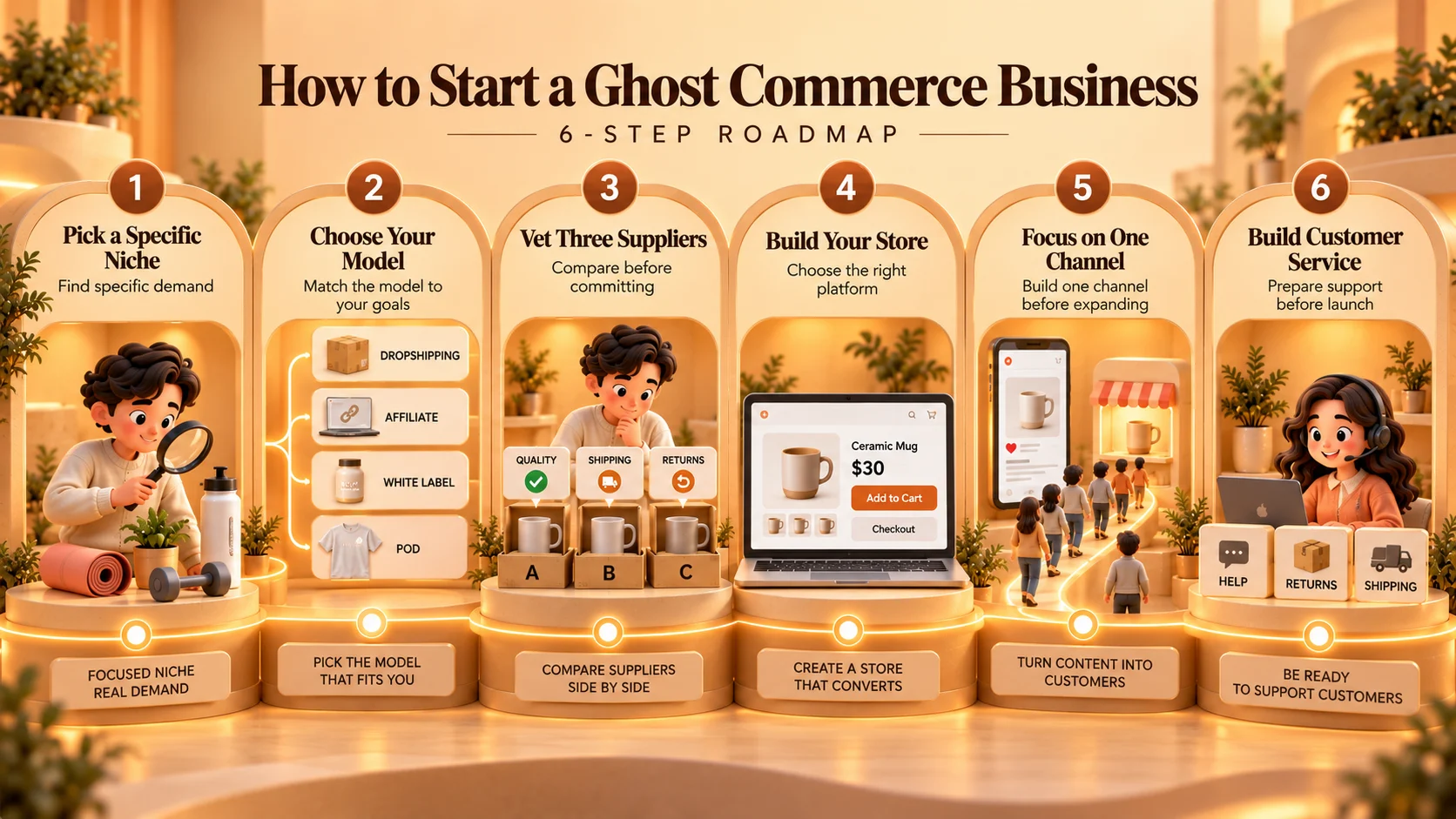
Building a ghost business requires choosing a niche, product offering, platform, and marketing approach that can create a successful online business.
1. Pick a specific niche with verifiable demand
Go to Google Trends, Reddit communities, and Amazon Best Sellers to find where people are shopping, not just browsing. Narrow beats broad: “running gear for new marathoners” beats “fitness products.
2. Choose your ghost commerce model
Do you run a brand (white label), a content company (affiliate), a store (dropshipping), or a merchandise company (POD)? Each has its own skill needs and development.
3. Vet at least three suppliers before committing
Order samples. See how long they take to ship to your intended market. Read reviews from other merchants, not just end customers. Confirm the supplier’s return and dispute process.
4. Build your store on a platform that fits your model
Shopify and WooCommerce are the usual choices for single-brand stores. If you are building a multi-vendor marketplace, you’ll need a marketplace platform that lets multiple vendors list and sell products from a single storefront. SPXCommerce has been designed to be the right solution for this scenario.
5. Invest in one marketing channel before spreading to five
Choose the right content marketing strategy based on your audience and budget, such as SEO, paid social, influencers, and email. Learn before spreading out. The biggest early mistake is spreading thin across all channels.
6. Build customer service infrastructure before you need it
Before you launch, set up a help desk tool, create your return and shipping policy, and establish a supplier escalation process, not after you have your first tough customer.
Why SPXCommerce for Ghost Commerce Marketplaces?
Most ghost commerce ventures start as small retail stores. However, the single-store configuration runs out of steam as they expand their supplier base, product range, and complexity. Having numerous connections with different suppliers in different stores is less efficient. Customers don’t get a standardized experience. It’s hard to surface “best available” options from a supplier network in a single location.
A multi-vendor marketplace can address this challenge, and that’s what SPXCommerce is designed to provide.
What SPXCommerce Offers for Ghost Commerce Operators?
SPXCommerce is a marketplace development platform that helps businesses create rich, robust multi-vendor eCommerce marketplaces. You no longer have to run 5 different Shopify stores for 5 different supplier niches, and you can create one marketplace where suppliers list, customers browse, and you control the experience.
Features include multi-vendor integrations, commission management, supplier dashboards, unified order management, and customer search and filtering. These features are essential for a ghost commerce operator to scale from one supplier to fifty without rebuilding their tech stack.
If you want to be the place to go, instead of store to store, for your niche, it’s a marketplace architecture that will help you achieve that goal. Discuss the possibilities with the SPXCommerce team for your model.