
Your platform may handle 500 orders per day reliably until a flash sale creates a sudden surge in demand, exposing architectural bottlenecks. Your checkout froze, your inventory system became out of sync, and your team couldn’t deploy a hotfix without risking a full deployment. This issue can occur when a monolithic architecture becomes difficult or inefficient to scale for specific workloads.
The monolithic vs. microservices discussion is the crux of nearly every serious eCommerce architecture decision in 2026, whether it’s creating a new marketplace or assessing a platform that is becoming a bottleneck.
Neither of these is wrong in all situations. However, choosing the wrong solution for your stage & scale can mean wasted months of engineering time, lost revenue during downtime, and loss of competitive flexibility.
This guide will help you to understand the differences between the two, when it is appropriate to use each one, and how a platform makes it possible to enjoy the best aspects of both without having to create everything from the ground up.
What is Monolithic Architecture and Why did it start so many years ago?
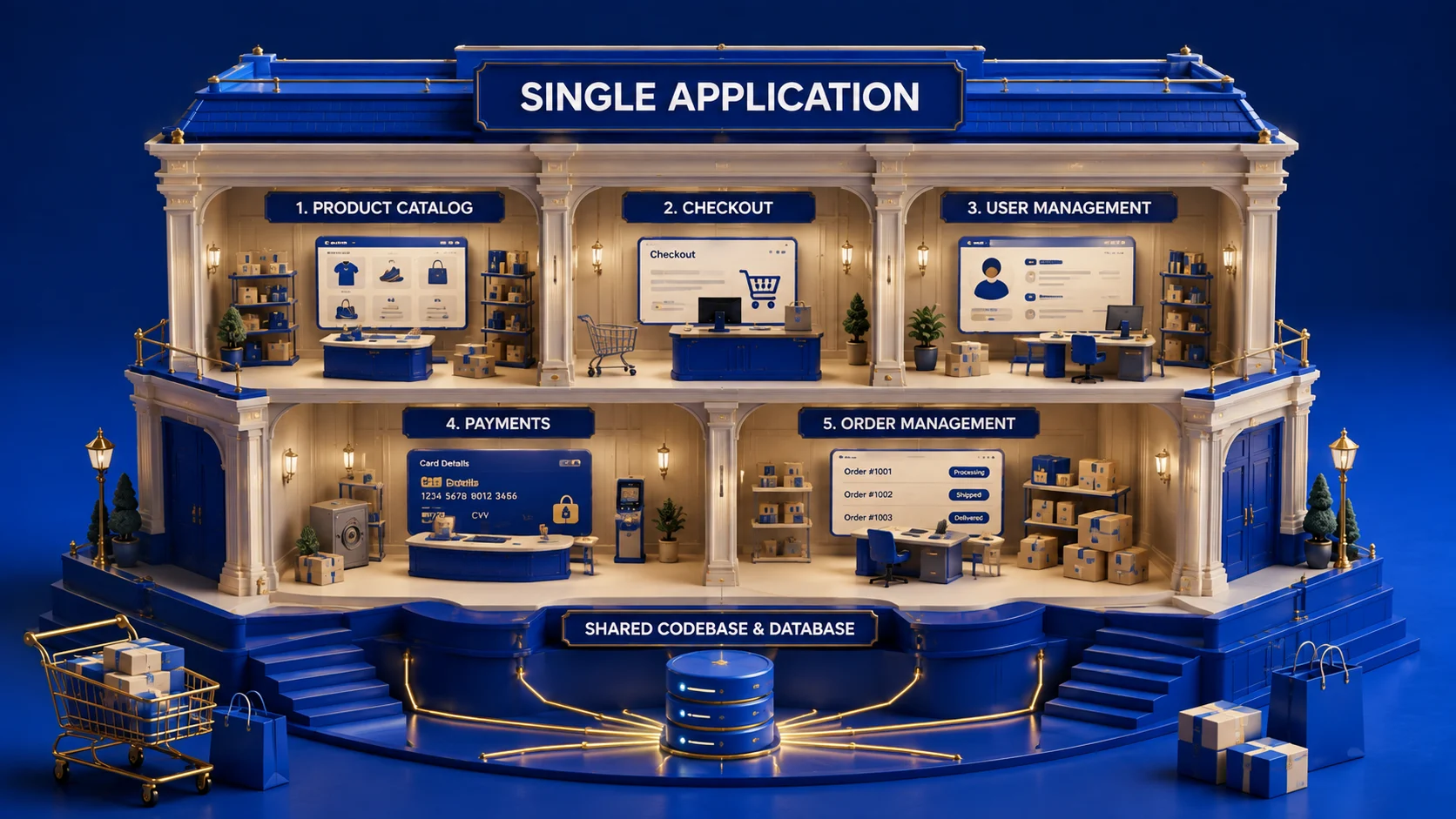
Monolithic Architecture is an architecture in which the entire application is packaged as a single deployable unit. The product catalog, checkout engine, user accounts, payments, and order management typically reside within the same application and deploy as a single unit.
Think of it like a department store in one building. When the store is small, it is neat, organized, centrally managed, and easy to navigate through. New product category added? You are working in the same building as everyone else!
This simplicity is actually a great asset for businesses in their early stages. With fewer moving parts, initial development is faster, debugging is simpler, and no distributed system problems to deal with.
According to McKinsey’s retail technology research, many traditional retail architectures remain monolithic or outdated, which can create challenges for digital transformation initiatives. The price tag is not the license fee, but it’s the engineering hours spent around rigidity.
The issue comes up later. If you have to scale your checkout service during a sell-off season, you are scaling the entire application, including the catalog, user data, and everything else. If this bug in the payment module crashes the server, it also crashes product pages. This is not a coding error in your code. That is a limitation of the structure.
What is Microservices Architecture and How it works?
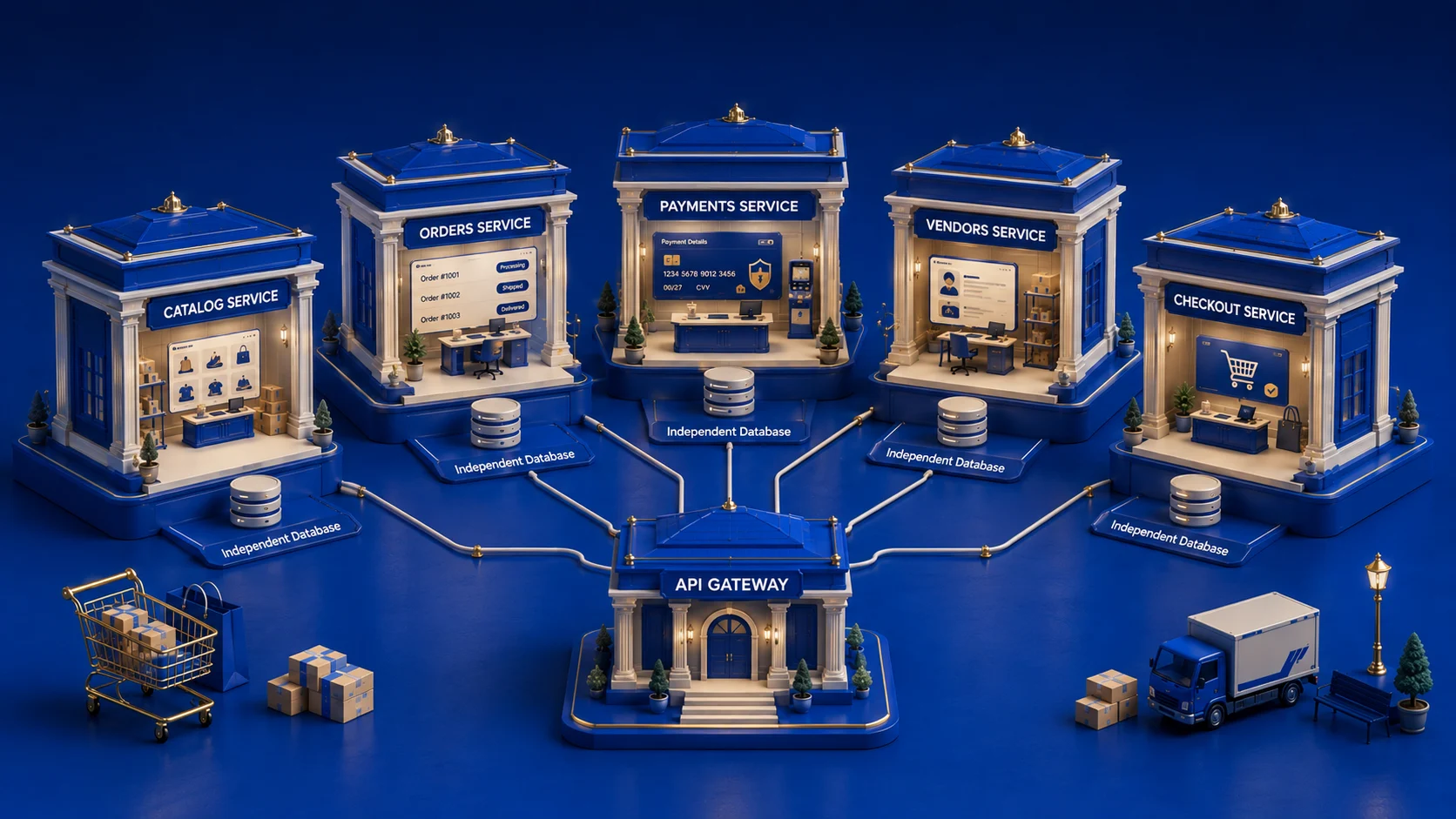
A microservices architecture that can be defined as breaking down an application into smaller, independent services, each responsible for one and only one business function. Each service typically has its own codebase and deployment pipeline, with independent data ownership where appropriate. They connect through APIs, usually REST, or event queues such as Kafka.
Imagine that every department is a different business in a mall, again the same department store. Each has its own hours, staff, and upgrades. When demand is high in the shoe department, it can grow without disrupting the food court.
Common features for eCommerce services include product catalog, inventory, pricing/promotion, order management, payment, customer accounts, search, and vendor/seller management. A marketplace context naturally belongs to the Seller Management System, which can be an isolated microservice with its own data model and workflows, and that does not fail the checkout system on restart.
What Is the Difference Between Monolithic and Microservices?
In short, monoliths are a bunch of things deployed together, and microservices are lots of things deployed separately. But there are more practical implications that go beyond that.
| Dimension | Monolithic | Microservices |
|---|---|---|
| Deployment | All-or-nothing; one release cycle | Each service deploys independently |
| Scalability | Scale the entire app even if only one part is bottlenecked | Scale only the services under load |
| Fault Isolation | One module crash can bring down everything | One service failure doesn’t cascade to others |
| Tech Flexibility | Locked to one language/framework per app | Each service can use best-fit technology |
| Development Speed | Faster to start; slower at scale | More setup upfront; faster iteration at scale |
| Operational Complexity | Low as there is only one system to monitor | High as it requires orchestration (Kubernetes, Docker, etc.) |
| Team Structure | Single codebase, harder to parallelize teams | Teams own services; parallel development works well |
| Data Management | Shared database with simpler joins, risky coupling | Per-service databases with data consistency |
Monolithic vs Microservices Pros and Cons
Both architectures have pros and cons in terms of scalability, deployment, complexity, and team ownership. The best choice depends on your application size, team size, and operational maturity.
Monolithic Architecture
Monolithic architecture is a single piece of code in which all features are tightly bound together and deployed as a single bundle. The table below highlights some of its main benefits and disadvantages in practice.
| Advantages | Disadvantages |
|---|---|
|
|
Microservices Architecture
A microservices architecture divides the system into autonomous services that are focused on particular business functions. It has significant advantages and disadvantages in real-world systems as summarized below.
| Advantages | Disadvantages |
|---|---|
|
|
Real-World Monolithic vs Microservices Examples
Several popular companies show that both monolithic and microservices architectures can succeed at scale. The examples illustrate how architectural decisions vary with business needs, team size, scalability, and operational complexity.
The classic microservices example is Amazon marketplace. They were once known for the ‘Bezos API Mandate,’ implemented in the early 2000s, which required only API-based communication between internal teams. All teams needed to have an open API, and all other teams needed to use that API. This field helped Amazon to develop AWS and Prime as standalone services. Today, their services number in the thousands.
Shopify is a helpful exception. Shopify ran a huge Rails monolith for many years and invested millions of dollars to scale it using a technique called “Modular Rails”. The lesson: no, a monolith isn’t, per se, evil, but as Shopify expanded into new markets such as Shopify Markets and Shopify Plus, it gradually switched to more service-oriented patterns as well.
When Netflix’s streaming business needed fault-tolerant infrastructure across the globe, it switched from a monolithic DVD company to microservices. Now they operate more than 700 microservices and have created tools such as Chaos Monkey to test the resilience of their services.
Microservices are smaller and easier to manage and deploy, and new components can be added without affecting the rest of the system; if one fails, the other parts of the system will remain unaffected.
Why Microservices Over Monolithic for Modern eCommerce Specifically?
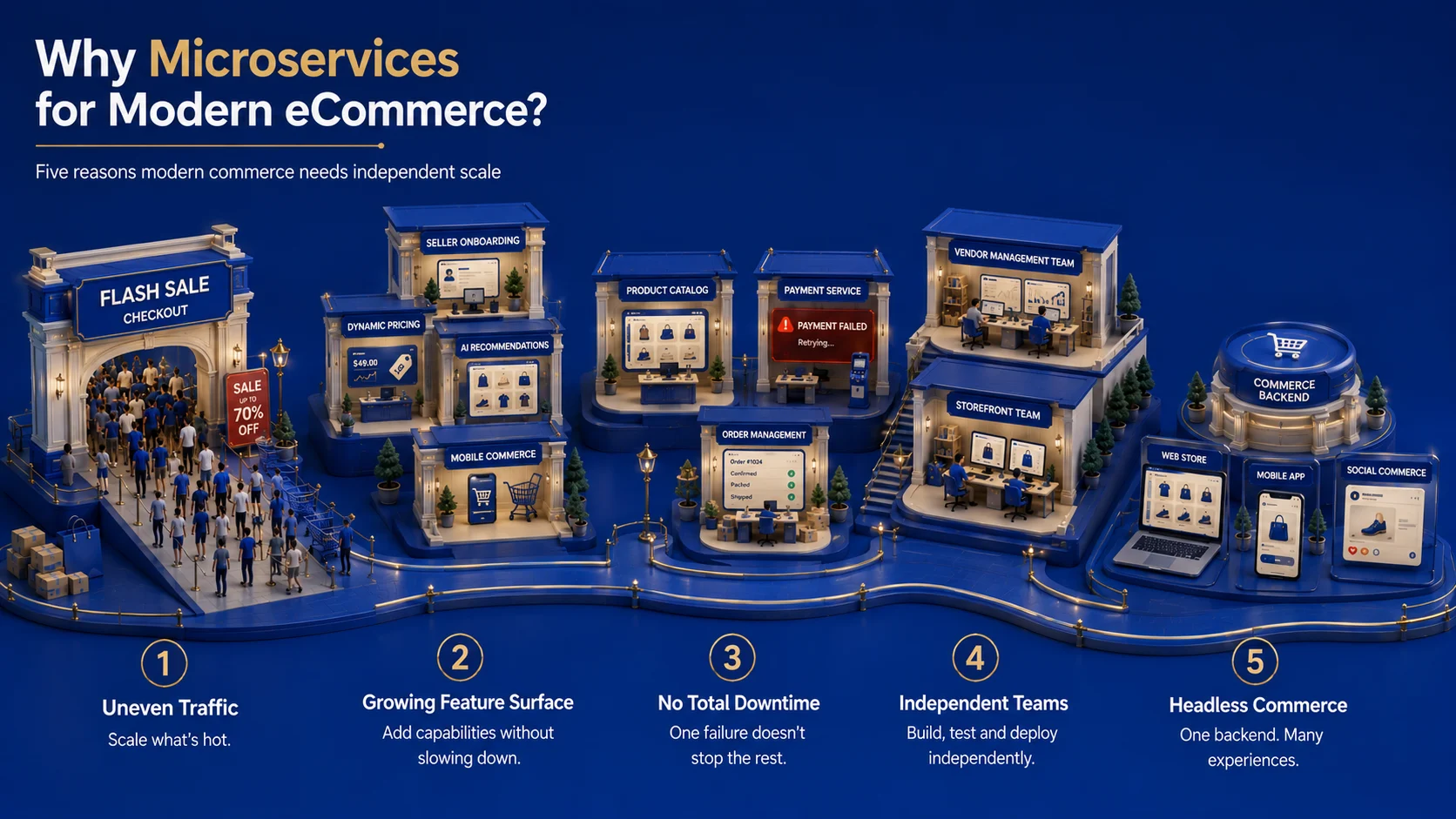
In fact, eCommerce has patterns that support this case for microservices, specifically:
1. There’s no even traffic
During a flash sale, checkout volume can increase significantly above normal levels. What you don’t need to scale is your content pages, and you need to scale payments and inventory. Microservices allow you to do that!
2. The feature surface is wide and growing
Today’s multi-vendor marketplaces require onboarding sellers, dynamic pricing, AI recommendations, real-time inventory sync, and mobile apps all from different vendors. Services can integrate through APIs, while poorly structured monolithic systems can accumulate tightly coupled integrations.
3. You can’t afford total downtime
You don’t want a payment service bug to take your product catalog down. In a microservices architecture, fault isolation separates revenue-critical paths.
4. Teams need to ship independently
The vendor management team and the storefront team should not depend on each other’s release cycle. The microservices approach enables teams to have their own domain and schedule.
5. Headless commerce requires it
The headless model complements microservices by separating storefront experiences from commerce logic. It enables you to connect multiple storefronts, apps, and channels to the same commerce engine.
Monolithic to Microservices Migration: How Do You Do It?
There’s no big-bang rewrite when moving from a monolith to microservices. This approach has a poor track record. The usual one is known as the Strangler Fig, a tree that grows around a host and eventually replaces it.
1. Audit your monolith for natural seams
Know how to find bounded contexts (parts of the system that may be considered standalone). Often, user authentication, product search, and checkout are the first steps.
2. Add API gateway layer
Use a single gateway for traffic between the monolith and your new services. This will help you move traffic in a step-by-step approach without a traffic cutover.
3. Take the top priority service first
What is the most painful? In high-traffic scenarios, such as product searches or payment processing, the advantages of independent scaling are clear from the start.
4. Handle data separation carefully
Each service should establish clear data ownership, which may require event-driven synchronization or transitional data patterns during migration.
5. Decommission the monolith module by module
After you have a service running successfully in production, remove the monolith code. Don’t attempt to hold both of these for long, ever.
A quicker solution for marketplace operators is to simply use a multi-vendor marketplace platform that’s already geared towards services, rather than migrating from a legacy system.
How to Choose the Right Architecture for Your Business
The honest answer is: it depends on where you are, not just where you want to go.
| Choose Monolithic When… | Choose Microservices When… |
|---|---|
|
|
Most e-commerce start-ups end up somewhere in the middle: They want some services pre-built that they can use as a foundation for the parts of their e-commerce site they are building (so that they don’t have to start from scratch); and they want to be able to add, modify, or remove individual elements as their business grows or changes. That’s the modular commerce model.
How SPXCommerce Solves This Architecturally?
SPXCommerce is a marketplace developer platform designed to provide modular, independently managed commerce capabilities without requiring businesses to build a distributed architecture from scratch.
It offers independently managed services across the commerce ecosystem, including Order Management, Product Information Management (PIM), Seller Management, native iOS and Android apps, and ProactiveAI.
The API-first, headless approach allows companies to use the entire platform or select specific services and integrate them into their existing technology stack. Its modular design enables progressive modernization: incrementally replacing the existing system, either for B2B eCommerce or B2C eCommerce.
Conclusion
There is no one correct answer to the monolithic vs microservices debate, and there is no right answer for your situation now. Monoliths can provide an effective starting point, while microservices can offer greater flexibility for organizations with complex scaling and team requirements. So, for ecommerce companies looking to evolve into a marketplace business model, the smartest option is to choose a platform that is already service-centric and then add services later.
Hence, SPXCommerce is constructed on the same concept. It uses a service-centric architecture rather than simply adding an API layer to a monolithic core. It’s a marketplace development platform, and all the big features order management, vendor control, catalog, AI, mobile are services that you can configure, extend, or replace. You can either build up from scratch or migrate from another system, and the architecture won’t hold you back. It’s designed for it.