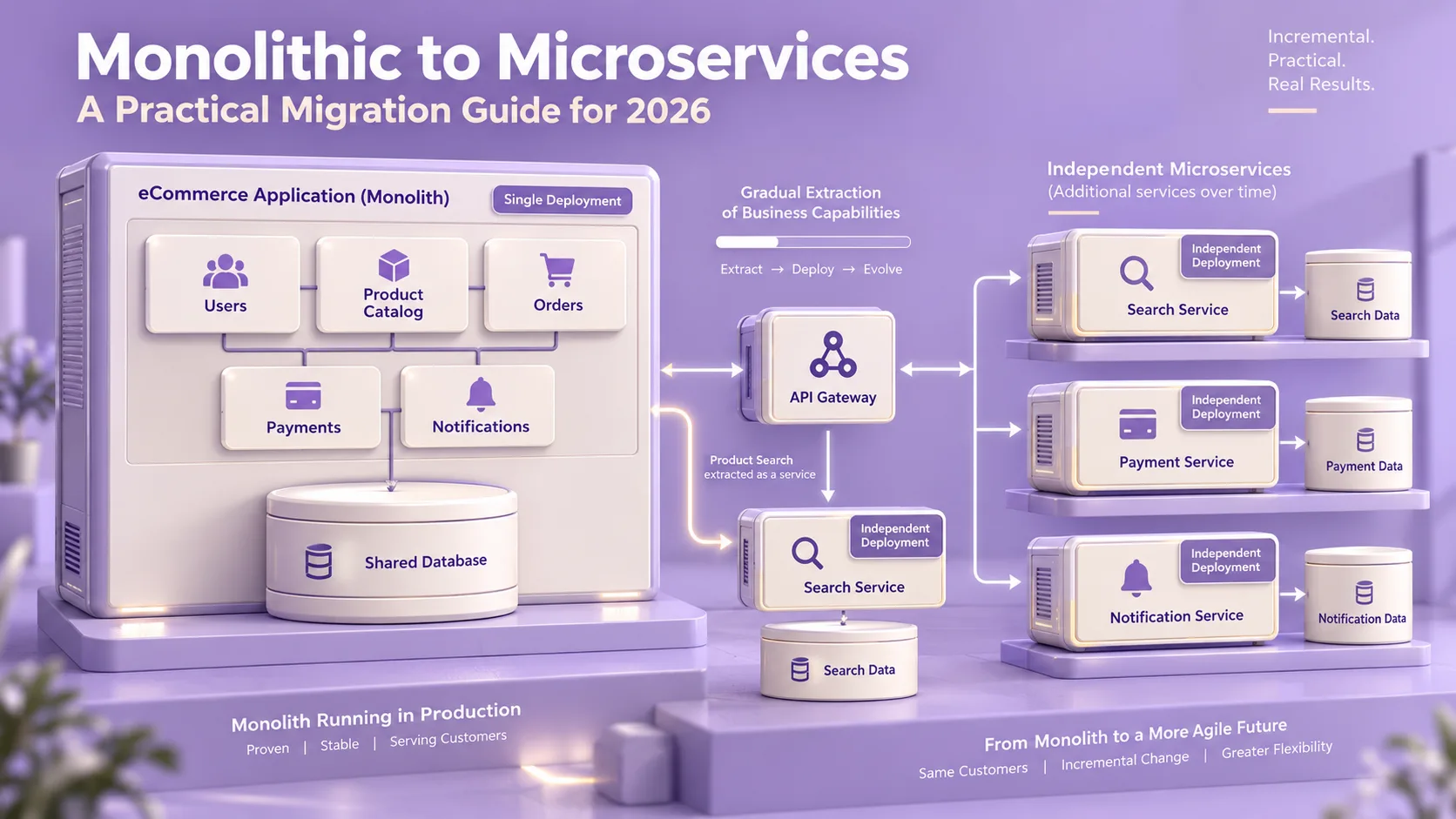
At one time, a monolithic application was a good thing. A single codebase, single deployment, single team. It enabled teams to deliver quickly in the early years. One day, a routine feature update took weeks. One bug in the payment module brought the platform down. Your top engineers spent more time maintaining dependencies than creating new functionality.
Sound familiar? The growing difficulty of maintaining monoliths drives many engineering teams to consider migration from monolithic to microservices, and the process rarely involves simply splitting the application. It is not planned, and it introduces new classes of complexity: distributed-system failures, data-consistency headaches, and friction among project stakeholders that can make a product languish for months.
This guide cuts through the clutter. Whether you are an engineering lead considering migration or a team already halfway and looking for some solid ground to stand on. You will learn what the migration strategy will look like, what the true pitfalls will be, and what practices will make or break your migration from an expensive rewrite to a real migration.
What Is Monolithic to Microservices Migration?
Before understanding migration, it’s important to know what monolithic and microservices architectures are.
Firstly, a monolithic application is constructed and released as a single application. Core business logic, such as user management, product catalog, order management, payments, and notifications, is usually in a single codebase and often shares a common database. As the system develops, changes in one part can affect other parts, resulting in slower releases and greater deployment risk.
Whereas a microservices architecture deconstructs the application into smaller, deployable services, each with a specific business capability. These services can interact via APIs, messaging, or events rather than through code or direct database access. For instance, an order service can interact with an inventory service through an API without knowing how the inventory service is implemented.
A monolithic to microservices migration is a gradual process of extracting functionality step by step, clarifying boundaries, separating data ownership, and progressively routing traffic to the new services, while maintaining continuous system uptime.
When Should You Consider Monolithic to Microservices Migration?
While microservices offer benefits in areas such as scalability, deployment speed, and team autonomy, they also add operational and architectural complexity. Before migrating, assess its value to your application.
When Microservices Make Sense?
Microservices are a strong fit when your application has:
- Independent deployment needs: Teams should be able to deploy features or fixes without redeploying the entire app.
- Scalability needs: Scaling requirements vary by business function, with some functions requiring independent scaling.
- Large engineering teams: Several teams must have distinct ownership of business capabilities.
- Identify business domains: The application can be broken down into separate domains, such as orders, payments, inventory, and customer management.
- Siloed technology: Different services may require different technologies, frameworks, and release cycles.
- Small but frequent releases: You need to deliver your product and business through smaller, faster releases.
When You Should Keep the Monolithic?
Microservices aren’t always the better choice. A monolith may be more practical when you have:
- Minimal engineering resources for distributed systems.
- An application that has a relatively flat architecture, in which the architecture will not change often.
- Low or predictable scaling requirements.
- Complex business logic and unclear boundaries of services.
- Limited DevOps maturity, monitoring capabilities, and infrastructure.
In such cases, breaking up the application is unlikely to provide significant business value and could introduce more complexity.
Consider a Modular Monolith First
For issues other than scalability, like code organization, a modular monolith may be a better starting point. While maintaining the application as a single deployable element, it separates the business capabilities into distinct elements with well-defined interfaces and ownership.
The modular monolith can offer many of the organizational advantages of microservices without the latency of networking, distributed transactions, and the need to manage and operate numerous services. It can also facilitate future microservices migration by laying down boundaries prior to service extraction.
The aim is not to have as many microservices as possible. This involves selecting an architecture that suits the complexity of your application, your team’s structure, and your business requirements.
When monolithic to microservices migration is the wrong call
Not all monoliths can be split. The initial operational burden of managing distributed services can outweigh the benefits for smaller teams, particularly those with limited engineering and DevOps capacity. When your domains are all so interdependent within your monolith that there is no separation, then you are stuck with “microservices” that are nothing but a distributed monolith, and that’s a bad thing in every way. Refactoring the monolith itself is often the most sensible solution.
What Are the Real Challenges of Monolithic to Microservices Migration?
The engineering blogs that extol the virtues of microservices don’t really devote enough time here. Let’s not beat around the bush and get straight to the point. Here’s what actually makes migrations hard:
1. The shared database problem
Most monoliths have a single relational database and use foreign keys to relate all the data. The easy part is splitting the app, and splitting the data without breaking referential integrity is where most migrations get bogged down. An order microservice can’t directly reference another service’s users table.
2. Distributed transaction complexity
A monolith can have a user purchase occurring within a single ACID transaction. In microservices, a purchase transaction will involve the inventory, payment, and order services. That doesn’t work well without a shared transaction, as it would require patterns such as saga orchestration, which add valuable complexity.
3. Network latency and failure modes
What was previously a function call within the same process is now an HTTP or gRPC call across a network. Networks fail. Services go down. Now you need circuit breakers, exponential backoff retries, and timeouts, or one downstream failure wreaks havoc on your platform.
4. Operational overhead
You’ve been deployed once, and now you’ve been deployed twenty times. Each service should have its own pipeline, health checks, monitoring dashboards, and runbooks. Teams that aren’t ready spend more time on infrastructure than on product.
5. Organizational misalignment
Conway’s Law is true, which states that your architecture reflects your team. Decomposing a monolith typically involves restructuring teams around service ownership. It’s as much a people and process change as it’s a technical change.
What Is the Right Monolithic to Microservices Migration Strategy?
There is no single recipe, but there are two common failure patterns that plague most busted migrations: “Big Bang” rewrite (throw out the monolith, build the whole thing at once, ship it as soon as it’s finished), and “Death March” partial migration (rip out the services, but have an unhealthy monolith running forever).
A lower-risk strategy is to extract business capabilities incrementally. Let’s look at an example.
| Approach | How It Works | Risk Level | Recommended? |
|---|---|---|---|
| Big Bang Rewrite | Rebuild all services as microservices and cut over | Very High | No, because it carries significant delivery and operational risk. |
| Strangler Fig | Deploy services to routes, and slowly scale down the monolith. | Low–Medium | Yes, it is good for most teams. |
| Parallel Run | Run monolith and service side-by-side; compare output before switching; | Low | Yes, to highly critical functions |
| Branch by Abstraction | Put deeply embedded logic in an abstraction layer and replace implementation over time | Medium | No due to loosely coupled modules |
How to Identify Microservices Boundaries
Deciding what to make a service of is one of the most crucial decisions when migrating to microservices. Technical layers or making too many small services can make it nothing more than a distributed monolith. Rather, establish boundaries for business capabilities, data ownership, and team responsibilities.
1. Map Business Capabilities
Begin by outlining the key features of your app. These could be product management, inventory, orders, payments, sellers, customers, and notifications for an eCommerce platform.
Think in terms of the business rather than the code structure. Any of the capabilities could be a stand-alone service.
2. Identify Bounded Contexts
Organize the business into “bounded contexts” using Domain-Driven Design (DDD), each representing a distinct area of the business with its own rules, processes, and vocabulary.
For instance, an “order” can be a customer order for the sales team and a fulfillment request for the warehouse team. Understand these differences so unrelated duties aren’t combined into a single service.
3. Analyze Code and Database Dependencies
Before extracting a service, first create a map of the relationships among modules, functions, and database tables. Search for tightly coupled areas, shared tables, cross-module transactions, and frequent database joins. The more dependencies a capability has, the more carefully teams should evaluate it before extraction.
4. Define Data Ownership
Each service should clearly own its data. The other services should not directly access that data, but rather use an API or events. First, determine the ownership of each business entity, and gradually remove shared database access as you migrate.
5. Assign Service Ownership to teams
Each service should have an owner. Assign one team to develop, deploy, monitor, and maintain it. This provides accountability and enables teams to roll out changes without continually coordinating across the application.
6. Choose the First Service to Extract
Don’t begin the migration with the most important or difficult portion of the monolith. Select a capability that is well-defined, has limited dependencies, and has a reasonable amount of business risk.
Modules such as notifications, reporting, document generation, or similar could be a good starting point. A successful first rollout can build confidence in your deployment, monitoring, testing, and migration cycles before you move into more critical domains.
How to Perform a Monolithic to Microservices Migration: Step-by-Step
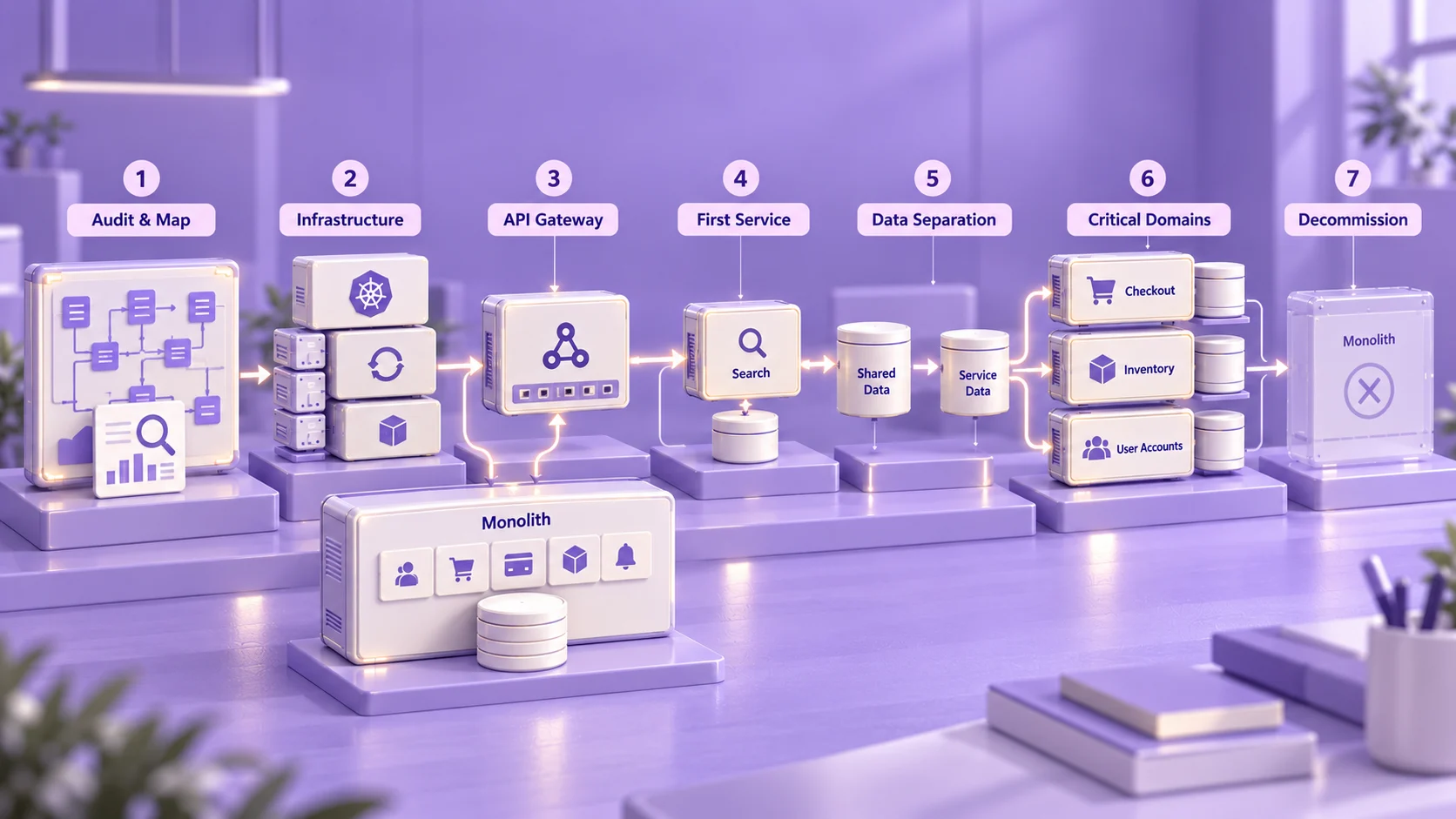
Converting a monolithic application to microservices is best done incrementally to reduce risk and maintain business continuity. The following steps provide a practical roadmap for breaking down the monolith while establishing the infrastructure needed to support each new service.
1. Audit and map monolith
Generate documentation of all modules, module dependencies, and the data model for each module. There are tools, such as vFunction and SonarQube, that can help with some of this analysis automatically. You have to know what you have before you decide what you want to remove first.
2. Establish your infrastructure foundation
Establish an appropriate container and orchestration strategy, along with CI/CD pipelines and distributed tracing. Otherwise, you’re running microservices without seeing.
3. Deploy an API gateway
Place an API gateway such as Kong, AWS API Gateway, or NGINX in front of the monolith. This serves as the routing layer that enables you to route traffic to new services without altering client code.
4. Extract your first low-risk service
Choose a project with clear requirements and minimal data tangling, such as email notifications, PDF generation, or a reporting module. This extraction is for testing to ensure your pipeline and deployment process work before you do anything important.
5. Decompose the database incrementally
Have a different schema or database for each extracted service. Use appropriate synchronization patterns, such as dual writes or change data capture, to maintain data consistency during the transition. Once the service is stable and in full production, eliminate shared table access.
6. Iterate outward to critical domains
Once the foundation is proven, start extracting core domains, such as [checkout], [inventory], [user accounts], and so on, one domain at a time. Test high-traffic functions concurrently before completely switching traffic.
7. Decommission the monolith
This is the final step (and only when all functions have a microservice replacement that is proven in production). Do not rush this, as a healthy monolith running in parallel is preferable to prematurely removing it.
Monolithic to Microservices Migration Patterns and Architecture Practices
These patterns help teams progressively decompose a monolith while reducing migration risk.
1. Strangler Fig Pattern
Replace components of the monolith with new ones, while keeping the running application alive. Guide functionality to new services as they are available until the monolith can be phased out.
2. Database-per-Service
Each service owns its data and shares it through its APIs/Events, rather than through a shared database. Separate schemas can also serve as a stepping-stone to independent databases during migration.
3. Event-Driven Architecture
Services can communicate asynchronously through events, reducing reliance on direct synchronous calls where appropriate. For example, an order.created event can trigger inventory, notification, and analytics workflows independently.
4. Saga Pattern for Distributed Transactions
Sagas orchestrate transactions across multiple services. A business process is broken down into smaller transactions, and the compensating actions are employed when a step fails to execute.
5. Branch by Abstraction
If you want to have tightly coupled functionality, first add an abstraction layer. Construct the new service behind it, progressively move traffic over to the new service, and then remove the old code.
6. API Gateway Pattern
An API gateway is also a single point of access for clients and acts as a traffic hub between the monolith and new services. It can also support authentication, rate limiting, routing, and even API versioning.
What Tools Help With Monolithic to Microservices Migration?
Refactoring a monolithic application into microservices requires the right tools to analyze the existing architecture, manage services, and support a safe transition. The table below highlights key tools across architecture analysis, deployment, communication, observability, and testing.
| Category | Tool | What It Does |
|---|---|---|
| Architecture Analysis | vFunction | Identification of service candidates in the existing code, assisted by AI. |
| Containerization | Docker + Kubernetes | Plan and coordinate services in environments |
| API Gateway | Kong and AWS API Gateway. | Redirect traffic from monolith to new services during transition. |
| Service Mesh | Istio, Linkerd | Provide service-to-service auth, retries & observability at platform level |
| Message Queue | Apache Kafka, RabbitMQ | Async communication and event streaming between services. |
| Observability | Datadog, Jaeger, Prometheus | Distributed tracing, metrics & alerting across services |
| CI/CD | GitHub Actions, CircleCI | Independent pipelines for build and deployment of services. |
| Contract Testing | Pact | Check service interface contracts prior to deployment |
What are Best Practices for Monolith to Microservices Migration?
The migration is more than just code extraction. The practices presented in this chapter help teams minimize risks, ensure reliability, and realize tangible benefits from the shift to microservices.
1. Start with Business Capabilities, Not Technical Layers
Design services around business functions, not technical components like controllers or databases. This makes it easier to establish clear boundaries and ownership.
2. Establish Clear Data Ownership
Services should own data and publish it via APIs or events. Try to avoid creating new dependencies (other than the ones specified in the database upgrade) on shared tables throughout the migration.
3. Design for Failure
Network calls may not succeed. Implement timeouts, retries, circuit breakers, idempotency, and fallbacks to limit the spread of a single service failure.
4. Make Observability a First-Class Requirement
Adopt centralized logging, metrics, and distributed tracing upfront. Requests that flow from one service to another require visibility.
5. Use Backward-Compatible APIs
Do not break consumers in between services. Use versioned APIs as needed and ensure compatibility during migrations.
6. Automate Contract Testing
Contract tests ensure that the services communicate as they should. Automating them helps detect API changes that might affect dependent services before deployment.
7. Standardize Cross-Cutting Concerns
Maintain a consistent approach to authentication, logging, error handling, health checks, and monitoring throughout services. Shared standards minimize duplication and operational complexity.
8. Maintain Services Independently Deployable (SID)
A service should be capable of being built, tested, deployed, and rolled back without affecting any other services. One of the key advantages of microservices.
9. Migrate Incrementally
Take one business capability at a time, test it in production, and learn from it to enhance the next migration. Do not try to write an entire book in one release.
10. Measure Migration Progress
Monitor migration and engineering performance. Useful metrics include:
- The frequency of change deployments: How often teams deploy changes.
- Time to change: The time it takes to get a change from commit to production.
- Change failure rate: The percentage of deployments that fail or rollback.
- Mean time to recovery (MTTR): The time it takes for the team to recover service from an incident.
- Service availability: Whether the individual services are reliable within their expected level.
- Migration progress: Proportion of business capabilities moved from the monolith to independent services.
These metrics can be used to gauge if it is delivering increased speed, reliability, and scalability benefits, or merely adding services.
Common Mistakes to Avoid During Monolith to Microservice Migration
Applications may fail to migrate due to insufficient attention to the impacts on architecture, data, and operations.
1. Rewriting Everything at Once
High technical and business risk for a complete rewrite. Rather, implement changes gradually and, while new services are added, run the existing application.
2. Creating Services Around Technical Layers
Don’t create services based on layers such as frontend, database, or authentication. Service definition by business capabilities such as orders, payment, inventory, etc.
3. Keeping a Shared Database Indefinitely
A common database might be helpful during the transition, but using it permanently will result in tight coupling between services. Define data ownership and progressively discontinue access to databases from multiple services.
4. Making Services Too Small
Not all modules have to be made into services. Services that are too small result in more calls across the network, greater deployment overhead, and increased maintenance complexity. Services should be a meaningful business capability.
5. Ignoring Operational Costs
Microservices demand extra team expertise, security, infrastructure, monitoring, and deployment pipelines. Plan for these costs before increasing the number of services.
6. Migrating Without Observability
Without centralized logging, metrics, and distributed tracing, it becomes difficult to diagnose failures across multiple services. Incorporate observability from the start of migration.
7. Treating Microservices as the End Goal
The goal is not to have microservices, but rather, they are a way to enhance team autonomy, flexibility, and scalability. Alternatively, if a modular monolith is sufficient to solve the problem, there might be no justification for adding distributed complexity.
8. Migrating Without a Rollback Strategy
There should be a clear rollback plan for every migration step. Implement a feature-flagging system, traffic-shifting, and deployment controls to quickly roll back to the monolith if a new service begins to experience production problems.
How SPXCommerce Approaches Microservices-Ready Commerce Architecture?
Most marketplace and eCommerce platforms are monoliths designed for the limitations of a bygone era. This lacks the flexibility needed for independent scaling, quick deployment cycles, and the extensibility and modularity required by today’s commerce.
SPXCommerce’s marketplace platform is designed under the principles of service. The OMS, seller management, PIM, and storefront layer are all loosely coupled modules, just the type of boundary needed for a future microservices decomposition that doesn’t resemble a chaotic mess.
If you’re creating a multi-vendor marketplace or expanding a B2B eCommerce site, you’re not adding the technical debt that often is incurred when you migrate to a monolith later on. On top of this modular bedrock, SPXCommerce’s ProactiveAI layer brings intelligent automation: demand forecasting, personalization, and pricing intelligence, all without creating a monolith to start with and fitting in perfectly.
Conclusion
The process of going from a monolith to microservices is not a matter of “divide it as much as you can. It is about designing an architecture which enables your business to be more scalable, flexible and manageable.
Establish clear business boundaries and identify current dependencies. Start building the appropriate infrastructure and observability base, then remove low-risk capabilities one by one. As each service stabilizes, start splitting data ownership and begin extracting more critical functionality from the monolith.
Most of all, rely on evidence to make the migration. Monitor speed, reliability, scalability, and cost of measure deployment on the fly. And if your application isn’t too complex for microservices, a modular monolith can be the better option.
The most successful migration isn’t the quickest one. It’s the one that delivers measurable business benefits without unnecessarily putting the business at risk.